Sep 5, 2026Product & Industry Knowledge
How to Choose an Electric Tricycle Manufacturer in China: B2B Buyer’s Guide
Learn how to choose an electric tricycle manufacturer in China by evaluating passenger or cargo design, payload, battery systems, QC, OEM/CKD support and after-sales service.
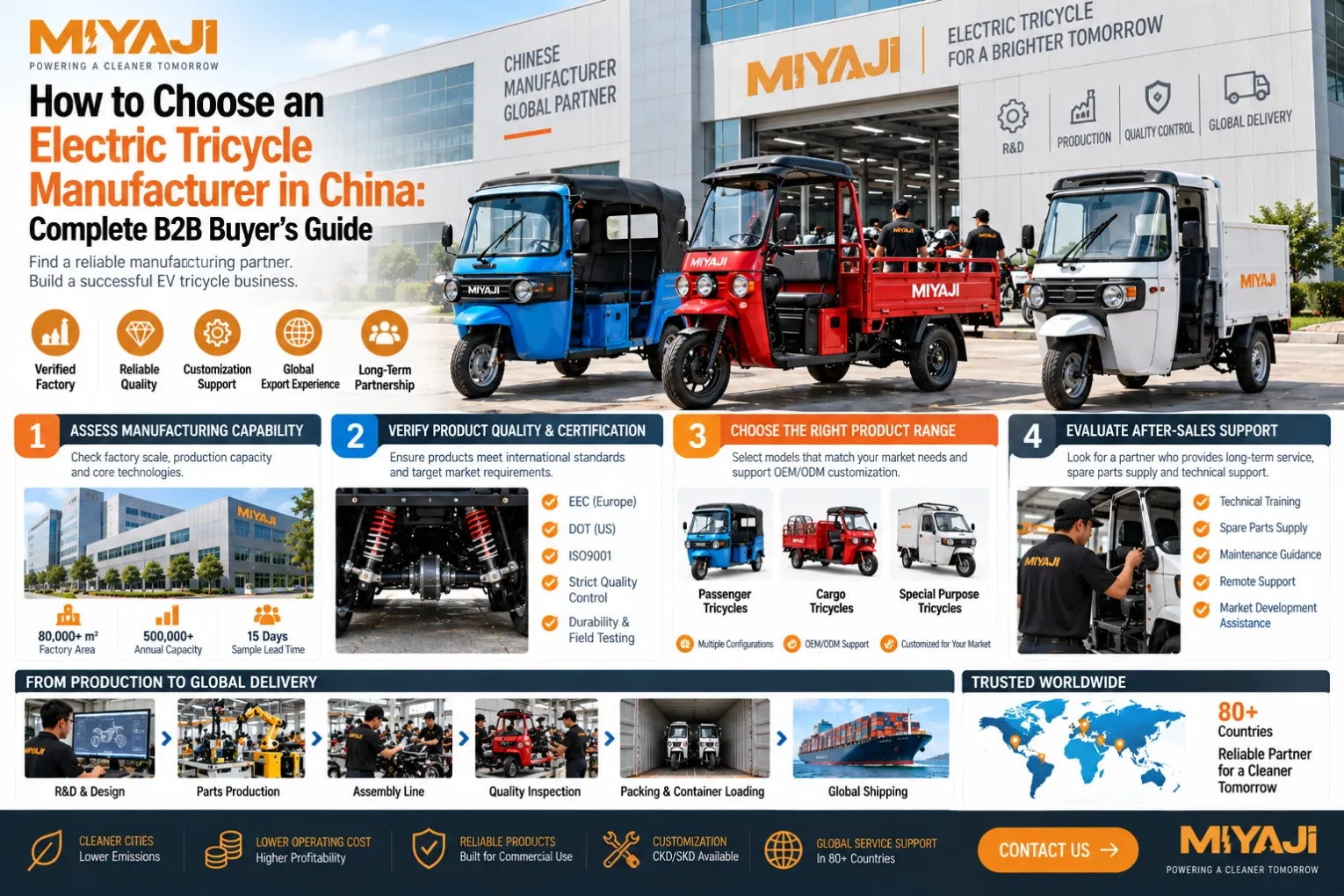
How to Choose an Electric Tricycle Manufacturer in China: Complete B2B Buyer’s Guide
Finding an electric tricycle supplier in China is relatively easy.
Finding a manufacturer that can support a real commercial project is more difficult.
An electric passenger tuk-tuk, cargo tricycle and industrial three-wheeler may look similar at first glance, but their engineering requirements can be very different.
A buyer may need to evaluate:
- Passenger or cargo architecture
- Payload
- Chassis
- Rear axle
- Suspension
- Brakes
- Motor and controller
- Battery
- Charging or swapping
- Cabin or cargo body
- Software
- Spare parts
- OEM customization
- CKD assembly
This means supplier selection should not begin with:
Who has the lowest price?
It should begin with:
Which manufacturer can configure the vehicle around my actual commercial operation?
1. First Decide What Type of Electric Tricycle You Need
Before comparing suppliers, define the vehicle category.
Passenger Electric Tricycle
Typically used for:
- Taxi
- Shuttle
- Local passenger transport
- Tourism
- Corporate mobility
Cargo Electric Tricycle
Typically used for:
- Delivery
- Retail distribution
- Local logistics
- Utility work
- Industrial transport
These two categories should not be evaluated using exactly the same criteria.
2. Passenger vs Cargo Manufacturer Capability
A supplier strong in passenger tuk-tuks may not necessarily be strong in cargo vehicles.
Likewise, a cargo tricycle factory may have limited experience with passenger comfort or cabin design.
Ask the supplier:
- What percentage of production is passenger vehicles?
- What percentage is cargo vehicles?
- Which models are mature?
- Which applications have been deployed before?
- What parts are genuinely customizable?
This helps determine where the manufacturer has real experience.
3. Define the Commercial Application
A serious manufacturer should ask:
- What will the vehicle carry?
- How many passengers?
- What payload?
- What daily mileage?
- What route?
- What operating hours?
- What gradient?
- What charging strategy?
If the supplier recommends a vehicle before understanding these questions, the recommendation may be too generic.
4. Evaluate Rated Payload
For cargo tricycles, payload is one of the most important specifications.
But do not look only at a headline number.
Ask:
What is the rated payload?
What is the maximum intended operating load?
Under what conditions was the vehicle tested?
The vehicle system must support the load.
Payload Is a System Requirement
Payload affects:
- Frame
- Rear axle
- Suspension
- Tires
- Braking
- Motor
- Battery consumption
A vehicle should not simply receive a larger cargo box while keeping the rest of the chassis unchanged.
5. Evaluate Passenger Capacity Properly
For passenger models, do not look only at:
Number of seats
Evaluate:
- Rated payload
- Seat layout
- Passenger space
- Entry and exit
- Suspension
- Brakes
- Stability
Commercial passenger vehicles need to be designed around real occupancy.
6. Check the Chassis
The chassis is especially important for commercial three-wheelers.
Evaluate:
- Main frame
- Rear frame
- Welding
- Material specification
- Mounting points
- Corrosion protection
A tricycle carrying passengers or cargo daily requires a stronger structural approach than a light personal-use vehicle.
7. Ask About Frame Manufacturing
Ask whether the manufacturer controls:
- Frame design
- Welding
- Jigging
- Inspection
- Surface treatment
The buyer does not necessarily need every component made internally.
But structural consistency should be controlled.
8. Rear Axle Matters
For many cargo and passenger tricycles, the rear axle is a critical component.
Ask about:
- Axle type
- Load rating
- Differential
- Gear ratio
- Maintenance
- Spare parts
The rear axle should match the motor and payload requirements.
9. Suspension
Suspension affects:
- Load capacity
- Passenger comfort
- Stability
- Tire wear
- Durability
For cargo applications, evaluate under realistic payload.
For passenger applications, evaluate both:
- Comfort
- Loaded stability
10. Braking System
A commercial tricycle can carry significantly more mass than a motorcycle.
Brakes should therefore be evaluated according to:
- Vehicle weight
- Payload
- Required speed
- Route conditions
Ask:
- What front brake is used?
- What rear brake is used?
- Is there a parking brake?
- What are common wear parts?
11. Tire Selection
Tires are easy to overlook during procurement.
But fleet operators should care about:
- Load rating
- Size
- Durability
- Replacement cost
- Local availability
A tire that is difficult to source locally can increase downtime.
12. Motor Selection
Motor power should match:
- Gross vehicle weight
- Route gradient
- Required speed
- Acceleration
- Duty cycle
Do not choose a manufacturer simply because one model advertises a larger motor.
The complete drivetrain matters.
13. Ask About Torque
Loaded tricycles often require strong low-speed performance.
This matters during:
- Starting
- Hill climbing
- Stop-and-go traffic
Ask the supplier to explain:
Motor
-
Controller
-
Gear Ratio
-
Rear Axle
rather than only motor wattage.
14. Verify Hill-Climbing Claims
If a manufacturer claims:
20% / 25% / 30% climbing capability
ask:
- With what payload?
- At what speed?
- At what battery SOC?
- On what road?
- For how long?
Without test conditions, the figure is difficult to compare.
15. Evaluate the Battery System
Battery selection should be based on:
- Daily mileage
- Distance between replenishment
- Payload
- Motor
- Route
- Operating hours
Ask:
- Chemistry?
- Voltage?
- Capacity?
- Cell supplier?
- BMS?
- Charging current?
- Fixed or removable?
16. Battery Capacity Should Be Expressed in Energy
Do not compare only Ah.
For example:
72V 100Ah ≈ 7.2 kWh nominal energy
A higher Ah battery gives more energy, but also usually increases:
- Cost
- Weight
- Space
- Charging time
The manufacturer should explain why the battery size fits the operation.
17. LFP vs NMC
Ask why a specific chemistry is recommended.
LFP
May be attractive where priorities include:
- Frequent cycling
- Cost
- Thermal-stability characteristics
- Commercial durability
NMC
May be attractive where:
- Weight is constrained
- Battery space is limited
- Higher energy density is useful
The actual cell specification matters more than chemistry name alone.
18. Ask Who Manufactures the Battery PACK
Understand whether the battery is:
- Made in-house
- Made by a specialized partner
- Purchased as a generic battery
The key question is:
Who is responsible for battery quality and vehicle compatibility?
19. BMS Capability
The BMS should match the battery and vehicle.
Depending on project requirements, it may manage:
- Voltage
- Current
- Temperature
- SOC
- Faults
- Communication
For connected fleets, BMS communication becomes particularly important.
20. Fast Charging
If the vehicle requires fast charging, the supplier should explain:
Cell
→ PACK
→ BMS
→ Connector
→ Charger
A powerful charger alone does not make the battery suitable for fast charging.
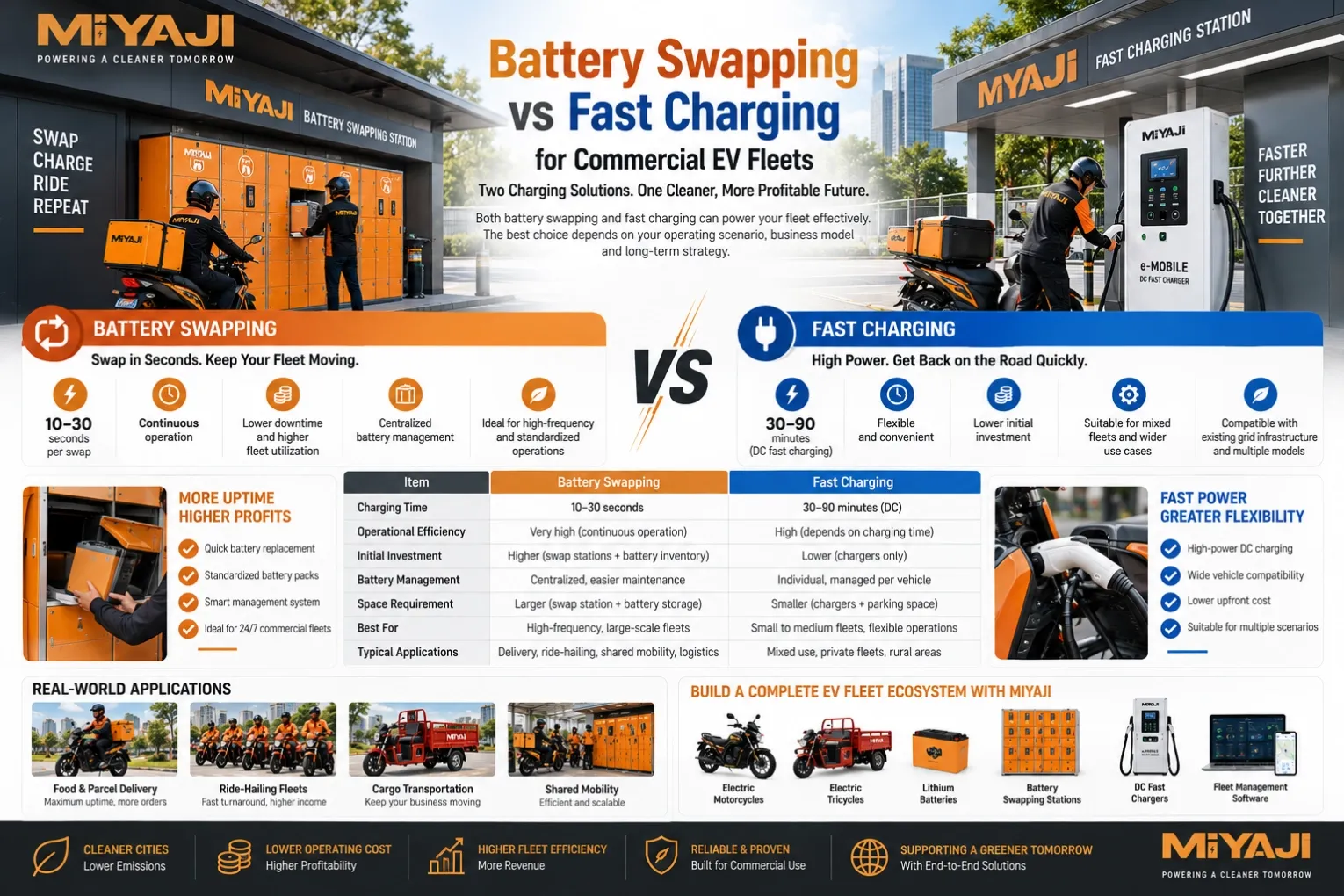
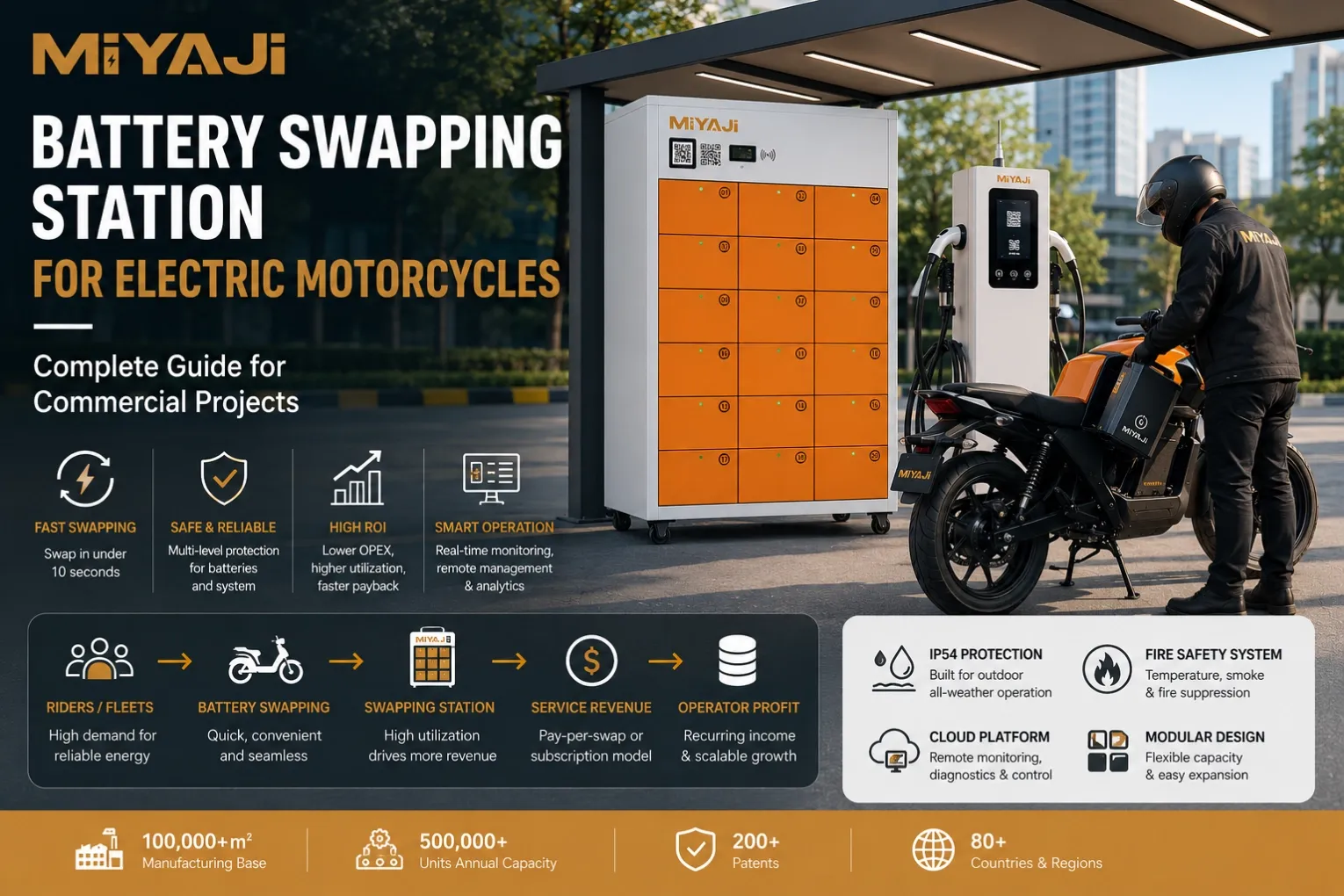
21. Battery Swapping
Swapping for tricycles can be more challenging than for motorcycles because battery packs may be larger and heavier.
Ask:
- Is the battery modular?
- How much does each module weigh?
- How is it removed?
- How is it locked?
- What connector is used?
- How does the BMS communicate?
The swap process must be practical.
22. Fixed Battery vs Swappable Battery
A fixed battery may suit:
- Overnight charging
- Predictable routes
- Larger onboard energy
Swapping may suit:
- High-utilization fleets
- Multi-shift operations
- Short downtime requirements
The manufacturer should help evaluate both rather than automatically recommending one.
23. Evaluate Passenger Cabin Design
For passenger vehicles, evaluate:
- Driver visibility
- Passenger seating
- Roof
- Windshield
- Door or side protection
- Ventilation
- Entry/exit
- Weather protection
Cabin design affects both user experience and daily commercial operation.
24. Evaluate Cargo Body Design
For cargo vehicles, ask whether the manufacturer supports:
- Open box
- Enclosed box
- Flatbed
- Tipping body
- Customized body
The cargo body should match the actual goods being carried.
25. Cargo Body Customization Is Not Just Appearance
Changing the body can affect:
- Vehicle weight
- Center of gravity
- Frame load
- Suspension
- Braking
- Energy consumption
Therefore substantial cargo-body customization should be engineered and validated.
26. Weight Distribution
For cargo tricycles, cargo placement matters.
Poor weight distribution can affect:
- Steering
- Stability
- Tire loading
- Braking
Ask the manufacturer how the vehicle is designed for loaded operation.
27. Center of Gravity
Passenger and cargo vehicle stability depends partly on center of gravity.
It can be affected by:
- Battery position
- Cargo height
- Cabin structure
- Passenger seating
Higher is not always better.
Large body modifications should consider stability.
28. Ground Clearance
Ground clearance should match the actual route.
Higher clearance may help on uneven roads, but it can also affect:
- Center of gravity
- Loading height
- Handling
The correct configuration is a compromise.
29. Waterproofing and Environmental Protection
Ask the supplier how electrical components are protected from:
- Rain
- Dust
- Water splash
- Heat
- Vibration
Do not assume that every component has the same IP rating.
Ask for specific component information where required.
30. Vehicle Testing
Commercial tricycles should be tested beyond basic function checks.
Depending on the product, validation may include:
- Loaded driving
- Range
- Braking
- Hill climbing
- Steering
- Suspension
- Electrical function
Buyers should ask for the conditions behind performance claims.
31. Range Testing
A passenger or cargo tricycle tested empty may show very different range from real commercial use.
Ask:
- Payload?
- Speed?
- Route?
- Battery?
- Temperature?
- SOC window?
This makes the range figure meaningful.
32. Production Quality Control
A strong factory should have controls across:
Incoming Parts
↓
Frame / Structure
↓
Assembly
↓
Electrical Installation
↓
Functional Test
↓
Final Inspection
The exact QC flow varies by manufacturer.
33. Check Electrical Wiring Quality
Commercial vehicles experience:
- Vibration
- Heat
- Dust
- Long operating hours
Evaluate:
- Connector quality
- Wire routing
- Protection
- Fixing
- Sealing
Poor wiring can create recurring fleet problems.
34. Check Manufacturing Consistency
One good sample is not enough.
For fleet buyers, the question is:
Can the manufacturer reproduce the same configuration across hundreds of vehicles?
Ask how critical components are controlled between production batches.
35. Configuration Change Control
For commercial fleets, agree on an approved specification.
Critical changes to:
- Battery cells
- BMS
- Motor
- Controller
- Brakes
- Tires
should ideally be communicated before implementation.
This reduces future spare-parts and maintenance problems.
36. Certification and Homologation
Vehicle requirements vary by country.
Passenger and cargo tricycles may even fall under different regulatory categories.
Buyers should confirm locally:
- Vehicle classification
- Homologation
- Road registration
- Lighting requirements
- Safety requirements
Do not assume one export configuration works in every country.
37. Passenger Vehicle Regulation Can Be Different
Passenger transport can involve additional requirements related to:
- Passenger safety
- Commercial transport licensing
- Vehicle classification
These vary widely by jurisdiction.
Verify before finalizing the vehicle.
38. Lithium Battery Transport Documentation
For lithium battery shipments, relevant documentation may include:
- UN38.3
- SDS / MSDS
- Transport-related documentation
Requirements depend on battery configuration and transport mode.
Confirm with the logistics provider.
39. OEM Branding
For distributors, OEM customization can include:
- Logo
- Vehicle color
- Decals
- Packaging
- Manuals
These are relatively straightforward forms of customization.
40. Deeper OEM Customization
More complex projects may require changes to:
- Battery
- Motor
- Controller
- Body
- Suspension
- Dashboard
- Software
These changes require engineering validation and may affect lead time and cost.
41. Passenger Vehicle Customization
Passenger projects may require:
- Different seat layouts
- Cabin structure
- Doors
- Roof
- Interior
- Luggage areas
The manufacturer should explain which changes can be made without compromising vehicle performance.
42. Cargo Vehicle Customization
Cargo buyers may require:
- Cargo dimensions
- Enclosed boxes
- Refrigerated concepts
- Shelving
- Flatbeds
- Tipping structures
More specialized bodies may require joint engineering between chassis and body suppliers.
43. CKD / SKD Capability
Electric tricycles are strong candidates for local assembly in some markets because shipping complete vehicles can consume significant container space.
But CKD should be evaluated as a production project.
Ask whether the manufacturer can provide:
- BOM
- Assembly instructions
- Packaging
- Tools
- QC process
- Training
44. Container Optimization
Logistics can significantly affect landed cost.
Ask the supplier to compare:
- CBU loading quantity
- SKD loading quantity
- CKD loading quantity
But do not choose CKD only because more vehicles fit in a container.
Local assembly cost must also be included.
45. Local Assembly
A local assembly project requires:
- Factory space
- Labor
- Tools
- Production process
- Quality control
- Inventory
The supplier should help define the appropriate level of assembly.
46. Assembly Equipment
Depending on scale, equipment may include:
- Assembly tools
- Torque tools
- Lifting equipment
- Electrical testing
- End-of-line testing
The required automation level should match volume.
47. Local Battery PACK Assembly
Some larger projects may also localize battery PACK production.
This requires a separate process including:
- Cell inspection
- Grading
- Welding
- BMS
- PACK assembly
- Testing
- Aging
Battery PACK production should not be treated as a simple extension of vehicle assembly.
48. Spare Parts Strategy
Before fleet deployment, ask for a recommended spare-parts package.
Categories may include:
Fast-Moving Parts
- Brake parts
- Tires
- Lamps
- Consumables
Critical Components
- Controllers
- Displays
- Motor parts
- Electrical components
The exact list depends on the vehicle.
49. Model Standardization
If a project needs several vehicle variants, ask whether they share:
- Motor
- Controller
- Battery
- BMS
- Display
- Brakes
- Tires
Greater component commonality can simplify local service.
50. After-Sales Support
Evaluate:
- Remote support
- Manuals
- Wiring diagrams
- Parts catalogs
- Technical training
- Spare-parts supply
For larger projects, the ability to train local technicians can be particularly valuable.
51. Software Capability
Commercial tricycle fleets may benefit from:
- GPS
- Vehicle status
- Battery SOC
- Battery SOH
- Faults
- Mileage
- Charging status
Software becomes more relevant as fleet size grows.
52. Fleet and Energy Management
If the project includes charging or swapping infrastructure, ask whether the platform can connect:
Vehicle
-
Battery
-
Charging / Swap Station
The buyer should avoid ending up with multiple disconnected systems where possible.
53. White-Label Software
Distributors and mobility operators may need:
- Their own brand
- Language
- User accounts
- App branding
Ask early if white-label software is important.
Software customization can take longer than logo customization on the vehicle.
54. Compare Suppliers With the Same Specification
One supplier may quote:
- Larger battery
- Different motor
- Better tires
- Stronger axle
while another offers a much lower price.
These are not equivalent quotations.
Build a controlled comparison sheet.
Electric Tricycle Supplier Comparison Sheet
Category | Supplier A | Supplier B | Supplier C |
|---|---|---|---|
Passenger / Cargo Platform | | | |
Rated Payload | | | |
Motor | | | |
Controller | | | |
Rear Axle | | | |
Suspension | | | |
Brakes | | | |
Battery | | | |
Cell | | | |
BMS | | | |
Charger | | | |
Fast Charging | | | |
Battery Swapping | | | |
Software | | | |
OEM | | | |
CKD | | | |
Spare Parts | | | |
Warranty | | | |
55. Compare TCO, Not Just Purchase Price
Commercial buyers should consider:
TCO = Vehicle + Battery + Logistics + Energy + Maintenance + Spare Parts + Infrastructure + Downtime
For passenger applications, also evaluate:
- Cost per trip
- Revenue per vehicle
For cargo applications:
- Cost per delivery
- Deliveries per shift
The cheapest FOB vehicle is not automatically the cheapest commercial vehicle.
56. Factory Inspection
For larger projects, inspect:
- Production
- Frame work
- Assembly
- Battery
- QC
- Warehouse
- Testing
If visiting in person is not possible, a live remote inspection can provide additional verification.
57. Request Sample Vehicles
Before large orders, use sample or pilot vehicles to test:
- Payload
- Range
- Loaded performance
- Charging
- Passenger comfort
- Cargo workflow
- Maintenance
Do not validate a commercial tricycle only with an unloaded showroom test.
58. Run a Pilot in the Target Market
A pilot should collect real data:
Passenger Fleet
- Trips/day
- Passenger load
- Wh/km
- Uptime
- Driver feedback
- Passenger feedback
Cargo Fleet
- Deliveries/day
- Payload
- Wh/km
- Loading time
- Uptime
Use these results to finalize the production configuration.
59. Supplier Red Flags
Investigate further if a supplier:
- Cannot clearly explain rated payload
- Cannot explain battery configuration
- Cannot provide test conditions
- Changes specifications without notice
- Cannot explain rear axle or suspension
- Offers any customization without engineering discussion
- Has no spare-parts strategy
- Avoids factory verification
These can indicate higher project risk.
60. What Should Passenger Fleet Buyers Prioritize?
Passenger fleet operators should prioritize:
Safety
Passenger Capacity
Comfort
Battery Strategy
Vehicle Uptime
Maintenance
TCO
The vehicle is a revenue-producing asset.
61. What Should Cargo Fleet Buyers Prioritize?
Cargo operators should prioritize:
Payload
Cargo Volume
Loading Efficiency
Durability
Energy Consumption
Uptime
Cost per Delivery
The best cargo vehicle is the one that fits the logistics workflow.
62. What Should Distributors Prioritize?
Distributors may additionally care about:
- Product range
- OEM branding
- Local regulations
- Spare parts
- Market adaptation
- CKD
- Commercial pricing
A manufacturer should be able to support both the product and the distributor's local business.
63. What Should CKD Buyers Prioritize?
CKD projects should evaluate:
- BOM clarity
- Packaging
- Assembly process
- Tools
- Training
- QC
- Local battery strategy
A CKD supplier should understand manufacturing, not just shipping components.
Electric Tricycle Manufacturer Checklist
Before choosing a manufacturer, verify:
Vehicle Type
Passenger / Cargo / Customized
Structure
Frame / Axle / Suspension / Brakes / Tires
Performance
Motor / Controller / Loaded performance / Gradient
Battery
Chemistry / Cells / BMS / Capacity / Charging
Energy
Standard charging / Fast charging / Battery swapping
Body
Passenger cabin / Cargo body / Customization
Manufacturing
OEM / SKD / CKD / Assembly equipment
Software
Vehicle / Battery / Fleet / Energy management
Quality
QC / Testing / Traceability / Change control
Support
Spare parts / Documentation / Training / After-sales
How MIYAJI Approaches Commercial Electric Tricycle Projects
MIYAJI approaches electric three-wheelers as commercial operating systems rather than isolated vehicles.
Depending on the application, project configuration can integrate:
Passenger & Cargo Electric Tricycles
-
Lithium Battery Systems
-
Battery Cells & BMS
-
Fast Charging
-
Battery Swapping
-
Fleet & Energy Management Software
-
OEM / CKD & Local Production
The project can be configured around:
- Passenger or cargo application
- Payload
- Daily mileage
- Route
- Battery strategy
- Fleet size
- Energy infrastructure
- Localization requirements
The objective is to match the vehicle to the commercial operation before scaling.
Looking for an Electric Tricycle Manufacturer in China?
Prepare:
Target Country
Passenger or Cargo Application
Initial Quantity
Future Fleet Size
Passenger Capacity / Payload
Daily Mileage
Operating Hours
Route Conditions
Required Speed
Battery Requirements
Charging / Swapping Strategy
Body Customization
OEM / CKD Requirements
With these inputs, the manufacturer can evaluate:
Vehicle
→ Battery
→ Energy
→ Software
→ Manufacturing
→ TCO
Discuss Your Electric Tricycle Project
Frequently Asked Questions
How do I choose an electric tricycle manufacturer in China?
Evaluate the manufacturer's vehicle engineering, payload capability, chassis, battery system, quality control, testing, OEM/CKD support, spare parts and after-sales service.
What should I check when buying an electric cargo tricycle?
Check rated payload, chassis, rear axle, suspension, brakes, motor, battery, cargo dimensions and energy consumption under realistic load.
What should I check when buying an electric passenger tricycle?
Evaluate rated passenger load, seating, comfort, suspension, braking, stability, battery range, charging strategy and fleet uptime.
How can I verify an electric tricycle factory in China?
Factory visits, live video inspections, production audits, samples and pilot testing can help verify manufacturing and product capability.
Can electric tricycle manufacturers customize cargo bodies?
Many manufacturers can support body customization, but substantial structural changes should be engineered and validated because they can affect weight distribution and vehicle performance.
Can electric tuk-tuks use battery swapping?
Yes, if the vehicle and battery architecture are designed for swapping. Battery size, weight, connector, BMS and station compatibility must be considered.
Can cargo electric tricycles support fast charging?
Potentially yes, when the cells, PACK, BMS, charging connector and charger support the required charging rate.
Should I buy CBU or CKD electric tricycles?
CBU can be suitable for pilots and initial deployment, while SKD or CKD may become attractive as volume, logistics or localization requirements grow.
What should a CKD electric tricycle supplier provide?
Support may include BOMs, packaging, assembly instructions, tools, testing, quality-control procedures and technical training depending on project scope.
Is the cheapest electric tricycle supplier the best choice?
Not necessarily. Commercial buyers should evaluate vehicle configuration, reliability, battery quality, maintenance, logistics, downtime and total cost of ownership.
Can MIYAJI support passenger and cargo electric tricycle projects?
MIYAJI can support commercial projects covering passenger or cargo vehicles, battery systems, charging, swapping, software and OEM/CKD/local-production requirements according to project scope.