Sep 2, 2026Product & Industry Knowledge
CKD vs CBU Electric Motorcycles: Which Is Better for Your Market?
Compare CBU, SKD and CKD electric motorcycles for international markets, including cost, logistics, localization, assembly and fleet scalability.
CKD vs CBU Electric Motorcycles: Which Is Better for Your Market?
When importing electric motorcycles from overseas, buyers often start with a simple question:
Should we buy complete electric motorcycles or assemble them locally?
The answer depends on the project's:
- Fleet size
- Import regulations
- Local manufacturing requirements
- Logistics
- Labor costs
- Technical capability
- Investment budget
- Market strategy
- Long-term sales volume
For some projects, CBU is the most practical starting point.
For others, SKD or CKD assembly can provide a better long-term structure.
Understanding the differences is therefore important before selecting a manufacturing and supply model.
What Does CBU Mean?
CBU means:
Completely Built Unit
The motorcycle is fully assembled before export.
The customer receives a complete vehicle that is generally ready for:
- Final inspection
- Registration
- Distribution
- Commercial operation
Depending on the destination market, some local preparation may still be required.
Typical CBU Supply Chain
Factory
↓
Complete Motorcycle
↓
Export
↓
Import
↓
Distribution / Fleet Deployment
CBU is usually the simplest model for buyers who want to launch quickly without establishing local assembly capability.
What Does SKD Mean?
SKD means:
Semi Knocked Down
The vehicle is exported in partially disassembled form.
Some assembly work is completed in the destination market.
The exact level of disassembly varies by supplier and market.
A typical SKD project may require local assembly of components such as:
- Wheels
- Handlebar
- Body panels
- Electrical components
- Battery
- Other vehicle modules
The exact configuration should be defined in the technical supply agreement.
What Does CKD Mean?
CKD means:
Completely Knocked Down
The vehicle is supplied as a set of components or modules that are assembled in the destination market.
Compared with CBU, CKD generally involves a substantially greater level of local assembly.
A CKD project may involve:
- Frame
- Motor
- Controller
- Battery
- Wiring harness
- Suspension
- Wheels
- Brakes
- Body components
- Electrical systems
- Fasteners
- Other assemblies
The exact CKD scope depends on the vehicle architecture and local production requirements.
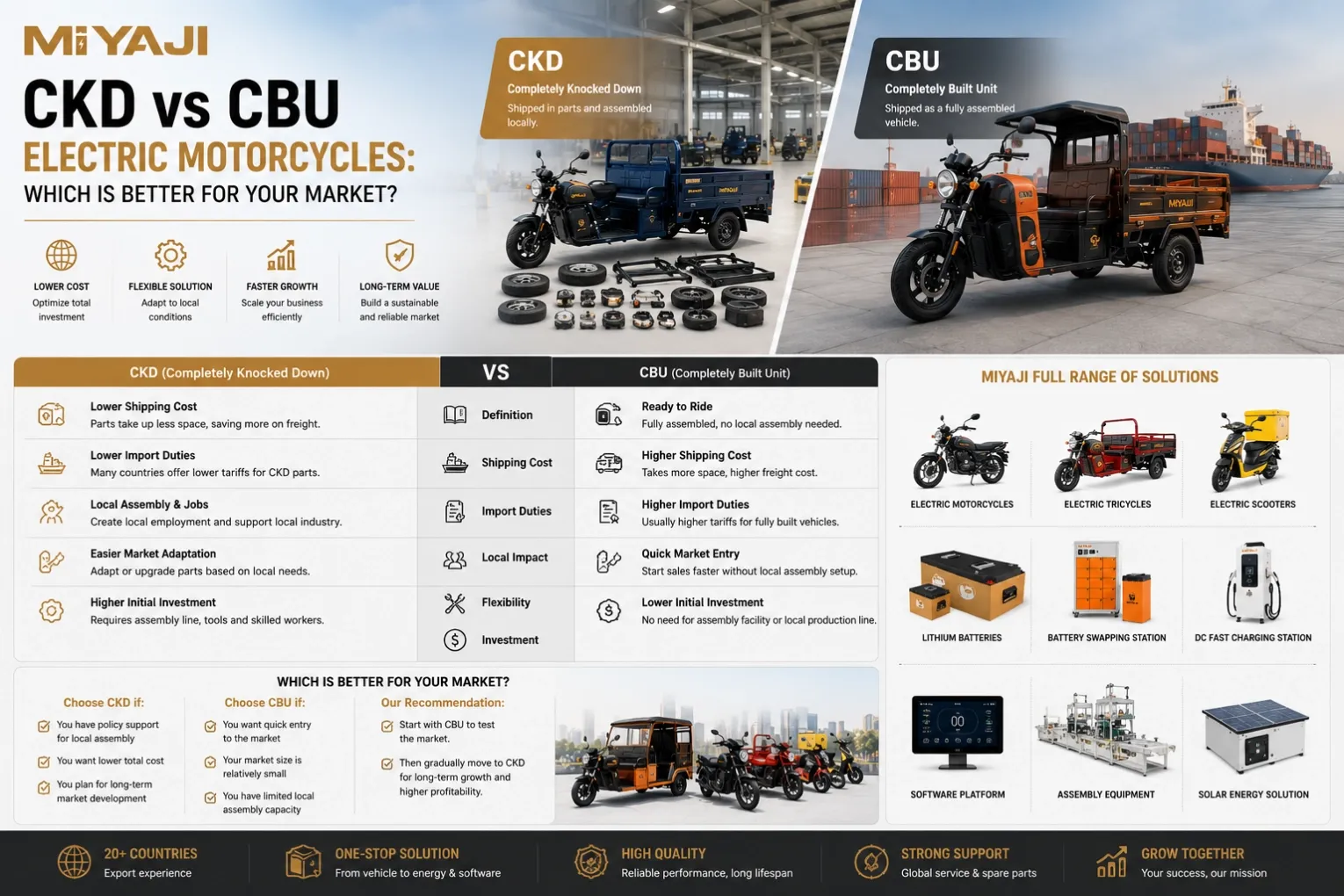
CBU vs SKD vs CKD
Model | Vehicle Assembly | Local Investment | Logistics | Localization Potential |
|---|---|---|---|---|
CBU | Mostly completed at factory | Low | Complete vehicles | Low |
SKD | Partial local assembly | Medium | Partially disassembled | Medium |
CKD | Higher local assembly content | Higher | Components | High |
These are general characteristics.
The actual commercial and regulatory implications depend on the destination country.
When Is CBU the Better Choice?
CBU is often suitable when:
The Project Is Still Small
For example:
- Initial market testing
- Pilot fleet
- Distributor trial order
- New market entry
There may not yet be enough volume to justify local assembly.
The Customer Wants Fast Deployment
The customer does not need to establish:
- Assembly lines
- Local technicians
- Production management
- Quality-control systems
Local Assembly Requirements Are Limited
If the destination market does not strongly incentivize or require local production, CBU may remain practical.
The Project Has Uncertain Demand
It may be safer to validate demand before investing in local manufacturing.
When Should You Consider SKD?
SKD can become attractive when the project has:
- Growing order volume
- Some local assembly capability
- A need for partial localization
- Moderate investment capacity
- Local labor availability
It can provide a middle ground between complete vehicle imports and a full CKD manufacturing structure.
When Does CKD Make More Sense?
CKD becomes more relevant when:
Fleet Volume Is Large
Higher volume can help justify:
- Assembly equipment
- Production staff
- Quality-control systems
- Local inventory
Local Manufacturing Is Strategically Important
Some markets may encourage:
- Local assembly
- Local employment
- Industrial development
- Localization
The exact policy varies by country and should be verified locally.
Long-Term Market Demand Is Strong
If the customer expects to operate or sell thousands of vehicles over several years, local assembly may become more economically meaningful.
Import Structure Favors Components
In some markets, the import treatment of components can differ from that of complete vehicles.
However, this is highly country-specific.
Buyers should verify applicable tariffs and regulations before making a business decision.
CKD Is Not Simply “Cheaper CBU”
This is an important point.
Some buyers assume:
CKD = Lower Import Cost
That is not automatically true.
CKD introduces additional costs.
These can include:
- Assembly facility
- Equipment
- Workers
- Training
- Quality control
- Local inventory
- Warehouse
- Utilities
- Management
- Technical support
- Production losses
Therefore the correct question is:
Does the total CKD structure reduce the project's long-term cost or create strategic value?
Calculate the Total Cost of Local Assembly
A preliminary CKD model can consider:
Component Cost
-
Shipping
-
Import Duties
-
Assembly Labor
-
Facility
-
Equipment
-
Quality Control
-
Inventory
-
Management
-
Maintenance
-
Training
-
Local Operating Costs
This should then be compared with the complete-vehicle CBU model.
Logistics Can Change the Equation
CBU means shipping complete motorcycles.
This can create challenges related to:
- Vehicle dimensions
- Container utilization
- Shipping cost
- Port handling
- Storage
CKD can allow components to be packed more efficiently.
However, CKD also creates more complex logistics because many different components must arrive in the correct quantities and sequence.
Therefore:
Better container utilization does not automatically mean lower total logistics cost.
The complete supply chain needs to be evaluated.
Inventory Management Becomes More Important
CBU is relatively straightforward:
One finished vehicle = one complete commercial unit.
CKD is different.
You may need to manage:
- Frames
- Motors
- Controllers
- Batteries
- Wheels
- Tires
- Wiring
- Body panels
- Fasteners
If one critical component is missing, a partially assembled vehicle may not be completed.
Therefore CKD projects require stronger:
BOM Management
Inventory Control
Production Planning
and
Quality Management
CKD Requires a Bill of Materials
A CKD project should have a clear BOM — Bill of Materials.
The BOM defines:
- Component name
- Part number
- Quantity
- Specification
- Supplier
- Assembly position
- Packaging requirements
This becomes the foundation of the local assembly process.
For an international CKD project, BOM accuracy is particularly important because a small component shortage can stop production.
Quality Control Is Different
With CBU, most manufacturing quality control occurs at the exporting factory.
With CKD, quality is distributed across two locations:
Original Manufacturer
-
Local Assembly Facility
This means the project needs clear standards for:
- Incoming inspection
- Assembly
- Torque
- Wiring
- Battery installation
- Functional testing
- Final inspection
Without a clear QC system, the same vehicle can have different quality levels after local assembly.
Local Assembly Requires Technical Documentation
A professional CKD project may require:
- Assembly instructions
- BOM
- Work instructions
- Wiring diagrams
- Torque specifications
- Inspection standards
- Testing procedures
- Troubleshooting guides
- Spare-parts lists
The supplier should define what technical documentation is included in the project.
Battery Assembly Is Another Layer
Electric motorcycles are different from conventional motorcycles because the battery is a major part of the vehicle system.
A local project may eventually need to consider:
Battery Pack Assembly
BMS
Cell Selection
PACK Testing
Aging
End-of-Line Testing
This creates an additional opportunity for localization.
However, battery manufacturing and vehicle assembly should not be treated as exactly the same activity.
The required equipment, processes and safety standards are different.
CKD Can Also Extend Beyond Vehicle Assembly
For larger projects, the supply structure may eventually evolve from:
CBU
↓
SKD
↓
CKD Vehicle Assembly
↓
Battery PACK Assembly
↓
Higher Local Manufacturing Content
The exact sequence depends on:
- Volume
- Investment
- Local capability
- Regulations
- Business strategy
Not every project needs to reach the final stage.
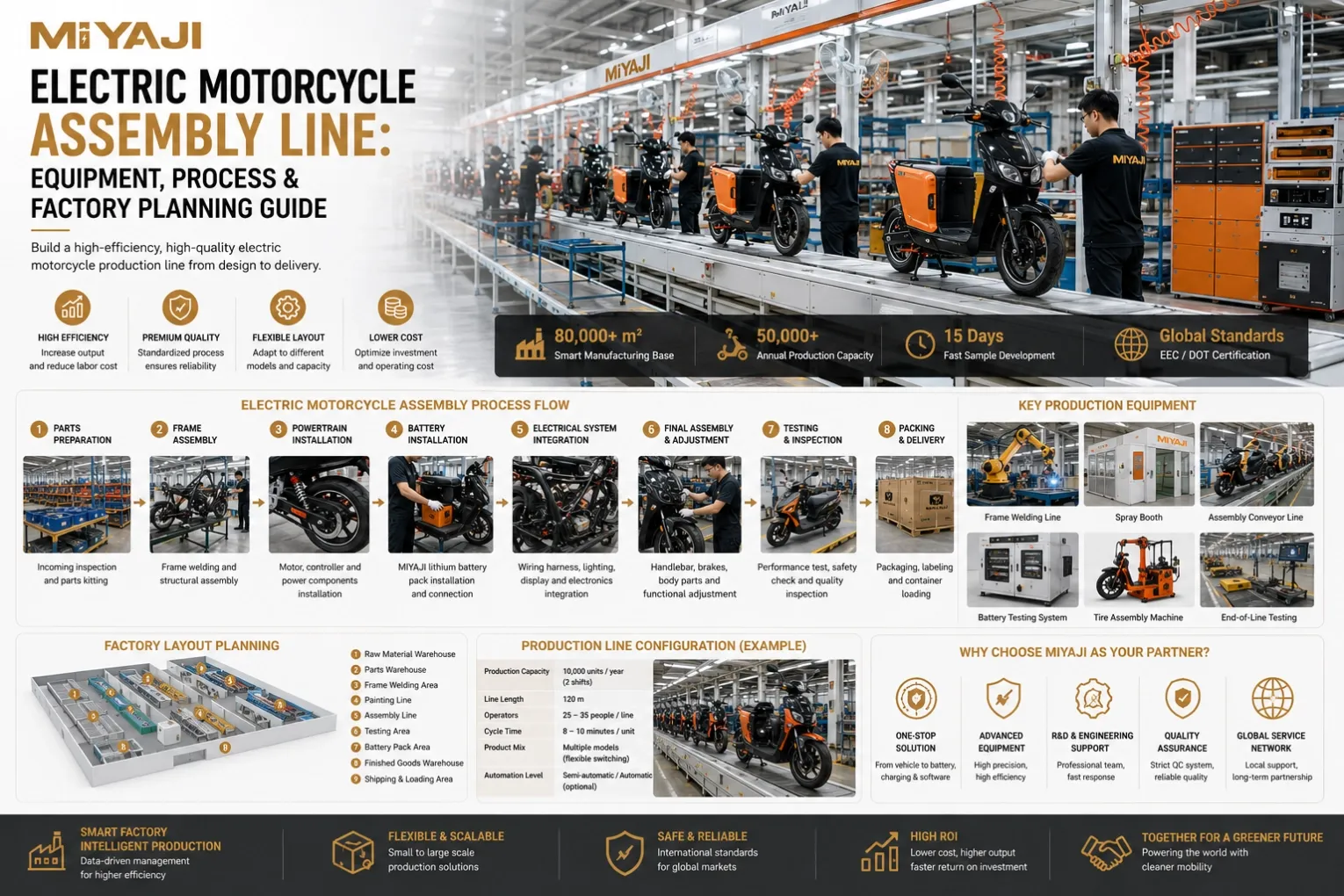
What Equipment Does a CKD Assembly Plant Need?
The equipment depends heavily on the intended production scope.
A motorcycle assembly line may require equipment for:
- Frame assembly
- Wheel installation
- Brake installation
- Electrical assembly
- Torque control
- Battery installation
- Functional testing
- Final inspection
If battery PACK assembly is included, additional equipment may be required for:
- Cell handling
- Welding
- BMS installation
- Pack assembly
- Testing
- Aging
- Safety inspection
The equipment configuration should therefore be designed according to the BOM, production volume and battery architecture.
Production Volume Determines Equipment Strategy
A 100-unit pilot project does not need the same factory architecture as a:
10,000-unit/year
or
100,000-unit/year
operation.
Low-volume projects may use:
- Manual assembly
- Basic tools
- Flexible workstations
Higher-volume projects may require:
- Dedicated stations
- Testing equipment
- Material handling
- Production-line management
- Automated or semi-automated processes
The right factory is not the factory with the most equipment.
It is the factory with the right equipment for the planned output.
Local Assembly Can Create Strategic Advantages
A successful local assembly project can potentially provide:
Shorter Local Delivery
Finished vehicles can be produced closer to the customer.
Local Employment
The project creates local technical and production jobs.
Market Localization
The vehicle can be adapted to local operating requirements.
Supply Chain Development
Local suppliers can gradually participate in the production system.
Future Scalability
Production capacity can be expanded as demand increases.
These advantages should be evaluated together with the additional investment required.
But Local Assembly Also Creates Risks
Local production is not automatically better.
Potential challenges include:
- Insufficient production volume
- Inconsistent quality
- Component shortages
- Poor inventory planning
- Lack of trained technicians
- Equipment downtime
- Weak local management
- Higher initial investment
This is why local assembly should be approached as an industrial project, not simply as “putting motorcycles together.”
How to Decide Between CBU and CKD
A useful decision framework is:
Choose CBU when:
- Market demand is uncertain
- Initial volume is small
- Fast deployment is important
- Local assembly infrastructure is unavailable
- The customer wants minimal investment
Consider SKD when:
- Volume is growing
- Partial localization is useful
- Some local assembly capability exists
- The project needs a transition stage
Consider CKD when:
- Long-term volume is substantial
- Local production is strategically important
- Import structure supports localization
- The customer can invest in assembly
- Technical and quality management can be established
CBU vs CKD: A Practical Comparison
Factor | CBU | CKD |
|---|---|---|
Initial Investment | Lower | Higher |
Deployment Speed | Faster | Slower |
Local Assembly | Limited | Significant |
Technical Requirement | Lower | Higher |
Inventory Complexity | Lower | Higher |
Local Employment | Lower | Higher |
Localization | Limited | Higher |
Scalability | Good for imports | Good for local production |
Quality Control | Centralized | Shared |
Factory Equipment | Minimal | Required |
Suitable for Pilot | Excellent | Usually less suitable |
Suitable for Large Long-Term Projects | Depends | Often more relevant |
Don't Decide Based on Volume Alone
A large fleet does not automatically mean CKD is better.
For example, a customer may have:
5,000 vehicles
but only operate the project for a short period.
Another customer may start with:
500 vehicles
but have a strong long-term plan to reach:
20,000–50,000 vehicles annually.
The second project may have a stronger case for local assembly.
Therefore the evaluation should consider:
Expected cumulative production volume
rather than only the first purchase order.
Market Regulations Matter
Before choosing CBU, SKD or CKD, buyers should investigate:
- Import duties
- Component duties
- Local-content requirements
- Type approval
- Vehicle certification
- Battery regulations
- Tax incentives
- Local manufacturing incentives
- Customs classification
These rules vary significantly between countries.
A manufacturing strategy should therefore be designed around the target market's actual regulatory environment.
The Best Strategy May Be Phased
For many new markets, a phased approach can reduce risk.
Phase 1 — Market Validation
Import:
CBU
Test:
- Product
- Market demand
- Fleet operation
- Customer feedback
↓
Phase 2 — Market Expansion
Move toward:
SKD
Build:
- Local assembly capability
- Technician team
- Parts inventory
↓
Phase 3 — Local Production
Move toward:
CKD
Establish:
- Assembly line
- QC system
- Local production management
↓
Phase 4 — Deeper Localization
Potentially add:
Battery PACK
Additional Local Components
Higher Manufacturing Content
This approach allows the investment level to grow together with market demand.
CKD for Electric Motorcycle Fleet Projects
For commercial fleets, CKD can become particularly interesting when:
- Vehicle volume is high
- Fleet deployment is long-term
- Local service capability is needed
- Battery and vehicle systems need local support
- The customer wants greater control over production
However, the project should first prove the vehicle configuration and operating model.
That is why a pilot before major factory investment can be valuable.
CKD Is Also Relevant for Electric Tricycles
The same principle applies to commercial electric tricycles.
Because tricycles can involve:
- Larger frames
- Cargo bodies
- Passenger structures
- Larger battery systems
- Different suspension
- Different motor systems
local assembly can sometimes provide additional flexibility.
For example, a standard vehicle platform could potentially be adapted locally for:
- Cargo
- Passenger
- Delivery
- Utility
depending on the project.
What a Complete Local Production Project Can Include
A mature commercial EV localization project may eventually combine:
Vehicle Assembly
-
Battery PACK Assembly
-
Battery Testing
-
Charging Infrastructure
-
Battery Swapping
-
Software
-
Spare Parts
-
Technical Training
This is no longer simply a vehicle purchase.
It becomes an integrated commercial EV manufacturing and energy project.
What Should You Ask an Electric Motorcycle OEM?
Before choosing a supplier for CKD or CBU, ask:
Product
- What vehicle platforms are available?
- What motor and battery configurations are supported?
- Can the vehicle be customized?
Manufacturing
- What CKD/SKD scope is available?
- Is a detailed BOM provided?
- What production documentation is included?
- What is the recommended production capacity?
Battery
- Can battery PACK assembly be localized?
- Which cell options are available?
- What BMS architecture is used?
- What testing process is required?
Equipment
- What assembly equipment is required?
- What battery equipment is required?
- What testing equipment is required?
- What technical support is provided?
Quality
- What are the incoming inspection standards?
- What are the assembly QC standards?
- What end-of-line tests are required?
Support
- Is technician training available?
- Are spare parts available?
- Is remote technical support available?
- Can the supplier support future production expansion?
How MIYAJI Supports Different Supply Models
MIYAJI's commercial EV projects can be structured around different levels of market entry.
Depending on the project's requirements, the supply model can progress from:
CBU Vehicle Supply
to
SKD / CKD Assembly
and potentially toward:
Local Battery PACK Assembly
and broader local production.
The project can combine:
Commercial Electric Motorcycles & Tricycles
-
Lithium Battery Systems
-
BMS
-
Fast Charging
-
Battery Swapping
-
Energy Management Software
-
Assembly & Testing Equipment
-
Technical Support
For projects requiring local manufacturing, equipment and production planning can also be considered as part of the overall solution.
This allows the customer to build according to actual market demand rather than investing in unnecessary production capacity from the beginning.
Planning a Local Electric Motorcycle Assembly Project?
Before selecting CBU, SKD or CKD, prepare:
Target Country
Expected Annual Volume
Initial Order Quantity
5-Year Volume Forecast
Vehicle Type
Battery Configuration
Local Assembly Requirements
Target Production Capacity
Available Factory Space
Local Labor Cost
Import Duty Structure
Localization Requirements
With these inputs, the project can compare:
CBU
vs
SKD
vs
CKD
and determine which model is more suitable for the market.
CTA Button
Discuss Your Local Production Project
Frequently Asked Questions
What is the difference between CBU and CKD electric motorcycles?
CBU motorcycles are substantially assembled before export, while CKD motorcycles are supplied as components for more extensive assembly in the destination market.
Is CKD cheaper than CBU?
Not necessarily. CKD may reduce certain import or logistics costs in some markets, but it also introduces assembly, equipment, labor, inventory and quality-control costs.
When should I switch from CBU to CKD?
There is no universal volume threshold. The decision should consider cumulative demand, local regulations, import structure, labor costs, factory investment and long-term market strategy.
What is SKD?
SKD means Semi Knocked Down. The vehicle is supplied partially disassembled for some assembly work in the destination market.
Does CKD require a factory?
A CKD project normally requires a suitable local assembly facility and the necessary tools, equipment, personnel and quality-control processes.
Can battery assembly be included in a CKD project?
Yes, where the vehicle and battery architecture are designed for it. Battery PACK assembly requires its own equipment, testing procedures and safety controls.
Can an electric motorcycle manufacturer provide assembly equipment?
Some manufacturers or manufacturing partners can support assembly-equipment planning or supply. The required equipment depends on production volume, BOM and the intended level of localization.
Should a new market start with CKD?
Not always. A phased approach—starting with CBU, validating demand and then moving toward SKD or CKD—can reduce investment risk for some markets.
Is CKD suitable for electric tricycles?
Yes. CKD can also be used for commercial electric tricycles, particularly where local assembly, customization or long-term fleet production is important.