Oct 30, 2026Product & Industry Knowledge
How MIYAJI Helps Commercial EV Operators Build Reliable Vehicle and Energy Systems
Discover how MIYAJI supports commercial EV operators with electric motorcycles, tricycles, battery PACK manufacturing, fast charging, battery swapping and software.
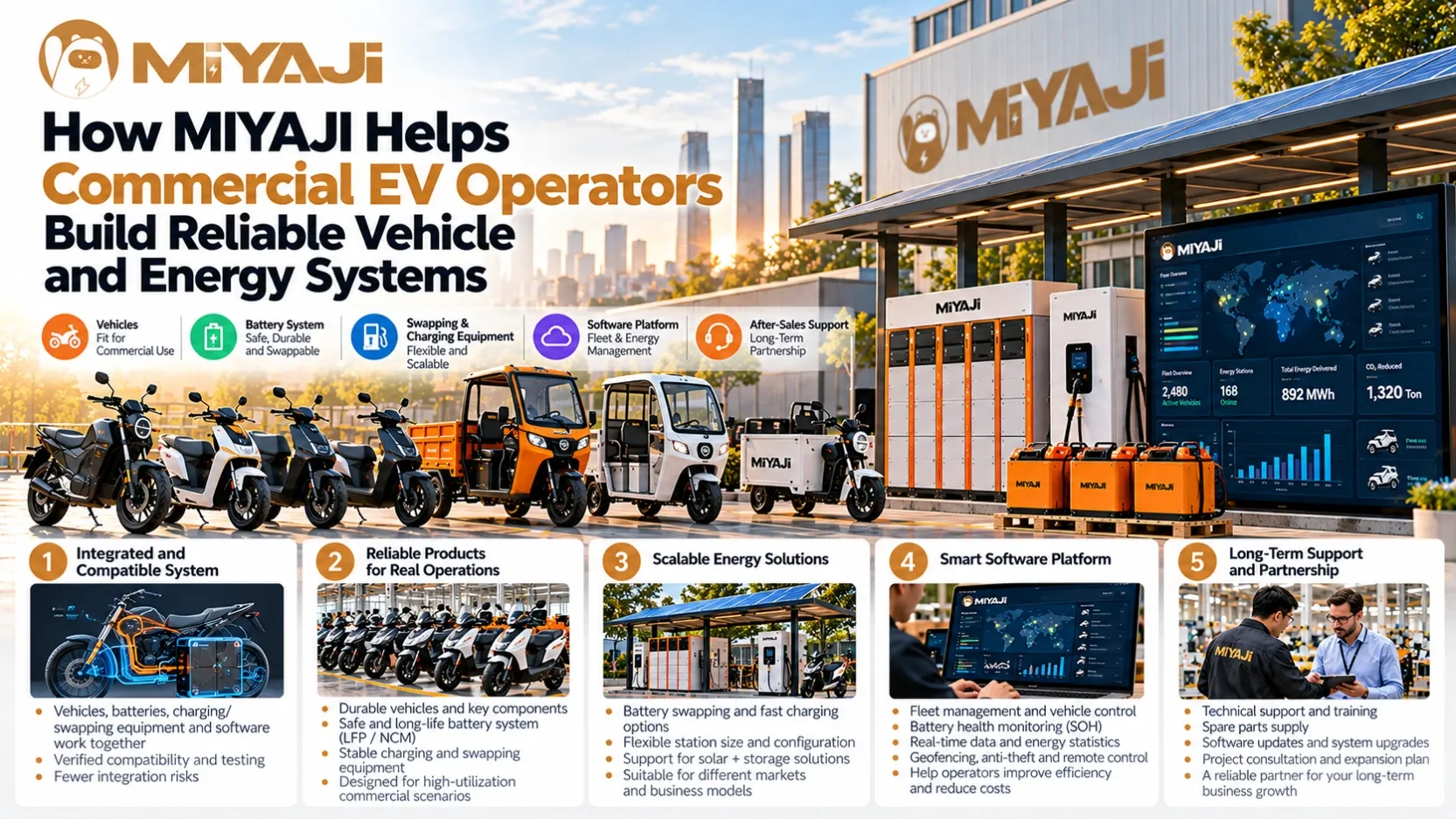
How MIYAJI Helps Commercial EV Operators Build Reliable Vehicle and Energy Systems
Launching a commercial electric vehicle business involves more than purchasing electric motorcycles or tricycles.
The vehicles must be suitable for daily operations. The batteries must meet their power and energy requirements. Charging or battery-swapping equipment must work with the selected battery systems. And when software is involved, the relevant hardware and digital functions must communicate correctly.
For an overseas operator, managing these requirements can become a significant challenge.
A vehicle may perform well during a short test but face different demands during full-day commercial use. A battery may have sufficient advertised capacity but still require careful matching with the motor and controller. A fast charger may offer impressive power specifications without being compatible with the intended battery.
These are not simply purchasing decisions. They are system decisions.
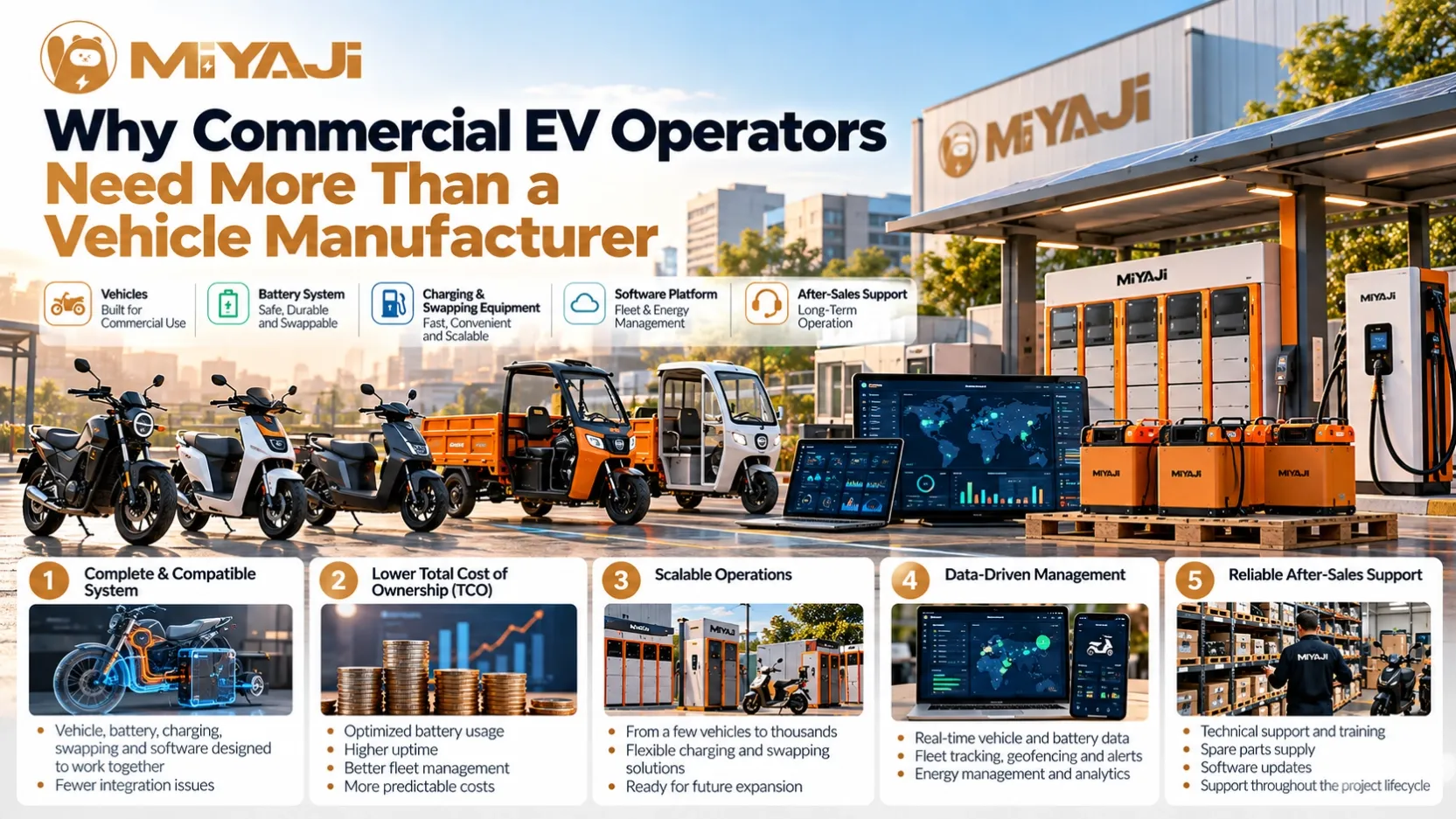
MIYAJI helps commercial EV operators address these challenges by bringing vehicles, battery systems, charging and swapping equipment, and software together within one coordinated solution.
With MIYAJI electric motorcycles and tricycles, its own lithium battery PACK manufacturing capabilities, charging and battery-swapping equipment manufacturing, and software development team, MIYAJI supports overseas customers planning commercial electric mobility projects.
The objective is straightforward: help customers select suitable products, establish compatible systems, and prepare for long-term commercial operation.
1. Commercial EV Reliability Begins Before the Vehicles Are Delivered
For a private vehicle owner, an occasional charging stop may be inconvenient.
For a commercial operator, unexpected downtime can affect daily revenue, delivery schedules, passenger services, and fleet availability.
That is why commercial electric vehicles should be evaluated differently from vehicles intended primarily for personal transportation.
An operator needs to consider the complete working conditions of the fleet:
- How many hours will each vehicle operate every day?
- What distances will vehicles travel between charging opportunities?
- Will they carry passengers, cargo, or delivery loads?
- How demanding are local road conditions?
- Will vehicles return to a depot or operate across a wider service area?
- How will batteries be charged, exchanged, monitored, and maintained?
The answers affect vehicle selection, battery specifications, energy infrastructure, and operating arrangements.
A vehicle that is suitable for one business may be unsuitable for another.
The MIYAJI Approach
MIYAJI begins with the intended commercial application.
Its product range includes electric motorcycles, passenger tricycles, and cargo tricycles, together with relevant battery and energy system solutions.
Rather than treating every vehicle as a standalone purchase, MIYAJI can evaluate the selected vehicle alongside its intended battery and charging configuration.
For overseas operators, this creates a more practical starting point: selecting a system based on how the business intends to use it.
2. MIYAJI Electric Motorcycles: Designed Around Commercial Applications
Commercial electric motorcycles are used in a wide range of applications, including delivery services, fleet transportation, and other daily operating activities.
The appropriate motorcycle depends on the intended workload.
A delivery fleet may prioritize practical range, vehicle durability, and predictable charging arrangements.
A business operating in hilly areas may need to pay particular attention to motor performance, controller settings, battery discharge capability, and loaded operation.
An operator planning battery swapping must also consider the battery installation structure and its compatibility with the selected swapping system.
MIYAJI offers electric motorcycle solutions for different commercial requirements.
Depending on the model and configuration, relevant considerations may include:
Powertrain Performance
Motor and controller specifications should be evaluated against payload, road conditions, acceleration requirements, and operating duty.
Battery Configuration
Battery capacity, discharge capability, installation space, and charging requirements should match the intended vehicle application.
Energy Replenishment
The project may require conventional charging, dedicated fast charging, battery swapping, or a suitable combination.
Connected Functions
Where required, supported vehicle management functions can be considered alongside the relevant electronics and software interfaces.
Service and Maintenance
Operators should consider spare parts, maintenance arrangements, warranty coverage, and the technical support needed for their deployment.
The goal is not to promote one motorcycle configuration for every market.
It is to identify a suitable MIYAJI vehicle and energy system combination for the customer's actual requirements.
3. MIYAJI Electric Tricycles: Passenger and Cargo Solutions
Commercial electric mobility is not limited to two-wheelers.
Electric tricycles can serve passenger transportation, local distribution, cargo delivery, and other business applications.
However, passenger and cargo vehicles have different design and operating priorities.
Electric Passenger Tricycles
Passenger tricycle projects may require attention to seating arrangements, vehicle stability, braking performance, passenger safety features, daily route conditions, and charging schedules.
A vehicle intended for regular passenger service should be assessed according to its actual operating environment and applicable local requirements.
MIYAJI offers electric passenger tricycle solutions that can be evaluated for different commercial transportation applications.
Electric Cargo Tricycles
Cargo operations introduce additional considerations.
Payload, frame structure, road clearance, braking performance, loading arrangements, and operating range may all influence vehicle selection.
A cargo tricycle used for urban delivery may have different requirements from one operating on uneven roads with heavier loads.
MIYAJI provides electric cargo tricycle options for different commercial applications.
Connecting Tricycles With the Right Energy System
Vehicle selection is only part of the project.
Battery capacity, charging arrangements, operating schedules, and maintenance requirements should also be considered.
Where a project requires additional charging or battery management capabilities, MIYAJI can coordinate the relevant system requirements alongside the selected tricycle configuration.
This helps customers evaluate vehicles and energy infrastructure as connected parts of their business.

4. MIYAJI Battery PACK Manufacturing: The Foundation of the Energy System
The battery is one of the most important components in a commercial electric vehicle.
It influences driving range, power delivery, charging performance, vehicle weight, and long-term operating requirements.
However, battery selection involves more than choosing a voltage and ampere-hour rating.
For example, two battery PACKs with similar nominal energy capacity may have different discharge characteristics, BMS settings, thermal behavior, and charging requirements.
These differences matter when batteries are used in demanding commercial applications.
MIYAJI has its own lithium battery PACK manufacturing capabilities.
This gives MIYAJI a direct manufacturing foundation for developing and supplying battery configurations within its commercial EV solution range.
Battery Chemistry and Application
MIYAJI works with lithium battery configurations using LFP and NCM chemistries.
The appropriate chemistry depends on the project requirements, including energy density, operating conditions, expected usage, and other technical considerations.
Neither chemistry should be selected solely on the basis of a general marketing claim.
Battery Management System Coordination
The BMS plays an important role in monitoring and protecting the battery.
Its configuration must be appropriate for the battery PACK and intended vehicle application.
Commercial operating conditions such as heavy loads, acceleration, and climbing can place demanding requirements on the battery system.
MIYAJI's battery engineering capabilities support the review of relevant battery and vehicle requirements.
Charging Requirements
The intended charging method also influences battery configuration.
A battery designed for a particular charging arrangement should not automatically be assumed compatible with a different fast charger.
Relevant voltage, current, protection, and communication requirements need to be confirmed.
Battery PACK Quality
Commercial buyers should evaluate the actual battery configuration, manufacturing quality, testing arrangements, and agreed warranty conditions.
MIYAJI's battery PACK manufacturing capabilities allow battery requirements to be considered as part of the wider vehicle and energy solution.
For customers, this is an important advantage over evaluating vehicles and batteries as completely separate products.
5. MIYAJI Fast Charging: More Than a High-Power Charger
Charging time can have a direct effect on commercial vehicle availability.
For some fleets, overnight charging provides sufficient energy for daily operations.
For others, reducing charging downtime may be an important business requirement.
MIYAJI offers dedicated fast-charging solutions for compatible electric motorcycle and tricycle applications.
Its charging equipment manufacturing capabilities form part of the MIYAJI energy system.
But fast charging is not simply about increasing charger power.
The complete charging arrangement must be considered.
Battery Compatibility
The battery must support the intended charging voltage, current, and operating conditions.
BMS and Charger Communication
Where the charging system requires communication, the charger and battery system must use compatible interfaces and control logic.
Electrical and Thermal Requirements
The charging arrangement must be evaluated against the relevant battery, connector, cable, protection, and equipment specifications.
Vehicle Integration
The charging interface and relevant vehicle-side requirements must also be considered.
MIYAJI's battery PACK and charging equipment capabilities allow these technical requirements to be coordinated within the same solution ecosystem.
For an overseas operator, this means fast charging can be evaluated as a complete system rather than simply purchasing a charger based on its advertised power rating.
The available charging performance depends on the selected battery, equipment, and validated configuration.
6. MIYAJI Battery Swapping: Supporting Commercial Fleet Continuity
Battery swapping is another energy replenishment option for commercial electric vehicles.
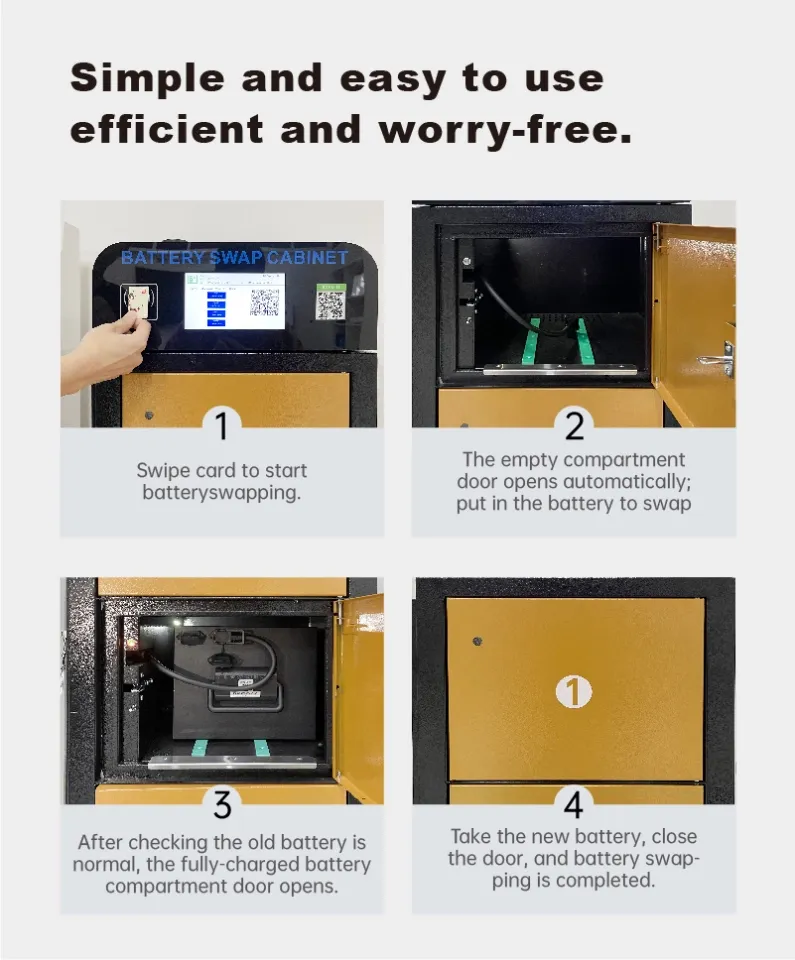
Instead of waiting for a battery to recharge inside the vehicle, an operator exchanges it for a charged battery at a compatible swapping station.
For suitable operations, this can reduce the time a vehicle spends waiting for energy replenishment.
However, the performance of a battery-swapping business depends on much more than the speed of an individual exchange.
It requires coordination between the vehicle, battery, swapping cabinet, and management software.
MIYAJI provides battery-swapping equipment as part of its commercial EV solutions.
Vehicle and Battery Compatibility
The battery must fit the intended vehicle and meet its electrical and operating requirements.
The battery installation and connection design must also support the intended swapping process.
Battery and Cabinet Compatibility
The swapping cabinet must support the selected battery configuration.
Mechanical fit, electrical connections, charging requirements, communication, and battery identification may all be relevant.
Battery Management
Commercial swapping operations may require information about battery status, equipment availability, and charging activity.
The available functions depend on the selected system and software configuration.
Station Planning
The number of swapping cabinets and batteries should be evaluated against the expected fleet size, daily energy demand, charging time, and operating patterns.
MIYAJI's battery PACK manufacturing, swapping equipment manufacturing, and software capabilities support coordinated planning of these requirements.
For overseas customers, the value is not simply purchasing a battery-swapping cabinet.
It is the ability to evaluate the battery, swapping equipment, and relevant software as parts of the same intended system.
7. MIYAJI Software: Connecting Vehicles and Energy Infrastructure
As commercial EV projects expand, operators may need more information about their vehicles and energy equipment.
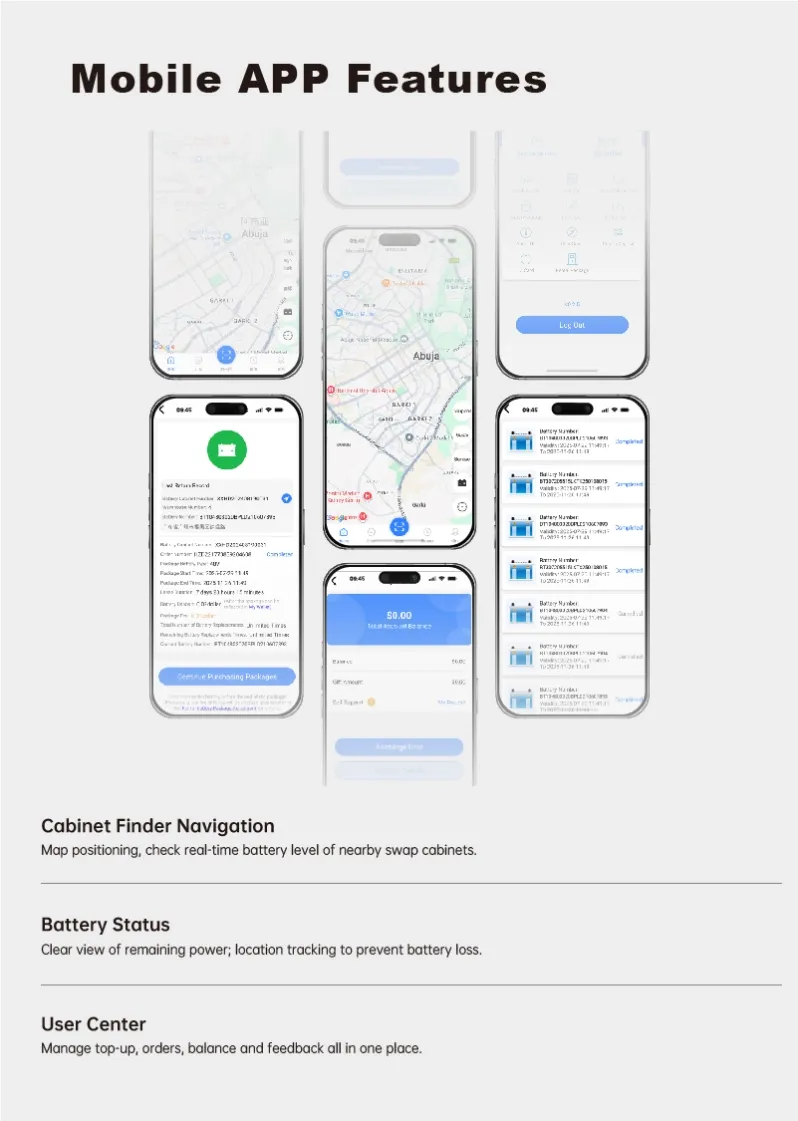
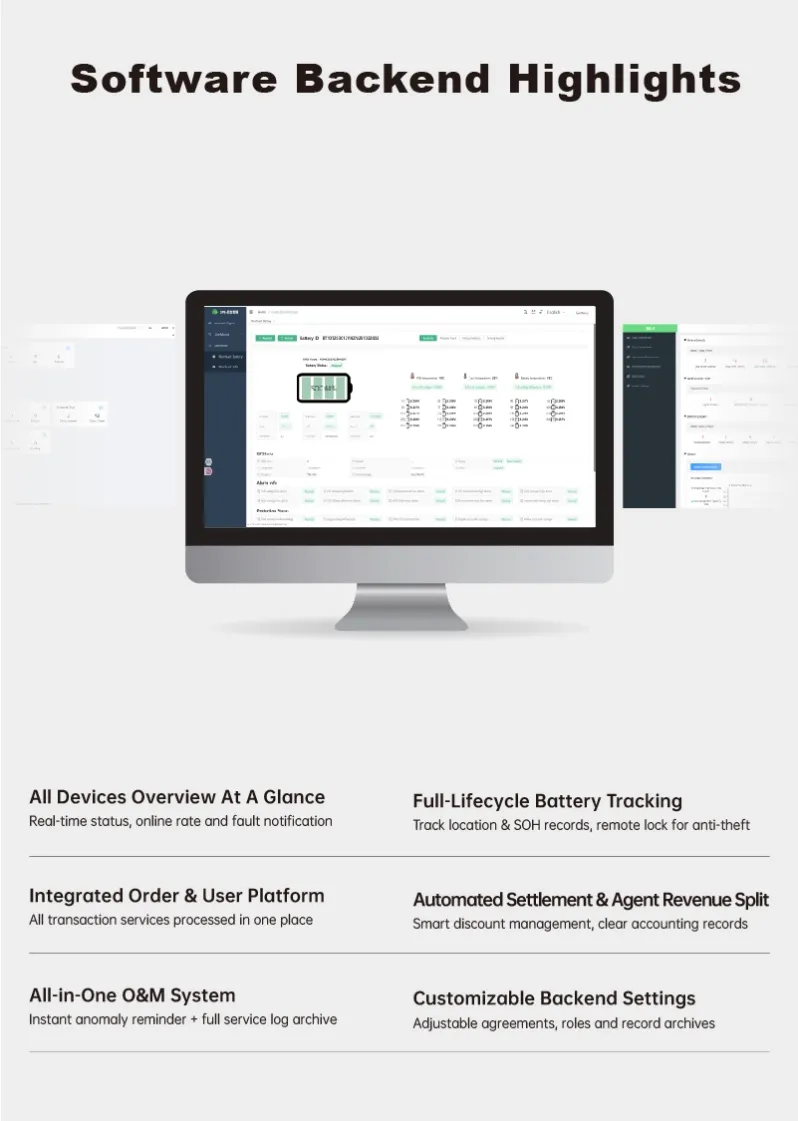
Depending on the application, software can support functions such as vehicle monitoring, equipment management, battery information, charging records, and supported remote-control features.
MIYAJI has its own software development team.
This allows relevant software requirements to be considered alongside its battery, charging, swapping, and connected vehicle solutions.
Vehicle Management
Where the selected vehicle hardware supports the required functions, software may provide location information, geofencing, or supported vehicle-control capabilities.
Battery and Energy Equipment Information
Compatible equipment may provide information related to battery or charging status.
The availability and accuracy of these functions depend on the connected hardware and communication interfaces.
Charging and Swapping Management
For projects using connected charging or swapping equipment, management software can support the agreed equipment and operational functions.
Why Integration Matters
A management platform cannot automatically communicate with every vehicle controller, BMS, or charging device.
Software compatibility must be considered during system planning.
By coordinating software and relevant hardware requirements, MIYAJI helps customers evaluate what functions can be supported by the selected configuration.
This is especially important for operators planning to manage vehicles and energy infrastructure together.
8. One Commercial EV Project, Multiple Connected Systems
Consider a business preparing to deploy electric motorcycles for delivery operations.
The initial purchasing list may appear straightforward:
- Electric motorcycles.
- Lithium batteries.
- Charging or battery-swapping equipment.
- Management software, if required.
- Spare parts and maintenance supplies.
However, each item affects the others.
The vehicle's motor and controller influence battery requirements.
The battery configuration affects charging compatibility.
The intended charging method influences operating schedules and infrastructure planning.
Software functions depend on compatible hardware interfaces.
Even spare parts and maintenance arrangements depend on the final vehicle configuration.
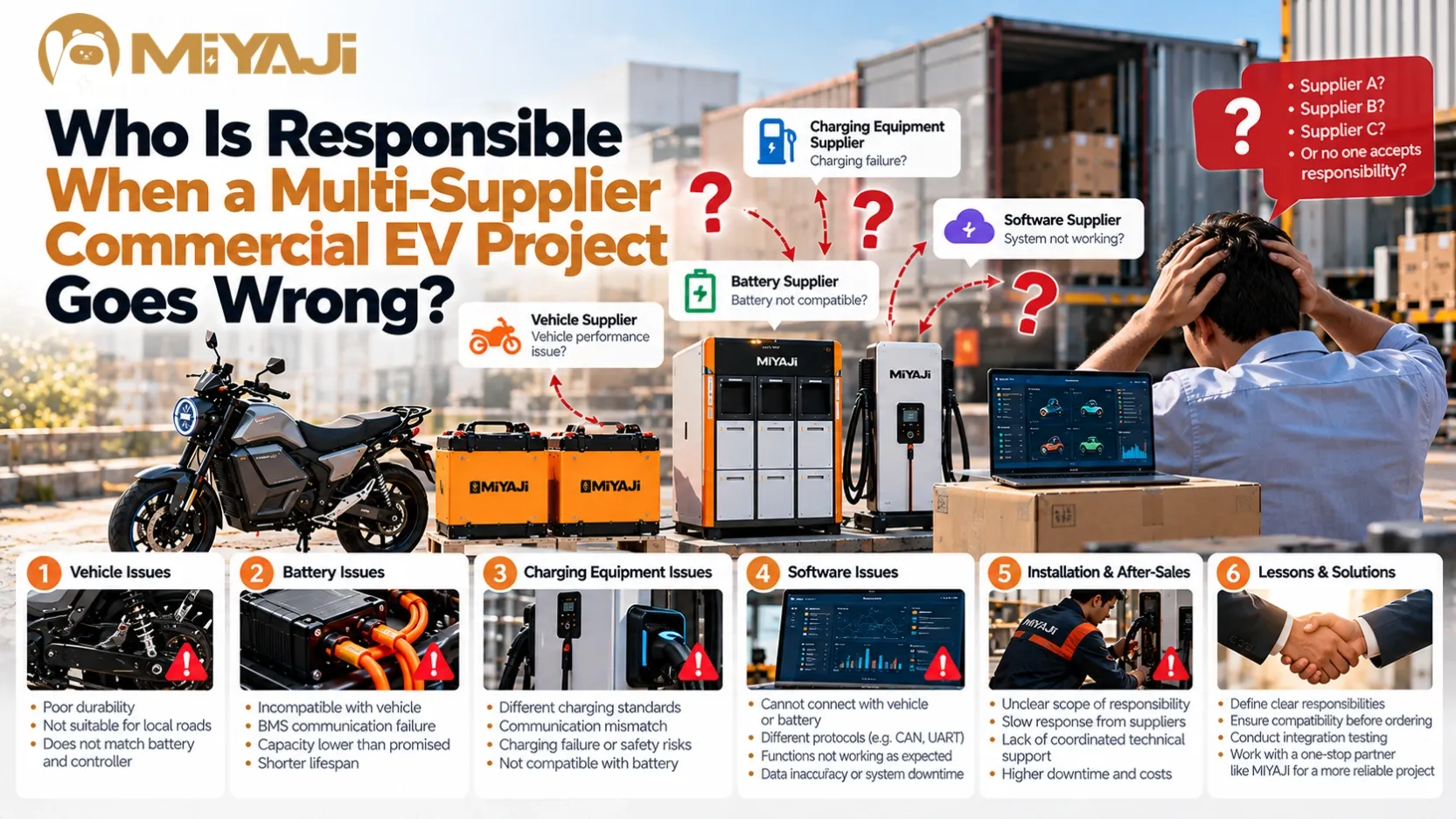
If these decisions are made independently, the operator may discover incompatibilities only after products have been ordered.
How MIYAJI Supports a Coordinated Project
MIYAJI can help customers review the relevant product and system requirements before confirming the intended configuration.
A typical project discussion may cover:
1. Commercial Application
The intended use, operating environment, workload, and deployment objectives.
2. Vehicle Selection
The MIYAJI motorcycle or tricycle model suitable for the proposed application.
3. Battery Configuration
Battery chemistry, capacity, discharge requirements, installation, and relevant BMS specifications.
4. Energy Infrastructure
Conventional charging, dedicated fast charging, battery swapping, or a combination appropriate to the project.
5. Software Requirements
The required management functions and relevant hardware compatibility.
6. Testing and Delivery
The agreed product specifications, necessary technical checks, and delivery requirements.
This process helps identify important system requirements before they become expensive operational problems.
The exact engineering, testing, and delivery scope is determined by the project agreement.
9. Why System Compatibility Matters More Than Individual Specifications
A commercial EV system is only as practical as the way its components work together.
A powerful motor is not useful if the battery cannot support the required operating conditions.
A high-power charger provides limited value if the selected battery does not support the intended charging profile.
A swapping cabinet cannot serve a fleet effectively if the battery and vehicle configurations are incompatible.
And software features cannot be delivered simply by listing them in a product catalogue.
The relevant hardware, interfaces, and control functions must support them.
This is why MIYAJI places importance on coordinated vehicle and energy system requirements.
Its own battery PACK manufacturing, charging and swapping equipment manufacturing, and software development capabilities provide a technical foundation for this approach.
For overseas buyers, the advantage is the opportunity to evaluate the complete intended system rather than comparing individual specifications in isolation.
The objective is not to offer the highest specification in every category. It is to provide a suitable and compatible configuration for the intended commercial application.
10. Supporting Commercial EV Projects From Pilot Deployment to Expansion
Many commercial EV businesses begin with a limited number of vehicles.
The initial deployment allows operators to evaluate how the selected products perform under local conditions.
Actual operating results can reveal requirements that were not obvious during the purchasing stage.
For example, a customer may discover that certain routes require additional battery capacity.
Another may find that charging schedules need to be adjusted.
A growing fleet may require additional energy equipment, spare batteries, or management functions.
These developments make it important to consider future requirements during initial product selection.
Initial Project Planning
MIYAJI can help customers review vehicle and energy system requirements for the intended application.
Product Evaluation and Pilot Deployment
The selected products can be evaluated against the agreed technical requirements and local operating conditions.
Feedback from the operator may identify necessary configuration adjustments.
Repeat Procurement
As the business develops, maintaining appropriate product specifications and system compatibility becomes increasingly important.
Additional Energy Infrastructure
A growing fleet may need additional charging or swapping equipment.
The new equipment should be evaluated against the existing system configuration.
Technical Coordination
When questions arise involving supplied products, MIYAJI can coordinate relevant technical support according to the agreed project scope.
MIYAJI supplies products and technical solutions; overseas customers remain responsible for their local fleet operations, infrastructure management, and commercial activities.
This division allows MIYAJI to focus on its manufacturing and technical strengths while customers develop their own markets.
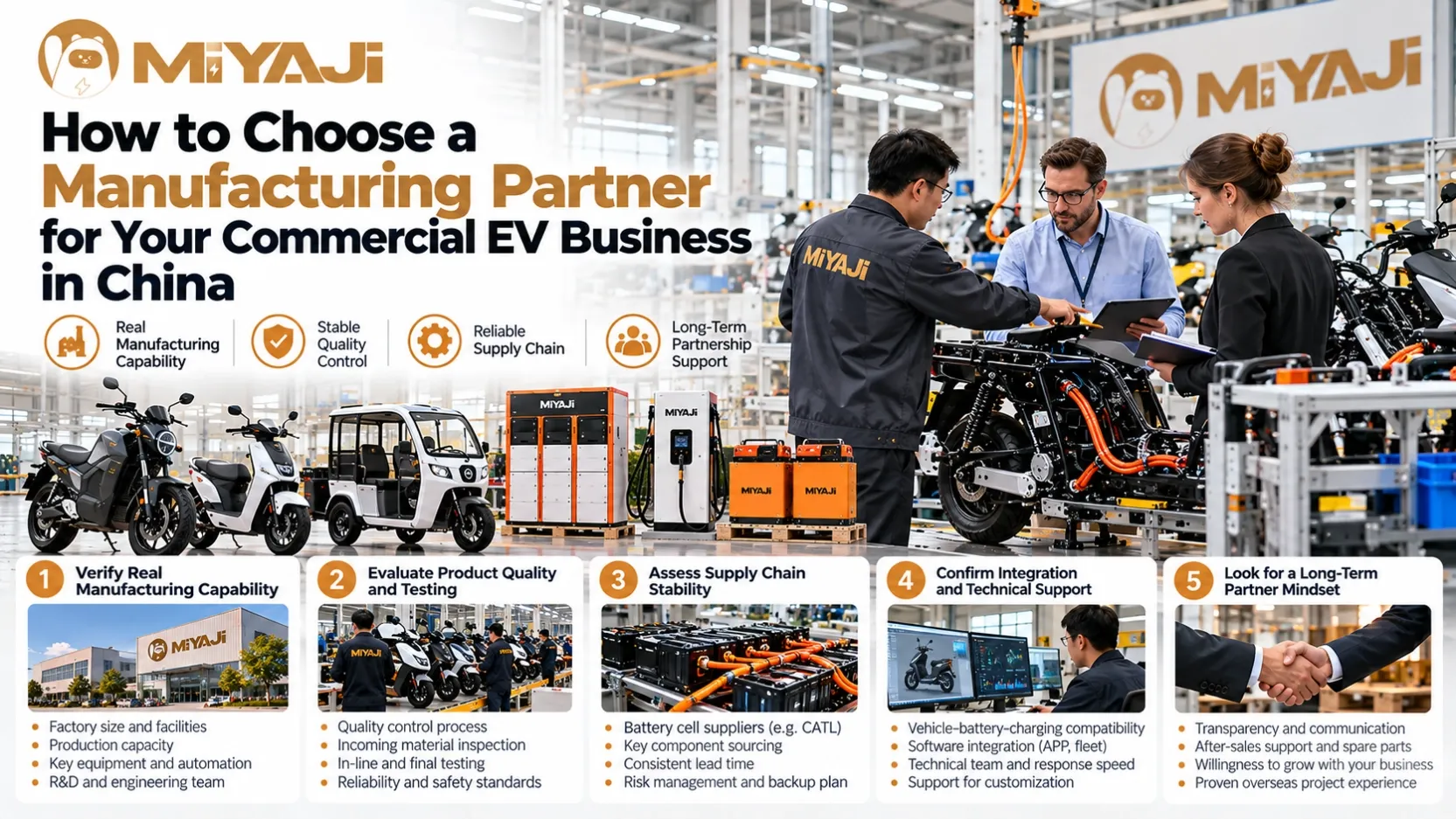
11. What Overseas Operators Should Expect From Their Commercial EV Supplier
A commercial EV supplier should provide more than an attractive product presentation.
Before making a purchasing decision, overseas operators should confirm several important areas.
Area | What the Buyer Should Confirm |
|---|---|
Vehicle suitability | Does the selected model match the intended commercial application? |
Battery configuration | Are capacity, discharge capability, and BMS requirements appropriate? |
Charging compatibility | Does the proposed charging equipment support the selected battery? |
Battery swapping | Are the vehicle, battery, cabinet, and software configurations compatible? |
Software functions | Which features are supported by the selected hardware? |
Quality and testing | What inspections and validation activities are included? |
Spare parts | What parts and maintenance support are available? |
Delivery | What products, documents, and services are included? |
After-sales support | How will technical issues be reported and investigated? |
Future expansion | Can additional products follow the agreed system configuration? |
These questions are important regardless of whether a customer is purchasing vehicles only or planning a complete commercial EV system.
MIYAJI aims to help customers address these requirements through its product range, core manufacturing capabilities, and technical coordination.
12. The MIYAJI Advantage: Vehicles, Energy Systems and Software Under One Brand
MIYAJI's value comes from the combination of its commercial EV products and core technical capabilities.
MIYAJI Commercial Electric Vehicles
Electric motorcycles, passenger tricycles, and cargo tricycles for different commercial applications.
MIYAJI Battery PACK Manufacturing
Lithium battery PACK manufacturing capabilities supporting relevant commercial vehicle and energy system requirements.
MIYAJI Charging Equipment
Dedicated charging solutions for compatible electric motorcycle and tricycle applications.
MIYAJI Battery Swapping Systems
Battery-swapping equipment and related system capabilities for suitable commercial fleet applications.
MIYAJI Software Development
Software capabilities supporting agreed vehicle and energy equipment management functions.
MIYAJI Technical Coordination
The ability to coordinate relevant product and engineering requirements across the intended commercial EV system.
Together, these capabilities allow MIYAJI to serve customers whose projects extend beyond a single vehicle purchase.
The goal is not to make every customer buy every product.
It is to provide suitable products and coordinated solutions according to the customer's actual business requirements.
Final Thoughts: Build the System, Not Just the Fleet
A successful commercial EV business depends on more than the number of vehicles purchased.
The vehicles need to suit the work they perform.
The batteries need to support their operating demands.
Charging and swapping infrastructure must be compatible with the selected energy systems.
Software must support the agreed functions.
And as the business grows, the operator needs a clear structure for product supply and technical coordination.
MIYAJI brings together commercial electric vehicles, its own battery PACK manufacturing, charging and battery-swapping equipment manufacturing, and software development capabilities to support these requirements.
For overseas operators, the objective is to build a practical vehicle and energy system that can support real commercial operations.
MIYAJI — Your Market. Our Manufacturing Ecosystem.
Frequently Asked Questions
What commercial EV products does MIYAJI offer?
MIYAJI offers electric motorcycles, electric passenger tricycles, electric cargo tricycles, lithium battery PACK solutions, charging equipment, battery-swapping systems, and related software capabilities.
Does MIYAJI manufacture lithium batteries?
MIYAJI has its own lithium battery PACK manufacturing capabilities, supporting battery configurations for relevant commercial EV applications.
Can MIYAJI provide vehicles and battery-swapping systems together?
Yes. MIYAJI can provide compatible vehicle, battery, swapping equipment, and software solutions according to the selected products and agreed project requirements.
Does MIYAJI support fast charging for electric motorcycles?
MIYAJI provides dedicated fast-charging solutions for compatible electric motorcycle and tricycle applications. Charging performance depends on the selected battery, charger, and validated system configuration.
Can MIYAJI support commercial EV fleet software?
MIYAJI has its own software development team. Available vehicle, battery, charging, and swapping management functions depend on the selected hardware and agreed software requirements.
Can I purchase MIYAJI vehicles without buying a complete charging or swapping system?
Product supply can be discussed according to the customer's requirements. Not every project needs a complete charging or swapping solution.
Can MIYAJI support a pilot project before a larger order?
MIYAJI can discuss product configurations and supply arrangements for pilot and larger commercial EV projects. Testing, technical services, and delivery terms are agreed according to the project.
Does MIYAJI operate commercial EV fleets overseas?
MIYAJI supplies commercial EV products and provides agreed technical coordination. Local fleet operations and business management remain the responsibility of the overseas operator.
Build Your Commercial EV Project With MIYAJI
Whether you are planning an electric motorcycle fleet, introducing electric tricycles, developing battery-swapping infrastructure, or evaluating dedicated fast charging, the right vehicle and energy system combination matters.
MIYAJI brings commercial EV products, battery PACK manufacturing, charging and swapping equipment, and software capabilities together to support your project.
Tell us about your market, intended application, operating conditions, and deployment plans.
We can help you evaluate suitable MIYAJI products and system configurations.
Your Market. Our Manufacturing Ecosystem.
Contact MIYAJI to Discuss Your Commercial EV Requirements.