Sep 2, 2026Product & Industry Knowledge
Battery Swapping Station for Electric Motorcycles: Complete Guide for Commercial Projects
Learn how electric motorcycle battery swapping stations work, including batteries, cabinets, charging, software, safety, costs and commercial fleet applications.
Battery Swapping Station for Electric Motorcycles: Complete Guide for Commercial Projects
For commercial electric motorcycles, charging is not only an energy question.
It is an operational question.
A delivery motorcycle, passenger motorcycle or other high-utilization commercial EV may operate for many hours every day. When the battery is depleted, every minute spent waiting for charging can reduce productive operating time.
A battery swapping station provides another approach.
Instead of waiting for the battery inside the vehicle to recharge, the rider removes the depleted battery and exchanges it for a charged battery.
The vehicle can then return to operation while the depleted battery is charged inside the swapping system.
The basic process is simple:
Ride
→
Battery Depleted
→
Arrive at Swap Station
→
Return Battery
→
Receive Charged Battery
→
Continue Operation
But behind this simple user experience is a much more complex system involving:
Vehicle + Battery + BMS + Swap Station + Charging + Software + Network Operations
For commercial projects, understanding this complete system is much more important than simply comparing battery swap cabinet prices.
This guide explains how electric motorcycle battery swapping stations work, what equipment is required, where swapping makes sense and what buyers should evaluate before building a battery swapping network.
What Is a Battery Swapping Station?
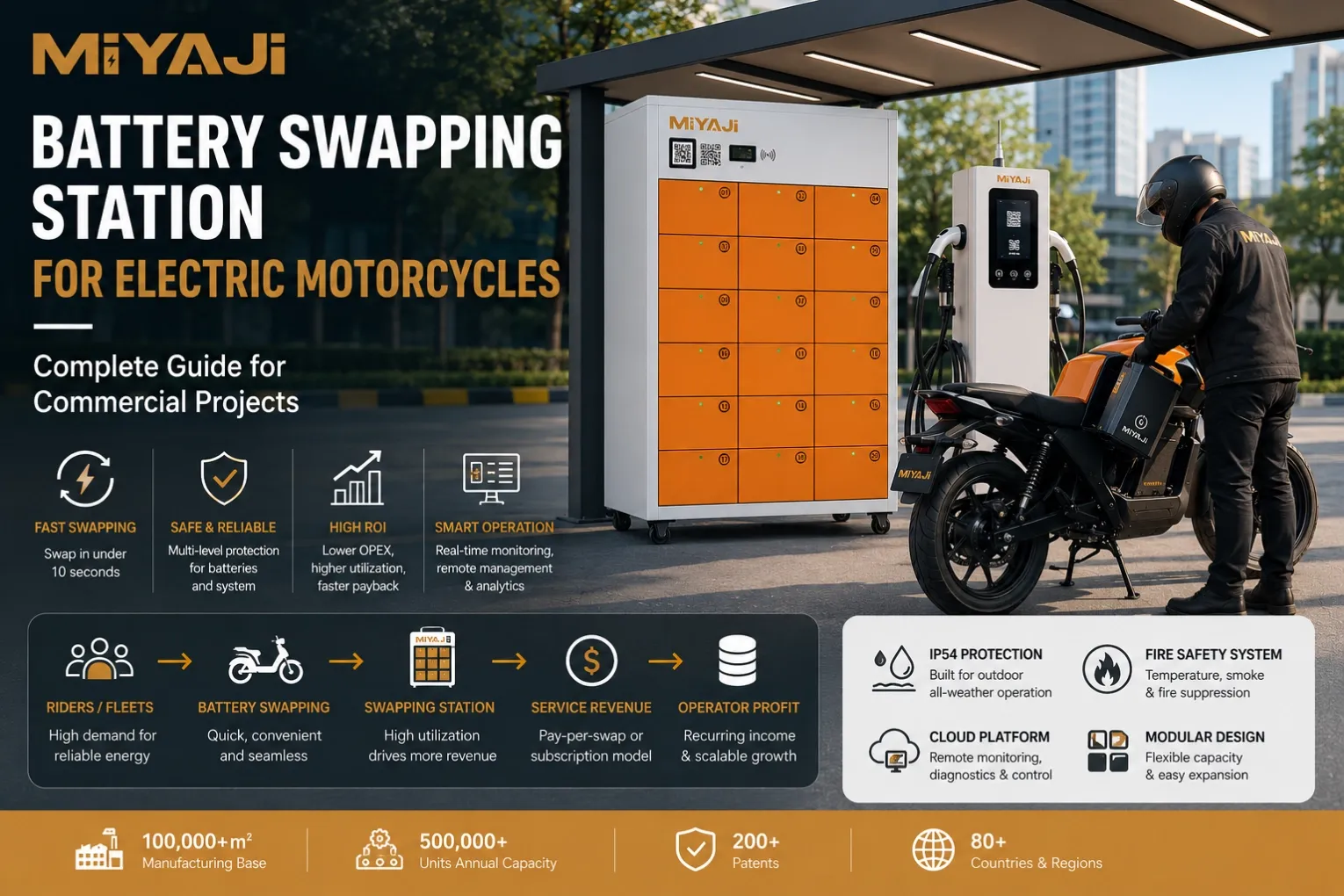
A battery swapping station is an energy replenishment facility where depleted EV batteries can be exchanged for charged batteries.
For electric motorcycles and other light electric vehicles, this is commonly achieved using removable battery packs.
The station typically stores and charges multiple batteries simultaneously.
When a rider arrives, the system identifies the rider and/or battery, accepts the returned battery and releases another battery that is ready for use.
Depending on the system design, authentication may use:
- Mobile application
- QR code
- RFID
- NFC
- Account identification
- Other connected authentication methods
The station may also communicate with a cloud platform to manage batteries, users, transactions and operational data.
Therefore, a modern battery swapping station is better understood as:
An automated battery charging, exchange and asset-management node within a connected energy network.
What Is the Difference Between a Battery Swap Cabinet and a Battery Swapping Station?
These terms are often used interchangeably, but for commercial projects it is useful to distinguish them.
A battery swap cabinet usually refers to the physical hardware:
- Cabinet enclosure
- Battery slots
- Charging modules
- Electrical components
- Display or user interface
- Communication hardware
- Safety devices
A battery swapping station can refer to the complete operational point, including:
Cabinet
-
Batteries
-
Electrical Infrastructure
-
Communication
-
Software
-
User Access
The distinction matters when requesting quotations.
A low cabinet price does not necessarily represent the total cost of deploying an operational swapping station.
How Does an Electric Motorcycle Battery Swapping Station Work?
A typical swapping process can be divided into several stages.
Step 1: Rider Arrives
The rider reaches a compatible swap station.
Depending on the platform, the rider may identify themselves using an app, QR code, NFC, RFID or another authentication method.
Step 2: System Verifies the User
The system may verify:
- User account
- Vehicle
- Battery
- Subscription
- Payment status
- Station availability
Step 3: Depleted Battery Is Returned
The rider places the depleted battery into an available compartment.
Step 4: Battery Is Identified
The station communicates with the battery or BMS where supported.
Relevant information may include:
- Battery ID
- SOC
- Temperature
- Voltage
- Fault status
Step 5: System Assigns a Charged Battery
A battery that meets the configured release conditions is made available to the rider.
Step 6: Swap Is Recorded
The platform records the transaction.
Step 7: Returned Battery Begins Charging
If the returned battery passes the required checks, it enters the charging process.
The rider leaves while the station prepares that battery for another user.
This circulation is the fundamental operating principle of battery swapping.
What Equipment Is Required for a Battery Swapping System?
A complete system usually requires much more than the cabinet itself.
1. Compatible Electric Vehicles
The motorcycle must be designed for practical battery removal and replacement.
Important factors include:
- Battery location
- Battery weight
- Locking mechanism
- Electrical connector
- Communication
- Vehicle controller compatibility
2. Swappable Lithium Batteries
The batteries must be compatible with both the vehicle and station.
Key specifications include:
- Chemistry
- Voltage
- Capacity
- Dimensions
- Weight
- Connector
- BMS
- Communication
- Charging limits
3. Battery Swap Station
The station provides:
- Battery storage
- Charging
- User interaction
- Battery release
- Electrical protection
- Communication
4. Charging System
Charging modules replenish returned batteries.
Charging power should be matched to:
- Battery chemistry
- Cell capability
- Battery capacity
- BMS limits
- Thermal design
- Available electrical power
5. IoT Communication
Connected projects may use cellular, Wi-Fi, Ethernet or other communication methods depending on deployment conditions.
6. Management Software
Software can connect:
Battery
Station
Vehicle
Rider
Operator
and potentially:
Payment
This is what transforms individual cabinets into a manageable network.
Why Use Battery Swapping for Electric Motorcycles?
The primary advantage is not simply “fast battery replacement.”
The real commercial advantage is:
Reduced vehicle downtime.
Imagine a delivery rider whose motorcycle needs additional energy during the working day.
With conventional charging, the vehicle may need to remain connected while the battery charges.
With swapping, the rider exchanges the battery and continues operating while charging occurs separately.
This can be particularly valuable for:
- Delivery fleets
- Courier operations
- Passenger motorcycle services
- High-mileage riders
- Multi-shift fleets
- Shared mobility
- Commercial tricycles
The higher the vehicle utilization, the more valuable downtime can become.
Battery Swapping vs Charging
Battery swapping is not automatically better than charging.
Each solution fits different operating conditions.
Factor | Battery Swapping | Plug-In / Fast Charging |
|---|---|---|
Vehicle downtime | Very low during exchange | Depends on charging time |
Spare batteries | Required | Usually not required |
Battery standardization | Very important | Less critical |
Infrastructure | Station + battery inventory + software | Charger + electrical infrastructure |
Asset management | More complex | Simpler |
Fleet suitability | Strong for high-utilization fleets | Strong where charging windows exist |
Network complexity | Higher | Generally lower |
A fleet returning to a depot every night may not require swapping.
A high-mileage fleet operating across multiple shifts may benefit significantly from it.
Some projects can also use:
Battery Swapping + Fast Charging
rather than choosing only one method.
The correct question is therefore not:
“Which technology is better?”
It is:
“Which energy strategy produces the best operational result for this fleet?”
What Batteries Are Used in Battery Swapping Stations?
Electric motorcycle swapping systems commonly use rechargeable lithium-ion battery packs.
Different projects may use different chemistries, including:
LFP — Lithium Iron Phosphate
and
NMC/NCM — Nickel Manganese Cobalt-based lithium-ion chemistry
The right chemistry depends on the project requirements.
Evaluation factors include:
- Energy density
- Weight
- Cycle requirements
- Charging performance
- Thermal behavior
- Cost
- Vehicle packaging
- Operating environment
Battery selection should therefore happen together with vehicle and station design.
A swapping station should not be selected first and then forced to accommodate an unsuitable battery.
Why Battery Standardization Matters
Battery standardization is one of the foundations of a scalable swapping network.
Imagine a network serving three motorcycle models.
If all three use different:
- Battery dimensions
- Connectors
- Voltages
- Communication protocols
the operator may need separate battery inventories and station configurations.
That creates operational complexity.
A standardized battery platform can improve:
- Battery interchangeability
- Inventory utilization
- Station compatibility
- Maintenance
- Software management
- Network expansion
For OEM or fleet projects, battery standardization should therefore be considered early in vehicle development.
What Is Inside a Battery Swap Cabinet?
A commercial battery swap cabinet may include:
- Individual battery compartments
- Charging modules
- Power distribution
- Circuit protection
- Battery connectors
- Communication controller
- Display or interface
- Network communication
- Temperature monitoring
- Smoke detection
- Cooling or ventilation
- Locks
- Emergency protection
Exact architecture varies by supplier and project.
More components do not automatically mean a better station.
The important question is:
How well do the battery, charging, safety and software systems work together?
How Many Slots Should a Battery Swap Station Have?
There is no universally correct number.
A station could use:
- Small distributed cabinets
- Medium-capacity stations
- Larger centralized installations
The required slot count depends on:
- Number of vehicles
- Swap frequency
- Charging time
- Peak demand
- Battery inventory
- Station location
- Electrical capacity
For example, two projects may both have 100 motorcycles.
Project A operates predictable routes and returns to one depot.
Project B operates across a large urban area.
They may require completely different station configurations.
This is why slot count should come from operating data and demand calculations, not simply cabinet size preference.
How Many Batteries Does a Swapping System Need?
One of the most common questions is:
“If I have 100 motorcycles, how many batteries should I buy?”
There is no responsible universal answer.
A swapping network generally has batteries in several states:
Inside Vehicles
-
Charging
-
Ready for Swap
-
Operational Reserve
The required battery inventory depends on:
- Battery capacity
- Daily mileage
- Vehicle energy consumption
- Charging time
- Swaps per day
- Peak swap demand
- Reserve strategy
Therefore:
100 vehicles does not automatically mean 100, 120 or 150 batteries.
The system should be calculated from actual fleet requirements.
Where Should Battery Swap Stations Be Installed?
Station location can be as important as station capacity.
Possible locations include:
- Fleet depots
- Delivery hubs
- Commercial districts
- Transport hubs
- Fuel stations
- Retail locations
- Residential areas
- High-traffic rider routes
But location should be based on demand.
A station is useful when it is located where riders actually need energy.
Network planning should consider:
Vehicle Movement
-
Swap Demand
-
Travel Distance
-
Electrical Availability
-
Site Cost
-
Redundancy
A cheap location with little rider traffic may ultimately be more expensive than a higher-cost site with strong utilization.
What Software Does a Battery Swapping Station Need?
For a small standalone station, software requirements may be relatively simple.
For a multi-station commercial network, software becomes much more important.
A battery swap management platform may provide:
Battery Management
- Battery ID
- SOC
- SOH
- Charging status
- Fault records
- Lifecycle history
Station Management
- Online/offline status
- Slot availability
- Charging status
- Fault alarms
- Battery inventory
User Management
- Rider account
- Vehicle
- Subscription
- Swap history
- Permissions
Transaction Management
- Swap records
- Billing
- Payment
- Subscription packages
Fleet Operations
- Vehicle information
- Rider activity
- Energy consumption
- Station demand
Analytics
- Swaps per station
- Battery utilization
- Peak periods
- Energy consumption
- Operational performance
At scale, software becomes the control layer connecting the physical network.
How Safe Are Battery Swapping Stations?
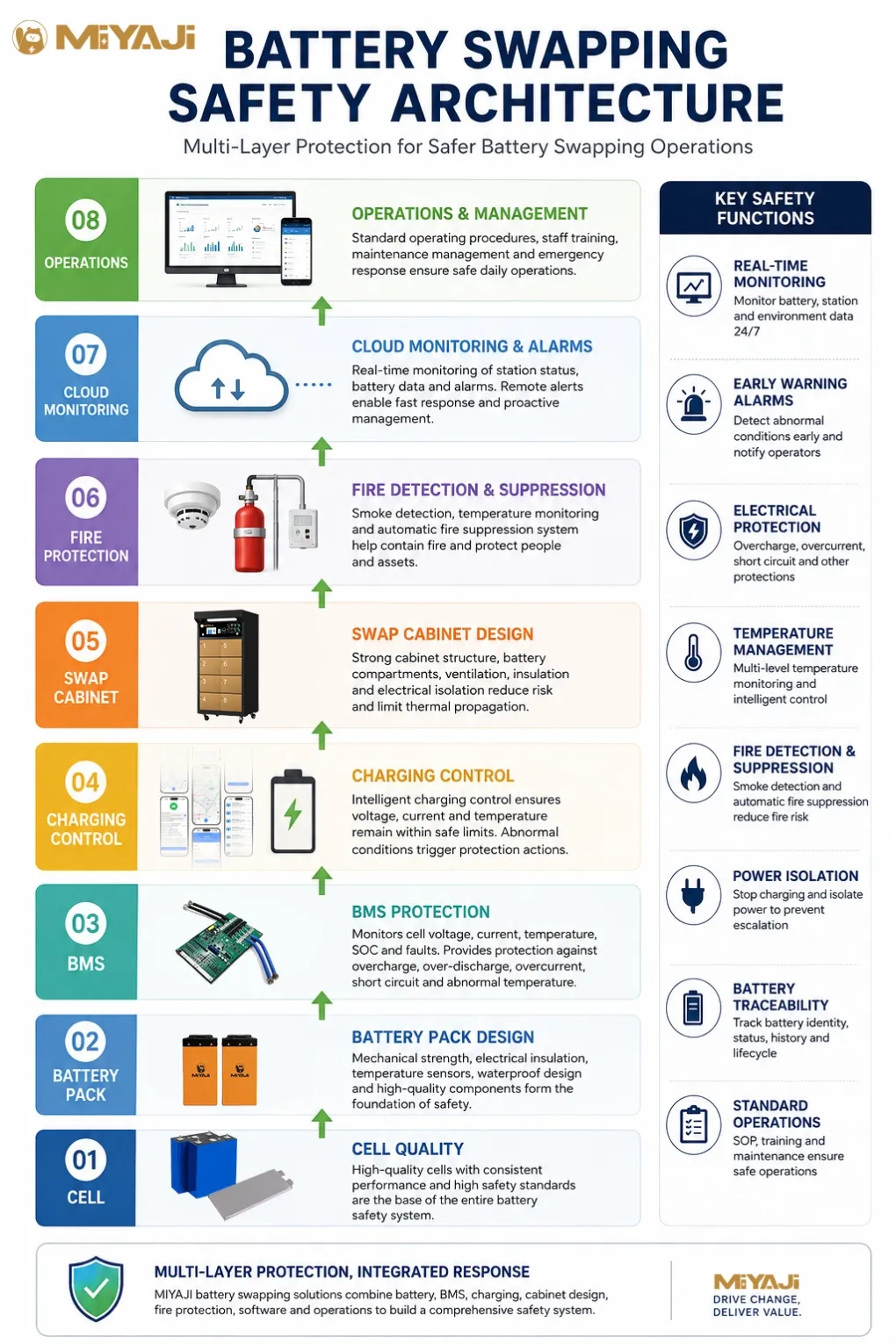
Safety should be evaluated as a multi-layer system.
A professional architecture may involve:
Cell Quality
↓
Battery Pack Design
↓
BMS Protection
↓
Charging Control
↓
Cabinet Protection
↓
Temperature & Smoke Detection
↓
Fire Response
↓
Cloud Monitoring
↓
Operating Procedures
This is exactly why judging station safety based on one feature—such as a fire extinguisher—is insufficient.
Buyers should evaluate how abnormal batteries are:
detected
→
stopped from charging
→
isolated
→
reported
→
inspected
Safety requirements also vary by battery design and destination market.
How Much Does a Battery Swapping Station Cost?
There is no single standard battery swap station price.
Total project cost may include:
Swap Cabinet
-
Battery Inventory
-
Software
-
Electrical Infrastructure
-
Installation
-
Site
-
Operations
Cabinet price itself can vary according to:
- Number of slots
- Charging power
- Battery specification
- Cooling
- Fire protection
- Communication
- User interface
- Outdoor protection
- Customization
For commercial projects, the better question is:
What is the total system cost required to support the target fleet?
not simply:
“How much is one cabinet?”
Can a Battery Swapping Station Make Money?
Yes, but the station itself does not guarantee a profitable business.
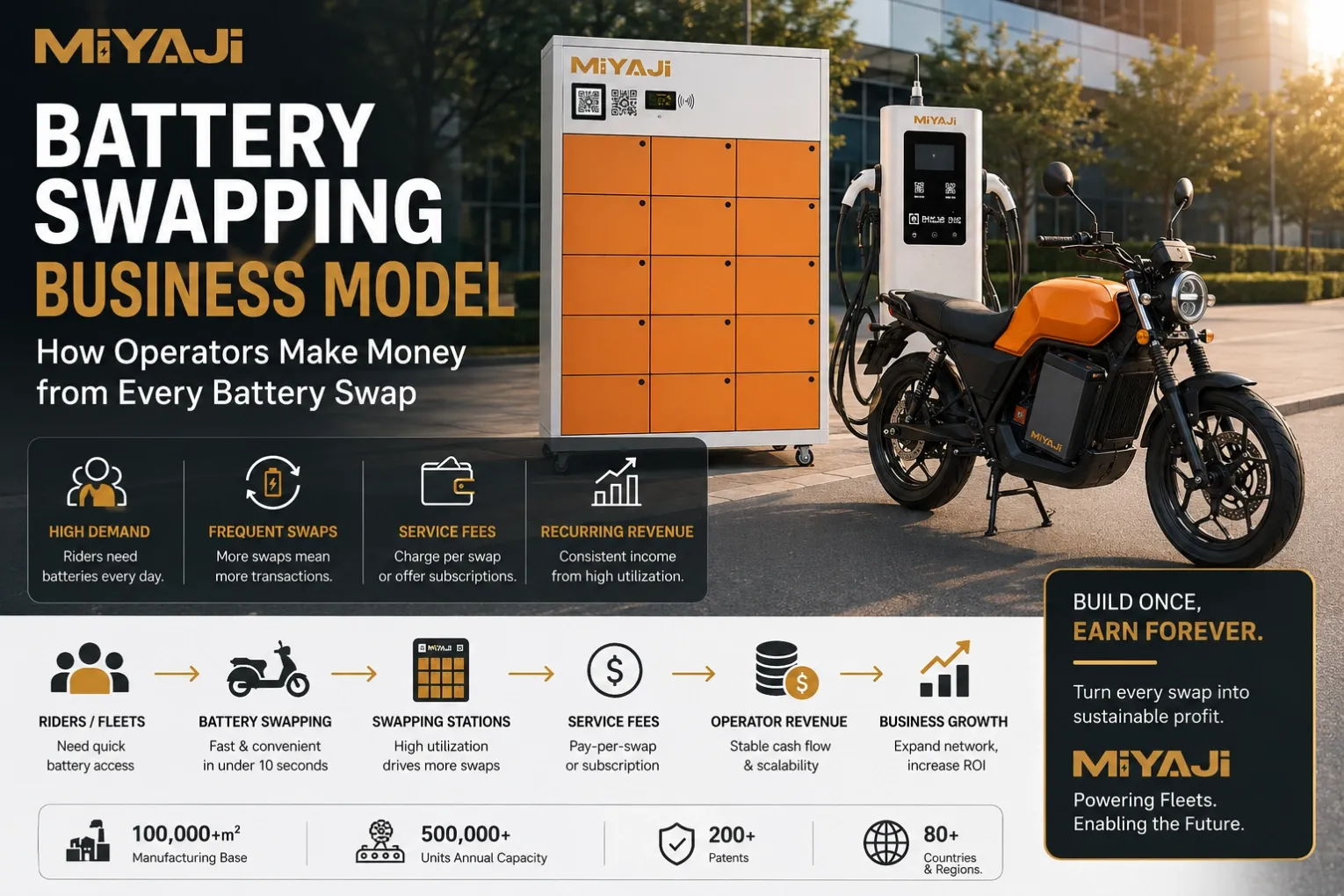
Possible business models include:
Fleet-Owned
A fleet operates the system internally to reduce vehicle downtime and operating cost.
Subscription
Riders pay a recurring fee.
Pay-Per-Swap
Users pay per transaction.
Battery-as-a-Service
The operator owns batteries and sells access to battery energy.
Fleet Service Contract
Commercial fleets purchase energy or battery services under contract.
Franchise / Partner Network
Local partners operate stations under a larger platform.
Profitability depends on factors including:
- Rider density
- Swap frequency
- Battery utilization
- Station utilization
- Electricity cost
- Battery depreciation
- Site cost
- Pricing
- Maintenance
- Financing
A cabinet with very low utilization can remain unprofitable regardless of its technical quality.
How Do You Build a Battery Swapping Network?
A practical project sequence is:
Define Commercial Use Case
↓
Choose Vehicle Platform
↓
Standardize Battery
↓
Calculate Energy Demand
↓
Estimate Swap Demand
↓
Calculate Battery Inventory
↓
Size Charging Capacity
↓
Plan Station Locations
↓
Configure Software
↓
Define Business Model
↓
Run Pilot
↓
Collect Real Data
↓
Optimize
↓
Scale
This order matters.
A common mistake is:
Buy cabinets first → figure out the business later.
Commercial projects should do the opposite.
Should You Start With a Pilot?
For a new market, a pilot can reduce uncertainty before larger investment.
A pilot can measure:
- Actual daily mileage
- Vehicle energy consumption
- Swaps per rider
- Peak swap demand
- Battery charging time
- Station utilization
- Battery performance
- Rider behavior
- Electricity cost
- Software performance
- Maintenance requirements
The purpose is to replace assumptions with operating data.
A successful pilot should not only prove:
“The cabinet works.”
It should help answer:
“Can this complete system scale commercially?”
What Should You Ask a Battery Swapping Station Supplier?
When comparing suppliers, look beyond price and slot quantity.
Ask about:
- Vehicle compatibility — Can the battery architecture work with the target motorcycle?
- Battery specification — Chemistry, voltage, capacity, dimensions and charging limits.
- BMS communication — What information can the station read and control?
- Charging architecture — How are charging power and battery limits managed?
- Safety architecture — What happens when an abnormal battery is detected?
- Software — Can batteries, stations, users and transactions be managed centrally?
- APIs — Can the system integrate with existing fleet or payment platforms?
- Outdoor deployment — What environmental protection has been designed and verified?
- Spare parts and maintenance — How will the equipment be supported after deployment?
- Scaling — Can the same architecture support more vehicles and stations later?
The supplier should be able to discuss the complete operating system, not only the cabinet specification sheet.
Battery Swapping Station vs Battery Swapping System
This distinction is particularly important for commercial buyers.
Battery Swapping Station
A physical point where batteries are exchanged and charged.
Battery Swapping System
The complete ecosystem:
Vehicle
-
Battery
-
Station
-
Charging
-
Software
-
Operations
A successful commercial deployment ultimately depends on the second one.
How MIYAJI Approaches Battery Swapping Projects
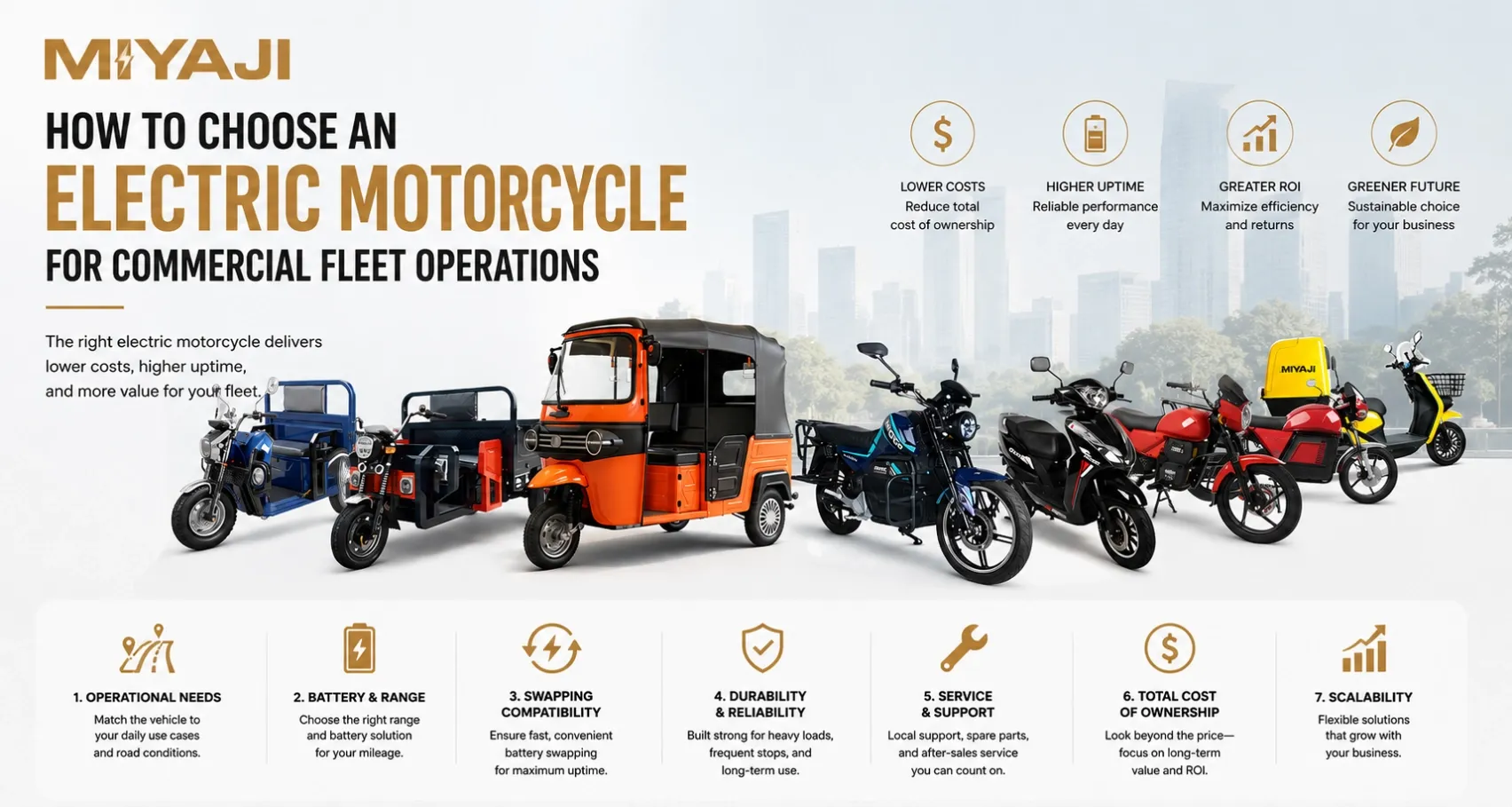
MIYAJI approaches battery swapping as part of an integrated commercial EV ecosystem rather than as an isolated cabinet product.
The system can combine:
Commercial Electric Motorcycles & Tricycles
-
Lithium Battery Systems
-
Battery Swap Stations
-
Fast Charging
-
Energy Management Software
-
OEM / CKD & Local Production Support
This allows project discussions to begin with operating requirements.
For example:
How many vehicles will operate?
How far will they travel each day?
How many hours will they operate?
What battery architecture is suitable?
How frequently will riders need energy?
Where should stations be located?
What software and payment functions are required?
From there, the vehicle, battery, charging, swapping and software architecture can be evaluated as one coordinated system.
Planning an Electric Motorcycle Battery Swapping Project?
For an initial project evaluation, prepare:
Target Country / City
Vehicle Type
Initial Fleet Size
Future Fleet Size
Daily Mileage
Operating Hours
Battery Requirement
Operating Area
Energy / Business Model
Project Timeline
These inputs can be used to evaluate:
Vehicle
→ Battery
→ Battery Quantity
→ Charging Capacity
→ Swap Station
→ Software
→ Network
CTA Button
Plan Your Battery Swapping Project
Frequently Asked Questions
What is a battery swapping station?
A battery swapping station allows EV users to exchange a depleted removable battery for a charged battery instead of waiting for the vehicle battery to recharge.
How long does an electric motorcycle battery swap take?
Actual swap time depends on the battery, vehicle, station design and user process. Buyers should evaluate the complete exchange process rather than relying only on advertised mechanical swap time.
How many batteries does a battery swap station need?
There is no fixed number. Battery quantity depends on fleet size, daily mileage, battery capacity, charging time, swap frequency, peak demand and reserve requirements.
How many battery swap stations are needed for 100 motorcycles?
There is no universal station quantity. The answer depends on station capacity, rider routes, peak swap demand, battery charging time, electrical capacity and desired network coverage.
Is battery swapping better than fast charging?
Neither is universally better. Battery swapping can suit high-utilization fleets with low downtime tolerance, while fast charging can be effective where vehicles have predictable charging windows. Some fleets can use both.
What software is needed for a battery swapping station?
Commercial systems may use software for battery monitoring, station management, user accounts, swap transactions, billing, fleet management, alarms and operational analytics.
Are battery swapping stations safe?
Safety depends on the complete architecture, including battery design, BMS protection, charging control, cabinet design, temperature monitoring, electrical protection, fire response, software and operating procedures.
How much does a battery swapping station cost?
Cost depends on station capacity, battery specification, charging power, software, safety configuration, electrical infrastructure, installation and battery inventory. Commercial projects should compare total system cost rather than cabinet price alone.
Can battery swap stations be customized?
Yes. Depending on the supplier and project, station capacity, battery interface, charging power, software, branding, payment and communication functions may be configured for specific operating requirements.