Sep 5, 2026Product & Industry Knowledge
EV Fleet Management Software: Vehicles, Batteries, Charging & Operations
Learn how EV fleet management software helps operators manage vehicles, batteries, charging, maintenance, drivers and fleet performance from one connected platform.
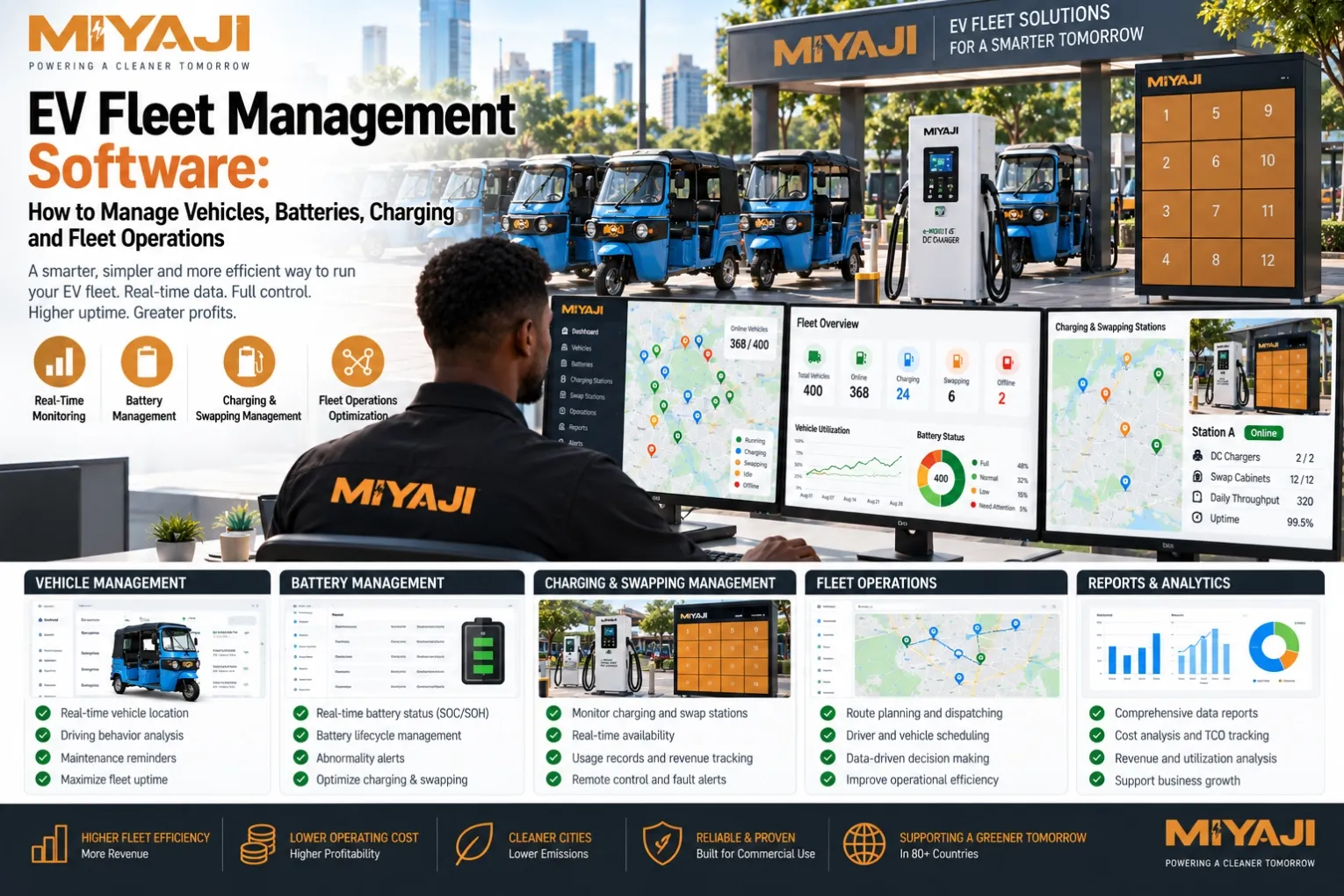
EV Fleet Management Software: How to Manage Vehicles, Batteries, Charging and Fleet Operations
Operating an electric vehicle fleet involves more than knowing where the vehicles are.
A commercial EV fleet may need to manage:
Vehicles
Batteries
Charging
Battery Swapping
Drivers
Maintenance
Energy
and
Operational Performance
As fleet size grows, managing these assets manually becomes increasingly difficult.
This is where EV fleet management software becomes important.
A connected fleet platform can combine data from:
Vehicle
→ Battery
→ Charger / Swap Station
→ Cloud
→ Fleet Dashboard
to help operators understand what is happening across the fleet.
The objective is not simply to collect data.
It is to improve:
- Vehicle uptime
- Battery utilization
- Charging efficiency
- Maintenance planning
- Fleet productivity
- Operating visibility
What Is EV Fleet Management Software?
EV fleet management software is a digital platform designed to monitor and manage electric vehicles and related fleet assets.
Depending on the system, it can include:
- Vehicle tracking
- Battery monitoring
- Charging management
- Swap-station management
- Driver management
- Maintenance records
- Alerts
- Energy analysis
- Fleet reporting
For commercial electric motorcycle and tricycle fleets, software can connect multiple systems that would otherwise operate separately.
Traditional Fleet Management vs EV Fleet Management
Traditional fleet software may focus on:
- GPS
- Mileage
- Driver behavior
- Maintenance
An EV fleet adds another layer:
Energy
This means operators also need visibility into:
- Battery SOC
- Battery SOH
- Charging status
- Charging power
- Battery temperature
- Energy consumption
- Swap activity
- Charger availability
Therefore EV fleet software must connect mobility management with energy management.
1. Vehicle Monitoring
A fleet management platform can provide visibility into each vehicle.
Depending on the hardware and system architecture, data may include:
- Vehicle ID
- Location
- Mileage
- Speed
- Operating status
- Fault status
- Battery level
This allows operators to see which vehicles are:
Operating
Idle
Charging
Under Maintenance
or
Offline
Why Vehicle Visibility Matters
Imagine a fleet has:
500 electric motorcycles
Without a connected system, it can become difficult to answer:
Which vehicles are working today?
Which vehicles are inactive?
Which vehicles have repeated faults?
Which vehicles are underutilized?
Software converts the fleet into measurable assets.
2. GPS and Location Tracking
GPS tracking can help operators monitor:
- Current vehicle location
- Route history
- Depot return
- Service area
- Vehicle recovery
For delivery or mobility fleets, location data can also support operational planning.
However, location data should be used according to applicable privacy and data-protection requirements.
3. Vehicle Utilization
A vehicle that exists in the fleet is not necessarily productive.
Useful KPIs can include:
- Operating hours
- Daily mileage
- Active days
- Idle time
- Trips
- Vehicle utilization rate
For example, if:
100 vehicles
are available but only:
70 vehicles
are consistently operating,
the operator has a utilization problem.
Buying more vehicles may not be the right solution.
4. Battery Monitoring
The battery is one of the most important assets in an electric fleet.
A connected platform can potentially monitor:
- SOC
- SOH
- Voltage
- Current
- Temperature
- Charge status
- Faults
- Battery ID
This allows the operator to manage batteries separately from vehicles.
Why Battery-Level Management Matters
In a commercial fleet, batteries can move between:
Vehicles
Charging Stations
Swap Cabinets
Maintenance
and
Storage
Without battery-level tracking, it can be difficult to know:
Which battery is installed in which vehicle?
Which battery is charging?
Which battery has abnormal behavior?
Which battery is available?
For swapping fleets, this becomes especially important.
5. SOC Monitoring
SOC means:
State of Charge
It estimates the remaining charge level of the battery.
Fleet operators can use SOC data to help identify:
- Vehicles requiring charging
- Low-energy vehicles
- Batteries ready for swapping
- Unusual energy consumption
But SOC should not be interpreted as a perfect measurement under every condition.
Its accuracy depends on the battery and BMS system.
6. SOH Monitoring
SOH means:
State of Health
It is used to estimate how the battery's condition changes over time.
Depending on the battery-management system, SOH-related information may help operators identify:
- Aging batteries
- Capacity loss
- Performance differences
- Batteries requiring inspection
For commercial fleets, this can support battery lifecycle planning.
7. Battery Temperature
Battery temperature can affect:
- Charging
- Discharging
- Performance
- Safety
- Battery aging
Software can help identify batteries operating outside expected conditions and trigger alerts where the system supports it.
8. Battery Fault Alerts
Potential alerts may include:
- Overvoltage
- Undervoltage
- Overcurrent
- Temperature abnormality
- Communication failure
The exact alert capability depends on the BMS and system architecture.
The value is not simply the alert itself.
It is:
How quickly the operator can respond.
9. Charging Management
An EV fleet may operate many chargers at once.
Charging software can help monitor:
- Charger status
- Vehicle/battery charging status
- Charging start and end time
- Energy delivered
- Charging faults
This provides visibility into the charging operation.
10. Why Charging Management Becomes Important at Scale
Imagine:
200 vehicles
return to a depot in the evening.
If every vehicle begins charging at the same time, the site may experience a high power demand.
Fleet energy management can potentially help operators:
- Schedule charging
- Prioritize vehicles
- Distribute charging load
- Avoid unnecessary peak demand
The exact strategy depends on the charging hardware and electrical infrastructure.
11. Smart Charging
Smart charging means charging decisions are controlled or scheduled using operational rules or data.
For example, vehicles required first the next morning could be prioritized.
Other vehicles may charge later.
A simple strategy can be:
Fleet Schedule
↓
Required Departure Time
↓
Battery SOC
↓
Charging Priority
This can improve infrastructure utilization.
12. Charging Power Allocation
When multiple chargers share limited electrical capacity, power may need to be distributed among vehicles.
For example:
Available Site Power
↓
divided between
Multiple Chargers
The objective is to use available electrical capacity efficiently without exceeding site limits.
13. Battery Swapping Management
For swapping fleets, the software layer becomes more complex.
The platform may need to connect:
- Batteries
- Swap stations
- Vehicles
- Riders
- Charging modules
- Payment systems
This is where battery swap management software becomes a specialized sub-system within broader fleet management.
14. Swap Station Status
Operators may need to know:
- Number of batteries inside
- Batteries charging
- Batteries ready
- Empty slots
- Station faults
- Station connectivity
This helps determine whether a station can support rider demand.
15. Rider or Driver Management
Depending on the business model, the platform may manage:
- Driver ID
- Assigned vehicle
- Vehicle usage
- Swap records
- Charging activity
- Mileage
For rental or mobility models, this can help connect:
Person + Vehicle + Battery + Transaction
16. Driver Behavior
Some systems can monitor behaviors such as:
- Speed
- Acceleration
- Route
- Usage patterns
This data can potentially help identify operational differences.
However, the objective should be operational improvement rather than unnecessary surveillance.
17. Maintenance Management
Maintenance is one of the most important fleet-management functions.
Software can help record:
- Maintenance history
- Vehicle faults
- Component replacement
- Service dates
- Mileage
This creates a structured service history for each vehicle.
18. Preventive Maintenance
Instead of waiting for vehicles to fail, maintenance can be planned using:
- Mileage
- Operating hours
- Time
- Fault data
For example:
Mileage threshold reached
→ maintenance reminder
This can help reduce unexpected downtime.
19. Predictive Maintenance
More advanced systems may use historical data to identify abnormal patterns before a major failure occurs.
Potential inputs include:
- Fault frequency
- Battery behavior
- Temperature
- Energy consumption
- Component data
However, predictive maintenance requires sufficient data and validated models.
It should not be treated as automatic “AI” simply because a system has a dashboard.
20. Spare Parts Management
Fleet software can also support maintenance operations by connecting:
Vehicle Fault
→ Required Part
→ Inventory
→ Repair
For larger fleets, this can help identify:
- Frequently replaced parts
- Stock requirements
- Maintenance cost
21. Energy Consumption Monitoring
Electric fleet operators should understand:
How much electricity does each vehicle consume?
Useful data may include:
- kWh per day
- kWh per vehicle
- kWh per route
- Wh/km
This creates the basis for energy-cost analysis.
22. Wh/km as a Fleet KPI
A useful efficiency metric is:
Energy Consumption = Energy Used ÷ Distance
usually expressed as:
Wh/km
If similar vehicles show significantly different Wh/km, the operator can investigate:
- Route differences
- Payload
- Driver behavior
- Tire condition
- Vehicle faults
23. Cost per Kilometer
Once energy and operating data are available, the fleet can calculate:
Cost per km
This may include:
- Electricity
- Maintenance
- Battery cost
- Software
- Other operating expenses
This is more useful for commercial decisions than simply knowing electricity consumption.
24. Vehicle Uptime
One of the most important fleet KPIs is:
Vehicle Uptime
A vehicle may be unavailable because of:
- Charging
- Battery problems
- Maintenance
- Missing spare parts
- Technical faults
Software can help identify the reasons behind downtime.
25. Downtime Analysis
Instead of only measuring:
How much downtime?
measure:
Why was the vehicle unavailable?
Possible categories:
Energy Downtime
Maintenance Downtime
Battery Downtime
Driver / Operational Downtime
This helps management focus on the real bottleneck.
26. Fleet Dashboard
A commercial fleet dashboard should prioritize actionable information.
Useful summary indicators may include:
- Active vehicles
- Vehicles offline
- Vehicles charging
- Battery SOC
- Battery faults
- Charger status
- Swap-station status
- Maintenance alerts
- Fleet mileage
- Energy consumption
The objective is not to display the maximum number of charts.
It is to help the operator make decisions quickly.
27. Alerts and Notifications
Operators should not need to watch dashboards continuously.
Alerts can help surface issues such as:
- Critical battery SOC
- Battery temperature abnormality
- Vehicle fault
- Charger failure
- Swap cabinet fault
- Connectivity loss
- Maintenance due
The correct notification rules should avoid both:
Missing important faults
and
Excessive useless alerts
28. Role-Based Access
Different users may need different information.
For example:
Fleet Manager
Needs overall fleet performance.
Maintenance Team
Needs faults and service records.
Energy Manager
Needs battery and charging data.
Finance Team
Needs cost and transaction data.
Local Dealer
May manage only assigned vehicles or stations.
Role-based access can help control who can see or modify information.
29. Multi-Region Fleet Management
Larger operators may run vehicles across:
- Multiple cities
- Multiple depots
- Multiple dealers
- Multiple station networks
The software may therefore need:
- Hierarchical account structures
- Regional dashboards
- Asset assignment
- Permission management
This becomes important when the fleet scales.
30. API Integration
Commercial projects may already use:
- Delivery platforms
- ERP
- Payment systems
- Ride-hailing platforms
- Customer apps
Therefore API capability can become important.
Potential integrations may include:
Fleet Platform
↔ ERP
↔ Payment
↔ Delivery Platform
↔ Customer App
The exact integrations depend on the project.
31. Payment and Subscription Management
Some mobility or battery-service models require:
- Subscription billing
- Pay-per-use
- Pay-per-swap
- Energy billing
- Account balance
This functionality may sit inside the fleet platform or integrate with another payment system.
32. Battery-as-a-Service
A BaaS model separates battery or energy service from vehicle ownership.
Software becomes particularly important because the operator may need to manage:
- Battery ownership
- Battery usage
- Rider account
- Swaps
- Billing
- Battery lifecycle
Without digital asset tracking, this model becomes difficult to operate at scale.
33. Data for Fleet Expansion
Fleet software can also help answer strategic questions.
For example:
Which routes need more vehicles?
Which stations are overloaded?
Which chargers are underutilized?
Which battery capacities work best?
Which vehicles have the lowest TCO?
This helps operators use real data when expanding the fleet.
34. From Pilot to Scale
During a pilot, software can collect:
- Daily mileage
- Wh/km
- SOC
- Charging
- Swap frequency
- Faults
- Maintenance
- Uptime
These numbers can then be used to design the larger deployment.
A pilot without data collection loses much of its value.
35. Fleet Software for Electric Motorcycles
Electric motorcycle fleets may prioritize:
- GPS
- Battery SOC
- Swap activity
- Rider management
- Vehicle utilization
This is particularly relevant for:
- Delivery
- Motorcycle taxi
- Rental
- Mobility operations
36. Fleet Software for Electric Tricycles
Passenger or cargo tricycle fleets may additionally focus on:
- Daily mileage
- Route
- Payload-related energy use
- Vehicle uptime
- Charging
- Maintenance
The platform architecture can remain similar, while the operational KPIs differ.
37. Fleet Software for Charging-Based Fleets
A charging-oriented fleet may prioritize:
Vehicle
-
Battery
-
Charger
-
Depot Energy
The system may help answer:
- Which vehicles need charging?
- Which chargers are available?
- How much electricity is being used?
- Can charging be shifted to different times?
38. Fleet Software for Swapping Fleets
A swapping fleet adds:
Battery Inventory
-
Swap Stations
-
Swap Transactions
-
Battery Circulation
The operator needs to know not only where vehicles are, but where batteries are moving across the network.
39. Software and Hardware Must Be Designed Together
A software platform cannot monitor data that the hardware does not provide.
Therefore successful fleet digitalization starts with:
Vehicle Sensors / Controller
-
BMS
-
Charger or Swap Station
-
Communication Hardware
-
Cloud
Software is only the visible layer of a connected hardware system.
40. Communication Architecture
A simplified architecture can look like:
Vehicle / Battery / Charger
↓
Controller / BMS / IoT Device
↓
Cellular / Wi-Fi / Other Communication
↓
Cloud Platform
↓
Dashboard / App / API
The exact architecture depends on the project and target market.
41. Offline Connectivity
Commercial fleets may operate in areas with inconsistent connectivity.
The system architecture should consider what happens when communication is temporarily unavailable.
Possible questions include:
- Is data stored locally?
- Can the vehicle still operate?
- Can swapping continue?
- Is data synchronized later?
These questions can be important in real deployments.
42. Cybersecurity and Permissions
Connected fleet systems should consider:
- User authentication
- Access permissions
- Data protection
- Software updates
- Device communication security
Requirements may vary by project and market.
Security should be considered during system design rather than added after deployment.
43. Data Ownership
Commercial buyers should clarify:
Who owns the fleet data?
Can the operator export the data?
Can third-party systems access it?
What happens if the software supplier changes?
These questions become increasingly important for large fleets.
44. Cloud vs Local Deployment
Some fleet platforms operate primarily in the cloud.
Others may require local or hybrid deployment depending on project requirements.
Factors can include:
- Connectivity
- Data requirements
- IT policy
- System integration
There is no universal architecture for every project.
45. White-Label Fleet Software
Distributors and mobility operators may want the platform presented under their own brand.
White-label requirements can include:
- Logo
- Colors
- Domain
- Mobile app
- Language
- User interface
This may be important for OEM or project-based cooperation.
46. Multi-Language Support
International fleet projects may require:
- English
- French
- Arabic
- Spanish
- Local languages
The exact language requirements should be defined before deployment.
Translation alone is not always sufficient; workflows and local payment or operational practices may also require adaptation.
47. Software Customization
Not every project should begin with custom software development.
A better approach can be:
Standard Platform
↓
Project Configuration
↓
Required Integrations
↓
Only Necessary Customization
This can reduce:
- Development time
- Cost
- Technical risk
48. What Features Do You Really Need?
A 50-vehicle fleet does not necessarily need the same software complexity as a 10,000-vehicle network.
Start with core requirements:
- Vehicle visibility
- Battery visibility
- Charging/swapping
- Faults
- Maintenance
- Fleet KPIs
Then expand as the operation grows.
49. Common Fleet Software Mistakes
Buying Software Before Defining Operations
Technology should follow the fleet workflow.
Tracking Vehicles but Ignoring Batteries
For EV fleets, battery data is essential.
Collecting Data Without KPIs
More data does not automatically improve operations.
Excessive Custom Development
Can increase cost and project complexity.
No API Strategy
Can create problems when the fleet later integrates with other systems.
Ignoring Connectivity
Software must match real communication conditions.
Ignoring Data Ownership
This can become a major issue as the fleet grows.
50. EV Fleet Management Software Selection Checklist
Before selecting a system, ask:
Area | Questions |
|---|---|
Vehicles | Can we monitor location, mileage, status and faults? |
Batteries | Can we monitor SOC, SOH, temperature and battery ID? |
Charging | Can we monitor charger status and energy use? |
Swapping | Can we track stations, batteries and swap records? |
Drivers | Can users and vehicle assignments be managed? |
Maintenance | Are faults, service and parts records supported? |
Energy | Can we monitor Wh/km and electricity use? |
Alerts | Can notification rules be configured? |
Reports | Can data be exported? |
API | Can it integrate with other systems? |
Permissions | Can different users have different access? |
Branding | Is white-label available if required? |
Language | Can the system support target markets? |
Connectivity | How does the system behave when offline? |
Scale | Can the system support future fleet growth? |
How EV Fleet Software Supports TCO Reduction
Software does not automatically reduce cost.
It creates the visibility needed to identify where cost is being created.
For example:
High Energy Consumption
→ investigate route / driver / vehicle.
Frequent Battery Faults
→ inspect battery or operating conditions.
Low Vehicle Utilization
→ improve asset allocation.
High Charging Peak
→ optimize charging schedules.
Repeated Component Failure
→ improve maintenance or component selection.
This is how software becomes part of fleet economics.
From Hardware Supplier to Fleet System
For commercial EV projects, the most valuable architecture is not:
Vehicle + separate software
It is:
Vehicle
-
Battery
-
Charging / Swapping
-
IoT
-
Cloud Platform
designed to communicate as one system.
This reduces integration problems and gives the operator more consistent operational data.
How MIYAJI Approaches Fleet Management Software
MIYAJI's software capability is designed to connect the hardware used in commercial EV operations.
Depending on project requirements, the system can integrate:
Electric Motorcycles & Tricycles
-
Lithium Battery Systems
-
BMS
-
Fast Chargers
-
Battery Swap Stations
-
Fleet & Energy Management Software
This enables project operators to manage multiple parts of the commercial EV ecosystem from a coordinated platform.
The objective is not simply to provide a dashboard.
It is to connect:
Vehicle + Battery + Energy + Operations
into one manageable system.
Planning a Connected EV Fleet?
Before discussing software, prepare:
Fleet Size
Vehicle Type
Battery Architecture
Charging / Swapping Strategy
Driver / Rider Model
Required Fleet KPIs
Payment Requirements
API Requirements
Countries / Languages
White-Label Requirements
Future Fleet Scale
From these inputs, the software architecture can be planned around the actual business.
Discuss Your Fleet Software Requirements
Frequently Asked Questions
What is EV fleet management software?
EV fleet management software is a digital platform used to monitor and manage electric vehicles, batteries, charging, maintenance, drivers and other fleet operations.
How is EV fleet management different from traditional fleet management?
EV fleet management includes energy-related data such as battery SOC, SOH, charging and energy consumption in addition to traditional GPS, mileage and maintenance functions.
Can EV fleet software monitor battery health?
Depending on the BMS and system integration, the platform can monitor battery-related information such as SOC, SOH, temperature, voltage and fault alerts.
Can fleet software manage chargers?
Yes, if the charging equipment is connected to the system. Functions may include charger status, charging sessions, energy usage and fault monitoring.
Can the same software manage battery swapping?
Yes, when swap stations, batteries, vehicles and the platform are integrated. Battery swapping typically requires additional battery-inventory and transaction-management functions.
Can EV fleet software reduce operating cost?
Software itself does not guarantee lower cost, but it can help identify energy waste, downtime, maintenance problems, low utilization and other operational inefficiencies.
What software does an electric motorcycle fleet need?
Typical requirements can include vehicle tracking, battery monitoring, charging or swapping management, driver accounts, maintenance, alerts and operational reporting.
Can EV fleet management software support electric tricycles?
Yes. The same platform architecture can support electric motorcycles, passenger tricycles and cargo tricycles if the vehicle hardware is integrated.
Does EV fleet software support API integration?
It can, depending on the platform. API capabilities may be important for integrating ERP, payment, delivery, mobility or other third-party systems.
Can fleet software be white-labeled?
Some project platforms can support customized branding, languages, domain or app requirements depending on the project scope.
Is cloud connectivity required?
Many fleet systems use cloud connectivity, but the architecture should consider offline behavior and local connectivity conditions.
Can MIYAJI integrate vehicles, batteries and energy equipment into one software platform?
MIYAJI can support integrated commercial EV projects connecting vehicles, battery systems, charging or swapping equipment and fleet-management software according to project requirements.