Sep 5, 2026Product & Industry Knowledge
Electric Tricycle Buying Guide: Passenger vs Cargo Models for Commercial Use
Learn how to choose a commercial electric tricycle for passenger or cargo operations based on payload, range, motor power, battery, charging, durability and TCO.
Electric Tricycle Buying Guide: How to Choose Passenger vs Cargo Models for Commercial Operations
Electric tricycles are increasingly used for commercial passenger and cargo transportation.
Compared with two-wheel motorcycles, three-wheel vehicles can provide:
- Greater carrying capacity
- More cargo space
- Improved low-speed stability
- Passenger transport capability
- Flexible body configurations
But not every electric tricycle is designed for the same job.
A passenger electric tuk-tuk operating throughout a city has very different requirements from a cargo tricycle carrying goods between warehouses and local stores.
The correct selection process should therefore begin with:
Commercial Application
↓
Payload / Passenger Requirement
↓
Route & Duty Cycle
↓
Vehicle Structure
↓
Motor
↓
Battery
↓
Charging / Swapping
↓
Operating Cost
This guide explains how commercial buyers can choose the right electric tricycle for their operations.
What Is a Commercial Electric Tricycle?
A commercial electric tricycle is a three-wheel electric vehicle designed primarily for business or fleet operations.
Typical applications include:
Passenger Transportation
- Urban passenger transport
- Short-distance mobility
- Taxi operations
- Shuttle services
- Tourism
Cargo Transportation
- Last-mile delivery
- Parcel delivery
- Food distribution
- Retail distribution
- Warehouse transport
- Local logistics
- Utility operations
The vehicle architecture should be selected according to its primary commercial purpose.
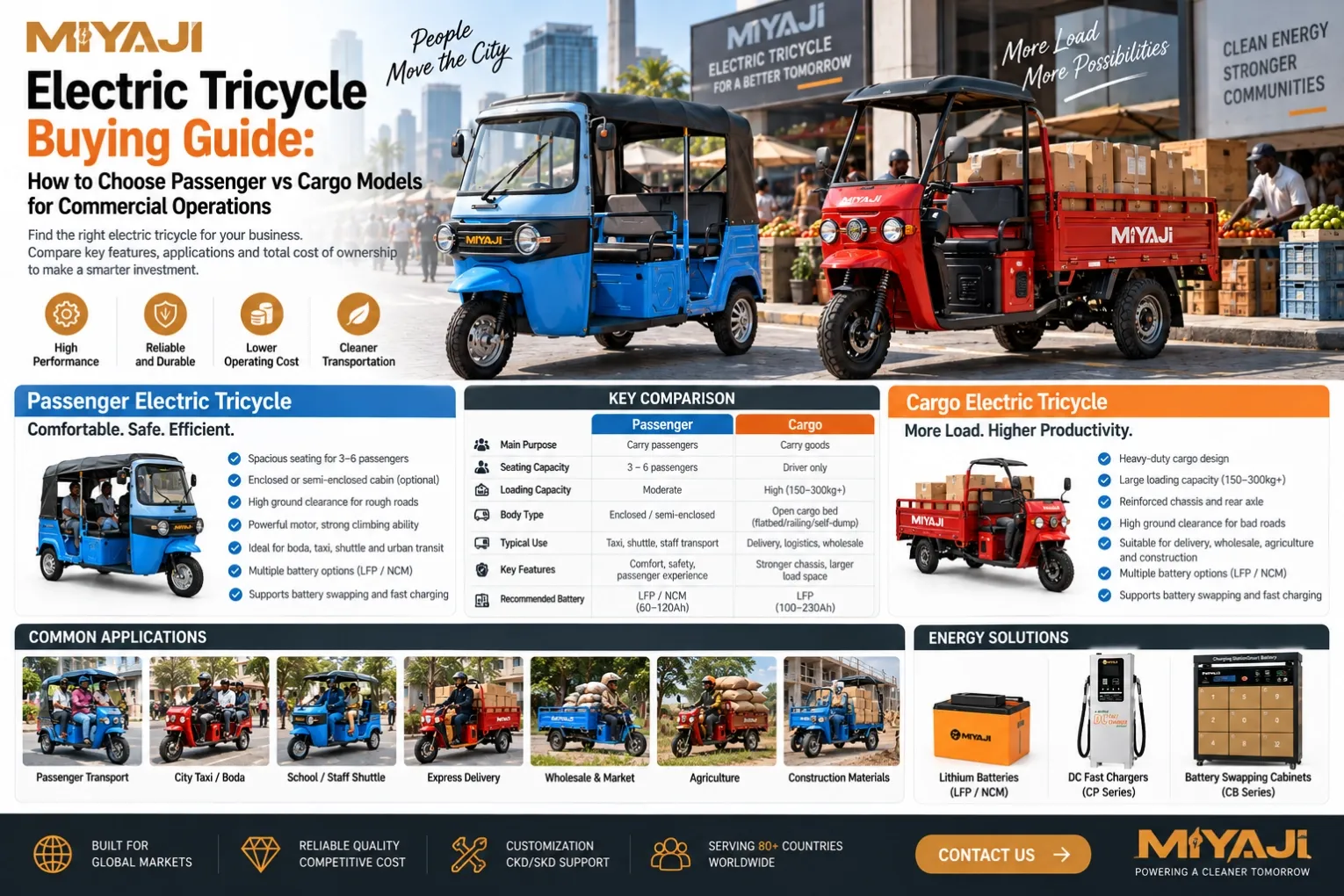
Passenger vs Cargo Electric Tricycle
The first major decision is whether the vehicle will primarily carry:
People
or
Goods.
Requirement | Passenger Tricycle | Cargo Tricycle |
|---|---|---|
Primary Function | Passenger transport | Goods transportation |
Body Design | Passenger cabin/seating | Cargo bed/box |
Main Load | Driver + passengers | Driver + cargo |
Key Priority | Comfort + uptime | Payload + durability |
Typical Operation | Taxi/shuttle/mobility | Delivery/logistics |
Body Customization | Seating/cabin | Cargo box/flatbed/dump |
Battery Requirement | Duty-cycle dependent | Duty-cycle + payload dependent |
Neither type is inherently better.
They are built for different commercial jobs.
1. Start With the Commercial Application
Do not begin with:
“Which tricycle has the biggest battery?”
Start with:
What will the vehicle do every day?
For passenger operations, define:
- Passenger capacity
- Daily trips
- Route distance
- Operating hours
- Average occupancy
- Passenger comfort requirements
For cargo operations, define:
- Cargo type
- Typical payload
- Maximum payload
- Cargo dimensions
- Loading method
- Delivery frequency
These requirements determine the vehicle architecture.
2. Passenger Electric Tricycle: What Should You Evaluate?
A passenger electric tricycle may operate for many hours every day.
Important considerations include:
- Passenger capacity
- Seating
- Cabin structure
- Driver visibility
- Suspension
- Braking
- Vehicle stability
- Battery range
- Charging downtime
- Weather protection
- Maintenance
For commercial passenger service, vehicle uptime can directly affect daily revenue.
Passenger Capacity Is More Than Seat Count
A vehicle advertised as:
3 Passenger
or:
4 Passenger
should not be evaluated only by the number of seats.
Buyers should also consider:
- Passenger weight
- Driver weight
- Vehicle gross weight
- Suspension capacity
- Motor performance
- Braking
- Available cabin space
A vehicle should be configured for its actual operating load.
3. Cargo Electric Tricycle: What Should You Evaluate?
Cargo tricycles prioritize a different set of requirements.
Important factors include:
- Payload
- Cargo volume
- Motor performance
- Frame strength
- Rear axle
- Suspension
- Tires
- Brakes
- Ground clearance
- Battery energy
- Loading/unloading
The correct vehicle depends heavily on what is being transported.
Payload vs Cargo Volume
These are not the same thing.
Imagine two businesses.
Business A
Carries:
Large boxes with relatively low weight
Business B
Carries:
Dense, heavy goods
Business A may need more:
Cargo volume
Business B may need more:
Payload capacity
Therefore cargo body size and payload rating should be evaluated separately.
4. Choose the Right Cargo Body
Cargo electric tricycles can use different rear-body configurations.
Depending on the application, these may include:
Flatbed
Suitable for flexible cargo loading.
Open Cargo Box
Suitable for general goods and local distribution.
Enclosed Cargo Box
Useful when cargo requires greater protection from weather or access.
Dump / Tipping Body
Useful for certain bulk-material applications.
Customized Body
Can be developed around specific commercial requirements.
The body should be selected according to the actual cargo workflow.
5. Motor Power: Bigger Is Not Always Better
Motor power should be selected according to:
- Vehicle weight
- Payload
- Required speed
- Gradient
- Route
- Acceleration requirements
A lightly loaded passenger vehicle and a heavily loaded cargo tricycle may require different motor characteristics even if their maximum speed targets are similar.
Torque Matters for Commercial Tricycles
For loaded vehicles, torque can be particularly important during:
- Starting
- Hill climbing
- Low-speed operation
- Heavy cargo transport
Therefore buyers should not compare tricycles using motor wattage alone.
Evaluate the complete:
Motor + Controller + Gear / Drivetrain + Wheel + Vehicle Weight
system.
6. Hill-Climbing Performance
If the operating route contains gradients, test the vehicle under realistic load.
A supplier's maximum climbing-angle claim may depend on:
- Vehicle load
- Speed
- Battery SOC
- Road surface
- Test method
Therefore commercial buyers should ask:
What load and test conditions were used for the climbing-performance figure?
This is more useful than comparing one headline percentage.
7. Choose the Right Battery Capacity
Electric tricycles often require more energy than motorcycles because they can have:
- Greater curb weight
- Higher payload
- Larger frontal area
- Higher rolling resistance
Battery capacity should therefore be calculated from the duty cycle.
A simplified approach is:
Required Energy = Distance Between Replenishment × Energy Consumption
Then consider:
- Usable SOC
- Operating reserve
- Battery aging
- Environmental conditions
before determining final nominal capacity.
Don't Choose Battery Capacity From Ah Alone
For example:
72V 100Ah
represents approximately:
7.2 kWh nominal energy
while:
72V 160Ah
represents approximately:
11.52 kWh nominal energy
But the larger battery is not automatically better.
It can also increase:
- Weight
- Cost
- Charging time
- Vehicle load
The correct capacity depends on the operation.
8. Passenger Tricycle Battery Requirements
Passenger operations may involve:
- Frequent stops
- Variable passenger load
- Long operating hours
- Multiple shifts
Battery planning should therefore consider:
Daily Energy Requirement
and
Distance Between Energy Replenishment
separately.
A vehicle can travel a high total daily mileage without carrying enough battery for the entire day at once.
9. Cargo Tricycle Battery Requirements
Cargo vehicles can experience large variations in energy consumption depending on load.
For example:
Empty outbound journey
and
Fully loaded return journey
may have very different consumption.
Therefore battery sizing should use realistic payload scenarios.
10. LFP vs NMC for Electric Tricycles
Both LFP and NMC can be used depending on the vehicle architecture.
LFP
Can be attractive where priorities include:
- Frequent cycling
- Commercial durability
- Cost
- Thermal-stability characteristics
NMC
Can be attractive where priorities include:
- Higher energy density
- Reduced battery weight
- Limited battery space
Because tricycles often provide more battery installation space than motorcycles, LFP can be particularly practical for many commercial configurations.
But the final choice should use actual cell specifications.
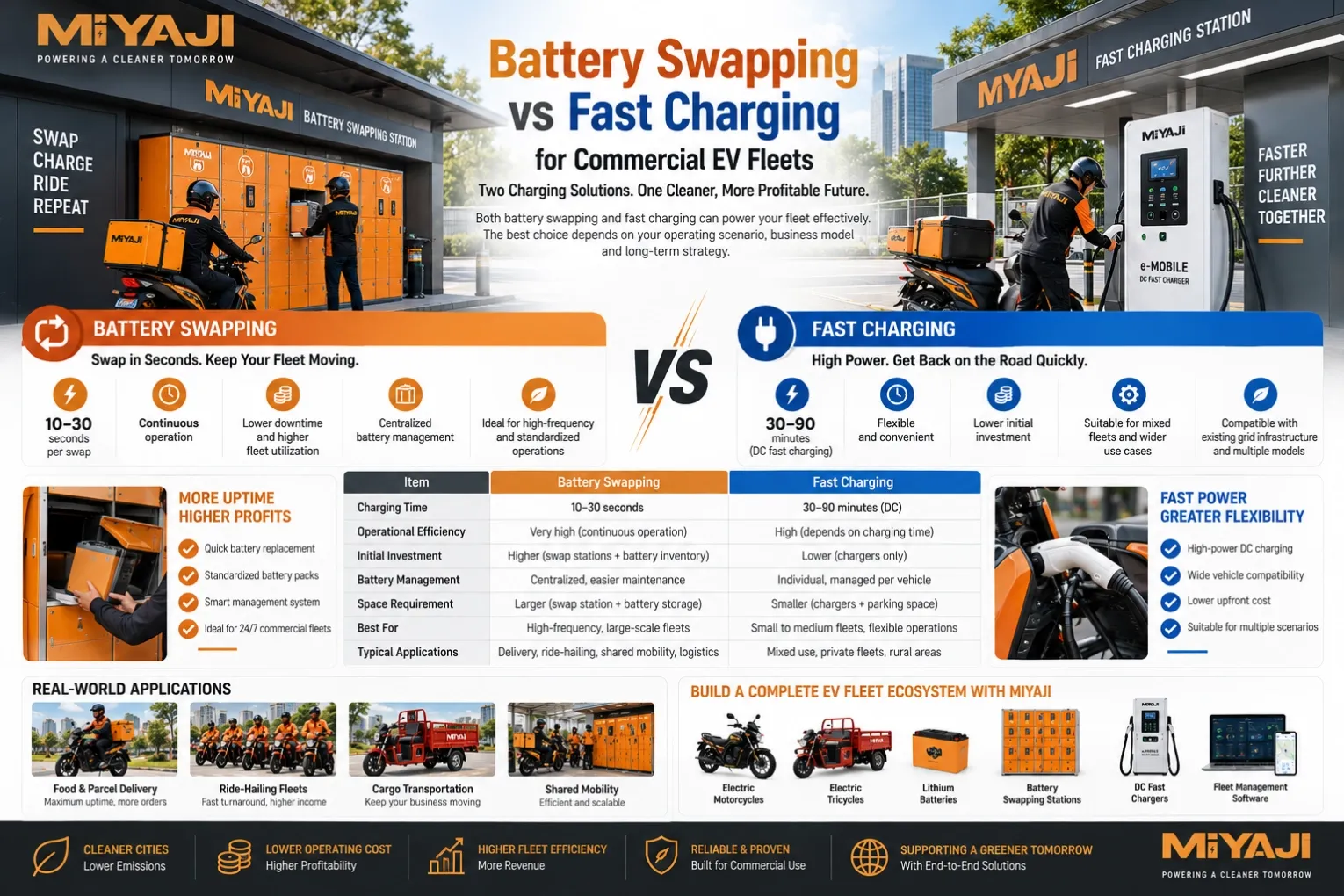
11. Fixed Battery vs Swappable Battery
Commercial tricycles can use different battery architectures.
Fixed Battery
Advantages may include:
- Larger battery capacity
- Simpler mechanical packaging
- Less manual battery handling
Swappable Battery
Advantages can include:
- Reduced vehicle energy-replenishment downtime
- Centralized battery management
- Flexible fleet operations
But battery weight becomes an important factor.
Large tricycle batteries may not always be practical for manual swapping.
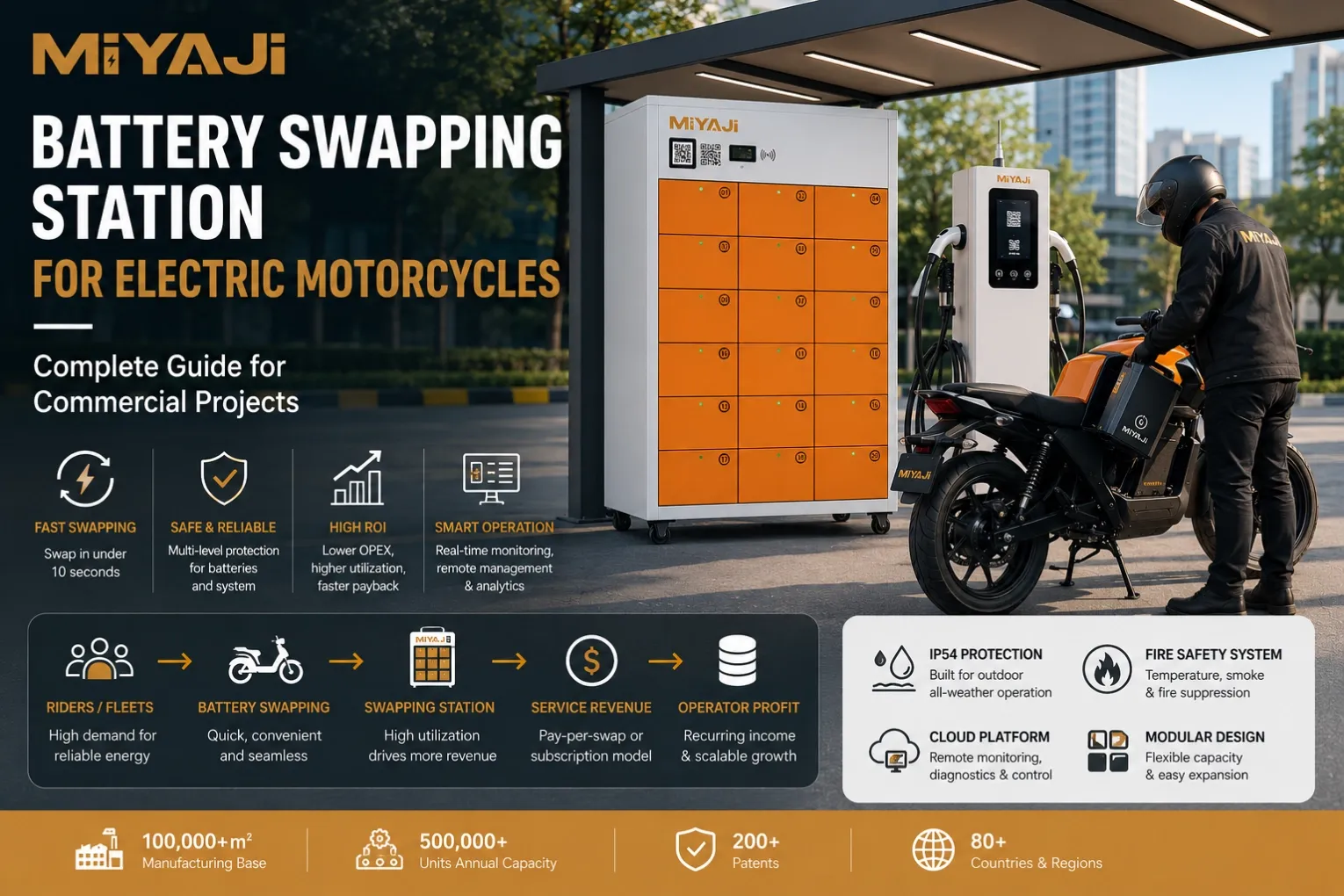
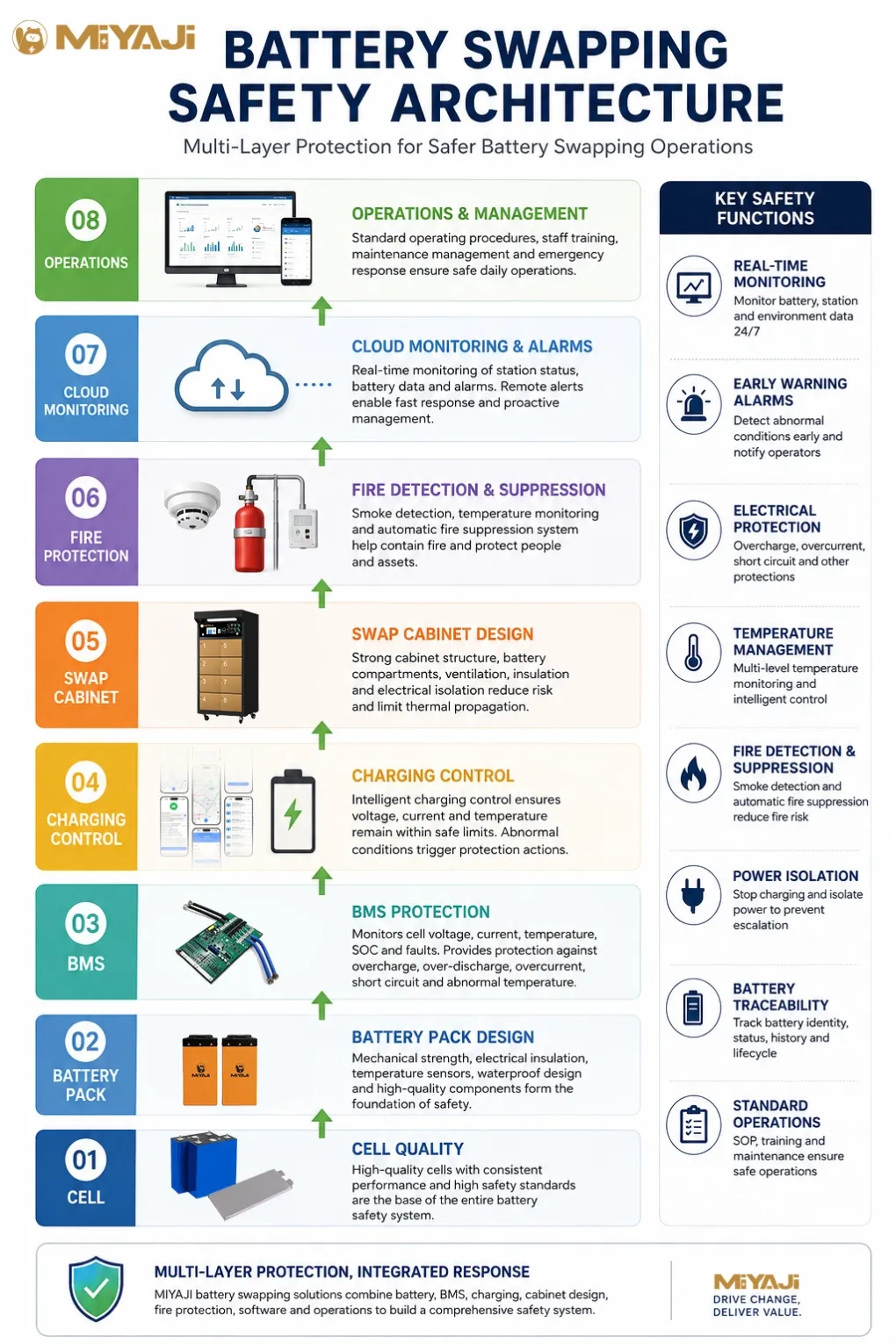
12. Battery Swapping for Electric Tricycles
If swapping is required, the system must consider:
- Battery module size
- Battery weight
- Number of modules
- Mechanical interface
- Connector
- BMS
- Swap station
- Charging system
One possible architecture is to use multiple standardized battery modules rather than one very large removable battery.
The appropriate design depends on the vehicle.
13. Fast Charging for Electric Tricycles
Fast charging can be useful when:
- Vehicles operate long hours
- Battery capacity is large
- Operators need shorter charging stops
- Electrical infrastructure is available
But fast charging requires compatible:
Cells
PACK
BMS
Connector
Charger
and appropriate thermal design.
A high-power charger alone does not make a battery fast-charge capable.
14. Should You Choose Swapping or Fast Charging?
Ask:
How long can the vehicle stop?
If long natural breaks exist, conventional charging may be sufficient.
Does the vehicle operate continuously?
Fast charging or swapping may become more attractive.
Is the battery too heavy to swap manually?
Fast charging may be easier.
Can the battery be divided into standardized modules?
Swapping may become more practical.
Is grid capacity available?
Charging infrastructure must match local site conditions.
There is no universal answer.
15. Range: Don't Buy Based on the Brochure Number
A range claim without test conditions is difficult to evaluate.
Ask the supplier:
- What speed?
- What payload?
- What temperature?
- What route?
- What battery?
- What SOC window?
- What test method?
A passenger tricycle tested with only a driver will not necessarily achieve the same range when fully loaded.
16. Calculate Range From Energy Consumption
A better preliminary model is:
Range ≈ Usable Battery Energy ÷ Average Wh/km
For example, suppose a hypothetical cargo tricycle has:
8 kWh usable energy
and consumes:
80 Wh/km
under a particular loaded route.
Then:
8,000 ÷ 80 = 100 km
This is only an illustrative calculation.
Actual consumption must be validated on the real vehicle.
17. Frame and Chassis
Commercial tricycles carry significantly more load than many two-wheel vehicles.
Buyers should evaluate:
- Frame design
- Welding
- Material specification
- Rear structure
- Mounting points
- Corrosion protection
For fleet procurement, durability matters more than appearance alone.
18. Suspension
Suspension should match:
- Vehicle weight
- Passenger/cargo load
- Road conditions
- Operating speed
A poorly matched suspension can affect:
- Comfort
- Stability
- Tire wear
- Component durability
This is especially important for high-frequency commercial operations.
19. Braking System
A loaded cargo tricycle carries more kinetic energy than the same vehicle when empty.
Braking performance should therefore be evaluated under realistic vehicle loading.
Consider:
- Front brakes
- Rear brakes
- Parking brake
- Brake maintenance
- Replacement parts
The exact braking system should be matched to the vehicle architecture and local requirements.
20. Tires and Wheels
Commercial tires should be evaluated for:
- Load rating
- Durability
- Availability
- Replacement cost
For overseas fleet projects, local tire availability can matter.
A technically excellent tire that is difficult to replace locally can create operational problems.
21. Ground Clearance
Ground clearance requirements depend on the target operating environment.
Some applications operate mainly on:
- Paved urban roads
Others may include:
- Uneven roads
- Construction areas
- Industrial zones
- Rural routes
More ground clearance is not always automatically better because vehicle stability and center of gravity must also be considered.
22. Weather Protection
Passenger and cargo applications may require different weather protection.
Passenger vehicles may need:
- Roof
- Windshield
- Side protection
- Wipers where applicable
Cargo vehicles may require:
- Enclosed cargo box
- Waterproof covering
- Sealed electrical components
The correct configuration depends on climate and operation.
23. Driver Ergonomics
Commercial drivers may spend many hours per day in the vehicle.
Consider:
- Seat position
- Visibility
- Steering effort
- Pedal/control layout
- Cabin space
- Entry/exit
Poor ergonomics can reduce driver productivity and comfort.
24. Passenger Comfort
For passenger applications, commercial performance includes customer experience.
Important factors may include:
- Seat space
- Suspension
- Entry and exit
- Noise
- Cabin ventilation
- Weather protection
Passenger comfort can influence whether a mobility service is commercially attractive.
25. Cargo Loading Efficiency
For delivery operations, loading and unloading time matters.
Consider:
- Cargo-floor height
- Rear access
- Side access
- Door opening
- Box dimensions
- Loading equipment
A vehicle that saves several minutes per delivery cycle can improve fleet productivity.
26. Maintenance and Serviceability
A commercial vehicle should be easy to maintain.
Buyers should ask:
- Are common wear parts easy to replace?
- Are diagnostic tools required?
- Can local technicians be trained?
- Are spare parts standardized?
- How quickly can components be supplied?
Maintenance complexity can affect fleet uptime.
27. Spare Parts
Before buying a fleet, establish a spare-parts plan.
Typical categories may include:
Wear Parts
Tires, brakes and related consumables.
Electrical Parts
Controllers, displays, wiring and sensors.
Body Parts
Lights, panels and cabin components.
Powertrain Parts
Motor and drivetrain components.
The exact spare-parts package should match the fleet and service environment.
28. Software and Connectivity
Commercial electric tricycles can also benefit from connected fleet systems.
Depending on the project, software may monitor:
- Vehicle location
- Mileage
- Battery SOC
- Battery SOH
- Faults
- Charging
- Driver activity
For larger fleets, this can help operators manage vehicles as assets rather than isolated units.
29. Calculate Electric Tricycle TCO
The correct commercial comparison is not:
Electric Tricycle Price
alone.
Consider:
TCO = Vehicle + Battery + Energy + Maintenance + Spare Parts + Downtime + Infrastructure + Financing − Residual Value
A more useful KPI is:
Cost per km
or for some cargo applications:
Cost per delivery
For passenger operations, operators may also evaluate:
Cost per passenger-kilometer
depending on the business model.
Passenger Tricycle Economics
Passenger operators should evaluate:
Vehicle Utilization
×
Trips per Day
×
Average Passenger Revenue
against:
Energy
-
Maintenance
-
Battery
-
Driver
-
Financing
-
Downtime
This connects the vehicle directly to business economics.
Cargo Tricycle Economics
Cargo fleets can evaluate:
- Deliveries per day
- Kilometers per delivery
- Cargo utilization
- Energy cost
- Maintenance cost
- Driver productivity
The objective is not simply to electrify the vehicle.
The objective is to improve the economics of commercial transport.
30. Passenger vs Cargo: Decision Framework
Choose a Passenger Electric Tricycle when the primary business is:
- Taxi
- Shuttle
- Passenger mobility
- Tourism
- Community transport
Prioritize:
Passenger Capacity + Comfort + Uptime + Range + Safety
Choose a Cargo Electric Tricycle when the primary business is:
- Delivery
- Logistics
- Retail distribution
- Warehouse transport
- Utility work
Prioritize:
Payload + Cargo Volume + Durability + Loading Efficiency + Operating Cost
31. Should You Buy CBU or CKD Electric Tricycles?
For initial market entry, CBU can provide:
- Faster deployment
- Simpler quality control
- Lower local manufacturing complexity
As volume grows, SKD or CKD may become relevant.
Potential reasons include:
- Logistics
- Local assembly
- Local-content requirements
- Import structure
- Market customization
But CKD also requires:
- Assembly equipment
- Factory space
- Training
- Quality control
- Inventory
Therefore the decision should be based on project economics.
32. Local Battery PACK Assembly
Larger projects may also consider localizing battery PACK production.
This can create a progression such as:
CBU Vehicle
↓
SKD / CKD Vehicle Assembly
↓
Local Battery PACK Assembly
↓
Higher Local Content
But battery PACK assembly requires its own:
- Equipment
- Processes
- Testing
- Quality control
- Safety management
It should not be treated as simply another vehicle-assembly workstation.
33. Start With a Pilot
Before deploying hundreds or thousands of electric tricycles, test them in the actual operating environment.
A pilot should measure:
Vehicle
- Energy consumption
- Payload performance
- Range
- Braking
- Reliability
Battery
- SOC usage
- Charging behavior
- Temperature
- Daily cycling
Operation
- Trips per day
- Downtime
- Loading time
- Driver feedback
Economics
- Cost per km
- Maintenance
- Energy cost
- Productivity
Use the data to finalize the commercial configuration.
Electric Tricycle Procurement Checklist
Before requesting a quotation, prepare:
Category | Information Needed |
|---|---|
Application | Passenger / Cargo |
Market | Country / City |
Fleet Size | Initial + Future |
Daily Mileage | km/day |
Operating Hours | hours/day |
Payload | Typical + Maximum |
Passengers | Required seating |
Route | Urban / Rural / Mixed |
Gradient | Actual operating requirement |
Speed | Required commercial speed |
Battery | Fixed / Swappable |
Charging | Standard / Fast / Swap |
Cargo Body | Flatbed / Box / Enclosed / Other |
Software | GPS / Fleet / Battery Management |
Supply | CBU / SKD / CKD |
Localization | Vehicle / Battery PACK |
This gives the manufacturer enough information to configure the vehicle properly.
How MIYAJI Approaches Commercial Electric Tricycle Projects
MIYAJI approaches electric tricycles as part of a complete commercial mobility system.
Depending on the application, a project can combine:
Passenger or Cargo Electric Tricycles
-
Lithium Battery Systems
-
Battery Cells & BMS
-
Fast Charging
-
Battery Swapping
-
Energy Management Software
-
OEM / CKD & Local Production
Vehicle configuration can be developed around:
- Passenger or cargo application
- Payload
- Daily mileage
- Operating environment
- Battery strategy
- Energy infrastructure
- Local production requirements
The objective is not simply to select the largest battery or motor.
It is to configure a vehicle that fits the commercial operation.
Planning an Electric Tricycle Project?
Tell us:
Passenger or Cargo
Target Market
Required Quantity
Daily Mileage
Passenger / Payload Requirement
Motor Requirement
Route Conditions
Battery Preference
Charging / Swapping Strategy
Cargo Body Requirement
CBU / CKD Requirement
From these inputs, the project can be evaluated across:
Vehicle
→ Battery
→ Energy
→ Software
→ TCO
→ Local Production
Discuss Your Electric Tricycle Project
Frequently Asked Questions
What is the difference between a passenger and cargo electric tricycle?
Passenger electric tricycles are designed primarily for transporting people, while cargo models prioritize goods transportation, payload and cargo-body configuration.
How do I choose an electric tricycle?
Start with the application, payload or passenger requirement, daily mileage, operating hours and route. Then select the motor, battery, charging strategy and body configuration.
What battery capacity does an electric tricycle need?
There is no universal capacity. Battery energy should be calculated according to vehicle consumption, required distance between charging or swapping, payload and operating conditions.
Is LFP or NMC better for an electric tricycle?
Both can be used. LFP can be attractive for frequent commercial cycling and where battery space is available, while NMC may be useful when higher energy density or lower battery weight is important.
Can an electric tricycle use battery swapping?
Yes, if the vehicle and battery architecture are designed for swapping. Battery weight, module size, connectors, BMS and swap-station compatibility must be considered.
Can electric tricycles use fast charging?
Yes, when the battery cells, PACK, BMS, connector and charger are designed to support the required charging rate.
How far can an electric tricycle travel?
Range depends on battery energy, vehicle efficiency, payload, speed, route, temperature and operating conditions. A fixed range cannot be determined from battery Ah alone.
What is the best electric tricycle for cargo delivery?
The best configuration depends on cargo weight and volume, route, daily mileage, loading method and energy strategy rather than a single universal model.
Should I buy CBU or CKD electric tricycles?
CBU can be suitable for initial deployment, while SKD or CKD may become relevant for larger projects or markets pursuing local assembly.
Can MIYAJI customize electric tricycles?
Commercial tricycle projects can be configured around passenger or cargo requirements, battery systems, charging or swapping, software and localization requirements depending on the project scope.