Sep 2, 2026Product & Industry Knowledge
Electric Motorcycle Assembly Line: Equipment, Process & Factory Planning Guide
Learn how to plan an electric motorcycle assembly line, including production processes, equipment, battery PACK assembly, testing, quality control and factory capacity.
Electric Motorcycle Assembly Line: Equipment, Process & Factory Planning Guide
As electric motorcycle markets expand, some distributors, fleet operators and local investors begin considering a different question:
Should we establish local electric motorcycle assembly capacity?
For a small market or pilot project, importing complete vehicles may be the simplest option.
But when annual demand grows, local assembly can become strategically valuable.
A professional electric motorcycle assembly project requires more than a row of workstations.
It involves:
- Vehicle architecture
- BOM management
- Assembly processes
- Production equipment
- Battery systems
- Testing
- Quality control
- Spare parts
- Workforce
- Factory layout
- Production capacity
This guide explains the key elements of an electric motorcycle assembly line and how to plan a scalable production project.
What Is an Electric Motorcycle Assembly Line?
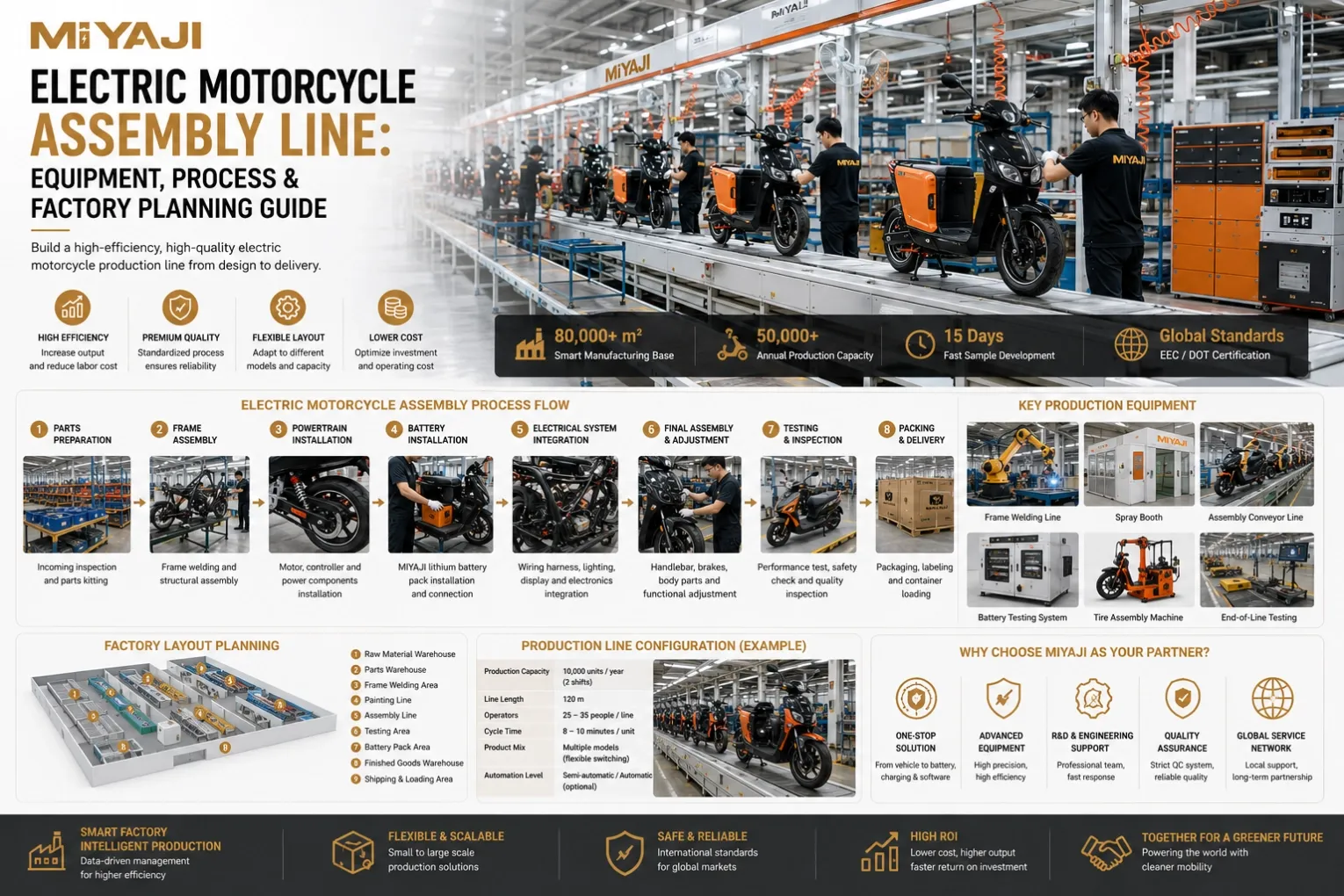
An electric motorcycle assembly line is a structured production system in which vehicle components are progressively assembled, tested and inspected until the completed vehicle is ready for delivery.
A simplified process can look like:
Incoming Components
↓
Frame Preparation
↓
Chassis Assembly
↓
Motor & Drivetrain
↓
Electrical System
↓
Brake & Suspension
↓
Body Assembly
↓
Battery Installation
↓
Electrical Testing
↓
Road / Functional Testing
↓
Final Inspection
↓
Finished Vehicle
The actual process varies according to vehicle design and production strategy.
What Is the Difference Between an Assembly Line and a Manufacturing Factory?
This distinction is important.
An assembly line focuses on putting components together.
A broader manufacturing factory may include:
- Component production
- Welding
- Painting
- Plastic parts
- Battery PACK
- Vehicle assembly
- Testing
- Warehousing
- Quality control
Therefore, a customer does not necessarily need to manufacture every component locally.
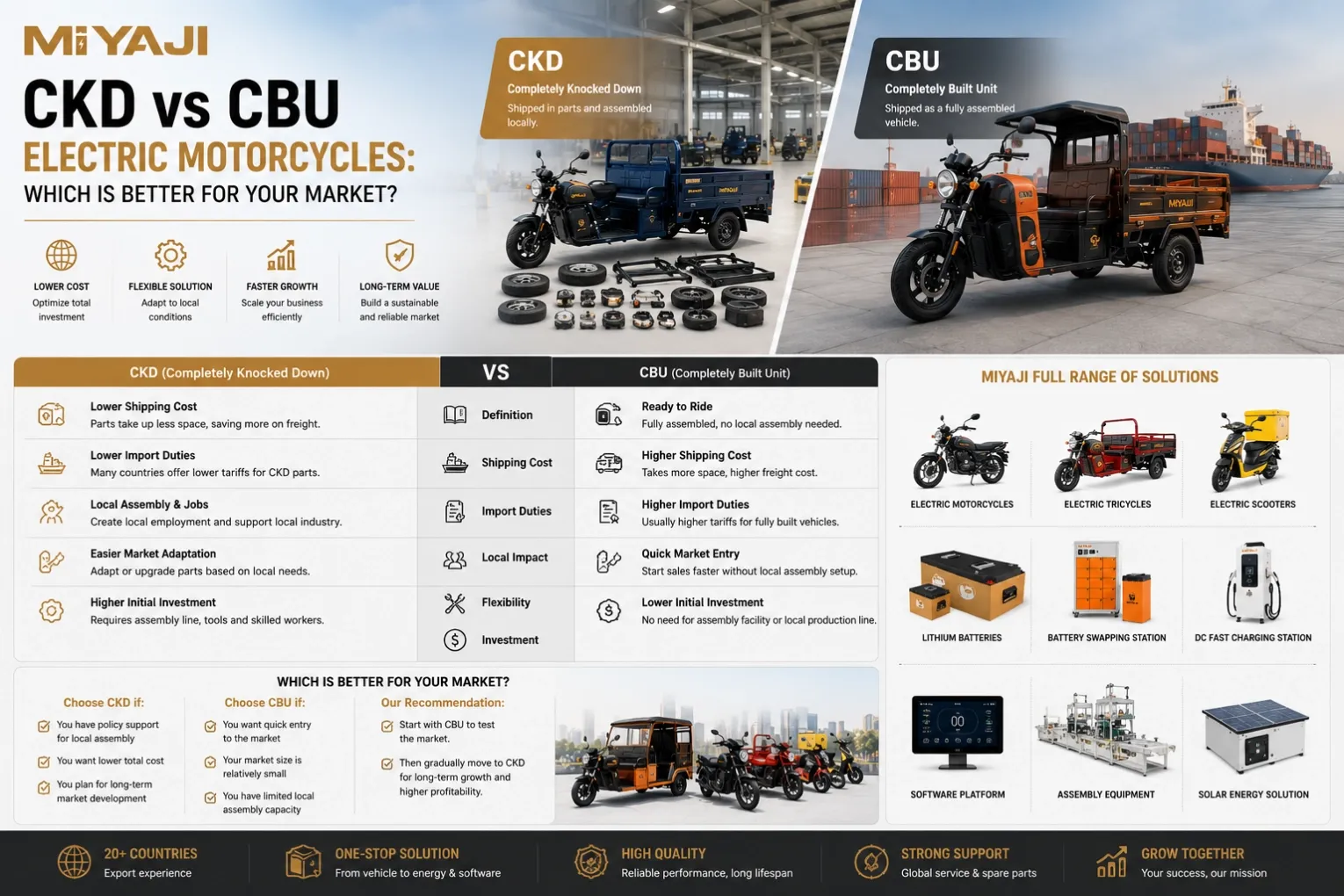
A practical project may begin with:
CKD Components + Local Assembly
and gradually increase local manufacturing content.
The Main Areas of an Electric Motorcycle Factory
A basic assembly project may contain several functional areas.
1. Incoming Material Warehouse
Components arrive and are inspected before entering production.
Typical materials include:
- Frames
- Motors
- Controllers
- Wheels
- Tires
- Suspension
- Brakes
- Wiring harnesses
- Body panels
- Batteries
- Chargers
- Fasteners
Good warehouse organization is essential because one missing component can stop an entire assembly station.
2. Incoming Quality Control
Before components enter production, they should be checked against defined specifications.
Inspection may include:
- Quantity
- Dimensions
- Appearance
- Electrical parameters
- Part numbers
- Packaging condition
Critical components should receive appropriate inspection based on their function and risk.
3. Frame Preparation
The frame is the foundation of the motorcycle.
Depending on the CKD structure, frame preparation may include:
- Inspection
- Cleaning
- Surface inspection
- Identification
- Initial component installation
If welding or painting is performed locally, the facility requirements become significantly more complex.
4. Chassis Assembly
The chassis gradually takes shape.
Typical operations may include:
- Front fork installation
- Rear suspension
- Wheels
- Tires
- Brake components
- Stands
- Steering components
Torque control is important for safety-critical fasteners.
5. Motor Installation
Electric motorcycles commonly use:
- Hub motors
- Mid-drive motors
The motor installation process must consider:
- Mounting
- Alignment
- Fastening
- Cable routing
- Connector protection
The correct process depends on the vehicle architecture.
6. Controller Installation
The controller is a critical electrical component.
Installation typically involves:
- Mounting
- Connector connection
- Cable routing
- Protection
- Inspection
The controller must be compatible with:
- Motor
- Battery voltage
- BMS
- Vehicle electrical architecture
7. Wiring Harness Installation
Electrical systems require careful routing.
A typical vehicle may contain wiring for:
- Motor
- Controller
- Battery
- Lights
- Display
- Throttle
- Brake sensors
- GPS
- Communication
- Other accessories
Poor wiring installation can lead to:
- Intermittent faults
- Connector damage
- Water ingress
- Electrical failures
Therefore wiring inspection should be part of the production process.
8. Brake and Suspension Assembly
Braking and suspension systems are important safety-related systems.
Assembly procedures should define:
- Component position
- Fastening
- Torque
- Brake adjustment
- Functional inspection
End-of-line testing should verify the completed system.
9. Body Assembly
Body components may include:
- Front panels
- Side panels
- Rear panels
- Seat
- Mudguards
- Cargo structures
For commercial motorcycles and tricycles, the body configuration may vary depending on the application.
10. Battery Installation
The battery is one of the most important components in an electric motorcycle.
The production process should verify:
- Battery model
- Voltage
- Capacity
- Connector
- BMS communication
- Mounting
- Cable routing
- Protection
The battery should only be installed after confirming that it matches the vehicle configuration.
Battery PACK Assembly Is a Separate Production Process
One of the most important points for investors planning an EV factory is:
Vehicle assembly and battery PACK assembly are not the same process.
A battery PACK production area may require processes such as:
Cell Incoming Inspection
↓
Cell Sorting / Grading
↓
Cell Arrangement
↓
Welding
↓
BMS Installation
↓
PACK Assembly
↓
Electrical Testing
↓
Insulation / Safety Testing
↓
Aging
↓
Final Inspection
The exact process depends on cell format, chemistry, PACK architecture and production requirements.
Why Cell Grading Matters
Battery cells used in the same PACK need appropriate consistency.
Depending on the battery design, production may involve:
- Voltage checking
- Capacity testing
- Internal resistance measurement
- Cell grouping
Proper cell matching can help create more consistent battery performance.
This is particularly important for commercial fleets where batteries may experience intensive daily use.
BMS Installation
The BMS is responsible for battery monitoring and protection functions.
Depending on the system, it may monitor:
- Voltage
- Current
- Temperature
- State of Charge
- Battery protection conditions
For connected commercial EV systems, the battery system may also communicate with vehicle or cloud software.
This becomes especially relevant when the project includes:
Fleet Management
Battery Swapping
or
Remote Battery Monitoring
Battery Testing and Aging
Battery production should include appropriate testing and quality-control procedures.
Depending on the PACK design, testing may include:
- Voltage
- Current
- Communication
- Protection functions
- Insulation
- Temperature
- Charge/discharge performance
Aging procedures can help identify abnormal battery behavior before shipment or deployment.
For high-volume projects, aging capacity and testing throughput should be considered during factory planning.
Electric Motorcycle Assembly Equipment
The exact equipment depends on production volume and automation level.
A basic assembly project may require:
Assembly Tools
- Torque tools
- Electric screwdrivers
- Hand tools
- Lifting equipment
Electrical Testing
- Multimeters
- Power supplies
- Diagnostic equipment
- Communication testers
Vehicle Testing
- Brake testing
- Lighting inspection
- Electrical functional testing
- Road or roller testing
Battery Production
Depending on the battery scope:
- Cell testing equipment
- Sorting / grading equipment
- Welding equipment
- BMS testing
- PACK testing
- Aging equipment
Manual vs Semi-Automated vs Automated Production
Not every factory needs full automation.
Manual Assembly
Suitable for:
- Small production volumes
- Pilot projects
- Market validation
- Flexible production
Advantages:
- Lower initial investment
- Flexible
- Easier to modify
Disadvantages:
- Higher labor dependency
- Lower consistency if process control is weak
Semi-Automated Assembly
A combination of:
Manual Assembly
-
Specialized Equipment
can provide a balance between investment and production efficiency.
This is often practical for medium-scale projects.
Highly Automated Production
Higher automation can involve:
- Automated material handling
- Specialized assembly equipment
- Production monitoring
- Automated testing
It can improve consistency and throughput but requires significantly greater investment and technical capability.
How Much Factory Space Is Required?
There is no universal factory size.
Required space depends on:
- Annual production
- Number of shifts
- Vehicle size
- Assembly method
- Warehouse inventory
- Battery production
- Testing
- Office area
- Finished vehicle storage
For example, a facility designed for:
1,000 units/year
will have completely different requirements from one designed for:
50,000 units/year.
Therefore factory planning should begin with:
Target production capacity
rather than:
How many square meters do we need?
Production Capacity Is More Than Assembly Speed
Suppose an assembly line can theoretically produce:
100 vehicles/day
That does not necessarily mean the factory can produce:
30,000 vehicles/year.
Real capacity depends on:
- Working days
- Shifts
- Line balance
- Component availability
- Labor
- Equipment uptime
- Quality rejects
- Maintenance
- Logistics
A more realistic planning model should consider effective production capacity rather than theoretical line speed.
What Is Line Balancing?
Line balancing means distributing production tasks across workstations so that one station does not become a major bottleneck.
For example:
Station 1: 5 minutes
Station 2: 6 minutes
Station 3: 15 minutes
Station 4: 5 minutes
Station 3 may become the bottleneck.
A good assembly-line design attempts to balance the workload across stations.
Quality Control Should Be Built Into the Line
Quality should not exist only at the end of production.
A stronger approach is:
Incoming QC
↓
Process QC
↓
Assembly QC
↓
Electrical Testing
↓
Battery Testing
↓
End-of-Line Testing
↓
Final Inspection
This allows problems to be identified earlier.
End-of-Line Testing
Before a vehicle leaves the factory, final testing may include:
- Vehicle power-on
- Display
- Lights
- Horn
- Throttle
- Brake sensors
- Motor operation
- Charging
- Battery communication
- Controller communication
Additional testing may be required depending on the vehicle.
Traceability Is Important for Commercial Fleets
For larger projects, each vehicle should ideally have an identifiable production record.
This can connect:
Vehicle VIN / Serial Number
with:
Battery
BMS
Motor
Controller
Production Date
QC Results
Software Version
This can become extremely valuable later for:
- Warranty
- Maintenance
- Recall
- Battery tracking
- Fleet management
Software Can Become Part of the Factory System
This is where a modern EV factory differs from a traditional motorcycle assembly operation.
Software can potentially connect:
Vehicle
→
Battery
→
BMS
→
Charging
→
Swap Station
→
Fleet Platform
This creates a digital layer across the physical manufacturing and energy system.
For a commercial EV project, the software architecture should therefore be considered early rather than added as an afterthought.
Battery Swapping Requires Additional Factory Considerations
If vehicles will operate with battery swapping, the production system should ensure compatibility between:
- Vehicle battery compartment
- Battery PACK
- BMS
- Swap cabinet
- Communication system
- Charging system
This means the vehicle and energy infrastructure should be designed as a coordinated system.
Fast Charging Requires Battery-System Compatibility
Similarly, fast charging is not simply a matter of installing a high-power charger.
The complete system needs to consider:
- Battery chemistry
- Cell specifications
- BMS
- Charging voltage
- Charging current
- Thermal management
- Charger communication
Therefore fast charging should be designed together with the battery system.
A Factory Can Be Built in Stages
A new market does not necessarily need to establish every production capability from Day One.
A possible roadmap is:
Stage 1
CBU Vehicle Import
Market validation.
↓
Stage 2
SKD Assembly
Establish local assembly capability.
↓
Stage 3
CKD Assembly
Increase local production.
↓
Stage 4
Battery PACK Assembly
Add localized battery production.
↓
Stage 5
Deeper Localization
Gradually increase local component content.
This allows factory investment to follow actual market demand.
What Equipment Should Be Purchased First?
The answer depends on production scope.
A common mistake is purchasing equipment before defining:
- Vehicle BOM
- Production volume
- Battery architecture
- Factory layout
- Assembly process
The correct sequence is:
Define Product
↓
Define BOM
↓
Define Production Capacity
↓
Define Process
↓
Design Factory Layout
↓
Select Equipment
↓
Train Workers
↓
Validate Production
This reduces the risk of buying equipment that is unnecessary or incompatible with the actual production process.
Building a Battery + Vehicle Production System
For a more integrated commercial EV project, the factory can eventually contain several production areas:
Vehicle Assembly
Electric motorcycles and tricycles.
Battery PACK
Battery assembly and testing.
Quality & Testing
Vehicle and battery testing.
Spare Parts
After-sales inventory.
Charging / Swapping
Energy infrastructure.
Software
Fleet and energy management.
This creates an integrated production and operating ecosystem.
What Does a Complete Factory Project Need?
A professional project assessment should consider:
Product
BOM
Annual Capacity
Factory Space
Assembly Process
Equipment
Battery System
Testing
Quality Control
Warehouse
Manpower
Training
Software
Spare Parts
Production Management
Local Regulations
Without these elements, simply purchasing an assembly line does not create a successful factory.
MIYAJI's Approach to Local Manufacturing
MIYAJI supports commercial electric mobility projects across different levels of localization.
Depending on the market and project requirements, the solution can include:
Electric Motorcycle & Tricycle Platforms
-
Lithium Battery Systems
-
BMS
-
Battery PACK Solutions
-
Charging Systems
-
Battery Swapping
-
Energy Management Software
-
Assembly & Testing Equipment
-
Technical Support
For customers planning local assembly or manufacturing, the production system can be designed around the required:
- Vehicle models
- Battery configuration
- Production capacity
- Assembly scope
- Testing requirements
- Localization target
The goal is not to sell a standard factory package.
It is to build a production structure that matches the customer's market and long-term business plan.
Planning an Electric Motorcycle Assembly Plant?
Before requesting an assembly-line quotation, prepare the following information:
Market
- Target country
- Expected market demand
- Local regulations
Product
- Motorcycle type
- Motor specification
- Battery voltage
- Battery capacity
- Vehicle configuration
Production
- Initial volume
- Annual target
- 3–5 year production forecast
- Number of shifts
Localization
- CBU
- SKD
- CKD
- Battery PACK
- Additional local components
Factory
- Available space
- Electricity supply
- Labor availability
- Warehouse capacity
Equipment
- Assembly equipment
- Battery equipment
- Testing equipment
- Quality-control equipment
With this information, an assembly project can be planned around actual production requirements rather than a generic factory template.
Frequently Asked Questions
How much does it cost to build an electric motorcycle assembly line?
There is no single standard price. Cost depends on production capacity, automation level, factory scope, testing requirements, battery PACK production and localization level.
What equipment is needed for an electric motorcycle assembly line?
Equipment may include assembly tools, torque equipment, electrical testing equipment, vehicle testing equipment and, when battery production is included, cell testing, welding, PACK testing and aging equipment.
Can electric motorcycles be assembled locally?
Yes. Depending on the project, vehicles can be supplied as SKD or CKD kits for local assembly.
Does CKD include the battery?
It can, but the exact supply scope must be defined in the BOM and technical agreement.
Can battery PACK assembly be established together with vehicle assembly?
Yes, but battery PACK production requires its own equipment, processes, testing and safety controls.
How much factory space is needed?
Factory space depends on production capacity, vehicle design, warehouse requirements, battery production, testing and production layout. It should be calculated after defining the production target.
Should a new factory use automation?
Not necessarily. Manual or semi-automated production may be more appropriate for smaller volumes, while higher-volume operations may justify greater automation.
Can an assembly line be expanded later?
A well-designed factory can be planned for phased expansion, allowing production capacity and localization to increase as market demand grows.
Can MIYAJI support factory setup?
MIYAJI can structure commercial EV projects around vehicle supply, battery systems, charging and swapping, software, assembly and testing requirements, depending on the project's scope.