Aug 28, 2026Product & Industry Knowledge
Battery Swapping vs Fast Charging for Commercial EV Fleets: Which Is Better?
Compare battery swapping vs fast charging for commercial EV fleets, including downtime, infrastructure, battery management and ideal use cases.
Battery Swapping vs Fast Charging for Commercial EV Fleets: Which Is Better?
For a commercial electric vehicle fleet, choosing between battery swapping and fast charging is not simply a question of which technology is faster.
The right energy replenishment strategy depends on how the fleet actually operates: daily mileage, operating hours, acceptable downtime, battery configuration, available grid capacity, site conditions and future fleet scale.
For a delivery fleet operating throughout the day, even a relatively short charging stop can affect vehicle utilization. For a fleet that returns to a depot for predictable periods, however, installing a charging system may be simpler than building a battery swapping network.
That is why there is no universal winner in the battery swapping vs fast charging debate.
The better question is:
Which solution fits your fleet's operating model?
Battery Swapping vs Fast Charging: Key Differences at a Glance
Factor | Battery Swapping | Fast Charging |
|---|---|---|
Vehicle downtime | Very low when charged batteries are available | Depends on battery and charging power |
Battery model | Often supports vehicle-battery separation | Battery normally remains with vehicle |
Infrastructure | Swap station + battery inventory + software | Charger + parking/charging area + electrical infrastructure |
Spare batteries | Required | Normally not required |
Standardization | High importance | Lower dependence on physical battery standardization |
Software requirements | High for networked operations | Moderate to high depending on fleet scale |
Fleet scalability | Strong for standardized, high-utilization fleets | Flexible for many fleet sizes |
Typical advantage | Maximum vehicle availability | Simpler energy infrastructure |
Suitable scenarios | High-frequency, multi-shift operations | Fleets with predictable charging windows |
Neither column should automatically be interpreted as “better.”
Each model solves a different operational problem.
How Battery Swapping Works for Commercial EV Fleets
A battery swapping system separates energy replenishment time from battery charging time.
Instead of waiting for the battery installed in the vehicle to recharge, the rider or operator removes the depleted battery and replaces it with another charged battery.
The depleted battery is then charged inside the station and returned to circulation.
A commercial battery swapping system therefore normally involves more than a cabinet. Depending on the project, the system may include:
- Commercial electric motorcycles or tricycles
- Standardized swappable batteries
- Battery Management Systems (BMS)
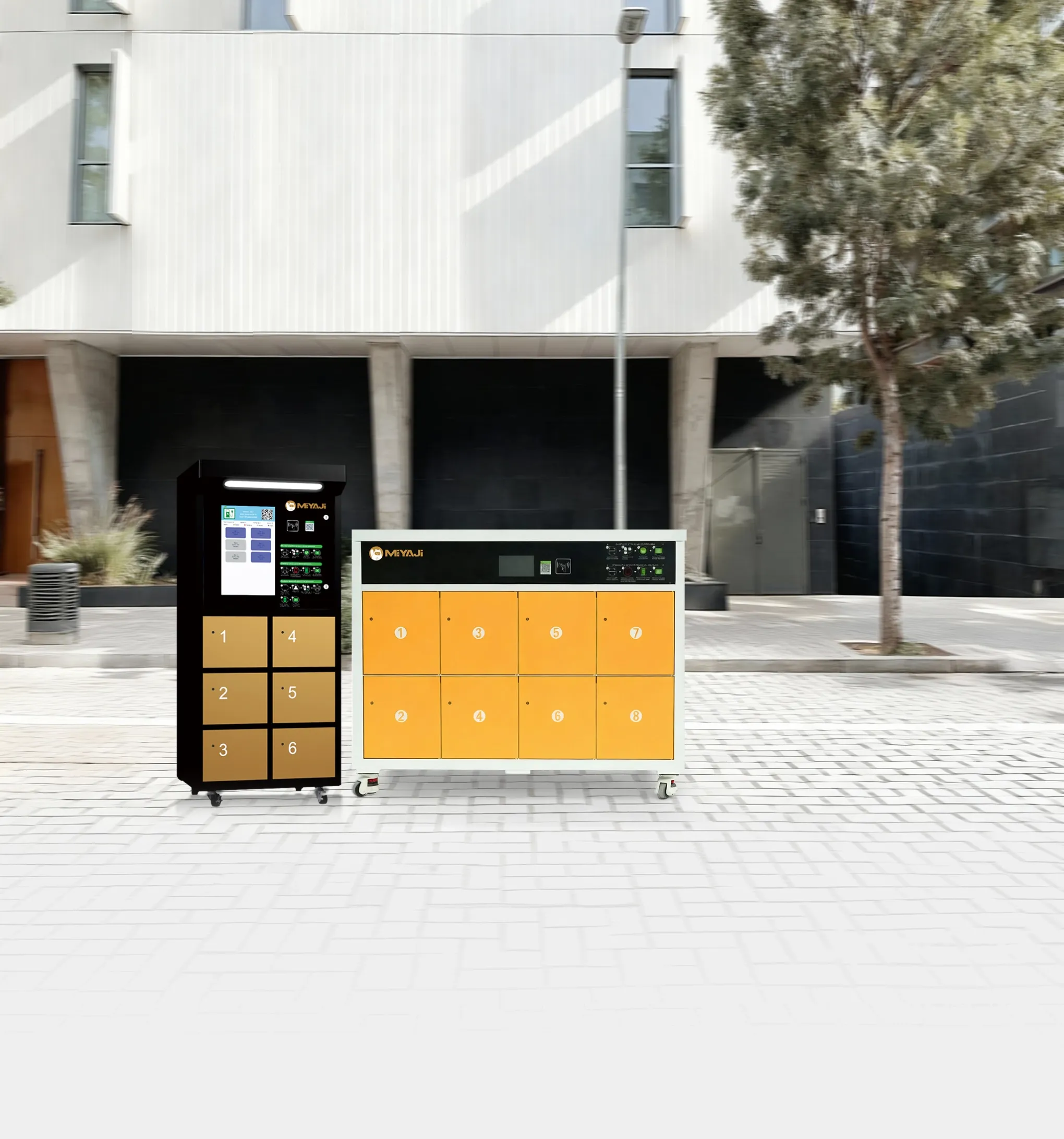
- Battery swap stations
- Charging modules
- Communication and IoT hardware
- Cloud management software
- User or rider identification
- Battery asset management
- Payment or subscription functions
Modern battery-swapping platforms can monitor batteries, stations, inventory and operational activity centrally, making software an important part of larger networks.
For the vehicle operator, however, the experience is much simpler:
Arrive → return depleted battery → receive charged battery → continue operating.
The primary advantage is therefore not that the battery itself charges faster.
It is that the vehicle does not have to wait for the battery to charge.
How Fast Charging Works for Electric Motorcycle Fleets
Fast charging takes a different approach.
The battery remains in or with the vehicle and receives higher charging power to reduce the time required to restore usable energy.
A typical commercial system may include:
Vehicle → Battery/BMS → Fast Charger → Charging Management → Return to Operation
Fast charging avoids the need to maintain a separate pool of replacement batteries and can simplify operations where vehicles already have predictable parking periods.
However, charging performance cannot be evaluated from charger power alone.
The actual charging time depends on factors including:
- Battery chemistry
- Cell characteristics
- Battery capacity
- BMS limits
- Charging protocol
- Thermal conditions
- State of charge
- Vehicle and battery design
Therefore, installing a higher-power charger does not automatically mean every electric motorcycle or battery can safely accept that power.
The vehicle, battery, BMS and charger must be designed as a compatible system.
1. Vehicle Downtime
For commercial fleets, downtime is often one of the most important differences between battery swapping and fast charging.
A private vehicle may remain parked for hours without affecting its economic value.
A commercial vehicle is different.
For delivery, passenger transport and other high-frequency operations:
Vehicle moving = productive asset
Vehicle waiting = unavailable asset
Battery swapping can significantly reduce the time the vehicle itself remains unavailable because battery charging happens separately from vehicle operation.
This is one reason battery swapping continues to be evaluated for high-utilization commercial fleets. For example, a Tokyo commercial EV program involving Mitsubishi Fuso, Mitsubishi Motors, Ample and Yamato Transport was designed around reducing charging downtime for delivery operations.
Fast charging can still work well when the fleet naturally has charging windows—for example:
- During driver breaks
- Between shifts
- During loading periods
- At a depot
- Overnight
- During scheduled vehicle idle time
So the real metric is not simply charging minutes.
It is:
How much productive operating time does the fleet lose?
2. Infrastructure and Initial Investment
The cost comparison between swapping and fast charging is more complicated than comparing the price of a swap cabinet with the price of a charger.
A battery swapping project may require:
- Swap station hardware
- Additional battery inventory
- Charging modules
- Software platform
- Communication systems
- Site preparation
- Electrical connection
- Installation
- Battery maintenance and replacement
- Operational support
A fast-charging project may require:
- Fast chargers
- Compatible batteries
- Electrical distribution
- Site preparation
- Parking or charging positions
- Installation
- Possible electrical capacity upgrades
- Charging management software
This is why statements such as:
“Battery swapping is always cheaper.”
or:
“Fast charging always requires less investment.”
are too simplistic.
The correct comparison is Total Cost of Ownership (TCO) over the expected operating period.
For a high-utilization fleet, additional battery inventory may be justified if it keeps vehicles productive for longer each day.
For another fleet with long natural parking periods, the additional infrastructure and battery inventory required for swapping may not provide enough operational benefit.
3. Battery Requirements and Lifecycle Management
Battery swapping changes the role of the battery.
In a conventional charging model, the battery is typically associated with one vehicle.
In a swapping network, batteries become shared operational assets circulating between vehicles and stations.
That makes battery management especially important.
Operators may need visibility into:
- State of Charge (SOC)
- State of Health (SOH)
- Battery temperature
- Voltage
- Charging status
- Cycle history
- Fault conditions
- Battery ID
- Station location
- Battery availability
Connected battery-management systems can help operators monitor battery condition and usage across a fleet. Battery health monitoring has also been explored commercially as part of Battery-as-a-Service models for fleet electrification.
This means a successful swapping project is not simply:
Vehicle + removable battery + cabinet.
It is an asset-management system.
4. Fleet Size and Daily Mileage
Fleet size alone should not determine whether you choose fast charging or battery swapping.
A better starting point is the combination of:
Fleet size × daily mileage × operating hours × energy consumption × acceptable downtime
Consider two hypothetical fleets.
Fleet A
50 electric motorcycles
Moderate daily mileage
Vehicles return to the depot every evening
Long overnight parking window
A charging-based solution may be perfectly practical.
Fleet B
50 electric motorcycles
High daily mileage
Multiple shifts
Vehicles need to remain active throughout the day
Very low tolerance for charging downtime
Battery swapping becomes much more attractive.
The number of vehicles is identical.
The operating model is not.
This distinction becomes even more important as fleets scale.
5. Grid Capacity and Site Conditions
Energy infrastructure should always be evaluated before choosing a replenishment model.
Important factors include:
- Available electrical capacity
- Local electricity reliability
- Peak demand
- Transformer capacity
- Site size
- Parking availability
- Electricity tariff structure
- Future fleet expansion
Battery swapping does not eliminate electricity demand.
The batteries still need to be charged.
What changes is where, when and how charging takes place.
Because batteries can be charged while other batteries are in use, operators may have greater flexibility in scheduling charging loads. Some commercial swapping systems are specifically designed around managing charging separately from vehicle availability.
Fast charging, meanwhile, can be very effective where sufficient electrical capacity is available and vehicles can be charged during predictable idle periods.
Therefore, infrastructure decisions should be based on the actual project location, not broad assumptions about a country or region.
6. Software and Fleet Management
This is one of the most overlooked differences between a small charging installation and a commercial battery swapping network.
Once an operator manages multiple:
Vehicles + batteries + stations + riders + transactions
software becomes increasingly important.
A battery swapping management platform may provide:
- Battery identification
- SOC and SOH monitoring
- Station status
- Slot availability
- Charging status
- Fault alarms
- Rider/user management
- Battery inventory
- Subscription management
- Payment management
- Asset tracking
- Usage reports
- Operational analytics
Commercial EV software platforms increasingly combine charging, swapping, fleet and energy-management functions rather than treating each device independently.
This becomes especially important when expanding from:
1 station → 10 stations → 100 stations
because the challenge changes from operating hardware to managing a network.
When Does Battery Swapping Make More Sense?
Battery swapping is particularly worth evaluating when a project has several of the following characteristics:
- High daily vehicle mileage
- High-frequency commercial operation
- Multiple operating shifts
- Low tolerance for downtime
- Standardized vehicle and battery platforms
- Large or expanding fleets
- Centralized battery asset management
- Need for rapid energy replenishment
- Subscription or Battery-as-a-Service business models
Delivery motorcycles, commercial passenger motorcycles and other continuously operated light EV fleets can be strong candidates.
But swapping should not be selected simply because it is faster.
The operational value of the time saved must justify the additional batteries, infrastructure and system complexity.
When Does Fast Charging Make More Sense?
Fast charging may be more practical when:
- Vehicles have predictable parking periods
- Fleet utilization is moderate
- Overnight or depot charging is available
- Fleet size is relatively small
- Batteries support the required charging rate
- Electrical infrastructure can support the charging load
- The operator wants to minimize spare battery inventory
- Physical battery standardization is difficult
For some fleets, the simplest infrastructure that meets the required vehicle availability target is the best solution.
More technology is not automatically better.
Can a Fleet Use Both Fast Charging and Battery Swapping?
Yes.
Battery swapping and fast charging do not always have to compete.
A commercial fleet can potentially use a hybrid energy replenishment strategy.
For example:
Battery swapping
for high-frequency daytime operations.
Fast or depot charging
for backup, scheduled charging or specific operating locations.
Some battery platforms are already designed around multiple replenishment methods rather than a single charging model.
A hybrid model can provide flexibility, but it also requires careful battery, BMS, charger and software compatibility.
The objective should not be to install every available technology.
It should be to build the simplest system that reliably meets the fleet's operational requirements.
How to Choose the Right Solution for Your Fleet
Before selecting battery swapping, fast charging or a hybrid model, evaluate these eight questions:
- How many vehicles will operate?
- How many kilometers will each vehicle travel per day?
- How many hours per day must the vehicles remain available?
- How much downtime can the operation tolerate?
- What battery capacity and chemistry will the vehicles use?
- What electrical capacity is available at the operating site?
- Where will vehicles park, charge or swap batteries?
- How will the fleet scale over the next several years?
The decision process should therefore look more like:
Fleet Size → Daily Mileage → Operating Hours → Downtime → Battery → Grid → Site → Business Model → Energy Solution
rather than:
“Which charger should I buy?”
That is the difference between purchasing equipment and designing a commercial EV energy system.
How MIYAJI Supports Commercial EV Energy Deployment
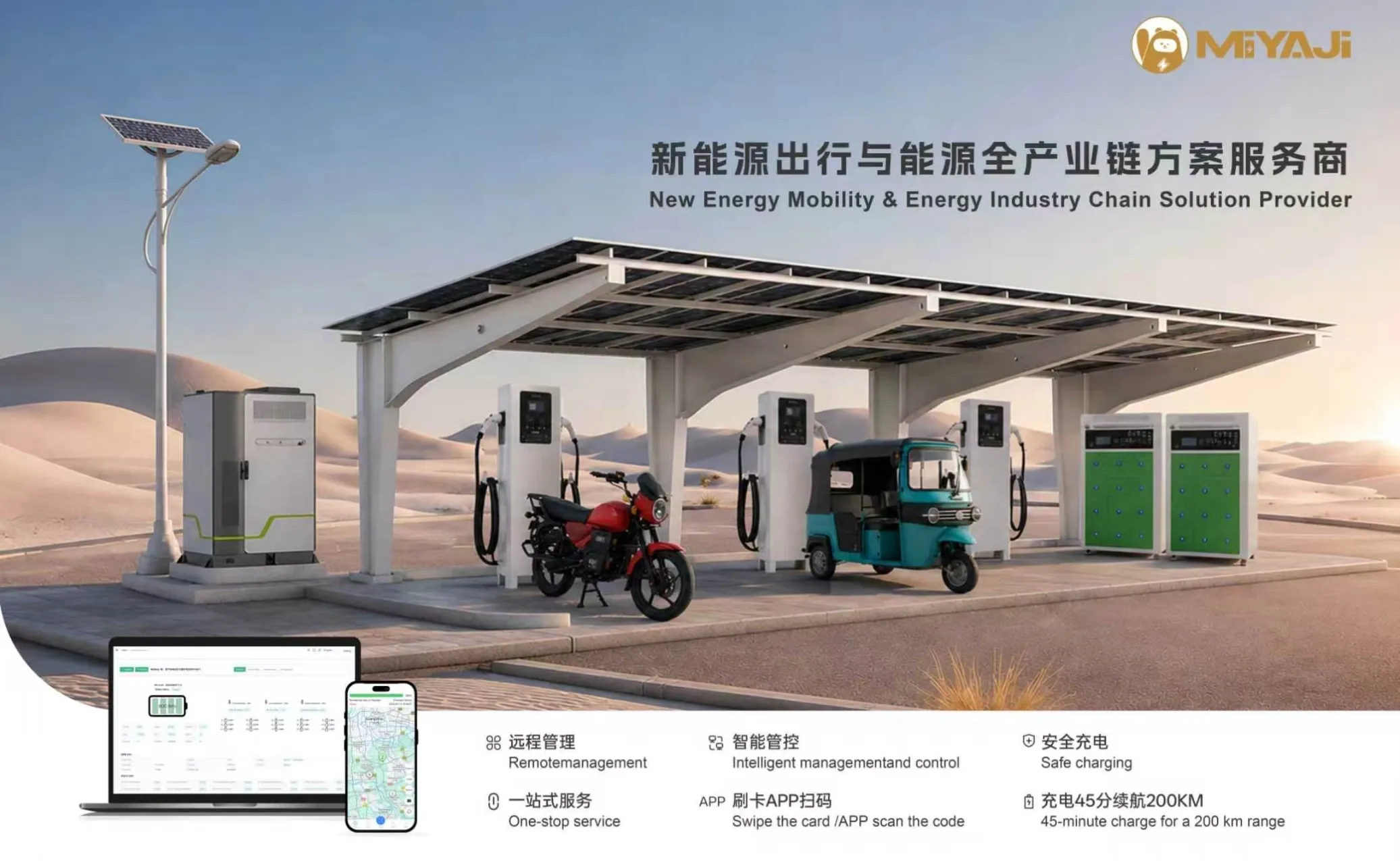
MIYAJI integrates commercial electric motorcycles and tricycles, lithium battery systems, fast-charging equipment, battery swapping systems and energy management software for commercial fleet applications.
Rather than treating the charger, battery or swap station as an isolated product, the project can be evaluated around the relationship between:
Vehicle → Battery → Charging / Swapping → Software → Fleet Operation
Depending on the operating model, the appropriate configuration may be fast charging, battery swapping or a combination of both.
For fleet operators, distributors and commercial EV project partners, this system-level approach helps ensure that the vehicle, battery and energy infrastructure are designed to work together.
Planning a Commercial EV Project?
Tell us your:
Target market · Fleet size · Daily mileage · Vehicle type · Operating hours · Charging conditions
and MIYAJI can help evaluate a suitable charging, swapping or hybrid energy configuration for the project.
CTA Button:
Discuss Your Project
Frequently Asked Questions
Is battery swapping faster than fast charging?
In terms of vehicle downtime, battery swapping can be significantly faster because the vehicle receives an already-charged battery instead of waiting for its existing battery to recharge. The actual advantage depends on station availability, battery inventory and system design.
Is battery swapping more expensive than fast charging?
Not necessarily. Battery swapping usually requires additional batteries, station hardware and management systems, while fast charging may require chargers, parking space and sufficient electrical capacity. The better comparison is total project cost and fleet utilization rather than equipment price alone.
How many batteries does a battery swapping fleet need?
There is no universal battery-to-vehicle ratio. It depends on daily mileage, battery capacity, charging time, swap frequency, peak demand, operating hours and reserve requirements. This deserves its own calculation rather than using a fixed industry number.
Can electric motorcycles support both fast charging and battery swapping?
Yes, if the battery, BMS, connectors, vehicle architecture and charging system are designed to support both methods. Compatibility must be considered during system design rather than added later.
Which is better for delivery fleets: battery swapping or fast charging?
Battery swapping can be attractive for high-mileage, multi-shift fleets with very low downtime tolerance. Fast charging may be simpler for fleets with predictable parking or charging windows. The operating model should determine the choice.