Sep 5, 2026Product & Industry Knowledge
How to Choose the Right Battery Cell for an EV Battery PACK
Learn how to choose the right lithium battery cell for an EV battery PACK based on chemistry, capacity, voltage, current, size, weight, cycle life and application requirements.
How to Choose the Right Battery Cell for an EV Battery PACK
Choosing a battery cell is one of the first decisions in battery PACK development.
However, selecting a cell should not start with:
“Which cell has the lowest price?”
or simply:
“Which cell has the highest capacity?”
The correct cell depends on the complete application.
For an electric motorcycle, electric tricycle or commercial EV, battery-cell selection should consider:
- Chemistry
- Capacity
- Voltage
- Current
- Energy density
- Dimensions
- Weight
- Cycle requirements
- Operating temperature
- Charging requirements
- PACK design
- Vehicle space
- Cost
- Supply stability
The right cell is the one that fits the entire battery system.
Start With the Vehicle, Not the Cell
One of the most common mistakes in battery procurement is choosing the cell first.
A better process is:
Vehicle
↓
Motor & Controller
↓
Operating Requirements
↓
Battery Voltage
↓
Required Energy
↓
Battery Space
↓
Cell Chemistry
↓
Cell Specification
↓
PACK Configuration
This prevents the battery from being selected independently from the vehicle.
Step 1: Define the Application
The first question is:
What will the battery be used for?
A battery for a private electric motorcycle may have very different requirements from one used for:
- Delivery fleets
- Commercial tricycles
- Taxi motorcycles
- Battery swapping
- Utility vehicles
- Energy storage
For commercial applications, you should also consider:
- Daily mileage
- Operating hours
- Payload
- Number of charging cycles
- Charging frequency
- Road conditions
Step 2: Choose the Battery Chemistry
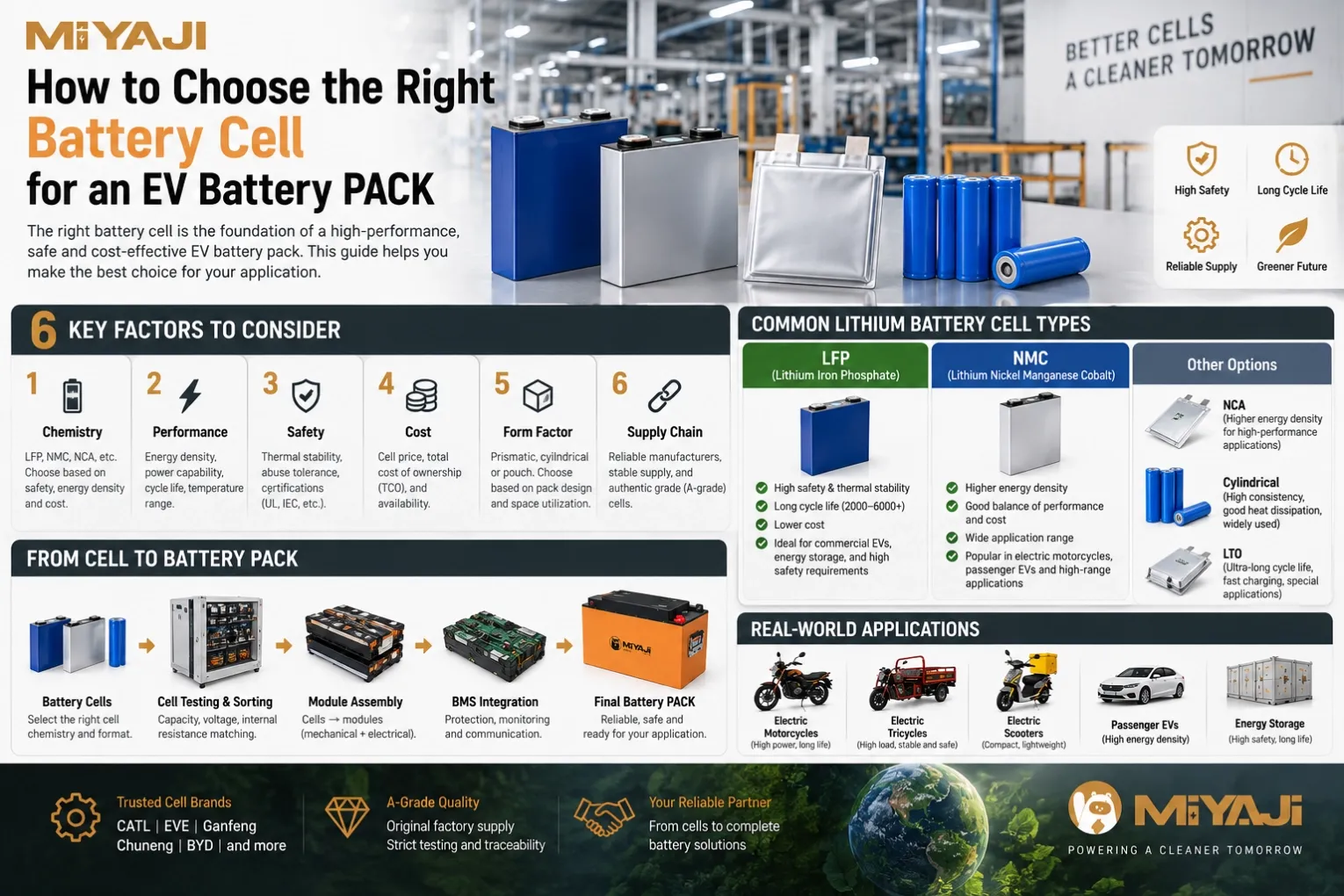
The two common chemistries discussed for commercial EV applications are:
LFP
and
NMC
LFP can be attractive where priorities include:
- Cycling
- Safety characteristics
- Durability
- Cost
NMC can be attractive where priorities include:
- Energy density
- Lower battery weight
- Limited installation space
The chemistry should be selected according to the vehicle's requirements.
For a deeper comparison, this article can internally link to:
LFP vs NMC Batteries for Electric Vehicles
Step 3: Determine the Battery Voltage
Battery voltage is determined by the vehicle's electrical architecture.
A simplified lithium-ion cell may have a nominal voltage around a few volts, while a vehicle battery may operate at much higher system voltage.
Therefore cells are connected in series to reach the required voltage.
For example:
More cells in series → Higher PACK voltage
The actual configuration depends on:
- Cell nominal voltage
- Motor
- Controller
- BMS
- Charger
- Vehicle architecture
Step 4: Determine Required Battery Capacity
Capacity is usually expressed in:
Ah — Ampere-hours
For example:
- 30Ah
- 50Ah
- 60Ah
- 100Ah
- 150Ah
- 200Ah
But Ah alone does not tell you how much energy the battery stores.
A more useful calculation is:
Energy ≈ Voltage × Capacity
For example, a nominal:
72V 100Ah
battery has approximately:
7.2 kWh
of nominal energy.
Actual usable energy will depend on the battery system, operating limits and conditions.
Ah Is Not the Same as kWh
This is an important distinction for buyers.
Two batteries can both be:
100Ah
but have completely different energy capacities if their voltages are different.
For example:
48V × 100Ah ≈ 4.8 kWh
while:
72V × 100Ah ≈ 7.2 kWh
Therefore when comparing battery cells or PACKs, don't look at Ah alone.
Always consider:
Voltage + Capacity + Usable Energy
Step 5: Estimate the Required Range
For an electric motorcycle or tricycle, battery capacity is closely related to range.
However, range is affected by many factors:
- Vehicle weight
- Rider weight
- Payload
- Motor efficiency
- Speed
- Road conditions
- Tire pressure
- Temperature
- Driving style
- Wind
- Regenerative braking
Therefore:
Battery capacity cannot directly guarantee a specific range.
A better approach is to estimate energy consumption under the actual operating conditions.
Energy Consumption Matters
Suppose a commercial vehicle consumes approximately:
50 Wh/km
A battery with approximately:
7.2 kWh
of nominal energy could theoretically provide around:
144 km
under simplified conditions.
But real-world usable range will differ.
This is why battery selection should use actual fleet operating data whenever possible.
Step 6: Check Maximum Current
Capacity is not enough.
The battery must also provide the required current.
A vehicle with a powerful motor may demand significantly more current during:
- Acceleration
- Hill climbing
- Heavy loading
- High-speed operation
Therefore the selected cell must support the required:
Continuous Current
and
Peak Current
within its specifications.
C-Rate and Battery Current
C-rate is commonly used to describe charging or discharging current relative to battery capacity.
For example, a:
100Ah
battery discharged at:
1C
would correspond to approximately:
100A
under the simplified definition.
At:
0.5C
the current would be approximately:
50A.
Actual allowable current depends on the cell manufacturer's specification.
Why Peak Current Matters
A vehicle may have a relatively modest average power requirement but much higher instantaneous demand.
For example, climbing a steep hill with cargo can create a temporary increase in:
- Motor power
- Battery current
- Battery temperature
Therefore the cell must be evaluated against the actual vehicle duty cycle rather than only average consumption.
Step 7: Check Cell Dimensions
A cell may have excellent electrical performance but still be unsuitable because it does not physically fit the battery.
Important dimensions include:
- Length
- Width
- Height
- Terminal position
The PACK designer must also consider:
- Insulation
- Cooling
- Mechanical support
- Busbars
- BMS
- Wiring
Therefore:
A battery cell must fit both electrically and mechanically.
Step 8: Consider Cell Weight
Battery weight is particularly important for motorcycles.
A heavier battery can affect:
- Vehicle handling
- Payload
- Acceleration
- Energy consumption
- Suspension
- Range
For commercial tricycles, however, the effect may be different because the vehicle can often accommodate a larger battery.
This is another reason the same cell cannot be considered “best” for every vehicle.
Step 9: Cell Format
Lithium battery cells are available in different physical formats.
Common formats include:
Cylindrical Cells
Advantages may include:
- Mature manufacturing ecosystem
- Standardized formats
- Flexible PACK design
Prismatic Cells
Advantages may include:
- High capacity per cell
- Fewer cells in a PACK
- Compact PACK architecture
Pouch Cells
Advantages may include:
- Flexible form factor
- Potentially high packaging efficiency
Each format has different mechanical and manufacturing considerations.
The best format depends on the PACK design.
Step 10: Cell Capacity
Different cell capacities can be appropriate for different applications.
For example, commercial battery projects may use cells in ranges such as:
- 30Ah
- 40Ah
- 50Ah
- 60Ah
- 80Ah
- 100Ah
- 120Ah
- 150Ah
- 160Ah
- 200Ah
- 230Ah
- 280Ah
- 314Ah
The number itself is not the deciding factor.
A larger Ah rating does not automatically mean a better cell.
Why Bigger Capacity Is Not Always Better
A higher-capacity cell can reduce the number of cells required.
That can potentially simplify:
- Connections
- PACK assembly
- BMS architecture
- Mechanical design
But larger cells may also create challenges involving:
- Weight
- Packaging
- Current requirements
- Thermal behavior
- Availability
Therefore cell capacity should be selected based on the PACK architecture.
Step 11: Energy Density
Energy density can be expressed based on:
Weight
or
Volume
Higher energy density can help when the battery has strict weight or packaging constraints.
For motorcycles, this can be particularly important.
For large commercial tricycles, energy density may be less important than:
- Cost
- Cycle life
- Durability
- Availability
Step 12: Cycle Life
For commercial fleets, cycle life can have a major impact on economics.
A fleet vehicle may operate:
300+ days per year
and experience frequent charging.
Therefore the battery may accumulate many cycles during its service life.
When comparing cells, always ask:
Under what test conditions was the cycle-life figure measured?
A cycle-life number without test conditions is difficult to compare meaningfully.
Cycle Life Depends on Operating Conditions
Battery aging can be affected by:
- Depth of discharge
- Charging current
- Discharging current
- Temperature
- State-of-charge window
- Rest periods
Therefore:
A laboratory cycle-life number is not automatically equal to real-world vehicle life.
Step 13: Charging Requirements
The selected cell must be compatible with the charging strategy.
Consider:
- Standard charging
- Fast charging
- Battery swapping
- Overnight charging
- Opportunity charging
Fast charging can require closer evaluation of:
- Maximum charging current
- Cell temperature
- BMS limits
- Charger compatibility
Battery Cells for Fast Charging
A cell should not be labeled “fast charging” simply because the PACK uses a powerful charger.
The complete system must support the charging strategy.
The chain is:
Cell
→
PACK
→
BMS
→
Charger
→
Vehicle
All parts must be compatible.
Step 14: Battery Swapping Requirements
For a battery-swapping vehicle, physical compatibility becomes especially important.
The battery needs to match:
- Battery compartment
- Mechanical lock
- Electrical connector
- BMS communication
- Swap cabinet
- Charger
Therefore swap batteries should be designed as part of the complete ecosystem.
A cell that works well in a conventional battery may not necessarily be suitable for a standardized swap battery.
Step 15: Operating Temperature
Temperature affects lithium battery performance.
When selecting cells for international markets, consider the target climate.
For example:
Hot Climate
Evaluate:
- High ambient temperature
- Charging temperature
- Thermal management
- Battery enclosure
Cold Climate
Evaluate:
- Low-temperature discharge
- Low-temperature charging
- Heating requirements
- Available capacity
This is particularly important when selling commercial EV systems internationally.
Step 16: Cell Consistency
For battery PACK production, consistency is extremely important.
Important parameters can include:
- Capacity
- Voltage
- Internal resistance
- Self-discharge behavior
Cells with appropriate consistency are easier to integrate into a stable PACK.
This is why cell grading and matching are important production steps.
Step 17: Traceability
When purchasing cells for commercial battery production, traceability should be considered.
A professional supply chain should ideally allow the buyer to identify:
- Cell manufacturer
- Cell model
- Production batch
- Production date
- Test information
This becomes particularly useful for:
- Warranty
- Quality control
- Batch management
- Failure analysis
Step 18: Certifications and Compliance
The required documentation depends on:
- Cell type
- Battery type
- Transport method
- Destination market
- Application
Depending on the project, buyers may need to consider documentation and testing related to:
- Transportation
- Battery safety
- Product compliance
- Environmental requirements
Requirements should be confirmed according to the destination country and final application.
Step 19: Supply Stability
This is often overlooked.
Imagine a cell is technically excellent but:
- Supply is unstable
- Lead time is unpredictable
- MOQ is too high
- Production batches change frequently
This can create serious problems for a commercial EV project.
For fleet production, the buyer should consider:
Technical Performance
-
Supply Stability
-
Cost
-
Quality Consistency
Step 20: Total Battery Cost
The cheapest cell does not necessarily produce the cheapest battery.
The complete cost can include:
Cell
-
BMS
-
Busbars
-
Enclosure
-
Welding
-
Assembly
-
Testing
-
Aging
-
Packaging
-
Logistics
Therefore buyers should compare the complete PACK cost rather than only the cell price.
How to Select a Battery Cell by Application
Electric Motorcycle
Priorities may include:
- Weight
- Energy density
- Compact dimensions
- Current capability
- Range
Depending on the application, both LFP and NMC can be considered.
Commercial Electric Tricycle
Priorities may include:
- Capacity
- Cycle life
- Cost
- Payload
- Daily operating hours
- Durability
LFP can be attractive for many commercial tricycle applications.
Delivery Fleet
Priorities may include:
- High daily mileage
- Frequent cycling
- Reliability
- Battery availability
- TCO
Cell selection should be based on the actual fleet duty cycle.
Battery-Swapping Fleet
Priorities may include:
- Standardized dimensions
- Weight
- Cycle life
- Charging capability
- BMS communication
- Swap compatibility
The cell must be selected together with the swap-battery architecture.
A Simple Battery Cell Selection Checklist
Before purchasing a cell, answer these questions:
Application
What vehicle or equipment will use the battery?
Voltage
What battery voltage is required?
Capacity
How much usable energy is required?
Current
What continuous and peak current is required?
Size
What battery space is available?
Weight
What is the maximum battery weight?
Chemistry
LFP or NMC?
Cycle Life
How many cycles are expected?
Charging
Standard, fast charging or swapping?
Environment
What temperature and operating conditions apply?
Supply
Can the cell be supplied consistently?
Compliance
What documentation is required for the destination market?
Example: Selecting a Cell for a 72V Commercial EV
Imagine a commercial vehicle requires approximately:
72V
and:
100Ah
The target nominal energy is approximately:
7.2 kWh
Now the engineer needs to work backward.
First:
72V system
↓
Determine series configuration based on the selected cell.
Then:
100Ah target
↓
Determine the parallel configuration.
Then evaluate:
- Cell dimensions
- Maximum current
- Cycle requirements
- BMS
- Charger
- PACK enclosure
Only after these steps can the final cell configuration be confirmed.
Why Battery Cell Selection Should Be Customized
A standard:
72V 100Ah
battery may work for one vehicle but not another.
Two vehicles may both use 72V 100Ah batteries while having completely different:
- Motors
- Controllers
- Payloads
- Daily mileage
- Battery compartments
- Charging requirements
Therefore battery specifications should always be evaluated in context.
Cell Supplier vs Battery Manufacturer
A cell supplier provides the fundamental energy-storage component.
A battery manufacturer integrates cells into a complete system.
A complete battery solution may therefore involve:
Cell Supplier
→
Cell Grading
→
PACK Manufacturing
→
BMS
→
Testing
→
Vehicle Integration
For commercial customers, having support across multiple stages can simplify battery development.
How MIYAJI Supports Battery Cell Selection
MIYAJI's battery business covers different levels of commercial battery requirements.
Depending on the project, customers can source:
LFP Cells
NMC Cells
BMS
Battery PACKs
Battery Components
or develop a more complete battery system around a specific vehicle application.
The objective is not simply to match a customer with a cell model.
The objective is to identify the cell and battery architecture that fits:
Vehicle
Duty Cycle
Operating Environment
Charging Strategy
and
Commercial Target
From Cell Selection to Battery PACK
The complete process can be summarized as:
Application
↓
Vehicle Requirements
↓
Battery Voltage
↓
Energy Requirement
↓
Chemistry
↓
Cell Selection
↓
Series / Parallel Configuration
↓
BMS
↓
PACK Design
↓
Testing
↓
Vehicle Integration
This is the foundation of a reliable commercial battery system.
Final Takeaway
The best battery cell is not necessarily:
- The largest cell
- The cheapest cell
- The highest-energy-density cell
- The cell with the highest cycle-life claim
The best cell is the one that matches the complete application.
For commercial EV projects, buyers should evaluate:
Chemistry
Capacity
Voltage
Current
Size
Weight
Cycle Life
Temperature
Charging
Supply Stability
Compliance
and ultimately:
Total Cost of Ownership
Need Help Selecting Battery Cells?
If you are developing an electric motorcycle, electric tricycle, commercial EV or battery PACK project, prepare your:
- Required voltage
- Capacity
- Motor power
- Daily mileage
- Battery dimensions
- Maximum battery weight
- Charging method
- Operating temperature
- Expected annual volume
These parameters can be used to identify a suitable cell and PACK configuration.
Talk to MIYAJI About Your Battery Requirements
FAQ
How do I choose the right battery cell?
Start with the vehicle and application requirements, then determine voltage, energy, current, size, weight, chemistry and cycle requirements before selecting a specific cell.
Which battery cell is best for electric motorcycles?
There is no universal best cell. The appropriate choice depends on range, battery space, weight, current demand, chemistry and operating conditions.
What battery cell capacity should I choose?
Capacity should be calculated from the required battery energy and vehicle operating conditions rather than selected simply by Ah rating.
Is a higher Ah battery better?
Not necessarily. Higher capacity can provide more energy but may increase battery size, weight and cost.
What is more important, Ah or kWh?
For comparing the amount of stored energy, kWh is generally more informative because it accounts for both voltage and capacity.
How many battery cells are needed for a 72V battery?
The number depends on the nominal voltage of the selected cell and the required battery configuration.
Can the same cell be used for motorcycles and tricycles?
Potentially, but the required PACK configuration can be different because the vehicles may have different power, space, payload and operating requirements.
How do I choose between LFP and NMC cells?
Consider energy density, weight, cycle requirements, cost, safety characteristics, available space, operating environment and the specific cell's performance data.
Can MIYAJI supply individual battery cells?
MIYAJI can support commercial battery projects with battery-cell sourcing as well as BMS, PACK and related battery-system requirements, depending on project specifications.