Sep 4, 2026Product & Industry Knowledge
Lithium Battery PACK Assembly: Process, BMS, Testing & Quality Control
Learn how lithium battery PACK assembly works, from cell grading and matching to welding, BMS installation, testing, aging and final quality control.
Lithium Battery PACK Assembly: Process, BMS, Testing & Quality Control
A lithium battery cell is only the starting point of a complete battery system.
For an electric motorcycle, electric tricycle, energy storage system or other commercial EV application, individual cells must be integrated into a complete battery PACK.
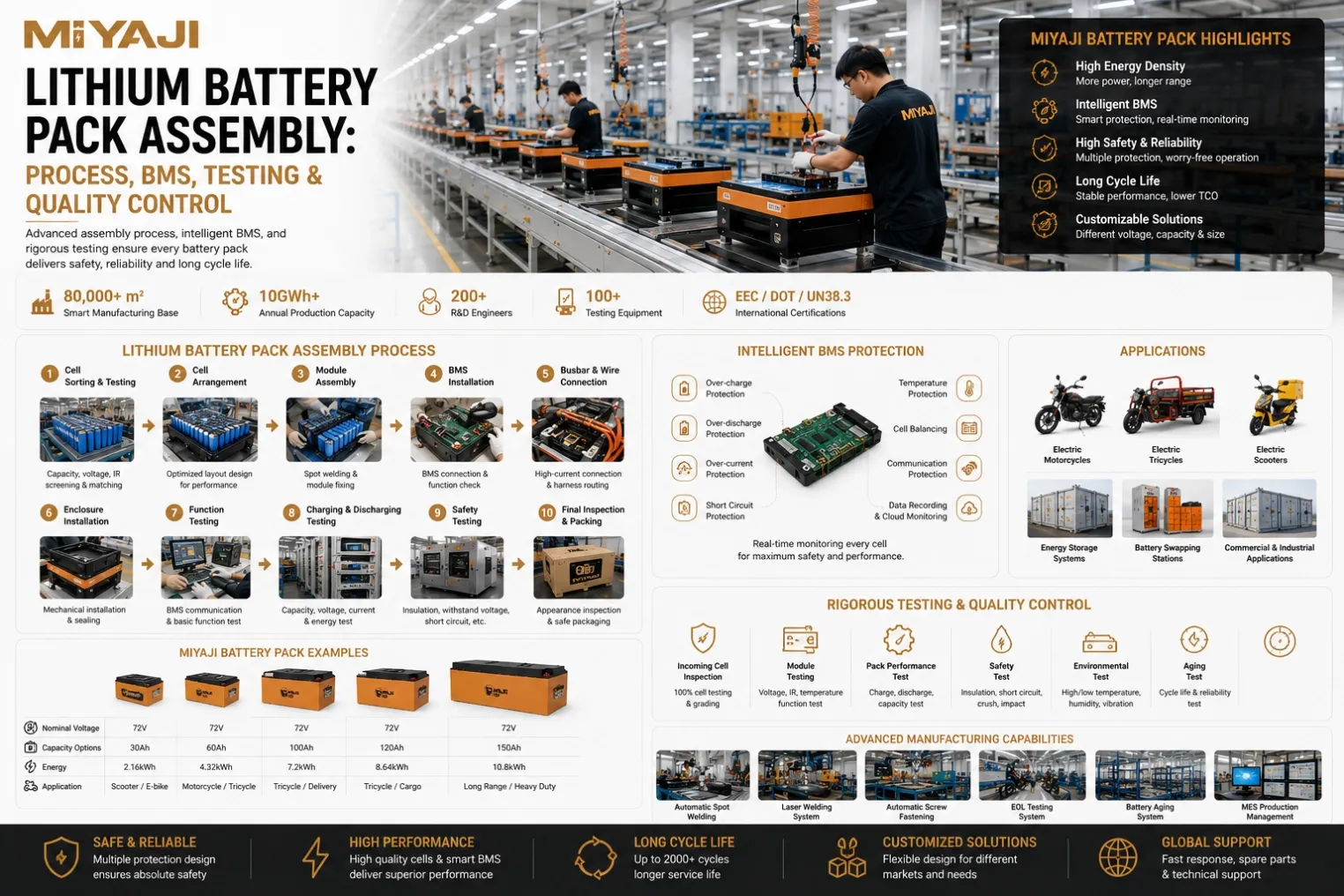
A typical battery production chain can be understood as:
Battery Cells
↓
Cell Inspection & Grading
↓
Cell Matching
↓
PACK Design
↓
Electrical Connection
↓
BMS Installation
↓
Mechanical Assembly
↓
Electrical Testing
↓
Safety Testing
↓
Aging
↓
Final Inspection
↓
Finished Battery PACK
The quality of every stage can influence the reliability, performance and service life of the final battery.
What Is a Lithium Battery PACK?
A battery PACK is an integrated battery system made from multiple individual cells together with electrical, mechanical and protection components.
A typical PACK may contain:
- Lithium-ion cells
- Busbars or nickel connections
- BMS
- Wiring harness
- Connectors
- Fuse or protection components
- Enclosure
- Insulation materials
- Mechanical supports
- Thermal management components where required
The exact architecture depends on the application.
An electric motorcycle battery PACK, for example, may have very different requirements from a stationary energy-storage PACK.
Cell → Module → PACK
Battery terminology can sometimes become confusing.
A simplified structure is:
Cell
↓
Module
↓
PACK
However, not every battery architecture uses a separate module stage.
Some PACK designs integrate cells directly into the PACK structure.
Therefore the actual manufacturing process depends on:
- Cell format
- Cell chemistry
- Voltage
- Capacity
- PACK architecture
- Application
- Mechanical design
- Thermal requirements
Why Battery Cells Matter
The individual cell is the fundamental energy-storage unit.
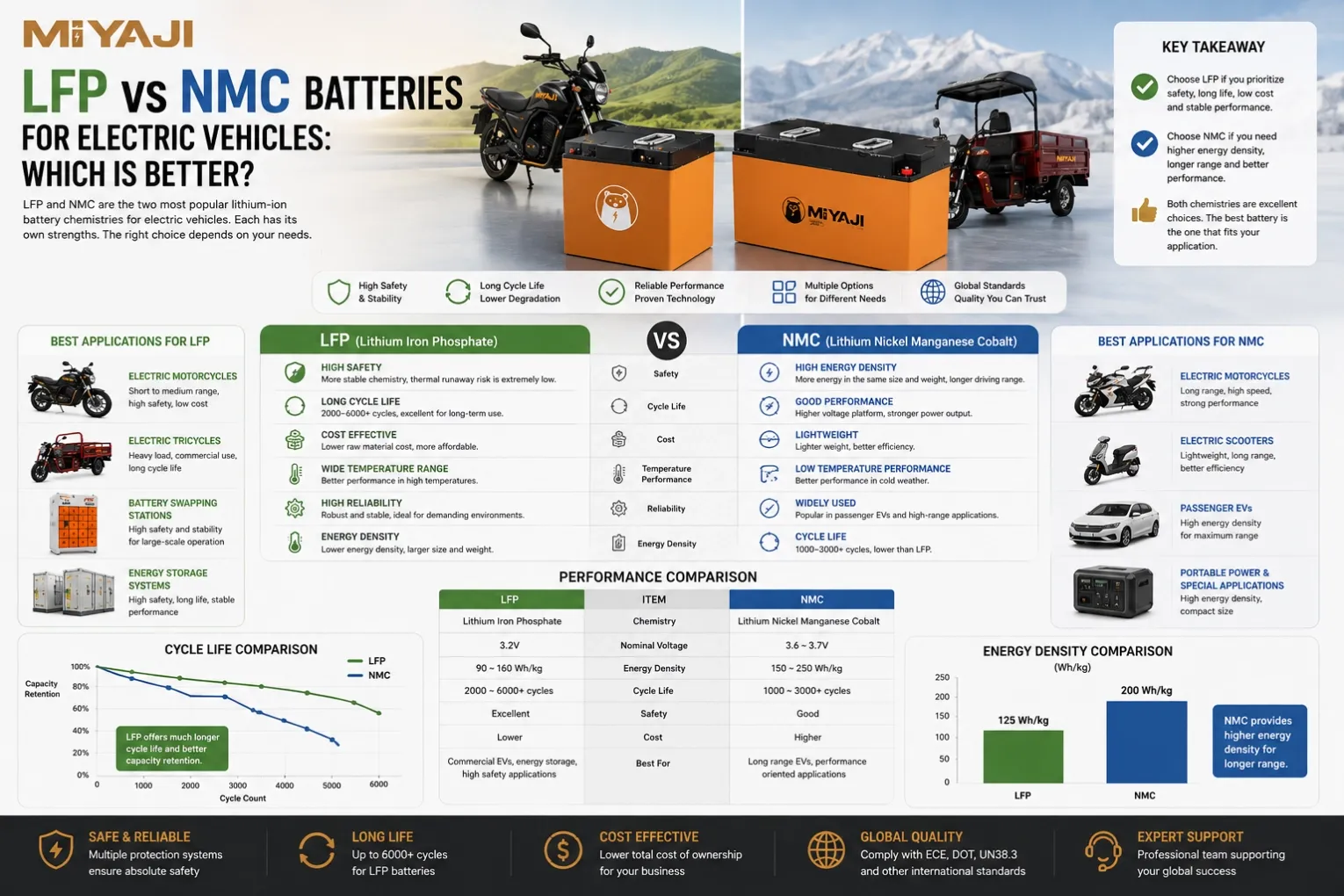
Common lithium-ion chemistries include:
- LFP — Lithium Iron Phosphate
- NMC — Nickel Manganese Cobalt
Different chemistries can offer different combinations of:
- Energy density
- Safety characteristics
- Cycle performance
- Cost
- Temperature behavior
- Application suitability
For commercial electric vehicles, battery chemistry should be selected according to the actual operating environment rather than a single specification.
LFP Battery PACKs
LFP cells are widely considered for commercial applications where factors such as:
- Safety
- Cycle life
- Cost
- Durability
are important.
They are commonly used in:
- Electric motorcycles
- Electric tricycles
- Commercial EVs
- Energy storage
The appropriate cell specification still depends on the actual vehicle and duty cycle.
NMC Battery PACKs
NMC cells generally offer higher energy density than many LFP configurations.
This can be useful where:
- Packaging space is limited
- Weight is important
- Higher energy density is required
However, the appropriate battery system depends on the application and required safety, thermal and performance characteristics.
There is no universally “best” chemistry.
Step 1: Cell Incoming Inspection
Before cells enter PACK production, they should be inspected according to defined specifications.
Possible checks include:
- Model
- Manufacturer
- Batch
- Voltage
- Appearance
- Capacity information
- Internal resistance
- Packaging condition
For larger production systems, traceability should begin at this stage.
Each batch should be identifiable.
Step 2: Cell Grading
Cells from the same production batch may still have variations.
Depending on the application, production may evaluate:
- Capacity
- Voltage
- Internal resistance
- Other electrical characteristics
Cells can then be grouped according to defined production criteria.
This process is often referred to as:
Cell grading or sorting
Why Cell Matching Matters
Imagine a PACK containing many cells.
If some cells behave significantly differently from others, the overall battery may become limited by the weaker cells.
Appropriate matching helps create a more consistent battery system.
This can be especially important for commercial vehicles because batteries may experience:
- Frequent charging
- High daily mileage
- Repeated cycling
- High current demand
Step 3: PACK Configuration
Before assembly begins, engineers need to determine the required electrical configuration.
For example:
Series Connection
determines voltage.
Parallel Connection
determines capacity.
A simplified configuration might be:
Ns × Np
where:
- Ns = number of cells connected in series
- Np = number of parallel cell groups
The actual configuration depends on:
- Cell voltage
- Cell capacity
- Vehicle voltage
- Required energy
- Motor system
- BMS
- Charger
Battery Voltage Is More Than Cell Count
The PACK voltage must be compatible with the complete vehicle system.
This includes:
- Motor
- Controller
- BMS
- Charger
- DC-DC converter
- Vehicle electrical system
A battery cannot be selected independently from the vehicle architecture.
This is particularly important for commercial EV projects.
Step 4: Cell Arrangement
Cells are physically arranged according to the PACK design.
The production team needs to control:
- Cell orientation
- Spacing
- Insulation
- Mechanical support
- Connection points
The arrangement must also consider:
- Heat
- Vibration
- Shock
- Water protection
- Serviceability
Commercial vehicles can expose batteries to significant vibration and environmental conditions.
Step 5: Electrical Connection
Cells must be electrically connected according to the PACK design.
Depending on the cell format and design, this may involve:
- Busbars
- Nickel materials
- Welding
- Connectors
The connection method should be selected according to:
- Cell type
- Current requirements
- PACK architecture
- Manufacturing process
Step 6: BMS Installation
The Battery Management System (BMS) is a critical part of a lithium battery PACK.
A BMS may monitor and manage:
- Cell voltage
- Pack voltage
- Current
- Temperature
- State of Charge
- Protection conditions
Depending on the system, the BMS can also communicate with:
- Vehicle controller
- Charger
- Swap station
- Fleet management platform
What Does a BMS Actually Do?
A BMS is not simply a “battery protection board.”
Depending on its architecture, it can provide functions such as:
Overvoltage Protection
Helps prevent cells from exceeding defined voltage limits.
Undervoltage Protection
Helps protect cells from excessive discharge.
Overcurrent Protection
Helps protect against abnormal current conditions.
Short-Circuit Protection
Provides protection against certain abnormal electrical conditions.
Temperature Monitoring
Monitors battery temperature through sensors.
Cell Balancing
Can help manage voltage differences between cells.
Communication
Some BMS systems communicate with external devices and platforms.
The actual functions depend on the BMS design.
Smart BMS for Commercial EVs
For commercial applications, a connected BMS can provide additional information.
Depending on the system, this may include:
- SOC
- SOH
- Voltage
- Current
- Temperature
- Fault status
- Cycle information
This data can potentially be integrated into fleet-management or energy-management systems.
That becomes particularly useful for:
Battery Swapping
and
Large Commercial Fleets
where many batteries need to be monitored.
Step 7: Mechanical PACK Assembly
After electrical integration, the battery must be mechanically secured.
The PACK may include:
- Enclosure
- Internal supports
- Insulation
- Sealing
- Mounting structure
- Connectors
For vehicle applications, the enclosure must be designed according to the actual operating environment.
IP Protection
Commercial batteries may be exposed to:
- Rain
- Dust
- Mud
- Humidity
- Road splash
Therefore enclosure design and sealing can be important.
The required protection level depends on the application.
An IP rating should not be claimed unless the complete product has been appropriately tested.
Step 8: Electrical Testing
Before a PACK enters final production, electrical testing should verify that the battery behaves as expected.
Testing may include:
- Total voltage
- Individual cell/group voltage
- Current
- BMS communication
- Protection functions
The specific test items depend on the battery design.
Step 9: Insulation and Safety Testing
Battery PACKs may require appropriate safety and electrical tests.
Depending on the design and applicable standards, these can include:
- Insulation testing
- Withstand-voltage testing
- Polarity checks
- Short-circuit protection verification
- BMS protection verification
The exact test requirements depend on the product and destination market.
Step 10: Charging and Discharging Tests
A battery PACK may undergo controlled charge/discharge testing to verify its electrical behavior.
This can help identify abnormalities such as:
- Voltage imbalance
- Unexpected temperature rise
- Communication errors
- Capacity abnormalities
For commercial applications, test procedures should be defined according to the battery's intended operating profile.
Step 11: Battery Aging
Aging is an important production-control stage.
The purpose is to allow the battery system to undergo controlled operation so that abnormal behavior can potentially be identified before shipment.
Depending on the process, aging may involve:
- Charging
- Resting
- Discharging
- Monitoring
The exact aging procedure depends on battery design and production requirements.
Why Battery Aging Matters
A battery may pass a simple voltage test and still have other abnormalities.
A more comprehensive production process can monitor:
- Voltage behavior
- Temperature
- Current
- BMS communication
- Charge/discharge behavior
This provides an additional quality-control layer.
Step 12: Final Inspection
Before shipment, the finished PACK should be checked against the production specification.
Typical checks may include:
- Appearance
- Dimensions
- Weight
- Voltage
- Communication
- Connector
- Label
- Serial number
- Packaging
For commercial projects, traceability is especially valuable.
Battery PACK Traceability
A professional battery system should ideally have a traceable production record.
For example:
PACK Serial Number
↓
BMS Serial Number
↓
Cell Batch
↓
Production Date
↓
Test Results
↓
Aging Results
This information can support:
- Warranty
- Maintenance
- Diagnostics
- Fleet management
- Quality analysis
Battery PACK Testing Is Not the Same as Cell Testing
This distinction is important.
A cell can pass inspection.
But after multiple cells are integrated into a PACK, the complete system has new variables.
For example:
- Electrical connections
- BMS
- Wiring
- Insulation
- Mechanical structure
- Communication
Therefore:
Cell quality does not replace PACK-level testing.
Both levels are important.
Battery PACK Manufacturing Equipment
Equipment depends on the cell format and production scale.
Typical equipment may include:
Cell Testing
- Voltage testing equipment
- Internal resistance testers
- Capacity testing equipment
Cell Sorting
- Automatic or semi-automatic sorting systems
Cell Connection
- Welding equipment
- Busbar assembly tools
BMS
- BMS programming equipment
- Communication testing equipment
PACK Testing
- Electrical test equipment
- Insulation testing
- Charge/discharge equipment
Aging
- Battery aging cabinets
- Monitoring systems
Final Inspection
- Voltage testing
- Communication testing
- Appearance inspection
Manual vs Automated PACK Production
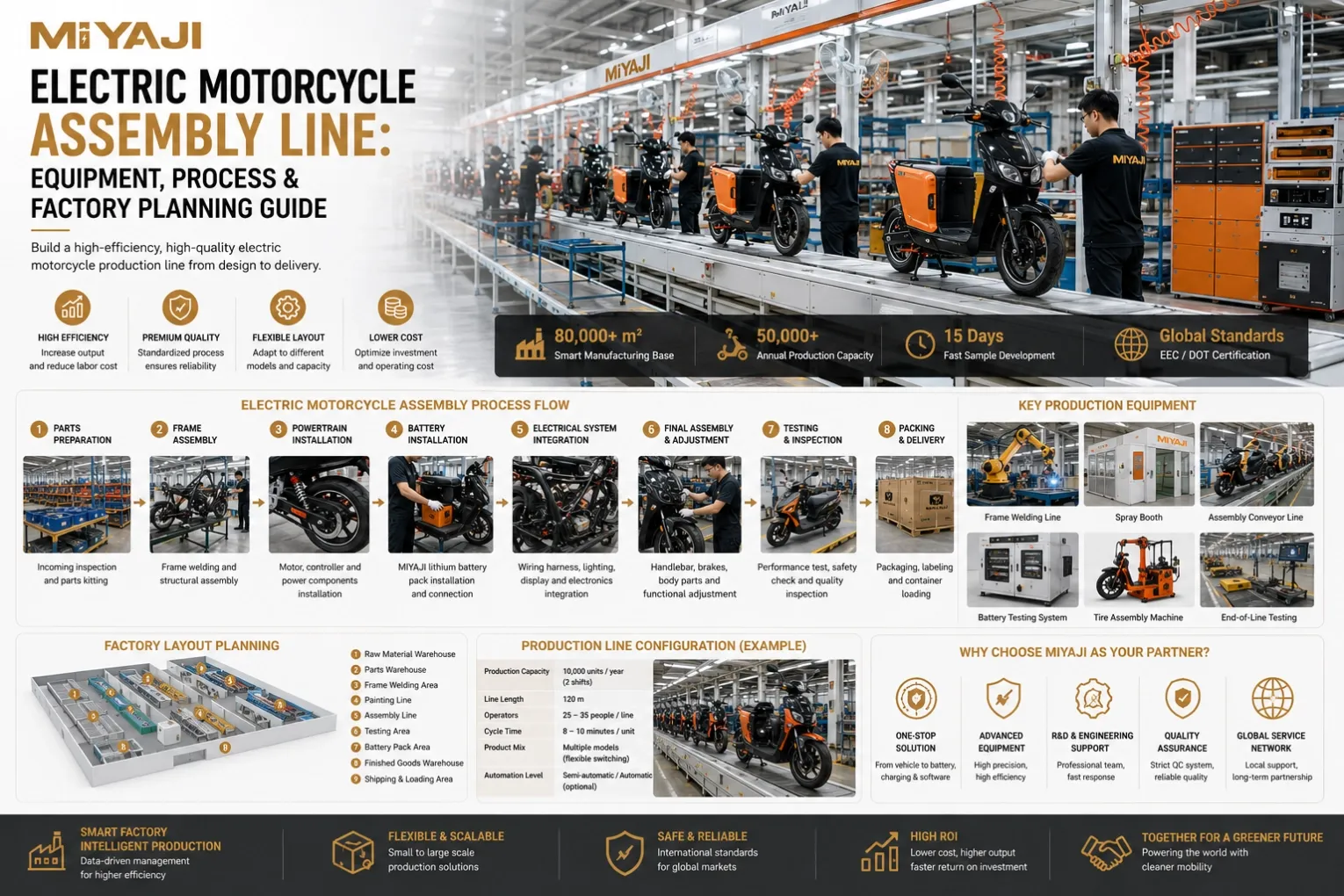
Like vehicle assembly, battery production can use different levels of automation.
Manual
Suitable for:
- Small production
- Prototyping
- Flexible configurations
Semi-Automated
Suitable for:
- Medium-volume production
- Standardized products
- Better process consistency
Automated
Suitable for:
- High-volume production
- Highly standardized battery designs
- Higher throughput requirements
The best choice depends on:
- Production volume
- Cell format
- Product variety
- Labor cost
- Investment budget
Battery PACK Production for Electric Motorcycles
Electric motorcycles often require batteries that balance:
Energy
Weight
Size
Current
Durability
and
Cost
A commercial motorcycle battery may need to support repeated daily operation.
Therefore battery design should consider the actual duty cycle rather than simply maximizing capacity.
Battery PACK Production for Electric Tricycles
Commercial electric tricycles may require larger battery systems because of:
- Higher payload
- Longer operating hours
- Higher energy demand
The PACK may therefore require different:
- Capacity
- Current capability
- Enclosure
- Mounting
- BMS configuration
The battery should be designed together with the vehicle.
Battery Design for Battery Swapping
A swap battery has additional requirements.
It must be designed around:
- Standardized dimensions
- Mechanical locking
- Electrical connectors
- BMS communication
- Charging compatibility
- Swap-station interface
This means the battery cannot be designed independently from the swap cabinet.
The complete system is:
Battery
↔
Swap Station
↔
Vehicle
↔
Software
Battery Design for Fast Charging
Fast charging creates additional requirements for the battery system.
The design must consider:
- Cell charging characteristics
- Maximum charging current
- BMS limits
- Thermal behavior
- Charger compatibility
- Connector specifications
A high-power charger alone does not automatically make a battery suitable for fast charging.
Why Commercial Battery Design Is Different
A consumer battery and a commercial fleet battery may operate under very different conditions.
Commercial batteries can experience:
- Higher annual mileage
- More frequent cycling
- Longer operating hours
- Greater vibration
- Greater environmental exposure
Therefore commercial battery design should focus on the complete duty cycle.
How to Choose Battery Cells for a PACK
Before selecting cells, define:
Voltage
What system voltage is required?
Capacity
How much energy is needed?
Current
What continuous and peak current is required?
Cycle Use
How frequently will the battery be charged and discharged?
Environment
What temperatures and operating conditions will the battery face?
Packaging
What physical dimensions are available?
Chemistry
Is LFP, NMC or another chemistry more appropriate?
Certification
What standards and market requirements apply?
Only after these requirements are clear should the cell be selected.
Cell Price Is Not the Whole Battery Cost
A common mistake is comparing:
Cell Price
and assuming that the cheapest cell creates the cheapest battery.
A complete PACK also includes:
- BMS
- Busbars
- Connectors
- Enclosure
- Insulation
- Welding
- Assembly
- Testing
- Aging
- Packaging
- Logistics
Therefore the correct commercial comparison is often:
Cost per usable commercial kilometer
rather than simply:
Cell cost per Ah
How Cell Suppliers Should Be Evaluated
For buyers sourcing cells for PACK production, important questions include:
- What is the cell manufacturer?
- What chemistry is used?
- What is the nominal capacity?
- What is the nominal voltage?
- What is the production batch?
- What testing data is available?
- What certifications apply?
- How is traceability managed?
- What is the warranty structure?
- What is the expected supply stability?
For commercial projects, supply consistency can be as important as the initial unit price.
How MIYAJI Approaches Battery PACK Solutions
MIYAJI's battery business can support different levels of the battery supply chain, depending on project requirements.
This can include:
Lithium Battery Cells
↓
Cell Selection & Grading
↓
BMS
↓
Battery PACK
↓
Testing & Aging
↓
Vehicle Battery Systems
The battery system can then be integrated into commercial applications such as:
- Electric motorcycles
- Electric tricycles
- Fleet vehicles
- Battery swapping
- Charging systems
This allows battery specifications to be evaluated together with the actual vehicle and energy requirements.
From Cell to Commercial EV
A complete commercial battery system can be viewed as:
Cell
↓
BMS
↓
PACK
↓
Vehicle
↓
Charging / Swapping
↓
Fleet
This is why battery procurement should not be separated from the application.
The correct battery is not simply the one with the highest capacity.
It is the one that matches:
Vehicle
Duty Cycle
Energy Infrastructure
Operating Environment
and
Commercial Target
Planning a Lithium Battery PACK Project?
Before requesting a PACK solution, prepare:
Battery
- Chemistry
- Cell format
- Capacity
- Voltage
- Current requirement
Vehicle
- Motor power
- Controller
- Daily mileage
- Payload
- Operating hours
Environment
- Temperature
- Humidity
- Dust
- Water exposure
- Vibration
Energy System
- Standard charging
- Fast charging
- Battery swapping
Production
- Annual volume
- PACK configuration
- Local assembly requirement
- Testing requirements
With these inputs, the PACK architecture, BMS and production process can be evaluated together.
Frequently Asked Questions
What is a lithium battery PACK?
A lithium battery PACK is an integrated battery system containing multiple cells and supporting components such as a BMS, electrical connections, enclosure and protection components.
What is the battery PACK assembly process?
A typical process includes cell inspection, grading, matching, electrical connection, BMS installation, mechanical assembly, testing, aging and final inspection.
Why is cell grading important?
Cell grading helps identify and group cells according to relevant electrical characteristics, supporting greater consistency within the final PACK.
What is the role of a BMS?
A BMS can monitor and protect the battery system by managing parameters such as voltage, current and temperature, with additional functions depending on the BMS design.
Does every battery PACK need a BMS?
Most rechargeable lithium battery PACKs used in practical applications require an appropriate battery-management and protection system, although the exact architecture varies by application.
What is battery aging?
Battery aging is a controlled production stage used to operate and monitor battery PACKs before final shipment, helping identify certain abnormal behaviors.
What equipment is needed for battery PACK assembly?
Equipment can include cell testing, sorting, welding, BMS testing, PACK testing, insulation testing and aging equipment. The exact configuration depends on the cell type and production volume.
Can LFP cells be used for electric motorcycles?
Yes. LFP is widely used in electric-vehicle applications, including commercial electric motorcycles and tricycles, where its characteristics are appropriate for the application.
Can NMC cells be used for electric motorcycles?
Yes. NMC cells can be considered where higher energy density is useful and the battery system is appropriately designed for the application.
Can battery PACKs be designed for swapping?
Yes. Swap batteries require mechanical, electrical and communication compatibility between the battery, vehicle and swap station.
Can battery PACK assembly be localized?
Yes. Depending on the project, battery PACK assembly can be established locally with appropriate equipment, technical processes, testing and quality-control systems.