Oct 30, 2026Product & Industry Knowledge
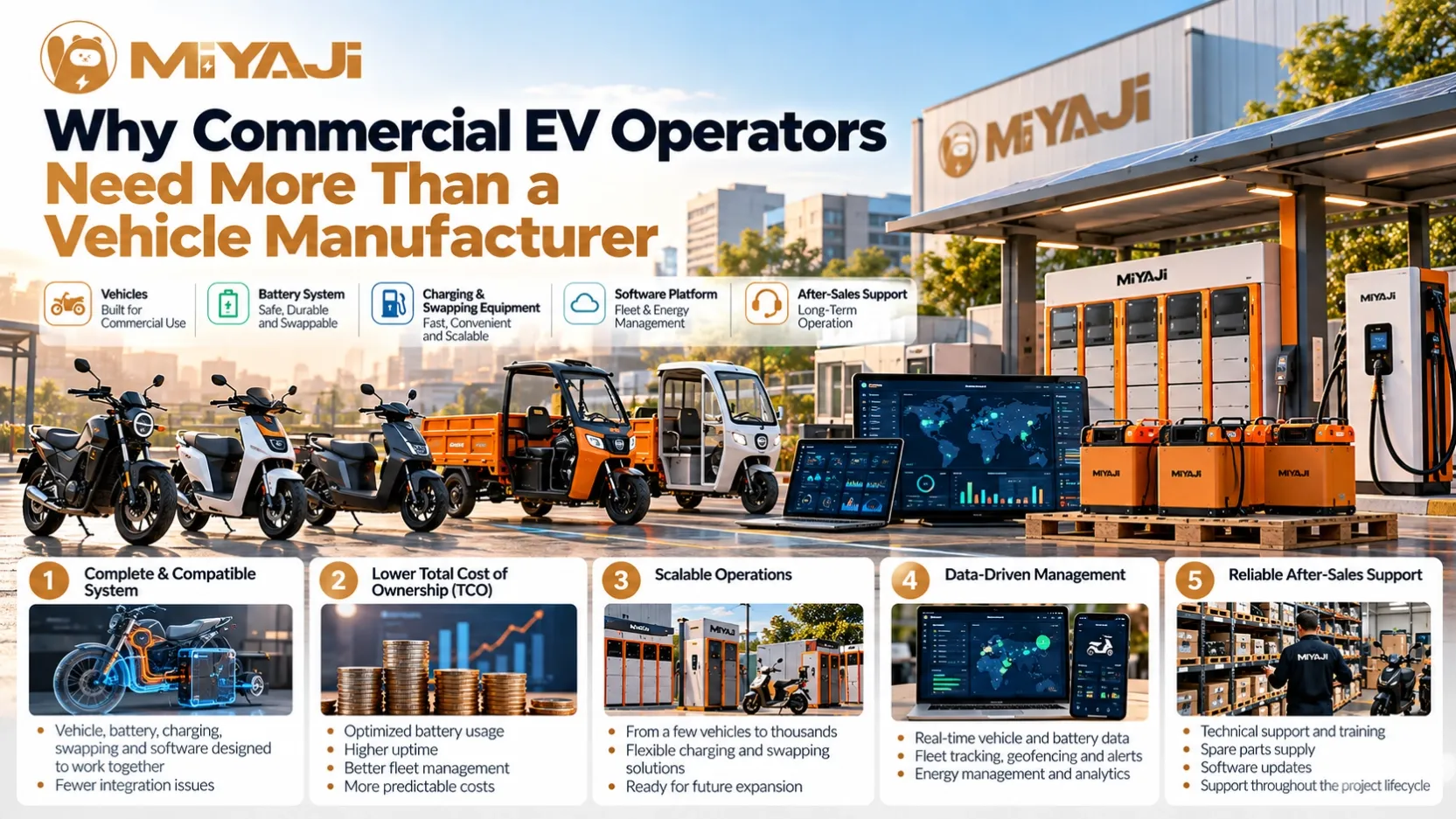
Why Commercial EV Operators Need More Than a Vehicle Manufacturer
Why do commercial EV operators need more than a vehicle manufacturer? Learn how integrated manufacturing, batteries, charging and software support fleet projects.
Why Commercial EV Operators Need More Than a Vehicle Manufacturer
Buying electric motorcycles or tricycles for a commercial fleet may seem straightforward. Find a manufacturer, compare vehicle specifications, negotiate prices, and arrange shipment.
But operating a commercial EV fleet involves more than putting vehicles on the road.
The vehicles need batteries suited to their daily workload. The charging or battery-swapping infrastructure must match the selected battery system. Software may be needed to monitor equipment, manage vehicles, or support fleet operations. When technical problems occur, the relevant engineering teams must be able to work together.
A professional vehicle manufacturer plays an essential role in this process. However, vehicle manufacturing is only one part of a complete commercial EV project.
This raises an important question for overseas fleet operators:
Should you source everything from individual manufacturers, or work with a commercial EV solution provider that coordinates the products and engineering behind the project?
The answer depends on your technical resources, project requirements, and long-term operating plans.
1. A Good Electric Vehicle Is Not the Same as a Complete Fleet Solution
Consider an operator planning to introduce 500 electric motorcycles for urban delivery.
The first purchasing decision is usually the vehicle itself.
The operator may compare motor power, carrying capacity, range, suspension, braking performance, and purchase price.
These are important considerations.
But the vehicles are only one part of the business.
The operator must also determine:
- How many kilometers each vehicle will travel daily.
- Whether batteries will be charged on the vehicle or removed.
- Whether fast charging or battery swapping is required.
- How many batteries are needed for the intended operating schedule.
- How the vehicles and energy equipment will be monitored.
- Who will provide technical support when connected systems encounter problems.
- Whether the same configuration can be supplied as the fleet expands.
A motorcycle may perform well during a road test but still be unsuitable for a particular commercial operation.
For example, a vehicle designed for conventional charging may require additional engineering work before it can support a specific battery-swapping system.
Similarly, a vehicle's advertised range does not automatically establish how it will perform under the operator's actual payload, terrain, speed, and operating conditions.
The right vehicle is not simply the one with the best specifications. It is the one that fits the complete operating system.
2. Why Vehicle Manufacturers and Energy System Manufacturers Have Different Specialties
Commercial EV projects bring together several manufacturing disciplines.
Vehicle Manufacturing
Professional electric motorcycle and tricycle manufacturers focus on vehicle engineering and production.
Their expertise may include:
- Frame and chassis design.
- Vehicle structure and durability.
- Motor and controller integration.
- Suspension and braking systems.
- Vehicle assembly and production quality.
- Road testing and vehicle performance.
These capabilities are fundamental to a reliable commercial vehicle.
Battery PACK Manufacturing
Battery PACK manufacturing requires a different set of engineering capabilities.
These include cell selection, electrical configuration, BMS integration, thermal considerations, mechanical protection, and battery testing.
For commercial applications, battery performance must be evaluated against the intended operating conditions, including load, discharge current, charging requirements, and expected usage patterns.
Charging and Battery Swapping Equipment
Charging and swapping equipment manufacturers specialize in power electronics, equipment control, electrical protection, communication interfaces, and the mechanical and operational requirements of their products.
A battery and charger must be matched according to their electrical and communication requirements.
A swapping system also needs an appropriate battery format, compatible interfaces, and validated equipment behavior.
Software Development
Software teams may develop functions for vehicle monitoring, equipment management, access control, operational data, and other agreed fleet or energy management requirements.
These functions depend on suitable hardware interfaces and reliable communication between connected products.
Each specialty contributes something different.
The objective is not to replace specialized manufacturers with one factory that claims to do everything. It is to make these different manufacturing capabilities work together.
3. What Happens When an Operator Sources Every Product Separately?
Purchasing directly from multiple manufacturers can be a reasonable approach, especially for companies with experienced engineering and procurement teams.
It can provide flexibility in supplier selection and product configuration.
However, the buyer must take responsibility for coordinating the different products unless an integrator has been appointed.
Imagine an overseas operator purchasing electric motorcycles from one factory, battery PACKs from another, chargers from a third, and fleet software from a fourth.
Each supplier provides its own quotation and product specifications.
The vehicle manufacturer confirms that the motorcycles meet the agreed vehicle requirements.
The battery manufacturer confirms that its battery PACKs pass the relevant factory tests.
The charger supplier confirms that its equipment operates within its specified parameters.
The software supplier confirms that its platform functions with supported devices.
Yet these separate confirmations do not establish that the buyer's intended combination has been fully validated.
If the battery cannot communicate correctly with the charger, the buyer may need to organize a joint technical discussion.
If the software cannot receive the required vehicle data, the buyer may need to coordinate the hardware and software providers.
If a production change affects compatibility, the buyer must determine which suppliers need to review the modification.
The challenge is not necessarily poor product quality.
It is the absence of a coordinated engineering structure.
For an overseas operator without a technical team in China, this can create additional costs, delays, and management work.
4. What Does a Commercial EV Solution Provider Actually Do?
A commercial EV solution provider should contribute more than a catalogue containing vehicles, batteries, and chargers.
Its value depends on the capabilities and responsibilities it can genuinely provide.
These may include several important activities.
Understanding the Operating Requirements
Before selecting products, the provider should understand the customer's intended application.
A passenger transport operation, an urban delivery fleet, and a cargo tricycle business may have different requirements for payload, range, battery capacity, charging frequency, and vehicle configuration.
These requirements influence product selection.
Coordinating Product Specifications
The provider should help identify important technical relationships between the vehicle, battery, charging equipment, and software.
For example, a vehicle's power demand must be considered alongside battery discharge capability and BMS protection settings.
A proposed charging system must be assessed against the intended battery configuration.
Organizing Relevant Engineering Teams
When multiple manufacturing specialties are involved, the provider should be able to coordinate the necessary technical discussions.
This may include vehicle, battery, charging equipment, and software engineers.
Supporting Integrated Testing
Individual product testing remains important, but some projects also require testing of the intended system configuration.
The testing scope should be defined according to the products, interfaces, and functions included in the project.
Coordinating Delivery and Technical Support
The provider may also help coordinate production schedules, configuration documentation, shipment preparation, and technical issue investigation within the agreed project scope.
A genuine solution provider should be able to explain how these activities are handled, rather than relying only on the phrase "one-stop solution."
5. Why the Manufacturing Ecosystem Behind a Brand Matters
When buyers evaluate a commercial EV supplier, they often focus on individual factory details.
They ask about production capacity, factory size, manufacturing experience, certifications, and product prices.
These questions are important.
However, when a project involves several connected products, buyers should also evaluate the manufacturing ecosystem behind the supplier.
Consider two different procurement arrangements.
In the first, the buyer selects each manufacturer independently and manages the technical relationships between them.
In the second, the buyer works with a solution brand that has established manufacturing capabilities and long-term relationships with specialized manufacturing partners.
The second arrangement may offer a clearer structure for product selection, engineering coordination, and technical support.
But the brand itself is not enough.
Buyers should understand what gives that brand credibility.
Manufacturing Capabilities
Does the provider have meaningful manufacturing or engineering capabilities of its own, or does it simply purchase unrelated products from external factories?
Manufacturing Partner Selection
How does the provider evaluate the manufacturers supplying critical products?
Are the partners capable of producing vehicles or equipment suitable for the intended commercial application?
Product Compatibility
Does the provider consider how products will operate together before recommending a configuration?
Quality and Configuration Control
Are the agreed product specifications and configurations documented and controlled?
Technical Support Structure
When a problem involves several products, is there a clear contact responsible for coordinating the investigation?
A trustworthy solution brand should represent a consistent approach to manufacturing, product selection, engineering, and customer support.
That trust must be earned through actual performance, not simply through branding.
6. Why Working With Specialized Vehicle Manufacturers Can Be an Advantage
Some buyers assume that a complete EV solution provider must manufacture every product in one factory.
That is not necessarily the most effective model.
Electric motorcycles, electric tricycles, lithium battery PACKs, charging equipment, and software involve different technical disciplines.
A manufacturer that specializes in commercial vehicles may have substantial experience in chassis engineering, vehicle assembly, production processes, and application-specific design.
A battery manufacturer may have stronger capabilities in battery system engineering.
A charging equipment manufacturer may specialize in power electronics and equipment control.
Bringing these capabilities together can be more practical than expecting one production facility to specialize equally in every category.
The important question is how the different manufacturers cooperate.
For example, a specialized electric motorcycle manufacturer may work with a battery and charging system provider to develop an agreed vehicle configuration.
The vehicle manufacturer contributes its expertise in vehicle engineering and production.
The battery and charging teams contribute their expertise in energy systems.
Together, they can review technical requirements that affect the complete product combination.
This approach allows each manufacturing specialist to focus on its strengths while supporting a common project.
Professional specialization and system integration are not competing ideas. They should complement each other.
7. How MIYAJI Builds Its Commercial EV Manufacturing Ecosystem
MIYAJI is built around this principle.
Rather than operating solely as a vehicle manufacturer or purchasing unrelated products as a trading intermediary, MIYAJI combines its own core manufacturing and software capabilities with professional commercial vehicle manufacturing partners.
The objective is to support overseas operators that need connected vehicles, batteries, charging or swapping infrastructure, and software.
MIYAJI's Core Manufacturing and Software Capabilities
MIYAJI has its own lithium battery PACK manufacturing capabilities, charging and battery-swapping equipment manufacturing resources, and software development team.
These capabilities form the foundation of its commercial EV energy solutions.
They allow relevant battery, charging, swapping, and software requirements to be coordinated within the MIYAJI ecosystem.
For example, a commercial electric motorcycle project involving fast charging may require the battery PACK, BMS, and charger to be reviewed as a matched system.
A battery-swapping project may require coordination of battery dimensions, electrical interfaces, cabinet compatibility, and software functions.
These are engineering relationships that cannot be established simply by selecting products with similar advertised specifications.
Cooperation With Professional Commercial Vehicle Manufacturers
MIYAJI works with specialized electric motorcycle and electric tricycle manufacturers to serve overseas commercial applications.
These manufacturing partners contribute their vehicle production experience, engineering expertise, and manufacturing facilities.
MIYAJI contributes its core battery, charging, swapping, and software capabilities, together with project-level coordination.
The vehicle manufacturing partners are not presented as anonymous factories with no independent expertise.
Their professional manufacturing capabilities are an important part of the overall ecosystem.
At the same time, overseas customers can approach MIYAJI as a unified solution brand instead of having to independently establish every manufacturing and technical relationship in China.
Coordinating Products Around the Project
The starting point is the customer's intended operation.
Depending on the project, MIYAJI and the relevant manufacturing partners can review:
- Vehicle type and application requirements.
- Battery configuration and operating demands.
- Charging or battery-swapping requirements.
- Vehicle and battery compatibility.
- Required software and connectivity functions.
- Applicable testing and delivery arrangements.
- Technical support responsibilities.
The agreed scope determines which products and engineering services are included.
Not every project requires the same equipment, software functions, or integration work.
A Clearer Structure for Technical Support
After delivery, technical problems sometimes involve more than one product category.
For systems supplied within an agreed MIYAJI project scope, customers can raise issues through the designated project contact.
MIYAJI can then coordinate the relevant manufacturing or engineering teams to investigate the problem.
This approach provides a more structured communication channel for customers who may otherwise need to contact several unrelated suppliers.
Specific warranty obligations, corrective actions, and engineering services remain subject to the applicable agreements.
MIYAJI's value comes from combining specialized manufacturing capabilities under a coordinated commercial EV solution brand.
8. Why This Model Matters for Overseas Fleet Operators
The benefits of a coordinated manufacturing ecosystem become particularly relevant when a project moves beyond its first vehicle order.
Initial Project Planning
An operator may begin with a small fleet to evaluate vehicle performance, energy requirements, and the suitability of the intended operating model.
Coordinated technical planning helps the buyer understand which products and interfaces need to be considered together.
Pilot Deployment
During a pilot, the operator may discover that actual routes, payloads, or charging schedules differ from initial assumptions.
Feedback may require adjustments to the vehicle configuration, battery selection, or charging arrangements.
Established communication between the relevant engineering teams can make this process easier to manage.
Fleet Expansion
When the operator expands from a pilot to a larger fleet, consistency becomes important.
New vehicles and batteries may need to remain compatible with previously deployed equipment.
Configuration control and coordinated product planning can help reduce unnecessary variation.
Long-Term Technical Support
Commercial fleets depend on continued access to suitable replacement parts, batteries, technical documentation, and support.
A coordinated supply ecosystem can provide a clearer route for discussing future requirements and resolving technical questions.
None of these benefits eliminates the need for careful project management.
However, they illustrate why supplier selection should consider long-term cooperation, not only the initial vehicle purchase price.
9. How to Evaluate a Commercial EV Solution Provider
Before choosing a supplier, overseas buyers should ask questions that reveal its actual capabilities.
Evaluation Area | Questions to Ask |
|---|---|
Business model | Is the company a manufacturer, a solution provider, a trading intermediary, or a combination? |
Core capabilities | Which products and engineering functions does it control directly? |
Vehicle manufacturing | Who manufactures the vehicles, and what are their production capabilities? |
Manufacturing partners | How are partners selected and evaluated? |
Battery systems | Who designs and manufactures the battery PACKs? |
Charging and swapping | Who manufactures and supports the charging equipment? |
Software | Who develops and maintains the required software functions? |
Integration | Who coordinates technical interfaces between products? |
Testing | What product and system testing is included? |
Configuration management | How are approved configurations maintained during production? |
After-sales support | Who coordinates issues involving multiple product categories? |
Project scope | Which responsibilities are included in the contract? |
A reliable supplier should be able to answer these questions clearly.
Buyers should also request appropriate supporting information, such as manufacturing documentation, product specifications, test records, or opportunities to review relevant production facilities.
The objective is not to find a company that claims to do everything.
It is to find a partner whose actual capabilities match the project's requirements.
10. When Is a Vehicle Manufacturer Alone the Right Choice?
Not every buyer needs an integrated solution provider.
If a customer only needs conventional electric motorcycles and already has suitable batteries, charging infrastructure, software, and technical resources, purchasing directly from a professional vehicle manufacturer may be entirely appropriate.
Likewise, an established fleet operator with an experienced engineering team may prefer to manage multiple suppliers independently.
An integrated solution provider becomes more relevant when:
- The project requires coordinated vehicles and energy equipment.
- Battery swapping or dedicated fast charging is part of the plan.
- Software functions must work with selected hardware.
- The buyer lacks a local engineering coordination team in China.
- Multiple manufacturing specialties must support the same project.
- The operator expects to expand the system over time.
The right procurement structure depends on what the buyer already has and what the project still requires.
11. From Buying Products to Building a Commercial EV Ecosystem
The commercial EV industry depends on specialization.
Vehicle manufacturers build vehicles.
Battery manufacturers develop battery systems.
Charging and swapping equipment manufacturers provide energy infrastructure.
Software developers create digital management capabilities.
For overseas operators, the challenge is turning these individual capabilities into a system suitable for their market.
This requires more than selecting products from different catalogues.
It requires technical coordination, compatible configurations, appropriate testing, and a clear support structure.
A strong solution brand can make that process easier by connecting established manufacturing capabilities around the customer's project.
For MIYAJI, this is the purpose of its manufacturing ecosystem.
Its own battery PACK, charging, swapping, and software capabilities form the core of the system, while specialized commercial vehicle manufacturers contribute professional vehicle production.
Together, these capabilities support a coordinated approach to commercial EV supply.
The goal is not to replace professional manufacturers. It is to bring their strengths together under a solution brand that overseas customers can understand, evaluate, and trust.
Frequently Asked Questions
What is a commercial EV solution provider?
A commercial EV solution provider coordinates the products and engineering required for a commercial electric vehicle project. Depending on its capabilities and agreed scope, this may include vehicles, battery systems, charging or swapping equipment, software, technical integration, and delivery support.
What is the difference between an EV manufacturer and an EV solution provider?
An EV manufacturer specializes in producing vehicles or components. A solution provider focuses on coordinating the products and technical requirements needed for a broader application. Some companies perform both roles.
Is it better to buy electric motorcycles directly from a factory?
Direct factory purchasing can be suitable when the buyer needs vehicles only or has its own engineering resources. Projects involving batteries, charging, swapping, and software may benefit from additional integration and coordination.
Does a commercial EV solution provider need to own every factory?
No. A solution provider can combine its own manufacturing and engineering capabilities with specialized manufacturing partners. What matters is the quality of the capabilities, coordination, and agreed responsibilities.
Why is battery and charger compatibility important for commercial fleets?
Battery and charging systems must meet compatible electrical and communication requirements. Incompatible configurations may create charging problems, protection events, or other operating limitations.
How does MIYAJI work with electric vehicle manufacturers?
MIYAJI combines its own battery PACK, charging, battery-swapping, and software capabilities with professional electric motorcycle and electric tricycle manufacturing partners. The relevant teams coordinate according to the technical and delivery requirements of each project.
Can MIYAJI support both electric motorcycles and electric tricycles?
Yes. MIYAJI works with specialized manufacturers of commercial electric motorcycles and electric tricycles and can coordinate relevant battery, charging, swapping, and software solutions according to project requirements.
Looking for a Commercial EV Solution Partner in China?
A successful commercial EV project requires more than selecting a vehicle from a catalogue.
It requires the right manufacturing capabilities, suitable energy systems, compatible products, and technical coordination.
MIYAJI brings together its own battery PACK, charging, battery-swapping, and software capabilities with professional commercial vehicle manufacturing partners to support overseas projects.
Whether you are evaluating electric motorcycles, passenger or cargo tricycles, fast charging, or battery swapping, our team can help you review the manufacturing and system requirements for your project.
Your Market. Our Manufacturing Ecosystem.
Contact MIYAJI to Discuss Your Commercial EV Project.