Sep 2, 2026Product & Industry Knowledge
How to Choose Battery Capacity for Commercial Electric Motorcycles & Tricycles
Learn how to choose battery capacity for commercial electric motorcycles and tricycles using daily mileage, Wh/km, usable energy, payload and charging strategy.
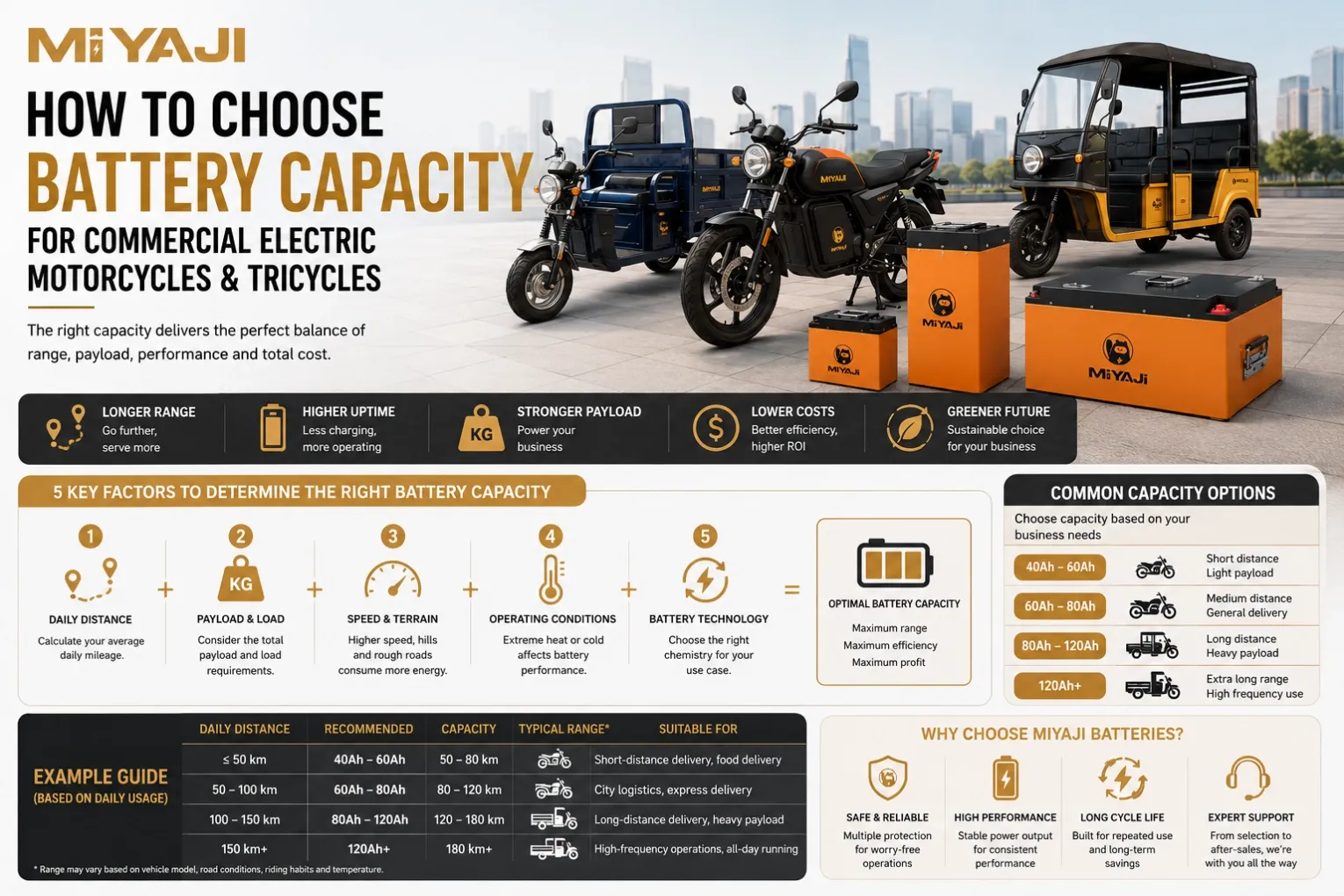
How to Choose Battery Capacity for Commercial Electric Motorcycles and Tricycles
Choosing the right battery for a commercial electric motorcycle or tricycle is not simply a matter of selecting the largest Ah rating available.
A larger battery can provide more energy.
But it may also increase:
- Vehicle weight
- Battery cost
- Charging time
- Space requirements
- Replacement cost
A battery that is too small can create a different set of problems:
- Insufficient operating range
- Frequent charging
- More vehicle downtime
- Higher dependence on charging infrastructure
- More frequent battery swapping
For commercial EV projects, battery capacity should therefore be determined from the vehicle's actual operating requirements.
A useful planning sequence is:
Daily Mileage
→ Vehicle Energy Consumption
→ Required Daily Energy
→ Usable Battery Energy
→ Charging / Swapping Strategy
→ Battery Capacity
The objective is not to install the biggest battery possible.
It is to select the right amount of usable energy for the commercial duty cycle.
Understanding Ah, V and kWh
Before selecting a battery, buyers should understand three common specifications:
Voltage — V
Voltage must be compatible with the vehicle's electrical system, including:
- Motor
- Controller
- Charger
- BMS
- Other high-voltage components
Common nominal voltage classes vary by vehicle design.
Capacity — Ah
Amp-hours describe the battery's electrical charge capacity.
For example:
60 Ah
does not by itself tell you how much energy the battery contains.
Voltage must also be considered.
Energy — Wh / kWh
For vehicle range and fleet energy planning, watt-hours or kilowatt-hours are generally more useful.
A simplified nominal-energy calculation is:
Battery Energy (Wh) = Nominal Voltage (V) × Capacity (Ah)
For example:
72 V × 60 Ah = 4,320 Wh
or approximately:
4.32 kWh nominal energy
This is why comparing only Ah can be misleading.
A 60 Ah battery at one voltage does not contain the same nominal energy as a 60 Ah battery at another voltage.
Ah Is Not the Same as Range
One of the most common mistakes in EV procurement is thinking:
Higher Ah = Predictable Longer Range
Higher capacity generally means more stored energy when other variables remain similar.
But vehicle range also depends on:
- Vehicle weight
- Payload
- Speed
- Motor efficiency
- Controller
- Aerodynamics
- Tires
- Road gradient
- Stop-and-go traffic
- Temperature
- Rider behavior
Therefore a supplier should be careful about making statements such as:
“72V60Ah = 150 km.”
without explaining the vehicle and test conditions.
A better approach is to calculate range from:
Usable Battery Energy ÷ Vehicle Energy Consumption
Nominal Energy vs Usable Energy
Suppose a battery has:
72 V × 60 Ah
Its simplified nominal energy is:
4.32 kWh
But a commercial vehicle may not use every theoretical watt-hour stored in the battery.
Usable energy can be affected by:
- BMS limits
- SOC operating window
- Cell characteristics
- Temperature
- Battery condition
- System protection strategy
Therefore:
Nominal Battery Energy ≠ Guaranteed Usable Driving Energy
For project calculations, the battery's expected usable energy should be confirmed with the battery and vehicle supplier.
The Most Important Number: Wh/km
For fleet planning, one of the most useful metrics is:
Wh/km
This represents the amount of battery energy required to move the vehicle one kilometer.
Suppose an electric motorcycle consumes approximately:
45 Wh/km
under a particular commercial operating condition.
If it needs to travel:
100 km
then estimated energy demand would be:
45 Wh/km × 100 km = 4,500 Wh
or:
4.5 kWh
This immediately gives the buyer a better basis for battery selection.
However, 45 Wh/km is only an illustrative example.
Actual consumption should be tested for the specific vehicle and duty cycle.
How to Calculate Required Battery Capacity
A simplified planning formula is:
Required Usable Energy = Target Distance × Expected Energy Consumption
Then add an appropriate operating margin according to the project requirements.
For example, imagine a motorcycle needs:
100 km/day
and expected consumption is:
40 Wh/km
Then:
100 × 40 = 4,000 Wh
The vehicle requires approximately:
4.0 kWh of usable energy
to complete that theoretical operating requirement.
If the project wants additional reserve, the required battery configuration would need to account for that as well.
This does not automatically mean:
“Install exactly a 4.0 kWh nominal battery.”
Because usable energy and nominal energy are different.
A Better Battery Sizing Formula
For preliminary project planning:
Required Nominal Battery Energy ≈ Daily Energy Requirement ÷ Expected Usable Energy Fraction
Then:
Required Ah ≈ Required Nominal Energy (Wh) ÷ Nominal Voltage
For example, imagine a hypothetical project requires:
4.0 kWh usable energy
and the battery architecture is expected to make approximately 90% of nominal energy available within the planned operating window.
Then:
4.0 ÷ 0.90 ≈ 4.44 kWh nominal
For a simplified 72 V calculation:
4,440 Wh ÷ 72 V ≈ 61.7 Ah
This would suggest a battery class around that energy requirement.
But this example is only to demonstrate the calculation method.
The actual usable-energy fraction should come from the specific battery/BMS configuration—not from a universal 90% assumption.
You May Not Need One Battery to Cover the Entire Day
This is especially important for commercial fleets.
Suppose a motorcycle travels:
180 km/day
The first instinct may be:
“We need a battery large enough for 180 km.”
Not necessarily.
There are several possible architectures.
Strategy A — Large Battery
One large battery covers most or all daily operation.
Strategy B — Mid-Size Battery + Charging
The vehicle charges during scheduled breaks.
Strategy C — Smaller Swappable Batteries
The vehicle exchanges batteries during the day.
Strategy D — Fast-Charge-Capable Battery
Energy is replenished during shorter operating breaks.
Therefore:
Daily Mileage ≠ Required Single-Charge Range
This distinction can significantly change vehicle cost and battery architecture.
Battery Capacity vs Vehicle Downtime
Imagine two fleet configurations.
Configuration A
Large battery
Long range
Higher battery cost
Higher battery weight
Less frequent energy replenishment
Configuration B
Smaller battery
Lower range per battery
Lower battery weight
More frequent charging or swapping
Neither is automatically better.
The commercial question is:
Which configuration keeps the vehicle productive at the lowest total cost?
This is where battery capacity becomes an operational decision rather than only a technical specification.
Battery Capacity for Delivery Motorcycles
Delivery motorcycles often experience:
- Frequent acceleration
- Frequent stopping
- Cargo load
- Long operating hours
- High daily mileage
Battery sizing should therefore consider:
Average Daily Mileage
and
High-Demand Daily Mileage
If the average rider travels 90 km/day but a meaningful portion regularly travels 140 km/day, designing only around the 90 km average may create operational problems.
Fleet data should therefore look at the distribution of mileage—not only the average.
Battery Capacity for Passenger Motorcycles
Passenger transport can create different energy requirements.
The vehicle may regularly carry:
Rider + Passenger
and operate for long periods.
Factors such as:
- Passenger weight
- Stop frequency
- Traffic
- Gradient
- Acceleration
can materially affect energy consumption.
Therefore battery sizing should use realistic loaded conditions.
An unloaded factory test is not sufficient for estimating commercial passenger-operation range.
Battery Capacity for Electric Tricycles
Electric tricycles often require a different battery-sizing approach from two-wheelers.
Why?
Because tricycles may have:
- Higher vehicle weight
- Larger payload
- Higher rolling resistance
- Larger motor requirements
- Cargo or passenger body structures
A cargo tricycle carrying substantial payload may consume considerably more energy than a lightweight electric motorcycle.
Therefore the same:
72V60Ah
battery can produce very different operating range in two different vehicles.
Battery specifications should always be evaluated together with vehicle consumption.
Cargo Tricycle Battery Sizing
For cargo applications, payload is particularly important.
Suppose a cargo tricycle operates:
80 km/day
But sometimes it travels empty and sometimes at high load.
Energy consumption may change throughout the route.
The battery calculation should therefore consider:
- Empty vehicle consumption
- Typical payload
- Maximum commercial payload
- Route gradient
- Stop frequency
If possible, pilot testing should reproduce the real cargo profile.
Passenger Tricycle Battery Sizing
Passenger tricycles may experience variable passenger loads throughout the day.
Important inputs include:
- Average passengers
- Maximum passengers
- Route distance
- Stop frequency
- Average speed
- Air conditioning or auxiliary loads where applicable
- Terrain
Again, advertised range alone is insufficient.
Payload Can Significantly Change Energy Consumption
Consider the complete moving mass:
Vehicle + Battery + Rider + Passenger + Cargo
As total mass increases, more energy may be required during:
- Acceleration
- Hill climbing
- Stop-and-go operation
This is why commercial battery sizing should not use vehicle curb weight alone.
For project evaluation, provide the supplier with:
Typical Payload
and
Maximum Payload
where possible.
Speed Also Changes Battery Requirements
Higher speed generally increases energy demand, particularly as aerodynamic resistance becomes more significant.
Therefore:
100 km at moderate urban speed
and
100 km at sustained higher speed
may require different amounts of energy.
This is another reason why range claims should include test conditions.
Commercial buyers should ask:
What average speed was used?
What was the payload?
What road conditions were tested?
Road Gradient Matters
Vehicles operating in hilly regions may require more energy than vehicles operating on flat routes.
Gradient also affects:
- Motor load
- Controller temperature
- Battery discharge current
- Range
If a target market has significant hills, battery selection should be evaluated together with:
Motor + Controller + Gear Ratio + Battery Discharge Capability
rather than simply adding more Ah.
Battery Capacity Is Not the Same as Battery Power
This distinction is important.
Energy capacity tells you roughly how much energy the battery stores.
Power capability affects how quickly the battery can deliver energy.
A battery can have high Ah but still be unsuitable for a high-power motor if:
- Cell discharge capability is insufficient
- BMS current limits are too low
- Connector is undersized
- Thermal design is inadequate
Therefore battery selection should consider:
kWh + Discharge Current + BMS + Cell Capability
not only Ah.
Match the Battery to the Motor and Controller
Suppose the vehicle has a high-power motor.
During:
- Hard acceleration
- Hill climbing
- Heavy payload operation
the motor/controller may demand high current.
The battery must be capable of supplying this current safely.
The system should therefore coordinate:
Motor
↔
Controller
↔
Battery
↔
BMS
A mismatch can lead to:
- Power limitation
- Voltage drop
- BMS protection events
- Excessive heat
- Poor vehicle performance
Battery Weight Matters
Larger capacity usually means more cells and therefore more weight, although the relationship varies by cell and pack design.
Battery weight affects:
- Vehicle payload
- Handling
- Suspension
- Energy consumption
For removable batteries, there is another issue:
Can the rider realistically handle the battery?
A battery designed for manual swapping should consider ergonomics as well as energy capacity.
At some point, increasing battery size can make manual swapping inconvenient or impractical.
Battery Size and Vehicle Packaging
The battery must physically fit inside the vehicle.
Increasing capacity may require:
- Larger enclosure
- Different frame structure
- Different battery location
- More cooling
- Stronger mounting
- Different connector arrangement
Therefore an OEM project should define battery architecture early.
Trying to dramatically increase capacity after the motorcycle design is finalized can create unnecessary compromises.
LFP vs NMC/NCM for Commercial EVs
Battery chemistry also affects pack design.
Two common lithium-ion chemistry families are:
LFP — Lithium Iron Phosphate
Often considered where cycle life, thermal stability and long-term commercial operation are important.
NMC / NCM
Often considered where higher energy density and compact packaging are important.
But chemistry alone does not determine battery quality.
Commercial buyers should also evaluate:
- Cell manufacturer
- Cell grade
- Pack structure
- BMS
- Thermal management
- Charging strategy
- Quality control
A well-engineered battery system matters more than choosing a chemistry based on one marketing claim.
Battery Capacity and Charging Time
Larger batteries store more energy.
If charging power remains unchanged, they generally require more time to replenish.
A simplified relationship is:
Charging Time ≈ Energy Required ÷ Charging Power
But real charging is not perfectly linear.
Charging power may change according to:
- SOC
- Battery temperature
- Cell limits
- BMS strategy
- Charger behavior
Therefore the formula is useful for preliminary planning but should not be treated as an exact charging-time guarantee.
Battery Capacity and Fast Charging
If a commercial fleet requires fast charging, battery capacity should be evaluated together with:
- Cell charging capability
- BMS
- Charging current
- Thermal behavior
- Connector
- Charger power
- Electrical infrastructure
Simply installing a more powerful charger does not mean the battery can safely accept that power.
Fast charging is a battery-system capability, not merely a charger specification.
Battery Capacity and Battery Swapping
Swapping creates a different optimization problem.
Instead of asking:
How large can the battery be?
ask:
What battery size provides enough operating range between convenient swap events while remaining practical for circulation?
A swapping battery may need to balance:
- Energy capacity
- Weight
- Physical size
- Charging time
- Cost
- Swap frequency
- Station compatibility
This is why a swapping project should design:
Vehicle + Battery + Cabinet
together.
One Battery or Two Batteries?
Some electric motorcycles can use multiple battery packs.
A dual-battery architecture may provide:
- Flexible range
- Modular energy capacity
- Easier manual handling
- Potential operational redundancy
But it can also increase:
- Connectors
- BMS coordination
- Vehicle complexity
- Packaging requirements
Whether one large battery or multiple smaller batteries are better depends on the vehicle and energy strategy.
Should Every Vehicle in the Fleet Use the Same Battery?
Standardization usually provides significant operational advantages.
A standardized battery platform can simplify:
- Procurement
- Spare inventory
- Charging
- Swapping
- Maintenance
- Software
- Technician training
However, forcing vehicles with very different duty cycles to use exactly the same capacity can also be inefficient.
A better strategy may sometimes be:
Common electrical/mechanical platform + multiple compatible capacity classes
where technically feasible.
The objective is to maximize compatibility without unnecessarily limiting vehicle performance.
Add Operating Reserve
Commercial vehicles should not normally be planned around a theoretical scenario where every journey ends at exactly 0% SOC.
Operational reserve may be needed for:
- Route changes
- Traffic
- Unexpected deliveries
- Detours
- Battery aging
- Weather
- Payload variation
The appropriate reserve depends on the project.
There is no universal percentage that should be applied to every fleet.
This should be agreed during vehicle and battery configuration.
Battery Aging Should Be Included in Fleet Planning
A new battery and an aged battery do not necessarily deliver identical usable capacity.
Over time, battery performance can change due to:
- Calendar aging
- Cycle use
- Temperature
- Charging behavior
- Operating conditions
Therefore a fleet designed with absolutely no energy margin when batteries are new may experience range problems later.
Long-term battery planning should consider expected degradation and replacement strategy.
Don't Oversize the Battery Without a Reason
It is tempting to solve every range concern by installing more capacity.
But unnecessary battery capacity means carrying additional:
Cost
and potentially:
Weight
for every kilometer the vehicle travels.
For a fleet of:
1,000 vehicles
even a relatively small unnecessary increase in battery cost per vehicle becomes significant at project scale.
Battery optimization therefore becomes more valuable as fleet size increases.
Don't Undersize It Either
An undersized battery can lead to:
- Frequent charging
- Frequent swapping
- Operational interruptions
- Higher infrastructure demand
- Rider range anxiety
- Reduced fleet flexibility
The lowest-cost battery is not necessarily the lowest-cost fleet solution.
The goal is:
Enough energy to support operations without paying for unnecessary capacity.
A Practical Battery Capacity Selection Framework
For a commercial EV project:
1. Define Vehicle Type
Motorcycle or tricycle
↓
2. Define Application
Delivery, passenger, cargo, fleet
↓
3. Measure Daily Mileage
Average + high-demand cases
↓
4. Estimate Wh/km
Under realistic payload and operating conditions
↓
5. Calculate Daily Energy
Mileage × Wh/km
↓
6. Define Energy Strategy
Charge / Fast Charge / Swap
↓
7. Determine Required Usable Energy
Per operating interval
↓
8. Add Appropriate Reserve
According to project requirements
↓
9. Convert to Nominal Battery Capacity
Based on actual battery/BMS configuration
↓
10. Validate Motor & Current Requirements
↓
11. Pilot Test
↓
12. Finalize Battery Specification
This is much more reliable than choosing a battery from an Ah table.
Example: Commercial Electric Motorcycle
Consider a hypothetical delivery motorcycle.
Daily Mileage: 120 km
Expected Consumption: 45 Wh/km
Daily energy:
120 × 45 = 5.4 kWh
Now consider two operating strategies.
Strategy A — Single-Charge Operation
The battery system needs enough usable energy to cover most or all of the operating requirement plus the planned reserve.
Strategy B — Battery Swapping
The vehicle might use a smaller battery and perform one or more swaps during the day.
Both approaches can deliver the same:
120 km/day
but require very different battery and infrastructure investments.
This is why battery sizing should never be separated from energy strategy.
Example: Commercial Electric Tricycle
Now imagine a cargo tricycle.
Daily Mileage: 80 km
Suppose its tested commercial consumption under the intended payload were:
80 Wh/km
Then:
80 × 80 = 6.4 kWh/day
Again, this is a hypothetical calculation—not a universal tricycle consumption figure.
The final battery architecture could use:
- One larger battery
- Modular batteries
- Mid-day charging
- Fast charging
- Battery swapping
depending on the operating model.
The important number is not simply:
“How many Ah?”
It is:
How much usable energy does the vehicle need between replenishment opportunities?
Commercial EV Battery Selection Checklist
Factor | Question |
|---|---|
Vehicle | Motorcycle or tricycle? |
Application | Delivery, passenger or cargo? |
Mileage | How many km/day? |
Payload | Typical and maximum load? |
Consumption | Expected Wh/km? |
Voltage | What electrical platform? |
Energy | How many usable kWh are required? |
Power | Required discharge current? |
Chemistry | LFP or NMC/NCM? |
Charging | Standard or fast charging? |
Swapping | Is manual battery exchange required? |
Weight | Can the battery be handled safely? |
Environment | Temperature, rain, dust, terrain? |
Reserve | What operating margin is required? |
Lifecycle | How will aging affect operation? |
Scale | How many vehicles will use the platform? |
How MIYAJI Approaches Commercial EV Battery Configuration
For commercial electric motorcycle and tricycle projects, MIYAJI evaluates battery requirements as part of the complete vehicle and energy system.
The configuration can consider:
Vehicle Type
-
Motor & Controller
-
Daily Mileage
-
Payload
-
Battery Chemistry
-
Battery Capacity
-
Fast Charging / Battery Swapping
-
Fleet Operations
Rather than selecting a battery based only on voltage and Ah, the objective is to match the battery architecture to the actual commercial duty cycle.
For projects using battery swapping or fast charging, battery configuration can also be coordinated with:
BMS
Charging Equipment
Swap Stations
and
Energy Management Software
This helps reduce compatibility problems between the vehicle and energy infrastructure.
Need Help Selecting Battery Capacity?
For an initial battery configuration, provide:
Vehicle Type
Application
Target Market
Daily Mileage
Typical Payload
Maximum Payload
Target Speed
Motor Power
Charging / Swapping Preference
Required Operating Hours
From these inputs, the project can evaluate:
Energy Consumption
→ Usable Energy
→ Battery Capacity
→ Battery Chemistry
→ Charging / Swapping Strategy
→ Fleet Configuration
CTA Button
Discuss Your Battery Configuration
Frequently Asked Questions
What battery capacity does an electric motorcycle need?
There is no universal capacity. It depends on vehicle energy consumption, required range, payload, speed, operating conditions and whether the vehicle can recharge or swap batteries during the day.
How do I calculate electric motorcycle battery capacity?
Estimate the vehicle's Wh/km under realistic conditions, multiply it by the required distance between energy replenishment opportunities, account for usable battery energy and operating reserve, then convert the required energy into the appropriate voltage and Ah configuration.
How many kWh is a 72V 60Ah battery?
Using the simplified nominal calculation:
72 × 60 = 4,320 Wh
or approximately 4.32 kWh nominal energy.
Actual usable energy depends on the battery and BMS configuration.
How far can a 72V 60Ah electric motorcycle travel?
There is no fixed range. It depends on usable battery energy and vehicle Wh/km, which changes with speed, payload, road conditions, temperature and vehicle efficiency.
Is a bigger battery always better for an electric motorcycle?
No. Larger batteries can increase range but may also increase weight, cost, charging time and packaging requirements. Commercial fleets should optimize capacity around their operating requirements.
Do electric tricycles need larger batteries than electric motorcycles?
Often they may require more energy because of higher vehicle weight and payload, but the correct capacity depends on the specific tricycle, route and duty cycle.
Should commercial fleets choose LFP or NMC batteries?
The choice depends on energy density, weight, cycle requirements, charging strategy, packaging, cost and operating environment. Neither chemistry should be considered universally superior for every project.
How much battery reserve should a commercial EV have?
There is no universal percentage. Reserve should account for route variability, traffic, payload, battery aging, environmental conditions and the availability of charging or swapping.