Sep 5, 2026Product & Industry Knowledge
Electric Cargo Tricycle for Last-Mile Delivery: Complete Fleet Buying Guide
Learn how to choose an electric cargo tricycle for last-mile delivery based on payload, cargo volume, range, motor power, battery, charging, durability and fleet TCO.
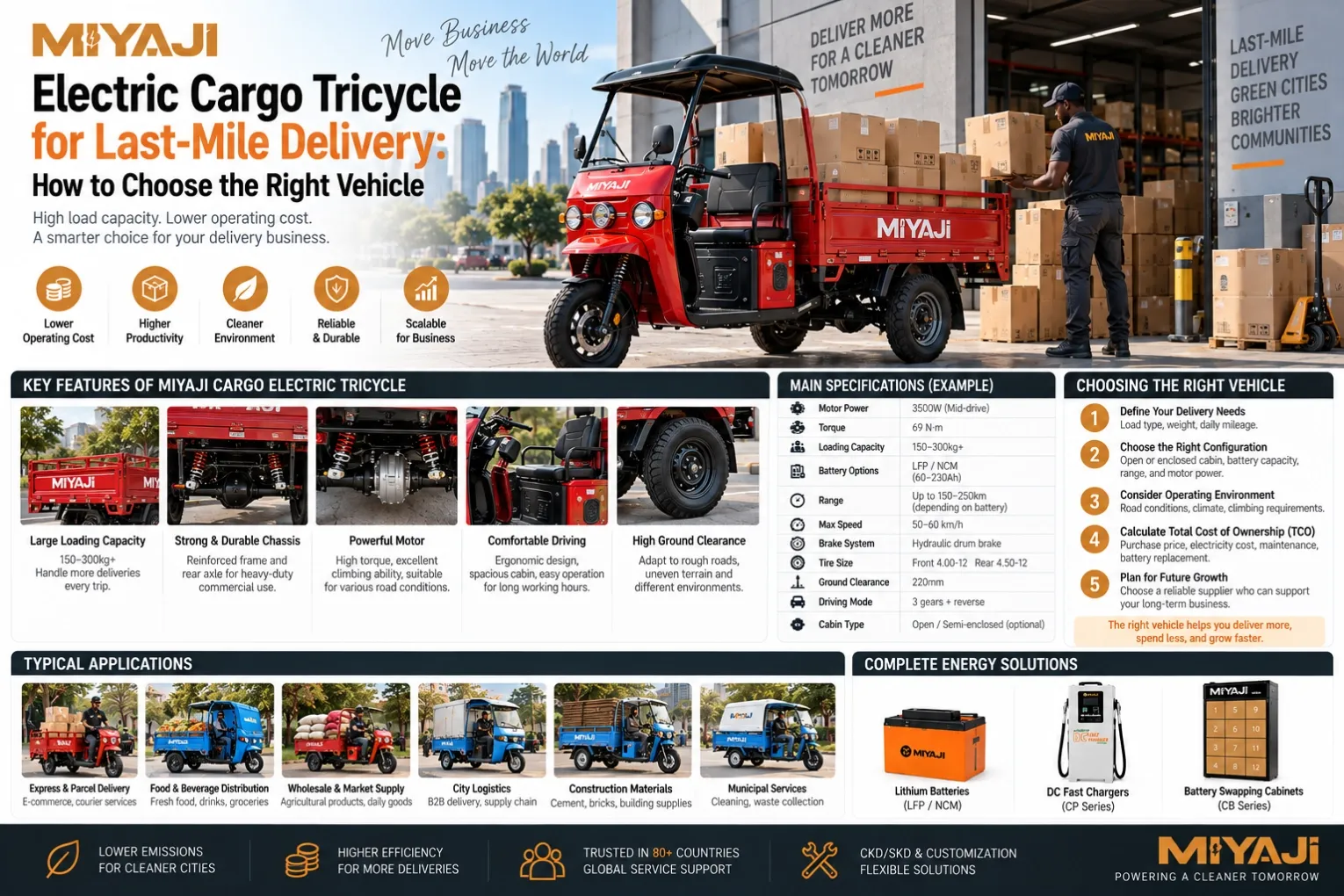
Electric Cargo Tricycle for Last-Mile Delivery: How to Choose the Right Vehicle
Last-mile delivery creates a difficult vehicle requirement.
Vehicles may need to:
- Start and stop frequently
- Carry changing payloads
- Operate for many hours
- Navigate dense urban areas
- Complete multiple delivery rounds
- Keep energy and maintenance costs under control
For some operations, vans may provide more capacity than necessary, while two-wheel motorcycles may not provide enough cargo space.
This is where an electric cargo tricycle can become an interesting commercial option.
But selecting the right vehicle requires more than comparing:
Payload + Range + Price
A commercial delivery vehicle should be evaluated as an operating asset.
The correct process is:
Delivery Operation
→ Cargo Requirement
→ Route
→ Payload
→ Vehicle
→ Battery
→ Energy Strategy
→ Fleet Management
→ TCO
What Is an Electric Cargo Tricycle?
An electric cargo tricycle is a three-wheel electric vehicle designed primarily for transporting goods.
Depending on its design, it can be used for:
- Parcel delivery
- Food distribution
- Grocery delivery
- Retail distribution
- Warehouse logistics
- Local freight
- Industrial transport
- Utility services
Different cargo bodies can be configured around different commercial applications.
Why Use a Three-Wheel EV for Last-Mile Delivery?
Last-mile logistics often involves relatively short trips combined with frequent stops.
An electric cargo tricycle can offer a different operating profile from both motorcycles and larger delivery vehicles.
Potential advantages include:
- More cargo space than a two-wheel motorcycle
- Smaller footprint than many vans
- Electric drivetrain
- Flexible cargo-body design
- Commercial fleet connectivity
- Different charging or battery strategies
But whether it makes financial sense depends on the route and business model.
Electric Cargo Tricycle vs Electric Motorcycle
A two-wheel motorcycle may be preferable when:
- Parcels are small
- Traffic maneuverability is critical
- Delivery density is high
- Payload is limited
A cargo tricycle may become more attractive when:
- Cargo volume increases
- Payload increases
- More parcels need to be carried per trip
- Vehicle stability at low speed is valuable
- A dedicated cargo body is required
The correct question is not:
Which vehicle is better?
It is:
Which vehicle produces the best delivery economics for this route?
Electric Cargo Tricycle vs Delivery Van
A delivery van provides significantly more capacity.
But not every delivery route needs that capacity.
For short-distance urban distribution, buyers may want to evaluate:
- Vehicle acquisition cost
- Energy consumption
- Parking requirements
- Cargo utilization
- Route accessibility
- Maintenance
- Driver requirements
A smaller vehicle can be commercially attractive when a larger vehicle would operate with low cargo utilization.
1. Define the Delivery Operation
Before choosing a vehicle, collect actual operating data.
Start with:
Daily Distance
How many kilometers does each vehicle travel?
Deliveries per Day
How many stops are completed?
Average Route Length
How long is each delivery round?
Operating Hours
One shift or multiple shifts?
Depot Return
Does the vehicle return to a central location during the day?
These parameters determine the vehicle and battery strategy.
2. Understand What You Are Carrying
Cargo is not simply measured in kilograms.
A delivery operation needs to understand both:
Payload
and
Cargo Volume
For example:
Parcel Delivery
May require high volume but relatively moderate weight.
Beverage Distribution
May create much higher payload.
Grocery Delivery
May require a combination of volume, weight and compartment organization.
Food Delivery
May require specialized boxes or thermal management.
Therefore cargo-body design should follow the actual goods.
3. Payload vs Maximum Payload
Commercial buyers should distinguish between:
Typical Operating Payload
and
Maximum Payload
If a vehicle can technically carry a certain maximum load, that does not mean it should operate at that load throughout every shift.
The typical operating payload is more useful for:
- Energy calculations
- Range estimates
- Suspension configuration
- Tire selection
- Maintenance planning
4. Choose the Right Cargo Body
Electric cargo tricycles can use different body configurations.
Open Cargo Box
Suitable for general goods and flexible loading.
Enclosed Cargo Box
Useful for:
- Parcels
- Retail goods
- Weather-sensitive cargo
It can also provide greater cargo security.
Flatbed
Useful for irregular or larger goods.
Tipping / Dump Body
Useful for certain utility and material-handling applications.
Customized Cargo Body
Can be designed around specific dimensions or workflows.
Cargo Volume Can Affect Productivity
Imagine Vehicle A can carry:
30 parcels per trip
while Vehicle B can carry:
50 parcels per trip.
If both serve the same route, Vehicle B may reduce the number of depot returns.
That can affect:
- Daily mileage
- Driver time
- Energy consumption
- Deliveries per shift
Therefore the cheapest vehicle is not always the most productive one.
5. Loading and Unloading Matter
Last-mile vehicles stop frequently.
If the driver saves even a small amount of time at every stop, the effect can accumulate across an entire shift.
Cargo design should consider:
- Door position
- Door opening
- Cargo-floor height
- Side access
- Rear access
- Internal organization
- Parcel visibility
Vehicle productivity is partly a workflow-design problem.
6. Choose the Right Motor
Motor selection should consider:
- Vehicle curb weight
- Typical payload
- Maximum payload
- Required speed
- Gradient
- Acceleration
- Wheel size
Do not choose motor power based only on the largest available wattage.
The objective is to provide sufficient commercial performance without unnecessarily increasing energy consumption or system cost.
Motor Power vs Torque
Motor power and torque describe different characteristics.
For a loaded delivery tricycle, sufficient low-speed performance can be important when:
- Starting with cargo
- Climbing gradients
- Operating in stop-and-go traffic
The complete drivetrain should therefore be evaluated rather than comparing wattage alone.
7. Route Gradient
If delivery routes include hills, test the vehicle under realistic payload.
Ask:
What load was used during the hill-climbing test?
What battery SOC was used?
At what speed?
What road conditions?
This provides much more useful information than a single advertised climbing-angle figure.
8. Select the Battery From the Duty Cycle
Battery sizing should start with:
How much energy does the vehicle actually need between replenishment opportunities?
A simplified formula is:
Energy Requirement = Distance × Energy Consumption
For example, suppose a hypothetical cargo tricycle consumes:
80 Wh/km
and needs to travel:
70 km
before it can recharge.
Then:
80 × 70 = 5.6 kWh usable energy
Additional factors must then be considered before selecting final nominal battery capacity.
9. Why Payload Changes Range
A heavily loaded cargo vehicle may consume more energy than the same vehicle operating lightly loaded.
Payload can affect:
- Acceleration demand
- Hill-climbing demand
- Rolling resistance
- Energy consumption
Therefore range testing should ideally include realistic cargo.
A brochure test with an unloaded vehicle may not represent commercial operation.
10. Don't Oversize the Battery
A larger battery provides more energy.
But it also adds:
- Weight
- Cost
- Space
- Charging time
If the vehicle returns to a depot several times per day, carrying enough battery for the entire day's mileage may be unnecessary.
This is why:
Daily Mileage ≠ Required Single-Charge Range
11. LFP vs NMC for Cargo Tricycles
Both chemistries can be considered.
LFP
May be attractive when priorities include:
- Frequent cycling
- Commercial durability
- Cost
- Thermal stability characteristics
NMC
May be attractive when:
- Battery weight is constrained
- Battery space is limited
- Higher energy density is required
Because cargo tricycles can often accommodate larger battery compartments, LFP may be practical for many commercial applications.
The specific cell still needs to be evaluated.
12. Charging Strategy for Delivery Fleets
Delivery fleets can use different charging models.
Overnight Depot Charging
Suitable when vehicles return to a depot and have sufficient overnight downtime.
Opportunity Charging
Vehicles recharge during:
- Lunch breaks
- Loading periods
- Shift changes
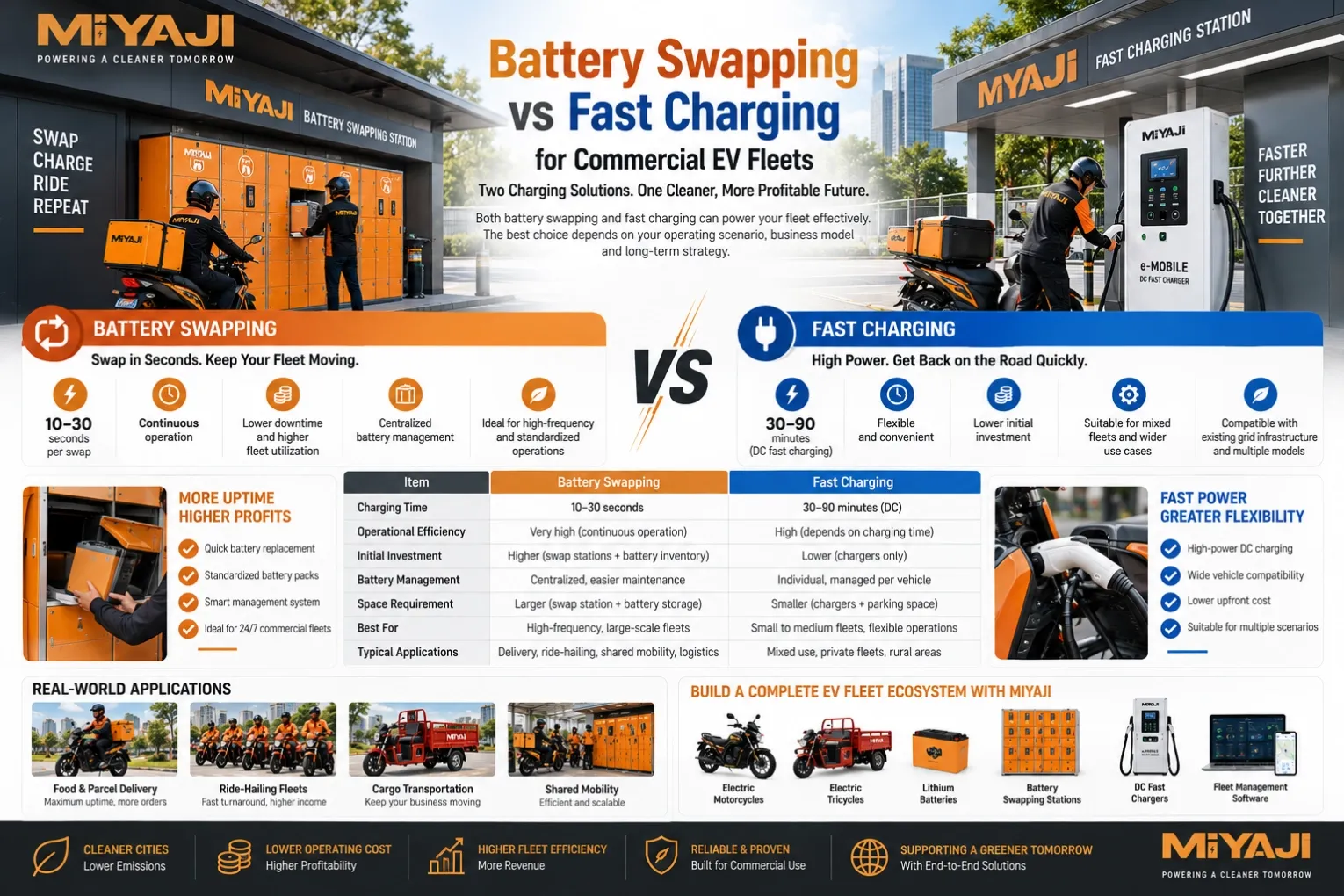
Fast Charging
Useful where shorter charging stops are required and the battery system supports higher charging power.
Battery Swapping
Can reduce energy-replenishment downtime when the vehicle architecture and operation support swapping.
13. Depot Charging
Depot charging can be operationally simple when:
- Vehicles return every night
- Routes are predictable
- Batteries have sufficient daily energy
- Electrical capacity is available
But operators should calculate:
Total simultaneous charging demand
A fleet of many vehicles charging at the same time can create significant electrical requirements.
14. Fast Charging
Fast charging can reduce downtime but requires a coordinated system.
The chain is:
Cell
→ PACK
→ BMS
→ Connector
→ Fast Charger
→ Electrical Infrastructure
All parts must support the charging strategy.
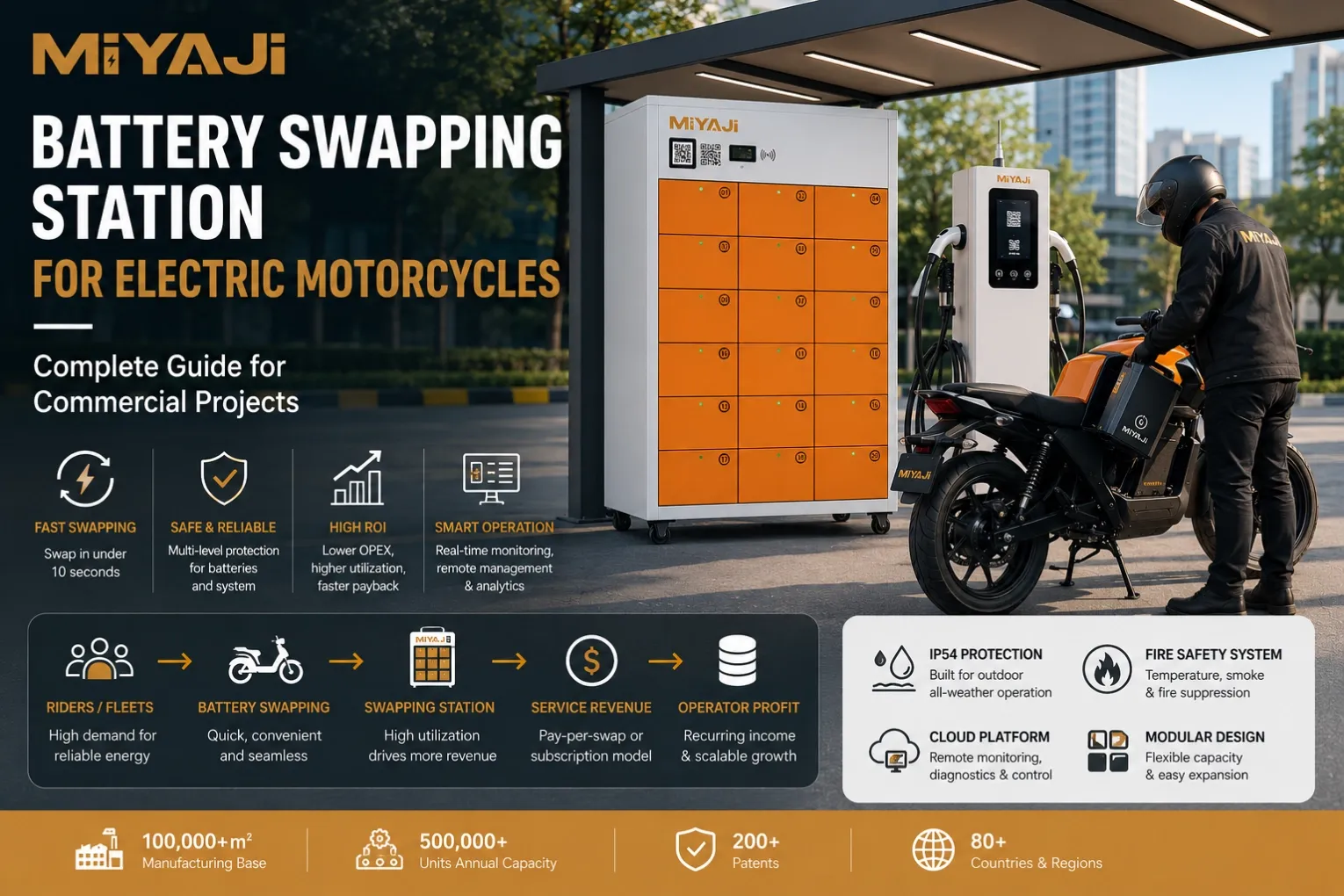
15. Battery Swapping for Cargo Tricycles
Swapping can be useful for high-utilization operations.
But tricycle batteries can be much larger than motorcycle batteries.
Therefore buyers need to consider:
- Battery weight
- Module quantity
- Manual handling
- Mechanical interface
- Swap time
- Battery inventory
A modular battery architecture may be more practical than manually moving one very large battery.
16. Hybrid Energy Strategy
Some commercial fleets may benefit from supporting more than one energy-replenishment method.
For example:
Normal Charging
for overnight energy replenishment
-
Fast Charging or Swapping
for high-utilization periods.
The objective is not to use every technology.
It is to maintain fleet uptime economically.
17. Frame Durability
Cargo vehicles place significant loads on the chassis.
Important areas include:
- Main frame
- Rear structure
- Cargo mounting points
- Welding
- Suspension mounts
A vehicle designed primarily for light personal use may not be appropriate for intensive commercial cargo operation.
18. Suspension
Suspension should be configured around actual payload.
An overloaded or poorly matched suspension can affect:
- Vehicle stability
- Driver comfort
- Tire wear
- Component life
- Cargo protection
Commercial buyers should evaluate the vehicle when loaded.
19. Brakes
A loaded cargo tricycle requires appropriate braking performance.
The braking system should be evaluated under:
- Typical payload
- Maximum intended load
- Normal operating speed
Maintenance accessibility and replacement-part availability should also be considered.
20. Tires
Tires are a recurring fleet expense.
Evaluate:
- Load capability
- Wear
- Size
- Local availability
- Replacement cost
For international fleets, using difficult-to-source tire sizes can create unnecessary downtime.
21. Ground Clearance
Ground clearance should match the operating route.
Higher clearance may help with uneven surfaces, but it must be balanced with:
- Vehicle stability
- Cargo-floor height
- Center of gravity
Do not maximize one specification without considering the whole vehicle.
22. Driver Cabin
Depending on the vehicle, a cabin can provide:
- Weather protection
- Driver comfort
- Storage
- Improved working conditions
For drivers spending long hours on the road, ergonomics can affect productivity.
Evaluate:
- Visibility
- Seating
- Controls
- Entry/exit
- Ventilation
23. Safety Equipment
Depending on vehicle design and local requirements, safety-related features may include:
- Lighting
- Mirrors
- Seat belts where applicable
- Parking brake
- Reverse warning
- Camera or sensors
- Vehicle diagnostics
Final requirements should be confirmed for the destination market.
24. Fleet Software
When operating dozens or hundreds of cargo tricycles, software becomes increasingly valuable.
A fleet platform can potentially monitor:
Vehicle
- Location
- Mileage
- Status
- Faults
Battery
- SOC
- SOH
- Temperature
- Alerts
Operations
- Route activity
- Vehicle utilization
- Charging
- Maintenance
This can help operators identify underutilized vehicles or recurring problems.
25. Battery Data for Delivery Operations
Battery data can also help answer operational questions.
For example:
Which routes consume the most energy?
Which vehicles return with very low SOC?
Which batteries behave abnormally?
Which drivers consistently consume more energy?
This turns battery management into an operational tool.
26. Maintenance
Delivery vehicles can accumulate mileage quickly.
Preventive maintenance should cover areas such as:
- Tires
- Brakes
- Suspension
- Steering
- Electrical connections
- Battery
- Charging connector
- Motor/drivetrain
Maintenance should be planned around commercial usage rather than only calendar time.
27. Spare Parts
Before deploying a fleet, determine:
Fast-Moving Parts
and
Critical Parts
The objective is to avoid a situation where a low-cost component keeps an entire vehicle out of operation for weeks.
28. Calculate Delivery Vehicle TCO
For a cargo fleet:
TCO = Vehicle + Battery + Energy + Infrastructure + Maintenance + Spare Parts + Downtime + Financing − Residual Value
But logistics operators can go further.
A particularly useful KPI is:
Cost per Delivery
Cost per Delivery
A simplified calculation is:
Total Operating Cost ÷ Number of Completed Deliveries
This connects the vehicle directly to logistics productivity.
Another useful metric is:
Cost per Kilometer
But a vehicle with a slightly higher cost per kilometer may still perform better if it completes substantially more deliveries per shift.
29. Deliveries per Shift
Commercial buyers should evaluate:
- Cargo capacity
- Route speed
- Loading time
- Charging downtime
- Maintenance downtime
because all of these affect:
Deliveries per Shift
This is ultimately more commercially meaningful than top speed alone.
30. Vehicle Uptime
If a delivery vehicle cannot operate, it cannot deliver.
Downtime may result from:
- Maintenance
- Charging
- Battery faults
- Tire problems
- Missing spare parts
- Electrical failures
Therefore:
Uptime should be treated as a financial metric.
31. Electric Cargo Tricycle Fleet Pilot
Before ordering a large fleet, test the vehicle in real operations.
A pilot can measure:
Route
- km/day
- Stops/day
- Average speed
Cargo
- Typical payload
- Maximum payload
- Volume utilization
Energy
- Wh/km
- kWh/day
- Charging time
- SOC pattern
Vehicle
- Reliability
- Maintenance
- Tire wear
- Brake wear
Business
- Deliveries/day
- Cost/km
- Cost/delivery
- Uptime
This provides the data needed for scale.
32. Pilot With Real Cargo
Do not evaluate a commercial cargo vehicle only with an empty test drive.
Test it with:
- Representative cargo weight
- Actual route
- Real delivery stops
- Typical driver
This gives much more useful data for procurement.
33. CBU vs CKD for Cargo Tricycle Projects
For initial deployment, CBU may be appropriate.
As fleet demand grows, buyers may evaluate:
SKD
or
CKD
for local assembly.
The business case should consider:
- Logistics
- Import duties
- Local labor
- Factory investment
- Quality control
- Local-content requirements
- Annual volume
CKD is a manufacturing strategy, not simply a shipping method.
34. Cargo Body Localization
One interesting localization strategy is to import core vehicle systems while manufacturing or sourcing certain cargo structures locally.
Depending on the project and engineering requirements, this can potentially help adapt the vehicle to:
- Local cargo dimensions
- Business requirements
- Local body styles
However, structural changes must be properly engineered and validated.
35. What Should You Ask an Electric Cargo Tricycle Manufacturer?
Before purchasing, ask:
Vehicle
- What is the vehicle architecture?
- What motor/controller is used?
- What braking system?
- What suspension?
Cargo
- Typical payload?
- Maximum rated payload?
- Cargo dimensions?
- Custom body options?
Battery
- Chemistry?
- Capacity?
- BMS?
- Charging?
- Swapping?
Testing
- Under what payload is range tested?
- Under what conditions is hill performance tested?
Commercial Support
- Spare parts?
- Technical training?
- Software?
- CKD?
- Local assembly?
This separates commercial procurement from simple price shopping.
Electric Cargo Tricycle Procurement Checklist
Requirement | Your Project Data |
|---|---|
Country / City | ______ |
Application | ______ |
Initial Fleet Size | ______ |
Future Fleet Size | ______ |
Daily Mileage | ______ km |
Deliveries per Day | ______ |
Typical Payload | ______ kg |
Maximum Payload | ______ kg |
Cargo Volume | ______ |
Operating Hours | ______ |
Required Speed | ______ |
Route Gradient | ______ |
Battery Strategy | Fixed / Swap |
Charging | Standard / Fast / Swap |
Cargo Body | ______ |
Software | ______ |
Supply | CBU / SKD / CKD |
This is the information a manufacturer needs to configure a commercial vehicle properly.
How MIYAJI Approaches Electric Cargo Tricycle Projects
MIYAJI develops commercial electric mobility around the complete operating system rather than the vehicle alone.
Depending on project requirements, a cargo fleet can combine:
Electric Cargo Tricycles
-
Lithium Battery Systems
-
Battery Cells & BMS
-
Fast Charging
-
Battery Swapping
-
Fleet & Energy Management Software
-
OEM / CKD & Local Production
The vehicle configuration can be developed around:
- Payload
- Cargo volume
- Route
- Daily mileage
- Operating hours
- Energy strategy
- Fleet size
- Local production requirements
The goal is to build a vehicle and energy configuration around the logistics operation.
Planning an Electric Cargo Tricycle Fleet?
Tell us:
Country / City
Delivery Application
Initial Fleet Quantity
Future Fleet Target
Daily Mileage
Deliveries per Day
Typical Payload
Maximum Payload
Cargo Dimensions
Route Conditions
Charging / Swapping Preference
CBU / CKD Requirements
From these inputs, the project can be evaluated across:
Vehicle
→ Cargo
→ Battery
→ Energy
→ Software
→ TCO
Discuss Your Cargo Fleet Requirements
Frequently Asked Questions
What is an electric cargo tricycle?
An electric cargo tricycle is a three-wheel electric vehicle designed primarily for commercial goods transportation, delivery and local logistics.
Are electric cargo tricycles suitable for last-mile delivery?
They can be suitable where cargo volume, payload, route, vehicle size and operating economics match the delivery operation.
How much weight can an electric cargo tricycle carry?
Payload varies significantly by model and vehicle design. Buyers should evaluate rated payload together with frame, suspension, brakes, tires and operating conditions.
How far can an electric cargo tricycle travel?
Range depends on battery energy, payload, route, speed, temperature and vehicle efficiency. Buyers should request range data under relevant load and test conditions.
What battery is best for an electric cargo tricycle?
The correct battery depends on daily energy demand, payload, battery space, charging strategy and operating conditions. Both LFP and NMC can be considered.
Can an electric cargo tricycle use fast charging?
Yes, when the cells, battery PACK, BMS, connector and charger are designed for the required charging rate.
Can cargo tricycles use battery swapping?
Yes, but battery weight and module design are especially important. Large batteries may require a modular swapping architecture.
Is an electric cargo tricycle cheaper than a delivery van?
Not universally. The correct comparison should include acquisition, energy, maintenance, cargo utilization, productivity and total cost of ownership.
What should logistics companies measure during a pilot?
Important metrics include payload, Wh/km, deliveries per day, charging time, maintenance, vehicle uptime, cost per kilometer and cost per delivery.
Can MIYAJI provide CKD electric cargo tricycles?
Commercial projects can be structured around CBU, SKD or CKD supply and local-production requirements depending on project scope.
#21 的内部链接要认真做
这篇不是孤立文章。建议正文自然链接到:
Electric Tricycle Buying Guide → #20
How to Choose Battery Capacity → #10
LFP vs NMC → #15
Battery Swapping vs Fast Charging → #04
Electric Motorcycle TCO → #11(后面最好再补一篇专门的 tricycle TCO)
CKD vs CBU → #12
Fleet Management Software → #06
这样 Cargo Tricycle 开始进入你原本已经搭好的 Battery / Energy / Software / Manufacturing 网络。