Sep 5, 2026Product & Industry Knowledge
72V Lithium Battery for Electric Motorcycles & Tricycles: How to Choose
Learn how to choose a 72V lithium battery for electric motorcycles and tricycles based on capacity, range, motor power, payload, LFP vs NMC, charging and swapping.
72V Lithium Battery for Electric Motorcycles and Tricycles: How to Choose the Right Capacity
A 72V lithium battery is widely used in electric motorcycles, electric tricycles and other light electric vehicles.
But specifying only:
“I need a 72V battery.”
is not enough to select the correct battery.
Two 72V battery systems can have very different:
- Energy capacity
- Current capability
- Weight
- Dimensions
- Range
- Charging performance
- Cycle characteristics
- BMS configuration
A commercial vehicle battery should therefore be selected as part of the complete vehicle system.
The basic process is:
Vehicle
→ Motor & Controller
→ Daily Mileage
→ Payload
→ Energy Requirement
→ 72V Battery Capacity
→ Charging / Swapping
→ BMS & PACK Configuration
This guide explains how to select a 72V lithium battery for commercial electric motorcycles and tricycles.
What Does “72V Lithium Battery” Mean?
72V describes the nominal voltage class of the battery system.
It does not describe how much energy the battery stores.
For example:
72V 30Ah
and
72V 100Ah
are both 72V-class batteries, but their nominal energy is very different.
Using the simplified formula:
Nominal Energy (Wh) ≈ Nominal Voltage × Capacity (Ah)
a 72V 30Ah battery contains approximately:
72 × 30 = 2,160 Wh ≈ 2.16 kWh
while a 72V 100Ah battery contains approximately:
72 × 100 = 7,200 Wh ≈ 7.2 kWh
This is why voltage alone cannot tell you the expected range or application.
Understanding 72V Battery Capacity
Battery capacity is commonly expressed in ampere-hours.
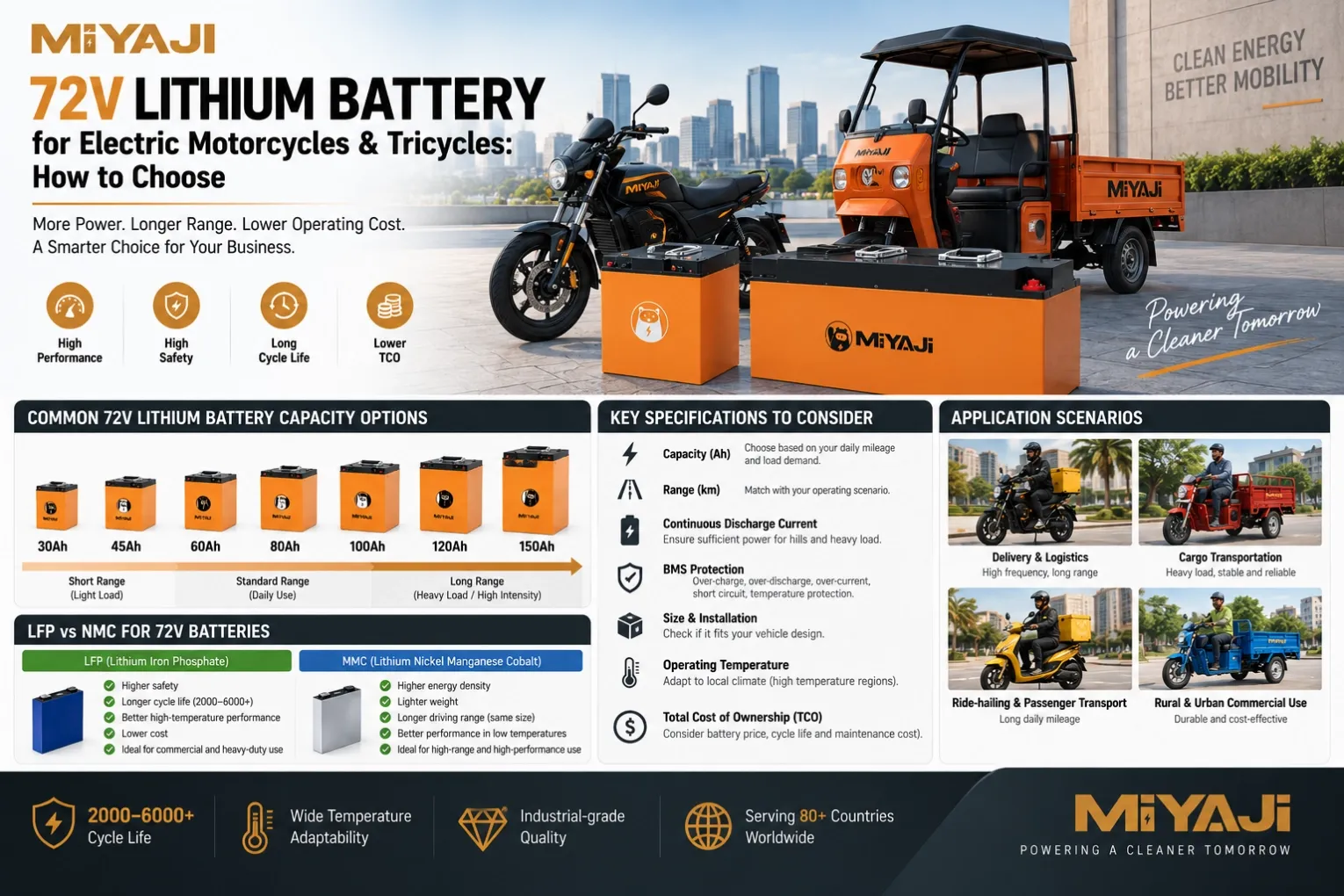
Typical commercial vehicle configurations may fall into different capacity classes depending on the application.
For example:
Nominal Battery | Approx. Nominal Energy* | Possible Application Direction |
|---|---|---|
72V 30Ah | 2.16 kWh | Lighter-duty / shorter-range applications |
72V 40Ah | 2.88 kWh | Light motorcycle applications |
72V 50Ah | 3.60 kWh | Motorcycle applications |
72V 60Ah | 4.32 kWh | Commercial motorcycle applications |
72V 80Ah | 5.76 kWh | Higher-energy vehicle applications |
72V 100Ah | 7.20 kWh | Long-range / heavier commercial applications |
72V 120Ah | 8.64 kWh | Higher-energy commercial applications |
72V 160Ah | 11.52 kWh | Larger vehicle / tricycle applications |
72V 230Ah | 16.56 kWh | High-energy commercial vehicle applications |
*Simplified nominal calculation using 72V × Ah. Actual battery voltage architecture and usable energy depend on chemistry, cell configuration and BMS design.
The right-hand column is intentionally broad.
A 72V 60Ah battery should not be marketed as automatically belonging to one specific motorcycle or range.
Vehicle consumption determines suitability.
72V 30Ah vs 60Ah vs 100Ah: What Actually Changes?
As Ah increases at the same nominal voltage, the battery generally stores more energy.
For example:
72V 30Ah ≈ 2.16 kWh
72V 60Ah ≈ 4.32 kWh
72V 100Ah ≈ 7.20 kWh
But increasing capacity may also affect:
- Battery dimensions
- Weight
- Cell quantity
- Cost
- Charging time
- Vehicle packaging
Therefore:
Larger capacity is not automatically better.
The objective is to carry enough energy for the operating requirement without adding unnecessary cost and weight.
How Much Range Can a 72V Battery Provide?
There is no fixed answer.
A 72V 60Ah battery does not automatically mean:
100 km
or:
150 km
of range.
Range depends on the usable battery energy and vehicle consumption.
A simplified relationship is:
Estimated Range = Usable Battery Energy ÷ Vehicle Energy Consumption
For example, suppose a vehicle has 4.0 kWh of usable energy and consumes an average of 40 Wh/km under a particular operating condition.
The simplified estimate would be:
4,000 ÷ 40 = 100 km
If the same vehicle consumes:
55 Wh/km
the estimate becomes:
4,000 ÷ 55 ≈ 73 km
This demonstrates why battery capacity alone cannot guarantee range.
What Affects Electric Motorcycle Energy Consumption?
Actual Wh/km can change according to:
- Vehicle weight
- Rider weight
- Cargo
- Speed
- Acceleration
- Traffic
- Gradient
- Tire pressure
- Motor efficiency
- Controller efficiency
- Weather
- Riding behavior
For commercial fleet projects, battery sizing should therefore use realistic operating data rather than brochure range alone.
How to Choose a 72V Battery for an Electric Motorcycle
Start with the vehicle's operating requirements.
1. Daily Mileage
How far does the motorcycle travel each day?
For example:
60 km/day
and
180 km/day
represent very different energy requirements.
But daily mileage still does not automatically determine battery size.
You also need to know how often energy can be replenished.
2. Distance Between Charging or Swapping
This is often more important than total daily mileage.
Imagine a delivery motorcycle travels:
180 km/day
but can swap its battery every:
60 km
The battery does not necessarily need enough energy for the full 180 km.
The relevant design requirement is closer to:
Required operating distance between replenishment events
This can dramatically change battery size, weight and cost.
3. Motor Power
Battery capacity and motor power are related but they are not the same thing.
A higher-power motor may require greater current during:
- Acceleration
- Hill climbing
- High-speed operation
- Heavy loading
Therefore a 72V battery must support both:
Energy Requirement
and
Power Requirement
A battery with sufficient Ah can still be unsuitable if its cells, BMS or connectors cannot provide the required current.
4. Payload
Commercial motorcycles may carry:
Rider + Passenger
or:
Rider + Cargo
Additional payload can increase energy consumption, particularly during acceleration and hill climbing.
Battery sizing should therefore use the expected commercial load.
5. Operating Hours
A motorcycle operating:
8 hours/day
may require a different energy strategy from one operating:
16–20 hours/day across multiple shifts.
High-utilization vehicles may benefit from:
- Battery swapping
- Fast charging
- Multiple batteries
instead of simply installing a very large battery.
How to Choose a 72V Battery for an Electric Tricycle
Electric tricycles can create significantly different battery requirements.
Compared with a two-wheel motorcycle, a tricycle may have:
- Greater vehicle weight
- Higher payload
- Larger motor
- Higher rolling resistance
- Longer operating hours
- Passenger or cargo body structures
Therefore a battery that performs well in a motorcycle may provide very different range in a tricycle.
Cargo Electric Tricycles
For cargo applications, evaluate:
- Vehicle curb weight
- Typical payload
- Maximum payload
- Daily mileage
- Route gradient
- Stop frequency
- Motor power
A cargo vehicle may operate empty for part of the route and heavily loaded for another part.
The battery should be evaluated under realistic commercial conditions.
Passenger Electric Tricycles
Passenger tricycles have another variable:
Passenger load changes throughout the day.
The battery calculation should consider:
- Typical occupancy
- Maximum occupancy
- Daily mileage
- Route
- Traffic
- Average speed
- Gradient
- Auxiliary electrical loads
For commercial passenger operations, actual field testing is particularly useful.
72V LFP vs 72V NMC Battery
A 72V battery can be built using different lithium-ion chemistries.
Two common options are:
LFP
Lithium Iron Phosphate
NMC / NCM
Nickel Manganese Cobalt
The chemistry changes the underlying cell voltage characteristics, which means the actual series configuration and charging voltage will differ.
Therefore:
A “72V LFP battery” and a “72V NMC battery” should not be assumed to use identical chargers or cell configurations.
This is important.
Why Charging Voltage Matters
The charger must match the actual battery chemistry and series configuration.
The correct charging voltage depends on:
- Cell chemistry
- Number of cells in series
- Cell charging limits
- BMS configuration
Therefore a buyer should never select a charger simply because both products are labeled:
72V
The battery manufacturer should confirm the correct charger specification.
LFP for 72V Commercial EV Systems
LFP can be attractive for commercial applications where priorities include:
- Frequent cycling
- Durability
- Thermal stability characteristics
- Long-term commercial use
It may be particularly suitable where the vehicle has enough space to accommodate the required battery energy.
NMC for 72V Commercial EV Systems
NMC can be attractive where:
- Battery weight is important
- Battery space is limited
- Higher energy density is needed
This can be useful for motorcycle applications where packaging is more constrained.
Neither chemistry is universally better.
The decision should be based on the vehicle and duty cycle.
72V Battery and BMS Selection
A 72V battery requires a BMS matched to the actual battery architecture.
The BMS should be selected according to factors such as:
- Chemistry
- Series configuration
- Capacity
- Continuous current
- Peak current
- Charging current
- Temperature monitoring
- Communication requirements
For commercial EV applications, the BMS may also communicate with:
- Vehicle
- Charger
- Swap cabinet
- Cloud platform
Don't Choose a BMS Based Only on Voltage
Two 72V batteries may require different BMS specifications.
For example:
Battery A
72V-class system
Lower-power motorcycle
and
Battery B
72V-class system
Higher-power cargo vehicle
may require different current capabilities.
Therefore BMS selection should consider:
Voltage + Current + Chemistry + Communication + Application
72V Battery for Fast Charging
If the project requires fast charging, battery design must consider more than capacity.
The complete system should evaluate:
Cell
→ PACK
→ BMS
→ Connector
→ Charger
→ Thermal Conditions
The charging power should remain within the limits of the battery system.
Simply using a larger charger does not make a standard battery a fast-charging battery.
72V Battery for Battery Swapping
A 72V battery can also be designed for battery swapping.
In this case, the battery should be compatible with:
- Vehicle battery compartment
- Mechanical locking
- Electrical connector
- BMS communication
- Swap cabinet
- Charging module
- Software platform
For manual swapping, battery weight and ergonomics become especially important.
Bigger Batteries Can Create a Swapping Problem
Suppose increasing battery capacity significantly increases battery weight.
That may improve range.
But if riders need to manually remove and carry the battery, the heavier design may reduce operational convenience.
Therefore a swapping battery needs to balance:
Range
↔ Weight
↔ Swap Frequency
↔ Charging Time
↔ Cost
This is different from designing a fixed battery.
One Large Battery vs Two Smaller Batteries
Some electric motorcycles can use two battery modules.
For example, instead of one large battery, the vehicle may use:
Battery A + Battery B
Potential advantages can include:
- Easier handling
- Modular range
- Flexible swapping
- Standardized battery modules
But dual-battery systems also require appropriate:
- Electrical architecture
- BMS coordination
- Connectors
- Vehicle packaging
The correct architecture depends on the project.
72V Battery Charging Time
Charging time depends mainly on:
- Battery energy
- Charger power
- Cell charging capability
- SOC
- Temperature
- BMS limits
A simplified preliminary relationship is:
Charging Time ≈ Energy to Replenish ÷ Charging Power
But real charging is not perfectly linear.
Charging power may reduce as the battery approaches higher SOC or according to battery-management requirements.
Example: Why Capacity Changes Charging Requirements
Consider:
72V 60Ah ≈ 4.32 kWh nominal
versus:
72V 120Ah ≈ 8.64 kWh nominal
The second battery stores approximately twice the nominal energy.
If both use the same charging power, the larger battery will generally require substantially more time to replenish a similar percentage of its capacity.
This is why:
Battery Capacity + Charger Power
should be selected together.
Battery Capacity and Vehicle TCO
Larger batteries cost more.
But smaller batteries may require:
- More charging
- More swapping
- More infrastructure
- More operational interruptions
Therefore the lowest battery price does not necessarily produce the lowest fleet cost.
Commercial buyers should consider:
Vehicle + Battery + Energy Infrastructure + Downtime + Battery Replacement
This connects battery selection directly to Total Cost of Ownership.
Should You Choose 72V 60Ah or 72V 100Ah?
There is no universal answer.
Ask:
How far must the vehicle travel between energy replenishment events?
What is the vehicle's real Wh/km?
What payload does it carry?
What motor/controller is used?
Can the vehicle charge during the day?
Can it swap batteries?
How much battery weight can the vehicle accept?
Only after answering these questions should the capacity be selected.
A Simple 72V Battery Selection Example
Imagine a hypothetical commercial motorcycle.
Required distance between charging events: 80 km
Estimated consumption: 45 Wh/km
Then:
80 × 45 = 3.6 kWh usable energy requirement
The project must then account for:
- Operating reserve
- Usable SOC window
- Battery aging
- Vehicle variation
before determining final nominal battery capacity.
This may point toward a particular capacity class, but the final specification should be validated using the actual vehicle.
A Different Operating Model Can Produce a Different Battery
Now imagine the same motorcycle travels:
160 km/day
but uses battery swapping every:
60–70 km.
It may not need one battery capable of delivering the full 160 km.
Instead, the project could optimize:
Battery Size
-
Battery Inventory
-
Swap Frequency
-
Station Capacity
This is why battery capacity should be designed around the operating model.
Common 72V Battery Selection Mistakes
Choosing by Ah Alone
Ah does not account for voltage or usable energy.
Choosing by Claimed Range
Range depends on actual vehicle consumption and test conditions.
Ignoring Current
Battery energy can be sufficient while current capability is inadequate.
Ignoring Battery Weight
Especially important for motorcycles and swapping.
Assuming All “72V” Chargers Are Compatible
Chemistry and series configuration matter.
Oversizing the Battery
Adds unnecessary weight and cost.
Undersizing the Battery
Creates excessive charging or swapping demand.
Ignoring the Future Fleet
Battery standardization becomes increasingly important as fleet size grows.
72V Battery Selection Framework
For a commercial EV project:
1. Vehicle Type
Motorcycle / Passenger Tricycle / Cargo Tricycle
↓
2. Motor & Controller
Determine voltage and current requirements
↓
3. Operating Requirement
Mileage / Hours / Payload
↓
4. Estimate Wh/km
↓
5. Determine Distance Between Replenishment
↓
6. Calculate Required Usable Energy
↓
7. Select Chemistry
LFP / NMC
↓
8. Select Capacity Class
↓
9. Confirm Current Capability
↓
10. Design BMS & PACK
↓
11. Select Charging / Swapping System
↓
12. Test on the Vehicle
This is a much safer procurement process than:
“Send me your price for 72V 100Ah.”
How MIYAJI Approaches 72V Battery Projects
MIYAJI supports 72V battery configurations for different commercial EV applications.
Depending on the project, the battery system can be developed around:
Electric Motorcycles
Passenger Electric Tricycles
Cargo Electric Tricycles
Commercial Fleets
Fast Charging
Battery Swapping
Battery configurations can use different:
- Chemistries
- Cell formats
- Capacities
- BMS specifications
- Charging architectures
according to the vehicle and operating requirements.
MIYAJI can also support different levels of the battery supply chain, including:
Battery Cells
→ BMS
→ PACK
→ Vehicle Integration
→ Charging / Swapping
The objective is not simply to supply a 72V battery.
It is to configure the battery correctly for the commercial application.
Need a 72V Battery Configuration?
Instead of sending only:
“I need 72V 100Ah.”
send:
Vehicle Type
Motor Power
Daily Mileage
Required Range Between Charging/Swapping
Typical Payload
Maximum Payload
Battery Compartment Dimensions
Charging Method
Target Market
Required Quantity
From these inputs, the battery configuration can be evaluated around:
Voltage
→ Capacity
→ Chemistry
→ Cell
→ BMS
→ PACK
→ Charging / Swapping
Discuss Your 72V Battery Requirements
Frequently Asked Questions
What is a 72V lithium battery?
A 72V lithium battery is a lithium-ion battery system designed around a nominal voltage class of approximately 72V. The actual cell configuration and charging voltage depend on chemistry and battery design.
How many kWh is a 72V 60Ah battery?
Using a simplified nominal calculation:
72 × 60 = 4,320 Wh
or approximately 4.32 kWh nominal energy.
How many kWh is a 72V 100Ah battery?
Using the same simplified calculation:
72 × 100 = 7,200 Wh
or approximately 7.2 kWh nominal energy.
How far can a 72V 60Ah battery go?
There is no fixed range. Range depends on usable battery energy, vehicle energy consumption, payload, speed, terrain, temperature and other operating conditions.
Is 72V 100Ah better than 72V 60Ah?
Not necessarily. A 100Ah battery stores more energy at the same nominal voltage but can also increase weight, size, cost and charging requirements.
Is a 72V battery suitable for an electric tricycle?
Yes, depending on the vehicle's motor, controller, power requirements and operating conditions.
Can a 72V battery use LFP cells?
Yes. A 72V-class battery can be designed using LFP cells, with the appropriate series configuration, BMS and charger.
Can a 72V battery use NMC cells?
Yes. NMC can also be used, but the series configuration and charging voltage differ from LFP.
Can I use the same charger for 72V LFP and 72V NMC batteries?
Do not assume so. The charger must match the actual chemistry, series configuration, BMS and charging-voltage requirements.
Can a 72V battery support fast charging?
Potentially, but the cells, PACK, BMS, connector and thermal design must all support the required charging rate.
Can a 72V battery be used for battery swapping?
Yes. It must be designed for compatibility with the vehicle, mechanical interface, electrical connector, BMS, charging system and swap station.