Sep 2, 2026Product & Industry Knowledge
Electric Motorcycle TCO: How to Calculate the Real Cost of a Commercial EV Fleet
Learn how to calculate electric motorcycle TCO, including vehicle, battery, electricity, maintenance, downtime and infrastructure costs for commercial fleets.
Electric Motorcycle TCO: How to Calculate the Real Cost of a Commercial EV Fleet
When purchasing motorcycles for a commercial fleet, the lowest vehicle price does not always mean the lowest operating cost.
A motorcycle may operate for several years and travel tens of thousands of kilometers during its commercial life.
During that period, the operator may pay for:
Vehicle Purchase
-
Energy
-
Battery
-
Maintenance
-
Spare Parts
-
Charging or Swapping Infrastructure
-
Downtime
-
Financing
−
Residual Value
Together, these costs form the vehicle's Total Cost of Ownership (TCO).
For fleet operators, delivery companies, passenger transport operators and mobility projects, TCO can provide a much more useful comparison than purchase price alone.
This guide explains how to calculate commercial electric motorcycle TCO and how to compare different vehicle and energy configurations.
What Is Total Cost of Ownership?
Total Cost of Ownership estimates the complete cost of owning and operating an asset over a defined period.
For a commercial motorcycle, a simplified model can be written as:
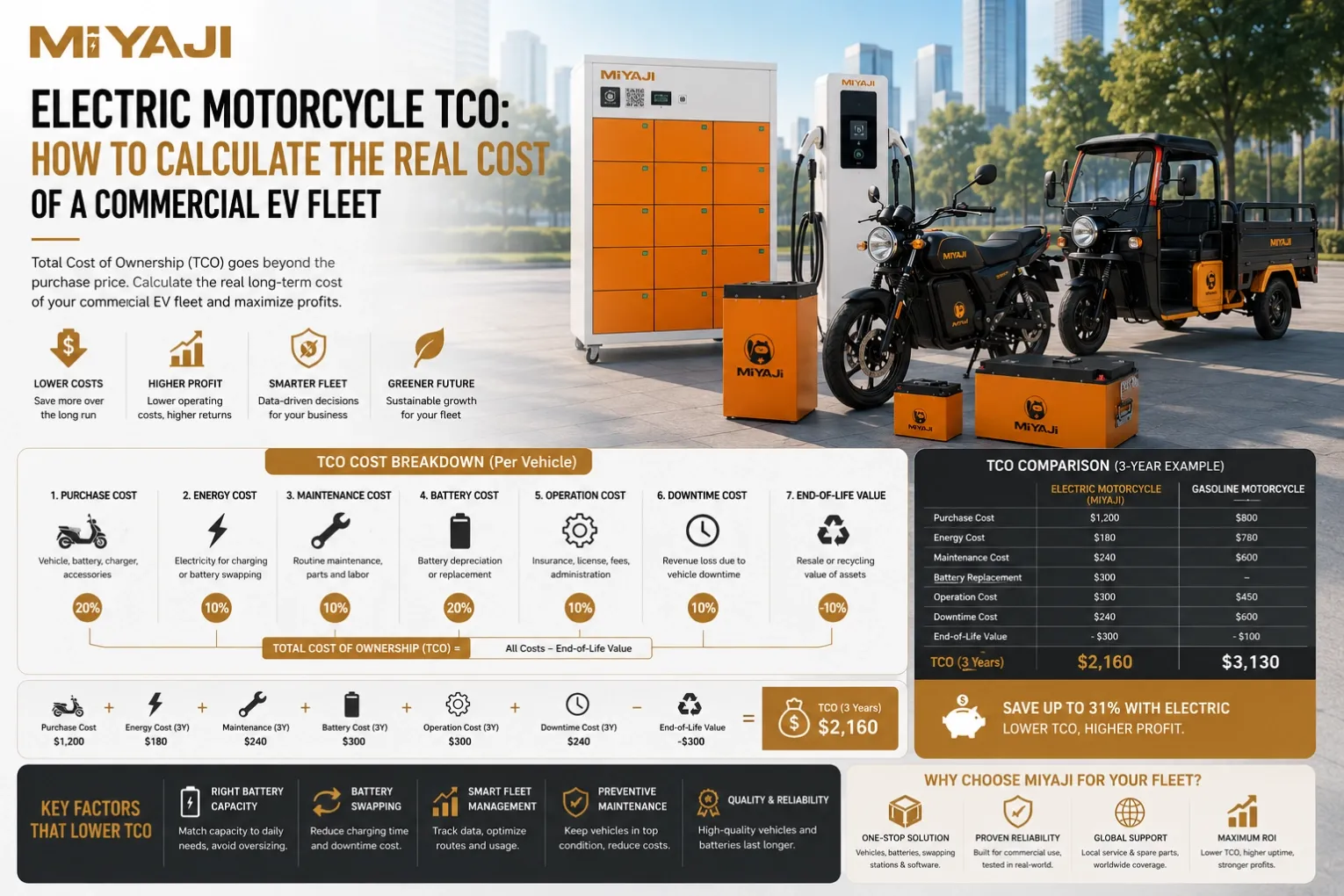
TCO = Acquisition Cost + Energy Cost + Maintenance Cost + Battery Cost + Infrastructure Cost + Operating Costs + Downtime Cost − Residual Value
The exact model can be expanded depending on the project.
For example, a fleet may also include:
- Financing
- Insurance
- Registration
- Taxes
- Software subscriptions
- Fleet management
- Labor
- Site rental
The important point is:
TCO looks beyond the purchase invoice.
Why Purchase Price Alone Can Be Misleading
Consider two hypothetical motorcycles.
Motorcycle A
Purchase price: $1,300
Motorcycle B
Purchase price: $1,600
Looking only at procurement price, Motorcycle A appears cheaper.
But suppose Motorcycle A:
- Consumes more energy
- Requires more maintenance
- Has shorter battery life
- Needs more replacement parts
- Experiences more downtime
while Motorcycle B performs better in these areas.
After several years of commercial operation, Motorcycle B could potentially have the lower total cost.
The opposite could also happen.
That is why:
Purchase Price ≠ Operating Cost ≠ TCO
The Main Components of Electric Motorcycle TCO
For commercial EV projects, it is useful to divide TCO into several categories.
1. Vehicle Acquisition Cost
This is the initial vehicle cost.
Depending on the project, it may include:
- Motorcycle
- Battery
- Charger
- Accessories
- Cargo box
- GPS
- Shipping
- Import costs
- Local assembly
When comparing suppliers, make sure the quotation scope is equivalent.
A motorcycle quoted without a battery cannot be directly compared with a motorcycle quoted with a complete battery and charger.
2. Battery Cost
The battery can represent a significant portion of an electric motorcycle's economics.
Battery-related cost can include:
- Initial battery
- Spare batteries
- Replacement batteries
- Battery maintenance
- Battery logistics
- Battery financing
For battery swapping projects, the fleet may also need a shared battery inventory.
Therefore battery cost should be evaluated at the fleet level, not only per vehicle.
3. Electricity Cost
Electricity cost depends on:
- Vehicle energy consumption
- Daily mileage
- Electricity tariff
- Charging efficiency
- Operating days
A simplified calculation is:
Daily Electricity Cost = Daily Mileage × Energy Consumption × Electricity Price
If consumption is expressed in Wh/km:
Daily Electricity Cost = Daily Mileage × Wh/km ÷ 1,000 × Electricity Price per kWh
For example, consider a hypothetical motorcycle operating:
120 km/day
with estimated consumption of:
45 Wh/km
Daily vehicle energy demand would be:
120 × 45 ÷ 1,000 = 5.4 kWh
If electricity hypothetically costs:
$0.15/kWh
then theoretical energy cost would be:
5.4 × $0.15 = $0.81/day
This example is illustrative only.
Actual electricity prices, vehicle consumption and charging losses vary by market and system.
4. Charging Losses Matter
The amount of electricity purchased from the grid can be higher than the energy eventually delivered to the vehicle.
Losses can occur in:
- Charger
- Battery
- Wiring
- Power conversion
- Thermal management
Therefore a more complete model can use:
Grid Energy Required = Battery Energy Requirement ÷ Charging Efficiency
For preliminary calculations, buyers should use actual system data where available rather than assuming perfect efficiency.
5. Maintenance Cost
Electric motorcycles generally have a different maintenance structure from internal combustion motorcycles.
An electric powertrain does not require some traditional engine-related service items.
However, electric motorcycles still require maintenance.
Possible items include:
- Tires
- Brake components
- Suspension
- Bearings
- Lighting
- Electrical connectors
- Wiring
- Motor
- Controller
- Battery
- BMS
- Body components
The correct question is not:
“Does an electric motorcycle need maintenance?”
It does.
The better question is:
What maintenance will this fleet require per kilometer and per year?
6. Spare Parts Cost
Commercial fleets should include spare parts in the TCO model.
Typical considerations include:
- Wear parts
- Replacement frequency
- Parts price
- Shipping cost
- Local stock
- Supplier lead time
A cheap replacement component is not necessarily cheap if the vehicle remains offline for several weeks waiting for it.
This leads to another important TCO component:
downtime.
7. Vehicle Downtime Cost
Downtime is frequently ignored in vehicle comparisons.
For a private motorcycle, a day without the vehicle may be inconvenient.
For a commercial motorcycle, a day offline may mean:
- Fewer deliveries
- Lost passenger trips
- Lower rider productivity
- Replacement vehicle cost
- Operational disruption
Therefore:
Vehicle Uptime Has Economic Value
A simplified approach is:
Downtime Cost = Offline Days × Estimated Productive Value Lost per Day
This number can vary significantly by business model.
A delivery company and a passenger transport operator may calculate it differently.
8. Battery Replacement Cost
A commercial EV TCO calculation should not assume the battery will perform identically forever.
Battery performance can change over time depending on:
- Cell chemistry
- Cycle use
- Temperature
- Charging strategy
- Depth of discharge
- Operating conditions
- Battery management
Instead of asking only:
“How many cycles does this battery have?”
fleet buyers should ask:
How long is the battery expected to remain commercially useful under our operating profile?
That is the number that matters economically.
9. Battery Cost per Kilometer
One useful way to evaluate battery economics is to allocate battery cost across its useful commercial mileage.
A simplified model is:
Battery Cost per km = Battery Lifecycle Cost ÷ Useful Vehicle Kilometers Supported
For example, if a battery costs more initially but supports significantly more productive mileage before replacement, its cost per kilometer may be competitive.
This is why battery procurement should not focus only on:
$/kWh
or
$/Ah.
10. Charging Infrastructure Cost
If vehicles charge at a depot or dedicated facility, infrastructure cost may include:
- Chargers
- Electrical distribution
- Cabling
- Protection
- Installation
- Metering
- Site upgrades
- Maintenance
For a small fleet, this may be relatively simple.
For a large fleet, electrical infrastructure can become an important part of project economics.
11. Battery Swapping Infrastructure Cost
A swapping project has a different cost structure.
It may include:
- Swap stations
- Spare battery inventory
- Charging modules
- Software
- Communication
- Installation
- Site rental
- Electricity
- Maintenance
- Battery redistribution
However, swapping may also reduce vehicle energy replenishment downtime.
Therefore it should not be evaluated simply as:
Swap cabinet cost vs charger cost
The relevant question is:
How does each system affect the total fleet operation?
12. Software Cost
Connected commercial EV fleets may use software for:
- GPS
- Vehicle monitoring
- Battery monitoring
- Swap station management
- Charging management
- Fleet operations
- Rider management
- Payments
- Analytics
Software may involve:
- Initial deployment cost
- Cloud services
- Communication
- SaaS subscriptions
- Custom integrations
These costs should be included when relevant.
But software can also create operational value through better asset visibility and management.
13. Financing Cost
Many commercial vehicle projects are financed rather than purchased entirely with cash.
In that case, TCO may include:
- Interest
- Financing fees
- Leasing costs
- Working capital
This can be particularly important because electric vehicles may have different upfront capital requirements from combustion vehicles.
Two projects with identical vehicles can have different economics if their financing structures differ.
14. Residual Value
At the end of the evaluation period, the vehicle and some components may retain value.
A simplified TCO model therefore subtracts expected residual value:
TCO = Total Costs − Residual Value
Residual value can be difficult to predict.
Commercial buyers should therefore avoid overly optimistic assumptions.
TCO per Kilometer
For fleet operators, one of the most useful metrics is:
TCO per km
The basic calculation is:
TCO per km = Total Cost of Ownership ÷ Total Commercial Kilometers
Suppose a hypothetical vehicle has a five-year TCO of:
$6,000
and travels:
150,000 km
Then:
$6,000 ÷ 150,000 = $0.04/km
This is a simplified example.
But cost per kilometer allows different vehicle configurations to be compared on a common operating basis.
TCO per Vehicle per Year
Another useful metric is:
Annual TCO per Vehicle
For example:
Total 5-Year TCO ÷ 5
This can help fleet operators with:
- Annual budgeting
- Contract pricing
- Fleet expansion
- Vehicle replacement planning
Fleet-Level TCO Matters More Than One-Vehicle TCO
Imagine a difference of only:
$0.01/km
between two configurations.
For one motorcycle traveling:
40,000 km/year
that equals:
$400/year
For:
1,000 motorcycles
that becomes:
$400,000/year
This is why relatively small differences in operating cost can become commercially important at fleet scale.
The numbers above are hypothetical, but the principle is important:
Fleet scale magnifies small unit-cost differences.
Electric Motorcycle vs Petrol Motorcycle TCO
Commercial buyers frequently ask:
Are electric motorcycles cheaper than petrol motorcycles?
There is no universal answer.
The comparison depends on:
Electric Motorcycle
- EV purchase price
- Battery cost
- Electricity
- Charging infrastructure
- Battery replacement
- EV maintenance
- Software
- Downtime
Petrol Motorcycle
- Vehicle purchase price
- Fuel consumption
- Fuel price
- Engine maintenance
- Oil
- Filters
- Transmission-related service
- Other maintenance
- Downtime
The correct comparison should use local operating data.
Calculate Petrol Motorcycle Energy Cost
For a petrol motorcycle:
Fuel Cost per km = Fuel Consumption per km × Fuel Price
If fuel consumption is expressed as liters per 100 km:
Fuel Cost per km = (L/100 km × Fuel Price per Liter) ÷ 100
For example, hypothetically:
2.5 L/100 km
and:
$1.20/L
gives:
2.5 × 1.20 ÷ 100 = $0.03/km
Again, actual fuel consumption and prices must use local data.
Calculate Electric Motorcycle Energy Cost
For an electric motorcycle:
Electricity Cost per km = Grid Energy Consumption per km × Electricity Price
If a motorcycle requires approximately:
0.05 kWh/km
from the grid and electricity costs:
$0.15/kWh
then:
0.05 × 0.15 = $0.0075/km
This hypothetical example shows how the calculation works.
It should not be used as a universal claim about electric motorcycle savings.
Don't Compare Energy Cost Alone
It is easy to calculate:
Electricity vs Petrol
and conclude that the cheaper energy source wins.
But this ignores:
- Vehicle purchase price
- Battery
- Infrastructure
- Maintenance
- Financing
- Replacement
- Downtime
A proper commercial comparison should therefore use:
TCO/km
rather than only:
Energy Cost/km
The Importance of Daily Mileage
Commercial EV economics can change significantly with utilization.
Why?
Because many costs are upfront:
- Vehicle
- Battery
- Charger
- Infrastructure
Higher productive mileage can spread these fixed costs across more kilometers.
This is one reason why high-utilization commercial vehicles can be particularly interesting for electrification.
But high utilization also creates stricter requirements for:
- Battery durability
- Charging
- Swapping
- Maintenance
- Vehicle reliability
Therefore utilization improves economics only if the system can support it.
Low Utilization Can Change the Economics
Suppose a vehicle travels only:
15 km/day
The potential fuel savings may be relatively small.
In that situation, a higher EV purchase price may take longer to recover.
Compare that with a commercial motorcycle traveling:
150 km/day.
Energy and maintenance differences accumulate much faster.
This is why fleet electrification should be evaluated by duty cycle, not ideology.
What Is Payback Period?
Fleet buyers may also want to know:
When does the higher initial investment pay back?
A simplified calculation is:
Payback Period = Additional Initial Investment ÷ Annual Operating Savings
Suppose an electric vehicle system costs hypothetically:
$800 more upfront
but saves:
$400/year
in operating costs.
Simplified payback would be:
$800 ÷ $400 = 2 years
But a professional project analysis may also consider:
- Financing
- Battery replacement
- Infrastructure
- Tax
- Residual value
- Discount rate
So simple payback is useful, but it is not the same as full financial analysis.
Break-Even Mileage
Another useful metric is:
Break-Even Mileage
This estimates how many kilometers the vehicle needs to operate before cumulative operating savings recover the additional upfront cost.
Simplified:
Break-Even Mileage = Additional Initial Cost ÷ Savings per km
For example:
Additional EV investment:
$600
Operating savings:
$0.02/km
Then:
$600 ÷ $0.02 = 30,000 km
Again, hypothetical.
But this metric can be particularly intuitive for fleet operators.
Example: Hypothetical Five-Year Fleet Comparison
Consider a simplified project.
Item | Electric Motorcycle | Petrol Motorcycle |
|---|---|---|
Vehicle + Energy System | $2,000 | $1,400 |
Annual Mileage | 30,000 km | 30,000 km |
Energy Cost/km | $0.008 | $0.030 |
Annual Maintenance | $180 | $320 |
Evaluation Period | 5 Years | 5 Years |
These numbers are illustrative only.
Electric Energy Cost
30,000 × $0.008 × 5
=
$1,200
Petrol Fuel Cost
30,000 × $0.030 × 5
=
$4,500
Electric Maintenance
$180 × 5
=
$900
Petrol Maintenance
$320 × 5
=
$1,600
Simplified five-year cost:
Electric
$2,000 + $1,200 + $900
=
$4,100
Petrol
$1,400 + $4,500 + $1,600
=
$7,500
In this hypothetical scenario, the electric motorcycle produces a lower simplified TCO.
But this example intentionally excludes factors such as:
- Battery replacement
- Infrastructure
- Financing
- Taxes
- Insurance
- Residual value
- Downtime
Those factors must be added for a real project.
Why Battery Quality Matters to TCO
Suppose Battery A is cheaper.
But it requires replacement significantly earlier than Battery B.
The cheaper battery may increase:
- Replacement cost
- Labor
- Vehicle downtime
- Logistics
- Waste handling
Therefore battery selection should consider:
Cost per useful commercial kilometer
rather than purchase price alone.
This connects battery engineering directly to fleet economics.
Why Vehicle Reliability Matters to TCO
Commercial EV manufacturers sometimes focus heavily on:
- Range
- Motor power
- Speed
- Battery capacity
But fleet economics also depend on components such as:
- Bearings
- Suspension
- Brakes
- Connectors
- Wiring
- Controller
- Frame
- Tires
A small component failure can stop the entire vehicle.
For commercial fleets:
Reliability is a financial metric.
Why Standardization Can Reduce Fleet Cost
Using standardized:
- Vehicle platforms
- Batteries
- Chargers
- Spare parts
- Diagnostic tools
can simplify:
- Inventory
- Technician training
- Maintenance
- Procurement
- Battery circulation
As fleet size grows, standardization can become increasingly valuable.
Why Energy Strategy Affects TCO
Consider three fleets using the same motorcycle.
Fleet A — Overnight Charging
Vehicles operate during the day and charge overnight.
Infrastructure may be relatively simple.
Fleet B — Fast Charging
Vehicles require additional energy during the day.
Higher charging power and electrical infrastructure may be needed.
Fleet C — Battery Swapping
Vehicles exchange batteries and continue operating.
Additional batteries, swap stations and software may be required.
Same vehicle.
Different energy architecture.
Different TCO.
This is why MIYAJI's approach of considering vehicle and energy together matters for commercial projects.
Five Common TCO Calculation Mistakes
1. Comparing Purchase Price Only
Ignores long-term operating cost.
2. Comparing Electricity With Petrol Only
Ignores battery, infrastructure, maintenance and financing.
3. Ignoring Downtime
A commercial vehicle only creates value when it is available for operation.
4. Assuming the Battery Never Needs Replacement
Battery aging should be considered according to the actual duty cycle.
5. Using Unrealistic Mileage
TCO should use actual or conservative operating assumptions rather than ideal scenarios.
A Better Commercial EV TCO Framework
A practical evaluation process is:
Define Fleet Application
↓
Estimate Annual Mileage
↓
Calculate Vehicle Acquisition Cost
↓
Calculate Battery Cost
↓
Calculate Energy Cost
↓
Estimate Maintenance & Spare Parts
↓
Include Charging / Swapping Infrastructure
↓
Estimate Downtime
↓
Include Battery Replacement
↓
Include Financing Where Relevant
↓
Estimate Residual Value
↓
Calculate TCO
↓
Calculate TCO/km
↓
Compare Alternative Configurations
This allows procurement teams to compare systems rather than isolated products.
How MIYAJI Approaches Fleet TCO
For commercial EV projects, MIYAJI considers the vehicle as part of a wider operating system.
The project may include:
Commercial Electric Motorcycles / Tricycles
-
Lithium Battery Systems
-
Fast Charging / Battery Swapping
-
Energy Management Software
-
Spare Parts & Technical Support
-
OEM / CKD & Local Production
The objective is not simply to minimize the initial vehicle price.
Vehicle, battery and energy configurations can instead be evaluated according to:
- Daily mileage
- Payload
- Operating hours
- Electricity conditions
- Charging or swapping strategy
- Maintenance requirements
- Expected fleet scale
This provides a stronger basis for evaluating long-term operating cost.
Planning a Commercial EV Fleet?
To perform a preliminary TCO comparison, prepare:
Target Country
Fleet Size
Vehicle Type
Daily Mileage
Operating Days per Year
Electricity Price
Fuel Price
Current Fuel Consumption
Battery Requirement
Charging / Swapping Strategy
Expected Project Period
These inputs can be used to compare:
Initial Investment
→ Energy Cost
→ Maintenance
→ Battery
→ Infrastructure
→ Operating Cost
→ TCO/km
CTA Button
Discuss Your Fleet Economics
Frequently Asked Questions
What is electric motorcycle TCO?
Electric motorcycle Total Cost of Ownership estimates the complete cost of purchasing, operating and maintaining the vehicle over a defined period, potentially including battery, electricity, infrastructure, maintenance, downtime, financing and residual value.
Are electric motorcycles cheaper to operate than petrol motorcycles?
They can be under suitable operating conditions, but there is no universal answer. The result depends on vehicle price, electricity and fuel prices, mileage, battery cost, maintenance, infrastructure and other local factors.
How do I calculate electric motorcycle cost per kilometer?
Calculate the total relevant vehicle and operating costs over the evaluation period and divide them by the total commercial kilometers traveled.
Should battery replacement be included in EV TCO?
Yes, where replacement is expected within the evaluation period. The estimate should be based on the actual battery configuration and commercial duty cycle.
Does battery swapping increase TCO?
Battery swapping adds costs such as battery inventory, stations and software, but it may reduce vehicle downtime. The complete fleet economics should therefore be evaluated rather than considering infrastructure cost alone.
Does fast charging reduce fleet costs?
It can reduce charging downtime in some operations, but it may require compatible batteries, chargers and electrical infrastructure. Its economic value depends on the fleet duty cycle.
Why is TCO important for large fleets?
Small differences in cost per kilometer can become substantial when multiplied across high annual mileage and hundreds or thousands of vehicles.
What is the difference between TCO and payback period?
TCO measures total ownership and operating cost over a defined period. Payback period estimates how long it takes for operating savings to recover an additional initial investment.