Oct 30, 2026Product & Industry Knowledge
How to Choose a Manufacturing Partner for Your Commercial EV Business in China
Learn how to choose a commercial EV manufacturing partner in China, from vehicle and battery capabilities to system integration, quality and after-sales support.
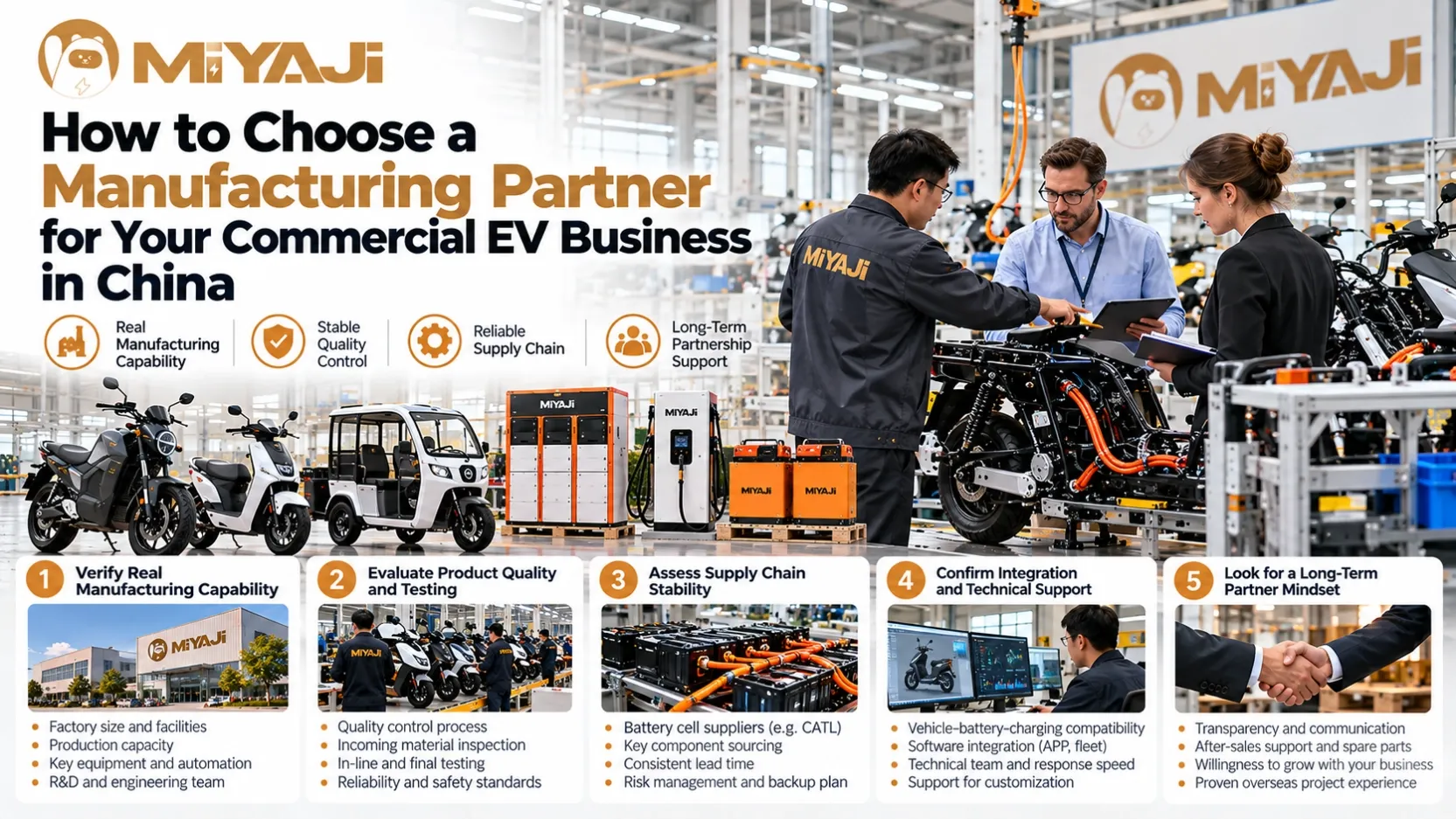
How to Choose a Manufacturing Partner for Your Commercial EV Business in China
Finding an electric motorcycle or tricycle manufacturer in China is not particularly difficult. There are many factories offering different models, specifications, and prices.
Finding the right manufacturing partner for a long-term commercial EV business is a different challenge.
An overseas operator may begin with 20 electric motorcycles, expand to several hundred vehicles, and eventually introduce battery swapping, fast charging, or fleet management software.
At each stage, the business needs more than a competitive vehicle price.
It needs suitable products, reliable manufacturing, compatible energy systems, clear technical responsibilities, and a supply structure that can support future expansion.
This is why choosing a commercial EV manufacturing partner in China should involve more than comparing factory catalogues.
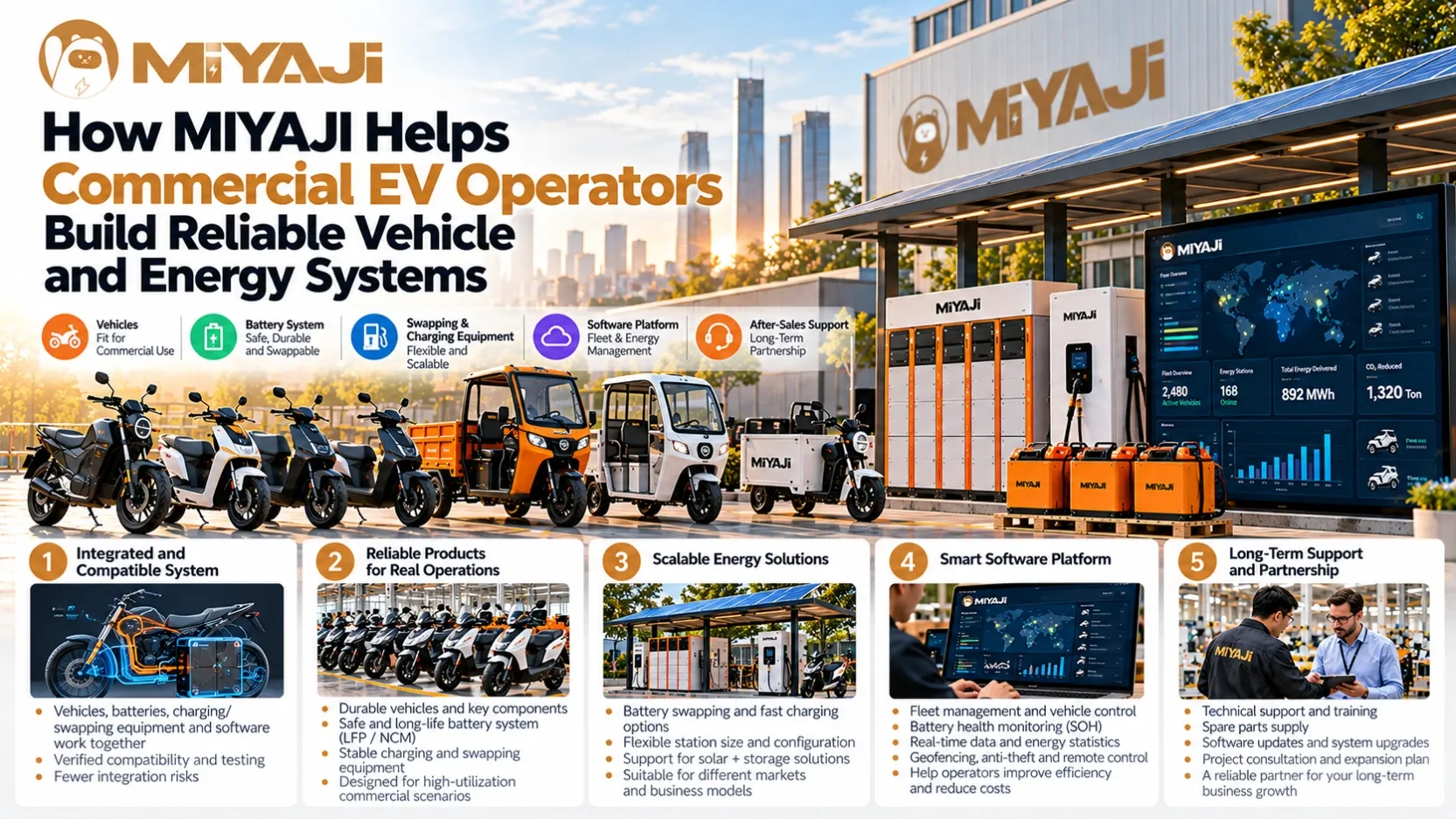
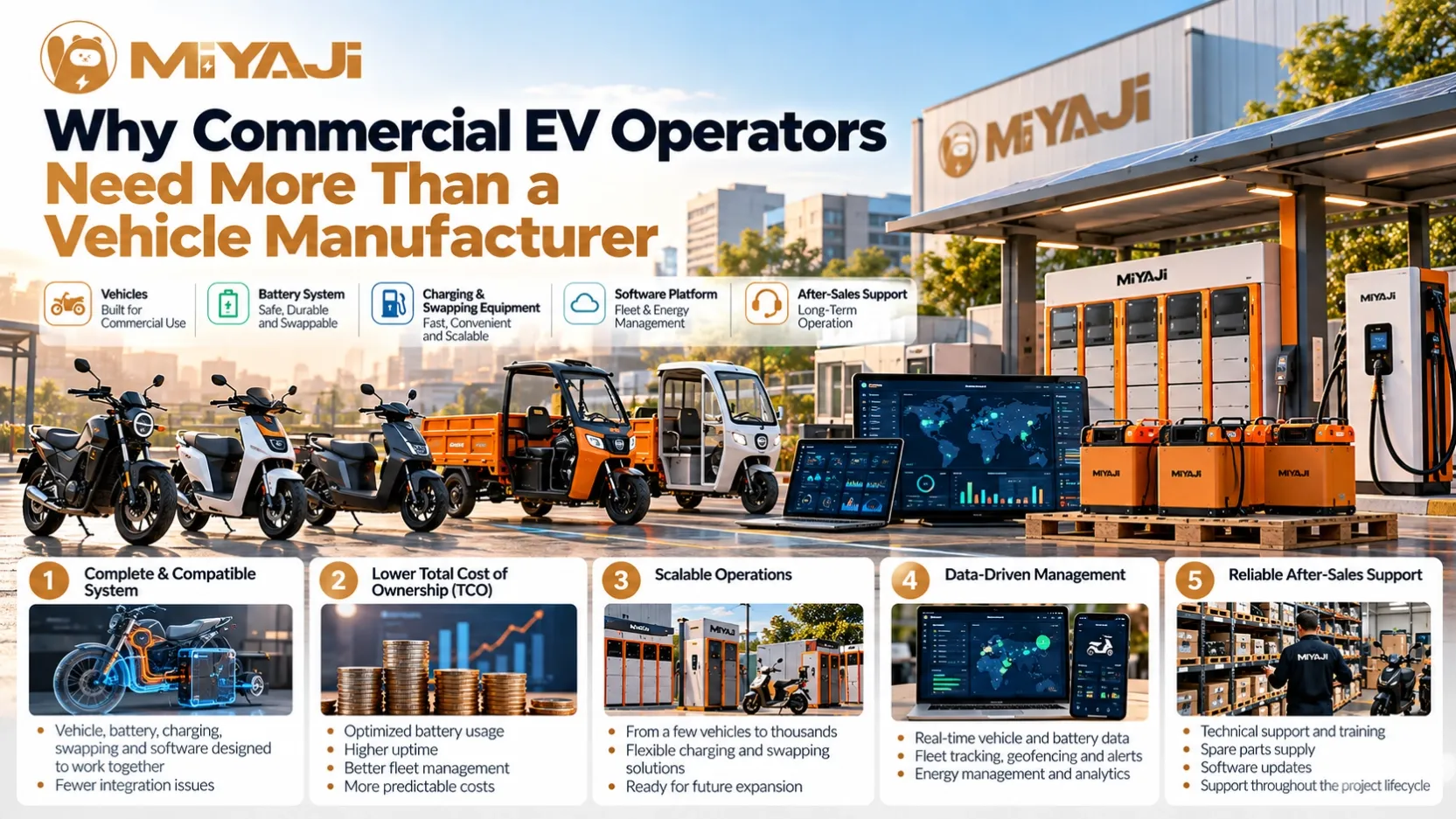
The following guide explains what overseas operators should evaluate, why manufacturing ecosystems matter, and how an integrated solution provider such as MIYAJI approaches commercial EV projects.
1. Start With Your Business Model, Not a Vehicle Catalogue
One of the most common mistakes in commercial EV procurement is selecting a vehicle before defining how it will be used.
A motorcycle designed for personal transportation may not be the best choice for intensive commercial delivery.
Similarly, a passenger tricycle and a cargo tricycle may require very different vehicle structures, battery configurations, and operating arrangements.
Before contacting manufacturers, buyers should clarify several questions:
- Will the vehicles be used for delivery, passenger transportation, cargo transport, or another commercial application?
- What are the expected daily distances and operating hours?
- What payloads and road conditions will the vehicles encounter?
- Will operators charge vehicles overnight, use dedicated fast chargers, or exchange batteries?
- Will the project require vehicle monitoring, geofencing, or other software functions?
- Is the initial purchase a pilot project or part of a larger deployment plan?
These answers influence the vehicle, battery, and charging system requirements.
For example, a fleet operating long daily shifts may need a different energy strategy from a business whose vehicles return to a central depot every evening.
A good manufacturing partner should understand these requirements before recommending products.
The objective is not simply to find a vehicle that can be manufactured. It is to find a configuration that makes sense for the intended commercial operation.
How MIYAJI Approaches This Question
MIYAJI works with overseas customers to understand their commercial application and identify the relevant vehicle and energy system requirements.
Because its ecosystem includes professional commercial vehicle manufacturers alongside battery, charging, swapping, and software capabilities, product selection can consider more than the vehicle itself.
The recommended solution depends on the customer's operating requirements and the agreed project scope.
2. Understand What the Manufacturer Actually Produces
Not every company selling commercial electric vehicles has the same business structure.
Some companies operate vehicle factories.
Others manufacture batteries or charging equipment.
Some act primarily as trading intermediaries, while others coordinate manufacturing and engineering resources across several product categories.
These models are not automatically good or bad.
The important question is whether the company's actual capabilities match the buyer's needs.
A Specialized Vehicle Manufacturer
A professional electric motorcycle or tricycle factory may offer strong capabilities in vehicle engineering, chassis production, assembly, and quality control.
This can be an excellent choice for buyers who primarily need vehicles.
However, the factory may not independently manufacture the battery systems, charging infrastructure, or software required for a broader commercial EV project.
A Trading Intermediary
A trading company may help buyers access different factories and coordinate commercial transactions.
Its value depends on its supplier knowledge, services, and ability to manage the agreed work.
However, buyers should distinguish commercial sourcing services from direct manufacturing and engineering capabilities.
An Integrated Manufacturing and Solution Provider
An integrated provider combines relevant manufacturing or engineering capabilities with coordination across the complete project.
It may own certain production facilities while working with specialized manufacturing partners for other products.
For overseas operators, this model can be useful when vehicles, batteries, charging infrastructure, and software need to work together.
MIYAJI's Manufacturing Structure
MIYAJI follows an integrated manufacturing ecosystem model.
It has its own lithium battery PACK manufacturing capabilities, charging and battery-swapping equipment manufacturing resources, and software development team.
For electric motorcycles and electric tricycles, MIYAJI cooperates with specialized commercial vehicle manufacturers.
This structure allows different manufacturing disciplines to contribute to the same commercial EV project.
MIYAJI does not need to claim that every product comes from one factory. Its value lies in combining relevant manufacturing capabilities through an established solution ecosystem.
3. Evaluate the Vehicle Manufacturing Partners
Even when working with an integrated solution provider, the quality of the vehicle manufacturing partners remains important.
Commercial vehicles may operate for long hours, carry substantial loads, and encounter demanding road conditions.
Buyers should therefore evaluate the actual manufacturing capabilities behind the vehicles.
Important areas include:
Vehicle Engineering
Does the manufacturer understand the structural and performance requirements of the intended application?
Production Capabilities
Does it have suitable manufacturing equipment, assembly processes, and production management?
Quality Control
How are critical components, assembly quality, and finished vehicles inspected?
Configuration Consistency
Can the manufacturer maintain agreed specifications across repeat orders?
Commercial Application Experience
Has the manufacturer developed vehicles for comparable usage conditions?
Technical Cooperation
Can its engineering team work with battery, charging, and software specialists when necessary?
These questions help buyers evaluate a manufacturer's suitability for a long-term project.
Why MIYAJI Works With Specialized Vehicle Manufacturers
Vehicle manufacturing is a professional discipline.
A manufacturer experienced in commercial motorcycles or tricycles brings valuable expertise in vehicle structures, production processes, and application-specific design.
MIYAJI works with specialized vehicle manufacturers while contributing its own battery, charging, swapping, and software capabilities.
This allows the project to benefit from professional vehicle manufacturing without treating the vehicle as an isolated product.
For buyers, the key advantage is the ability to discuss vehicle requirements alongside the energy systems and software that may be needed for the intended operation.
The suitability of any particular vehicle still needs to be assessed against the project's requirements.
4. Check Whether Battery Engineering Is Part of the Manufacturing Ecosystem
For commercial electric vehicles, battery performance affects more than driving range.
It can influence vehicle power delivery, charging arrangements, operating schedules, and maintenance planning.
A manufacturing partner should be able to explain how the battery configuration has been selected for the intended application.
Important questions include:
- Which battery chemistry and configuration are proposed?
- What are the intended operating voltage and capacity?
- What discharge current does the application require?
- How are BMS protection settings matched with the vehicle?
- What charging requirements must be considered?
- How are battery configurations identified and controlled?
- What testing and warranty terms apply?
Buyers should be cautious about choosing batteries solely by advertised capacity.
Two batteries with similar nominal specifications may behave differently under demanding operating conditions.
MIYAJI's Battery PACK Manufacturing Advantage
MIYAJI has its own battery PACK manufacturing capabilities.
This is an important distinction from a supplier that simply purchases finished batteries without direct involvement in the battery manufacturing process.
Within the agreed project scope, MIYAJI's battery engineering and manufacturing teams can coordinate with relevant vehicle and charging equipment teams.
For example, a commercial motorcycle configuration may require review of vehicle power demand, battery discharge capability, BMS protection requirements, and charging compatibility.
This coordinated approach supports more informed system selection and technical communication.
It does not mean that every possible battery can be installed in every vehicle without modification.
Compatibility must be evaluated for the intended configuration.
5. Determine Whether Charging and Battery Swapping Are Part of the Plan
Charging infrastructure should not be treated as an afterthought.
A vehicle's battery configuration, operating schedule, and charging method are closely connected.
An operator may choose conventional charging, dedicated fast charging, battery swapping, or a combination of approaches.
Each option has different implications for the project.
Conventional Charging
Conventional charging may be suitable for vehicles with sufficient downtime between shifts.
Buyers still need to confirm charger compatibility, electrical requirements, and practical charging arrangements.
Dedicated Fast Charging
Fast charging can reduce charging time when supported by the intended battery and charging system.
However, fast charging is not simply a matter of connecting a higher-power charger.
The battery, BMS, charger, and relevant communication interfaces must support the proposed charging conditions.
Battery Swapping
Battery swapping can support operations that need rapid battery replacement.
However, the vehicle, battery, swapping cabinet, and associated software must be compatible with the intended system.
A battery that physically fits into a cabinet is not necessarily electrically or digitally compatible.
Why MIYAJI's Charging and Swapping Manufacturing Matters
MIYAJI has its own charging and battery-swapping equipment manufacturing capabilities.
Together with its battery PACK manufacturing and software team, these capabilities support coordinated development and supply of commercial EV energy systems.
When a project requires charging or swapping, the relevant engineering teams can review system requirements and compatibility within the agreed project scope.
This reduces the need for overseas buyers to independently coordinate every technical relationship between unrelated equipment suppliers.
For a fleet planning future expansion, it also provides a clearer structure for discussing additional vehicles, batteries, and energy equipment.
6. Evaluate Software Capabilities, Not Just Hardware
Commercial EV projects may require software for equipment management, vehicle monitoring, or other operational functions.
Depending on the application, the system may include:
- Vehicle location information.
- Geofencing and supported remote-control functions.
- Battery and equipment status.
- Charging or swapping records.
- User and equipment management.
- Operational reporting.
Not every project needs every function.
The important point is that software requirements should be defined early enough to influence hardware selection.
For example, remote vehicle control depends on compatible vehicle electronics and connectivity hardware.
Battery information displayed in a management platform depends on the available data interfaces and how that information is transmitted.
A software provider cannot automatically access every function of an unrelated vehicle or battery.
MIYAJI's Software Team
MIYAJI has its own software development team supporting its commercial EV solution ecosystem.
This allows software requirements to be considered alongside relevant battery, charging, swapping, and vehicle interfaces.
For projects that include software functions, the appropriate engineering teams can coordinate the agreed requirements and integration work.
The exact functionality depends on the selected products, interfaces, and project scope.
A strong manufacturing partner should help buyers understand what the complete system can actually do, rather than promising unlimited software compatibility.
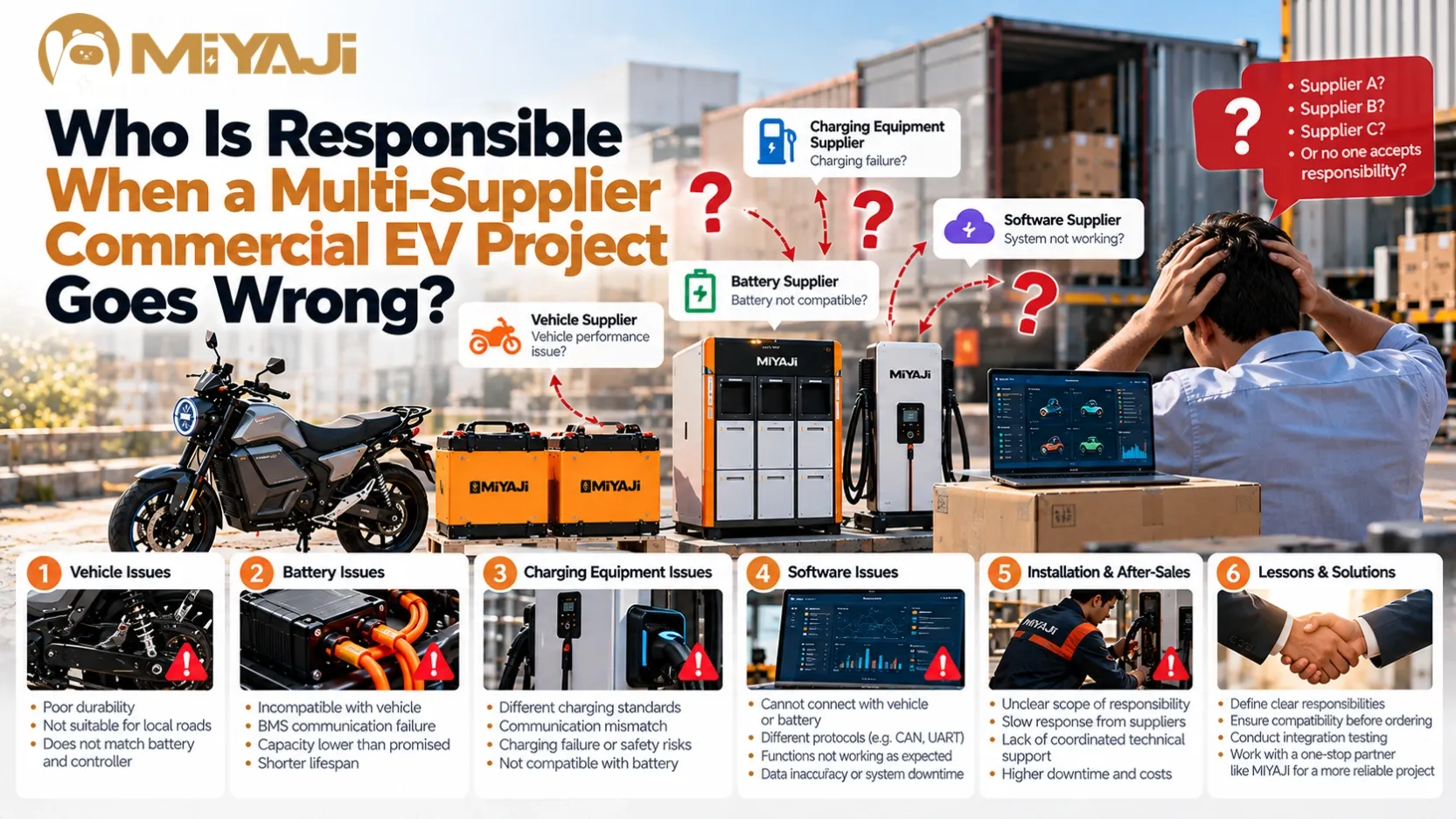
7. Ask Who Coordinates Technical Integration
One of the most important questions in commercial EV procurement is also one of the easiest to overlook:
Who is responsible for making the selected products work together?
A vehicle manufacturer may be responsible for vehicle production.
A battery manufacturer may be responsible for its battery PACK.
A charging equipment manufacturer may be responsible for its charger.
A software developer may be responsible for its platform.
But if the products are sourced independently, no supplier may have agreed to coordinate the complete system.
This creates a potential gap between product delivery and project readiness.
Before placing an order, buyers should confirm:
- Who reviews the technical interfaces between products?
- Who organizes the necessary engineering discussions?
- Which product combinations will be tested?
- Who approves the agreed configuration?
- Who coordinates investigation if an integration problem occurs?
These responsibilities should be documented rather than assumed.
The MIYAJI Approach
MIYAJI's manufacturing ecosystem brings together its battery, charging, swapping, and software capabilities with specialized commercial vehicle manufacturers.
For projects requiring multiple connected products, MIYAJI can coordinate the relevant China-side engineering teams according to the agreed scope.
This provides overseas buyers with a more structured approach than managing every manufacturer independently.
The benefit is not that technical problems become impossible.
It is that the necessary manufacturing and engineering relationships are already part of a coordinated supply structure.
8. Consider the Difference Between a Pilot Order and Long-Term Expansion
A small pilot order and a large fleet deployment have different requirements.
A pilot may focus on verifying vehicle suitability, energy consumption, charging arrangements, and operational performance.
A larger deployment may require additional attention to production capacity, configuration consistency, spare parts, delivery schedules, and ongoing technical support.
Buyers should therefore consider whether their manufacturing partner can support the business beyond the first order.
Stage 1: Initial Evaluation
Confirm the intended application, product requirements, and proposed system configuration.
Stage 2: Sample and Pilot Testing
Evaluate the selected products under relevant operating conditions.
Document important findings and any agreed changes.
Stage 3: Repeat Orders
Maintain control over critical configurations and coordinate production and delivery requirements.
Stage 4: Expansion
Review whether additional vehicles, batteries, charging equipment, and software requirements remain compatible with the existing deployment.
A manufacturing partner should be able to discuss these stages realistically.
How MIYAJI Supports Different Project Stages
MIYAJI's model allows the relevant vehicle, battery, charging, swapping, and software resources to be coordinated as project requirements develop.
For example, a customer may initially purchase vehicles and later evaluate a compatible charging or battery-swapping arrangement.
Another customer may begin with a complete vehicle and energy system package.
The suitable approach depends on the customer's existing infrastructure, operating model, and technical requirements.
MIYAJI provides products and technical coordination within the agreed scope; the overseas operator remains responsible for its local fleet operations and business management.
9. Review Quality Control and Configuration Management
A manufacturing partner should not be evaluated only by the quality of a single sample.
Buyers should also consider how the agreed configuration will be maintained during production.
A sample may use a particular controller, battery BMS, connector, or firmware version.
If a critical component changes later, the modification may affect the complete system.
This is especially important when vehicles, batteries, chargers, and software are expected to work together.
Buyers should ask:
- How are approved product specifications documented?
- Which component changes require technical review?
- How are production configurations identified?
- What inspection and testing records are available?
- How are quality problems investigated and corrected?
- What acceptance requirements apply before shipment?
For an integrated system, quality control should consider both individual product performance and relevant compatibility requirements.
Why Manufacturing Coordination Matters
When several independent suppliers are involved, the buyer may need to manage these requirements across multiple companies.
A coordinated manufacturing ecosystem can make it easier to identify which teams should review a proposed change.
For MIYAJI projects, the relevant manufacturing and engineering teams can coordinate agreed technical requirements across connected product categories.
The specific inspection, testing, and acceptance activities should be confirmed for each order.
10. Do Not Overlook After-Sales Technical Coordination
For overseas commercial EV operators, after-sales support is not limited to receiving replacement parts.
Some problems involve more than one product.
For example:
- A vehicle may experience a battery protection event under demanding operating conditions.
- A charger may not communicate correctly with the selected battery.
- A swapping cabinet may fail to recognize a particular battery configuration.
- A software function may not receive the expected information from connected hardware.
In these cases, the cause may not be obvious.
Vehicle, battery, charging, or software engineers may need to participate in the investigation.
If the products were purchased from unrelated suppliers, the operator may need to coordinate those discussions independently.
MIYAJI's Coordinated Support Structure
For products and systems supplied within an agreed MIYAJI project scope, customers can report technical issues through the designated project contact.
MIYAJI can coordinate the relevant manufacturing and engineering teams to investigate the issue and determine appropriate next steps.
This gives overseas customers a clearer communication structure when a problem involves multiple product categories.
Warranty coverage, corrective actions, replacement obligations, and engineering services depend on the applicable agreements.
The value is not a promise that no problems will occur.
It is a clearer process for bringing the right technical teams together when support is needed.
11. Compare Manufacturing Partnerships, Not Just Quotations
A lower purchase price does not always mean a lower total project cost.
Consider two hypothetical supply arrangements.
Supplier A offers a lower vehicle price, but the buyer must independently source batteries, chargers, software, and integration services.
Supplier B offers a coordinated vehicle and energy system arrangement with defined technical responsibilities.
Supplier A may still be the better choice for a buyer with an experienced engineering team and established infrastructure.
Supplier B may be more suitable for a buyer that needs additional technical coordination.
The decision should consider the complete scope of work.
Evaluation Factor | Questions to Consider |
|---|---|
Vehicle cost | What is included in the vehicle price? |
Battery supply | Is the intended battery configuration included and validated? |
Charging equipment | Is compatible equipment available? |
Software | Which functions and services are included? |
Engineering | Who performs required integration work? |
Testing | What testing is included before delivery? |
Spare parts | What parts and support arrangements are available? |
Future expansion | Can additional products follow the agreed configuration? |
After-sales support | Who coordinates technical problems? |
The most suitable partner is not necessarily the one with the lowest initial quotation.
It is the one whose capabilities, products, responsibilities, and commercial terms best match the project.
12. A Practical Checklist for Choosing a Commercial EV Manufacturing Partner in China
Before committing to a long-term partnership, overseas buyers can use the following checklist.
Area | What to Verify |
|---|---|
Business understanding | Does the supplier understand the intended commercial application? |
Manufacturing structure | Which products does it manufacture directly? |
Vehicle partners | Who manufactures the vehicles, and what are their capabilities? |
Battery engineering | Who manufactures and supports the battery PACK? |
Charging and swapping | Who provides the required energy equipment? |
Software | Who develops and supports the agreed software functions? |
Technical integration | Who coordinates interfaces between products? |
Testing | What product and integrated testing is included? |
Quality control | How are specifications and production changes managed? |
Delivery | Who coordinates the agreed products and documentation? |
After-sales | Who investigates problems involving multiple products? |
Expansion | Can the supplier support future orders and configuration requirements? |
Contract scope | Are responsibilities and exclusions clearly documented? |
A supplier that can provide clear, evidence-based answers is easier to evaluate than one relying only on broad promises.
Buyers should also request appropriate factory information, technical documents, sample evaluations, and project-specific commitments before making a decision.
13. Why MIYAJI Is Built for Long-Term Commercial EV Cooperation
MIYAJI's approach is based on a practical understanding of the commercial EV manufacturing industry.
Vehicles, batteries, charging infrastructure, and software require different engineering specialties.
Rather than treating these products as unrelated purchases, MIYAJI brings together its own core manufacturing capabilities and professional vehicle manufacturing partners.
Its lithium battery PACK manufacturing, charging and battery-swapping equipment manufacturing, and software development capabilities form the foundation of its energy system solutions.
Specialized electric motorcycle and electric tricycle manufacturers contribute professional vehicle engineering and production.
Together, these resources support a coordinated approach to commercial EV projects.
For overseas customers, the value lies in several areas:
Real Manufacturing Capabilities
MIYAJI's core battery and charging-related capabilities are supported by its own manufacturing resources and software team.
Professional Vehicle Manufacturing Partners
Commercial vehicles are supplied through cooperation with specialized manufacturers that bring their own production expertise.
Coordinated System Requirements
Vehicle, battery, charging, swapping, and software requirements can be reviewed together where the project requires integration.
A Clearer Technical Communication Structure
Customers can work with a coordinated project team rather than independently managing every technical relationship between unrelated suppliers.
Support for Different Project Stages
From initial product selection to pilot deployment and future procurement, MIYAJI can coordinate relevant manufacturing and technical resources according to the agreed scope.
This is the purpose of the MIYAJI manufacturing ecosystem.
It is not simply about offering more products.
It is about connecting the right manufacturing specialties around the needs of a commercial EV business.
Final Thoughts
Choosing a commercial EV manufacturing partner in China is a long-term business decision.
Vehicle quality and price remain important, but they are only part of the evaluation.
Overseas operators should also consider battery manufacturing, charging and swapping capabilities, software support, technical integration, configuration control, and after-sales coordination.
Some buyers may be well served by purchasing directly from a specialized vehicle manufacturer.
Others may benefit from a coordinated manufacturing ecosystem that brings multiple technical disciplines together.
The right choice depends on the buyer's business model, technical resources, and growth plans.
For a commercial EV project, the best manufacturing partner is not simply the factory that can deliver the first order. It is the partner whose capabilities can support the system your business needs to operate and grow.
Frequently Asked Questions
How do I find a reliable commercial EV manufacturing partner in China?
Start by defining your business requirements, then evaluate the supplier's actual manufacturing capabilities, vehicle partners, battery and charging expertise, technical integration responsibilities, quality control, and after-sales support. Request supporting documentation and verify important claims.
Should I buy electric motorcycles directly from a manufacturer or through a solution provider?
Direct purchasing can be suitable when you need vehicles only or have your own technical team. A solution provider may be more useful when the project also requires batteries, charging, swapping, software, and coordination between manufacturers.
Does a commercial EV solution provider need to own a vehicle factory?
Not necessarily. A solution provider may combine its own manufacturing and engineering capabilities with specialized vehicle manufacturing partners. Buyers should verify who manufactures each product and how the relevant teams cooperate.
Why is in-house battery PACK manufacturing valuable?
Direct battery PACK manufacturing capabilities can support closer coordination of battery configurations, BMS requirements, charging compatibility, and technical support. The specific benefits depend on the supplier's actual engineering resources and project scope.
Can I start with a small EV fleet and expand later?
Yes, many commercial EV projects begin with a pilot. However, future expansion should be considered during initial product selection, particularly where battery compatibility, charging infrastructure, software, and configuration consistency matter.
What makes MIYAJI different from a traditional trading company?
MIYAJI has its own lithium battery PACK manufacturing capabilities, charging and battery-swapping equipment manufacturing resources, and software development team. It also cooperates with specialized commercial vehicle manufacturers to provide coordinated commercial EV solutions.
Does MIYAJI operate electric vehicle fleets overseas?
MIYAJI supplies products and supports technical coordination for overseas commercial EV projects. Local fleet operations and business management remain the responsibility of the overseas operator.
Looking for a Long-Term Commercial EV Manufacturing Partner in China?
Your business needs more than a product catalogue.
It needs manufacturing capabilities, suitable vehicle and battery configurations, compatible charging infrastructure, and technical support that can develop alongside your project.
MIYAJI combines its own battery PACK, charging, battery-swapping, and software capabilities with specialized electric motorcycle and electric tricycle manufacturers.
Together, we support overseas customers looking for coordinated commercial EV manufacturing and system solutions.
Your Market. Our Manufacturing Ecosystem.
Contact MIYAJI to Discuss Your Commercial EV Project.