Sep 10, 2026Product & Industry Knowledge
LFP vs NCM Batteries for Electric Vehicles: Which Is Better?
Compare LFP and NCM batteries for electric vehicles, including energy density, safety, cycle life, cost, weight, temperature performance and applications.
LFP vs NCM Batteries for Electric Vehicles: Which Is Better?
Choosing the right lithium battery chemistry is one of the most important decisions when developing an electric vehicle.
Two of the most widely considered lithium-ion chemistries are:
LFP — Lithium Iron Phosphate
and
NCM — Nickel Manganese Cobalt
Both can be used in electric-vehicle applications, but they have different characteristics.
The right choice depends on:
- Vehicle design
- Required range
- Battery weight
- Available space
- Daily mileage
- Charging strategy
- Operating temperature
- Cycle requirements
- Cost target
There is no universal winner.
For commercial electric motorcycles, tricycles and fleet vehicles, the better chemistry is the one that matches the actual operating requirements.
What Is an LFP Battery?
LFP stands for:
Lithium Iron Phosphate
Its cathode chemistry is based on lithium iron phosphate.
LFP batteries are widely used in applications where characteristics such as:
- Safety
- Long cycle life
- Cost
- Durability
are important.
They are commonly considered for:
- Commercial EVs
- Electric motorcycles
- Electric tricycles
- Energy storage
- Fleet applications
What Is an NCM Battery?
NCM stands for:
Nickel Manganese Cobalt
NCM batteries use a nickel-manganese-cobalt cathode chemistry.
One of their major advantages is relatively high energy density.
This can be valuable when the vehicle needs:
- More energy in limited space
- Lower battery weight
- Longer range without significantly increasing battery volume
NCM is also widely used in electric vehicles and other high-energy-density applications.
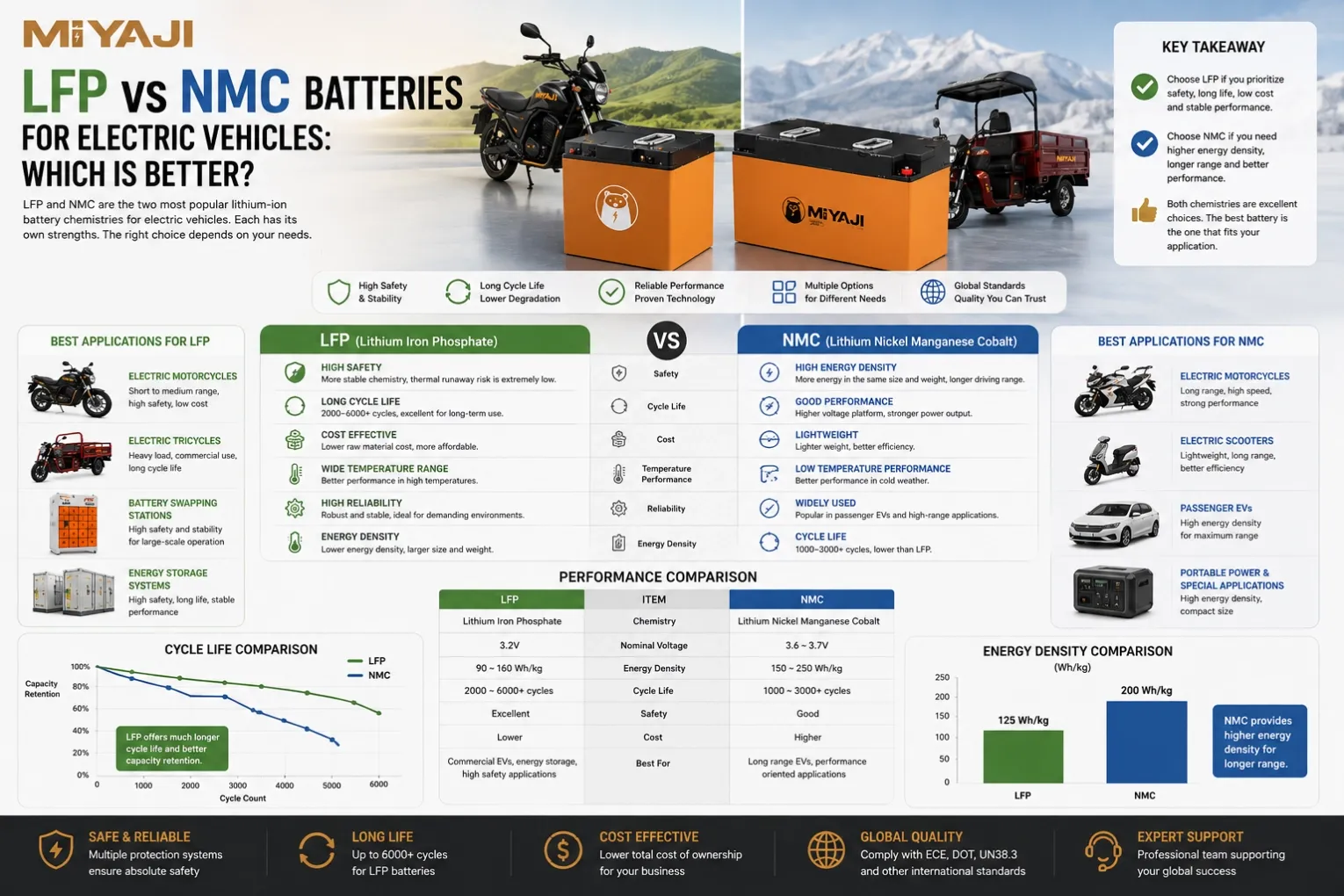
LFP vs NCM: Quick Comparison
Characteristic | LFP | NCM |
|---|---|---|
Energy Density | Generally lower | Generally higher |
Weight for Same Energy | Generally higher | Generally lower |
Cycle Life | Generally strong | Depends on cell design |
Thermal Stability | Generally strong | Requires careful system design |
Cost | Often competitive | Can be higher |
Raw Material Composition | Iron / phosphate based | Nickel / manganese / cobalt |
High Energy Density Applications | Moderate | Strong |
Commercial Fleet Applications | Strong | Strong |
Best Choice | Depends on duty cycle | Depends on duty cycle |
These are general characteristics.
Actual performance depends on the specific cell design, manufacturer, battery architecture and operating conditions.
Energy Density: One of the Biggest Differences
Energy density describes how much energy can be stored relative to the weight or volume of a battery.
For an EV battery, higher energy density can help achieve:
- Lower battery weight
- Smaller battery volume
- Greater range within the same packaging space
This is one reason NCM can be attractive for applications where space and weight are critical.
LFP generally has lower energy density, but that does not automatically make it unsuitable for commercial vehicles.
Why Lower Energy Density Can Still Be Acceptable
For example, a commercial motorcycle may have:
- Large available battery space
- Moderate speed
- Fixed operating routes
- Depot charging
- Battery swapping
- High daily utilization
In such cases, the advantages of LFP may outweigh the penalty of additional battery weight or volume.
Therefore:
Energy density should be evaluated together with the vehicle's actual duty cycle.
Cycle Life Matters for Commercial Vehicles
Commercial vehicles may cycle their batteries much more frequently than private vehicles.
A fleet motorcycle may operate:
Every day
for:
Several hours per day
and may experience frequent charging or swapping.
Therefore cycle performance can have a significant influence on long-term battery economics.
LFP chemistry is often considered attractive for applications requiring frequent cycling.
However, actual cycle life depends on:
- Cell design
- Charging conditions
- Temperature
- Depth of discharge
- Current
- BMS strategy
- Operating conditions
A chemistry name alone does not determine the actual lifetime of a battery.
Does NCM Have a Shorter Life Than LFP?
It is too simplistic to say:
LFP always lasts longer than NCM.
Actual cycle performance depends on the specific cell.
Factors such as:
- Cathode formulation
- Cell design
- Charging protocol
- Temperature
- C-rate
- Depth of discharge
can significantly affect battery aging.
Therefore buyers should evaluate the actual manufacturer's test data rather than relying only on chemistry labels.
Safety and Thermal Behavior
Battery safety is a system-level issue.
It depends on:
- Cell chemistry
- Cell quality
- Battery design
- BMS
- Mechanical protection
- Thermal management
- Manufacturing quality
- Charging system
- Testing
LFP is generally recognized for favorable thermal stability characteristics.
NCM can also be safely used in EV applications when the cell, PACK and battery-management system are properly designed.
Therefore:
Do not evaluate battery safety based on chemistry alone.
Cost Considerations
Battery cost depends on much more than chemistry.
Factors include:
- Cell price
- Cell format
- Capacity
- Production volume
- Manufacturer
- Raw materials
- BMS
- PACK design
- Testing
- Logistics
LFP can offer cost advantages in many applications because it does not rely on nickel and cobalt in the cathode chemistry.
But actual commercial pricing changes over time and depends on the specific cell.
Temperature Performance
Temperature can significantly affect lithium batteries.
Cold temperatures can reduce:
- Available power
- Charging capability
- Usable capacity
High temperatures can accelerate:
- Battery aging
- Degradation
- Safety risks if the system is poorly designed
The actual temperature performance depends on:
- Cell chemistry
- Cell design
- Battery thermal management
- Charging strategy
- BMS
- Environmental conditions
This is particularly important for commercial vehicles operating in:
- Africa
- Central Asia
- Middle East
- Cold climates
- High-temperature environments
LFP in Hot-Climate Commercial Fleets
For fleets operating in hot climates, thermal behavior becomes an important design consideration.
The battery system should be evaluated for:
- Ambient temperature
- Battery temperature
- Charging temperature
- Continuous operating current
- Parking conditions
The correct battery architecture may require additional thermal and protective measures depending on the environment.
NCM for Weight-Sensitive Vehicles
NCM may be attractive when battery weight is a major concern.
For example, if the vehicle has:
- Limited payload
- Limited battery compartment
- Long range requirement
- High energy demand
higher energy density can provide packaging advantages.
This is one area where NCM can be particularly useful.
LFP for High-Utilization Fleets
LFP can be attractive when the vehicle is expected to:
- Operate daily
- Cycle frequently
- Remain in service for many years
- Prioritize durability
- Have sufficient battery space
This can make LFP a strong candidate for commercial delivery and mobility fleets.
Again, actual suitability depends on the specific battery design.
LFP vs NCM for Electric Motorcycles
For electric motorcycles, the decision can be simplified into several questions.
Is battery weight critical?
If yes:
NCM may have an advantage.
Is long-term cycling important?
If yes:
LFP may be attractive.
Is battery space available?
If yes:
LFP becomes easier to accommodate.
Is maximum range required from a compact battery?
If yes:
NCM may be more suitable.
Is the vehicle designed for commercial daily use?
If yes:
Both can be considered depending on the duty cycle.
LFP vs NCM for Electric Tricycles
This can make lower-energy-density chemistries more practical.
For commercial cargo tricycles, priorities may include:
- Payload
- Daily mileage
- Reliability
- Cycle life
- Battery cost
- Charging time
LFP can therefore be a strong candidate for many commercial tricycle applications.
But NCM may still be useful where:
- Weight is constrained
- Higher energy density is needed
- Battery space is limited
LFP vs NCM for Battery Swapping
Battery standardization.
A swap battery must physically and electronically match:
- Vehicle
- Swap cabinet
- Charger
- BMS
- Software
If a fleet uses standardized batteries, the chemistry should be selected together with:
- Battery dimensions
- Weight
- Cycle requirements
- Charging speed
- Swap frequency
The battery is part of the entire swapping ecosystem.
LFP vs NCM for Fast Charging
The maximum charging rate depends on:
- Cell specification
- Battery design
- BMS
- Thermal conditions
- Charger
- Charging protocol
Therefore:
NCM does not automatically mean fast charging, and LFP does not automatically mean slow charging.
The specific cell's charging characteristics must be evaluated.
Battery Chemistry and TCO
The best battery is not necessarily the battery with the lowest price per kWh.
Consider:
Cell Cost
-
PACK Cost
-
Energy Cost
-
Battery Lifetime
-
Replacement Cost
-
Downtime
-
Maintenance
The final result is:
Battery Cost Over the Vehicle's Commercial Life
Example: Two Different Commercial Applications
Imagine two hypothetical vehicles.
Vehicle A
- Large battery compartment
- Moderate speed
- High daily mileage
- Frequent cycling
- Fleet operation
LFP may be a strong candidate.
Vehicle B
- Limited battery space
- Strict weight target
- Long-range requirement
- Higher energy-density priority
NCM may be a stronger candidate.
Neither example means one chemistry is universally better.
It means:
The vehicle defines the battery requirement.
Cell Selection Should Come Before PACK Design
A common mistake is starting with:
A better engineering process is:
Application
↓
Vehicle Duty Cycle
↓
Power Requirement
↓
Energy Requirement
↓
Battery Space
↓
Chemistry
↓
Cell
↓
↓
BMS
↓
Charging System
This results in a battery that is designed around the application.
How to Choose Between LFP and NCM
Use the following framework.
Choose LFP when priorities include:
- Long cycle operation
- Safety characteristics
- Cost efficiency
- Commercial durability
- Larger available battery space
- High-utilization fleets
Consider NCM when priorities include:
- High energy density
- Lower battery weight
- Limited packaging space
- Longer range within a constrained battery volume
- Weight-sensitive applications
But the final decision should be based on actual cell specifications and project requirements.
Don't Compare Chemistry Without Comparing Cells
This is perhaps the most important point.
“LFP” is not one cell.
“NCM” is not one cell.
Two LFP cells can have completely different:
- Internal resistance
- Cycle performance
- Charging characteristics
- Temperature performance
The same applies to NCM.
Therefore a professional comparison should look at:
Specific Cell Model
rather than only:
Chemistry
What Should You Ask a Battery Cell Supplier?
Before purchasing cells, ask for:
Cell Information
- Manufacturer
- Model
- Chemistry
- Capacity
- Nominal voltage
- Dimensions
- Weight
Performance
- Energy density
- Maximum continuous current
- Maximum charging current
- Operating temperature
- Cycle test conditions
Quality
- Production batch
- Traceability
- Test data
- Certifications
- Warranty
Supply
- MOQ
- Monthly capacity
- Lead time
- Packaging
- Shipping requirements
This is particularly important when cells will be used in commercial battery PACK production.
LFP vs NCM: The Decision Matrix
Requirement | LFP | NCM |
|---|---|---|
High Energy Density | ★★★ | ★★★★★ |
Lower Battery Weight | ★★★ | ★★★★★ |
Commercial Fleet Cycling | ★★★★★ | ★★★★ |
Safety Characteristics | ★★★★★ | ★★★★ |
Cost Efficiency | ★★★★★ | ★★★★ |
Limited Battery Space | ★★★ | ★★★★★ |
Large Battery Space | ★★★★★ | ★★★★ |
High Daily Utilization | ★★★★★ | ★★★★ |
Weight-Sensitive Applications | ★★★ | ★★★★★ |
Note: These ratings are a simplified conceptual comparison, not laboratory specifications. Actual performance depends on the specific cell and battery system.
What About Battery Life?
Battery life should not be defined only as:
Number of Years
or:
Number of Cycles
A more useful commercial question is:
How many useful kilometers or operating hours can the battery support before replacement becomes necessary?
For a commercial fleet, this connects battery performance directly to business economics.
Battery Chemistry Is Only One Part of the System
A good cell can still produce a poor battery if:
- PACK design is weak
- BMS is poorly configured
- Connections are unreliable
- Thermal management is inadequate
- Manufacturing quality is inconsistent
Conversely, a well-engineered battery system can make effective use of a suitable cell.
Therefore:
Cell + PACK + BMS + Charger + Vehicle = Battery System
MIYAJI Battery Solutions
MIYAJI works across different levels of the commercial EV battery supply chain.
Depending on project requirements, customers can evaluate:
LFP Battery Cells
NCM Battery Cells
BMS
Battery PACKs
Battery Systems
For larger projects, battery systems can be designed around:
- Electric motorcycles
- Electric tricycles
- Commercial fleets
- Fast charging
- Battery swapping
- Local PACK assembly
This allows battery selection to start from the customer's actual application rather than from a single standard battery model.
From Battery Cell to Commercial Application
The correct workflow is:
Customer Application
↓
Vehicle Requirements
↓
Duty Cycle
↓
Battery Chemistry
↓
Cell Selection
↓
PACK Design
↓
BMS
↓
Charging / Swapping
↓
This is how battery chemistry becomes a commercial decision rather than simply a technical specification.
Need Help Choosing LFP or NCM?
Before selecting a battery chemistry, prepare:
- Vehicle type
- Motor power
- System voltage
- Required capacity
- Daily mileage
- Payload
- Operating temperature
- Charging method
- Charging frequency
- Battery compartment dimensions
- Expected battery life
- Annual fleet mileage
These parameters can be used to evaluate whether an LFP or NCM battery system is more appropriate.
Discuss Your Battery Requirements
Frequently Asked Questions
Is LFP better than NCM?
Neither chemistry is universally better. LFP is often attractive for durability, cycling and cost-sensitive applications, while NCM can provide higher energy density and lower weight for a given energy requirement.
Which is safer, LFP or NCM?
Battery safety depends on the complete cell, PACK, BMS, thermal design, manufacturing process and charging system. LFP generally has favorable thermal-stability characteristics, but both chemistries require proper system engineering.
Which has higher energy density, LFP or NCM?
NCM generally offers higher energy density than LFP, although actual values depend on the specific cell design.
Is LFP suitable for electric motorcycles?
Yes. LFP can be suitable for electric motorcycles, particularly commercial models where durability, cycling and cost are important and sufficient battery space is available.
Is NCM suitable for electric motorcycles?
Yes. NCM can be useful for motorcycles where battery weight, compact packaging or higher energy density are priorities.
Is LFP suitable for electric tricycles?
Yes. LFP can be a strong option for commercial electric tricycles, particularly when battery space and payload requirements allow its higher battery weight.
Can NCM be used for battery swapping?
Yes. NCM batteries can be designed for battery-swapping systems when their mechanical, electrical, BMS and charging characteristics are compatible with the swap infrastructure.
Which battery chemistry is better for fast charging?
Neither chemistry automatically guarantees faster charging. Charging performance depends on the specific cell, PACK design, BMS, thermal conditions and charger.
Should I choose a battery based only on $/kWh?
No. Commercial buyers should also consider cycle life, replacement cost, usable energy, weight, packaging, maintenance and total cost of ownership.
Can MIYAJI supply both LFP and NCM cells?
MIYAJI can support different battery-cell and battery-system requirements depending on the project, including LFP and NCM configurations.