Sep 5, 2026EV E2W/E3W Business Insights
How to Start an Electric Motorcycle Fleet: Complete Guide for Commercial Operators
Learn how to start an electric motorcycle fleet, from vehicle and battery selection to charging, swapping, software, TCO, pilot testing and fleet scaling.
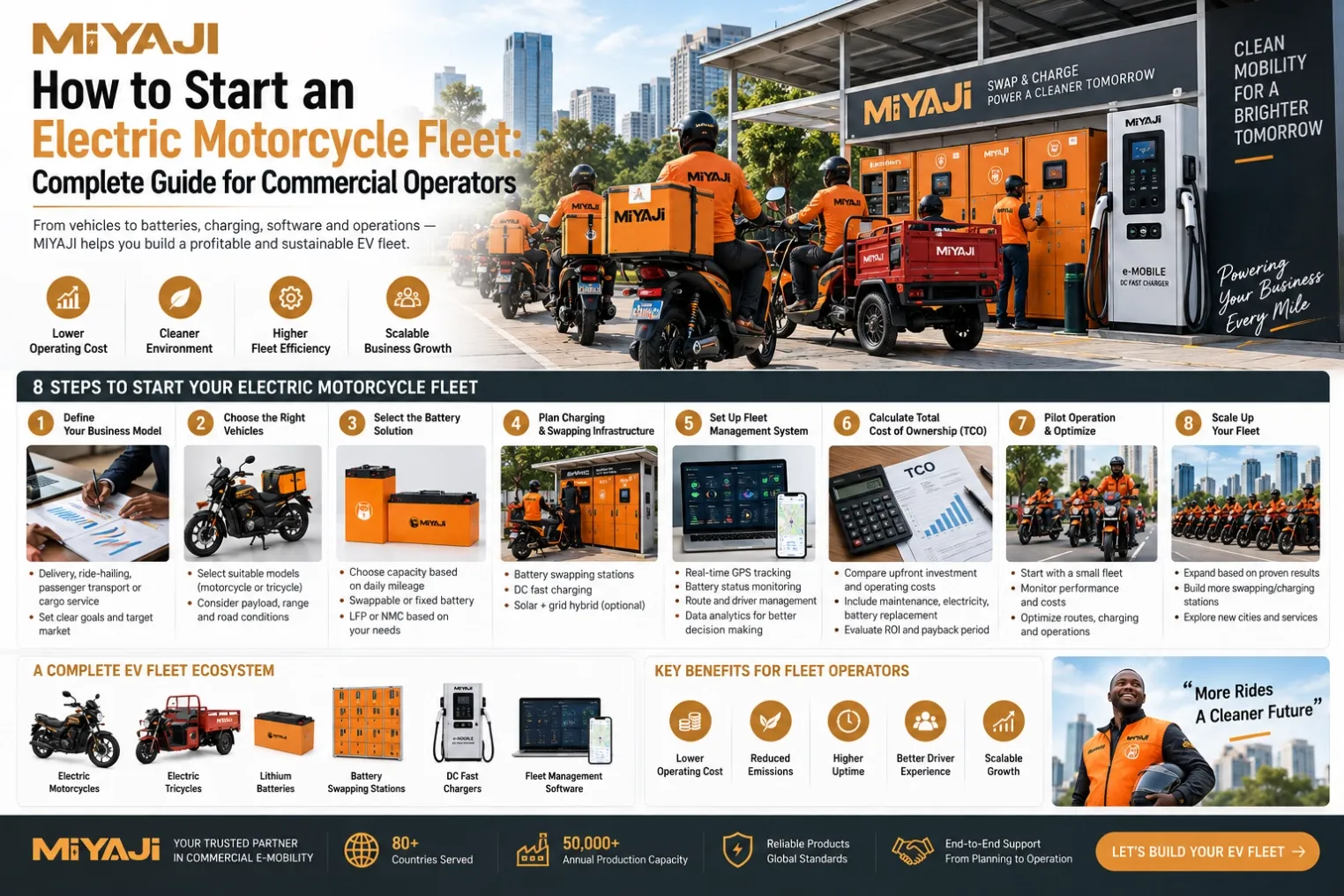
How to Start an Electric Motorcycle Fleet: Complete Guide for Commercial Operators
Starting an electric motorcycle fleet involves much more than purchasing electric motorcycles.
A commercial fleet is a complete operating system.
The vehicle must work with:
Battery
Charging or Swapping Infrastructure
Fleet Software
Maintenance
Spare Parts
and most importantly:
The actual operating model.
A motorcycle that performs well for an individual rider may not be the right choice for a fleet operating hundreds of kilometers every day.
For fleet operators, delivery companies, mobility platforms and project investors, the correct planning sequence is:
Business Model
↓
Duty Cycle
↓
Vehicle
↓
Battery
↓
Energy Strategy
↓
Infrastructure
↓
Software
↓
Maintenance
↓
TCO
↓
Pilot
↓
Scale
This guide explains each step.
1. Start With the Business Model
Before choosing a motorcycle, define how the fleet will make money.
Possible commercial applications include:
- Last-mile delivery
- Food delivery
- Parcel delivery
- Motorcycle taxi
- Corporate fleet
- Vehicle leasing
- Rider rental
- Mobility-as-a-Service
- Battery-as-a-Service
- Government or institutional fleet
Each model creates different vehicle and energy requirements.
For example, a delivery fleet may prioritize:
Cargo Capacity + Uptime + Low Operating Cost
while a motorcycle taxi fleet may prioritize:
Passenger Comfort + Range + Durability + Fast Energy Replenishment
Therefore:
Do not start fleet planning from the motorcycle specification sheet. Start from the operation.
2. Define the Fleet Duty Cycle
The duty cycle describes how vehicles actually operate.
You need to understand:
- Daily mileage
- Operating hours
- Number of shifts
- Average speed
- Peak speed
- Payload
- Route
- Gradient
- Stop frequency
- Idle time
- Charging opportunities
These parameters determine almost every technical decision that follows.
Daily Mileage Is Not Enough
Suppose two fleets both travel:
150 km/day
They may still need completely different systems.
Fleet A
Operates from:
8:00–18:00
with a long lunch break at a central depot.
Fleet B
Operates:
18 hours/day
with riders continuously moving across a city.
Fleet A may have convenient charging opportunities.
Fleet B may prioritize rapid energy replenishment.
Same daily mileage.
Different energy strategy.
3. Choose the Right Commercial Electric Motorcycle
A fleet motorcycle should be selected differently from a consumer motorcycle.
Important factors include:
- Motor performance
- Payload
- Battery architecture
- Frame durability
- Suspension
- Brakes
- Tires
- Ground clearance
- Serviceability
- Spare parts
- Connectivity
The vehicle should be evaluated against the real operating environment.
Don't Choose a Fleet Motorcycle Based on Top Speed Alone
Consumer marketing often focuses on:
- Maximum speed
- Acceleration
- Styling
- Maximum claimed range
Commercial operators should focus more on:
- Uptime
- Reliability
- Energy consumption
- Maintenance
- Battery life
- Spare parts
- Cost per kilometer
The fastest motorcycle is not necessarily the most profitable fleet vehicle.
4. Estimate Real Energy Consumption
Battery sizing starts with energy consumption.
Electric motorcycle energy consumption is commonly expressed as:
Wh/km
A simplified relationship is:
Daily Energy Requirement = Daily Distance × Energy Consumption
For example, if a hypothetical motorcycle consumes:
45 Wh/km
and travels:
120 km/day
then:
120 × 45 = 5.4 kWh/day
This is only an illustrative calculation.
Actual consumption should be validated using the real vehicle, route, rider and payload.
5. Choose the Battery Capacity
Once the energy requirement is understood, battery capacity can be selected.
But there is an important distinction:
Daily energy requirement is not necessarily the same as battery capacity.
A vehicle consuming:
6 kWh/day
does not automatically need a:
6+ kWh battery.
Why?
Because the vehicle may recharge or swap during the day.
Battery Capacity Depends on Energy Strategy
There are several possible approaches.
Large Fixed Battery
Carry more energy onboard and charge less frequently.
Smaller Battery + Opportunity Charging
Recharge during natural operating breaks.
Swappable Battery
Exchange depleted batteries for charged batteries.
Fast Charging
Use higher-power charging to reduce charging downtime.
Hybrid Energy Strategy
Combine charging and swapping depending on fleet operations.
The correct solution depends on economics and operational requirements.
6. Choose LFP or NMC
Battery chemistry can affect:
- Energy density
- Weight
- Packaging
- Cycle performance
- Thermal behavior
- Cost
Two common choices are:
LFP
and
NMC / NCM
LFP can be attractive for high-utilization commercial fleets where cycling, durability and cost are important.
NMC can be attractive where battery weight and energy density are major constraints.
Neither is automatically better.
The actual cell specification matters.
7. Choose the Energy Replenishment Strategy
This is one of the most important fleet decisions.
Three common approaches are:
Conventional Charging
Fast Charging
Battery Swapping
There is no universal winner.
Conventional Charging
Conventional charging may work well when:
- Vehicles have predictable downtime
- Vehicles return to a depot
- Overnight charging is possible
- Daily energy requirements are manageable
Its infrastructure can be relatively straightforward.
But charging time may reduce vehicle availability if the duty cycle is intensive.
Fast Charging
Fast charging can reduce charging downtime.
It may work well where:
- Batteries support higher charging rates
- Vehicles can stop at planned locations
- Sufficient electrical power is available
- Fast chargers can be economically deployed
However, the complete system must be designed for fast charging.
That includes:
Cell + PACK + BMS + Connector + Charger
Battery Swapping
Battery swapping can reduce vehicle energy-replenishment time by exchanging a depleted battery for a charged battery.
It can be attractive for:
- High-utilization fleets
- Delivery operations
- Motorcycle taxis
- Multi-shift operations
But swapping requires more than a cabinet.
The system includes:
Swap Batteries
-
Swap Stations
-
Charging Modules
-
Software
-
Locations
-
Operations
8. Calculate How Many Batteries the Fleet Needs
A swapping fleet requires more batteries than vehicles.
At minimum, batteries can exist in several states:
In Vehicle
Ready for Swap
Charging
Reserve / Maintenance
Therefore:
100 motorcycles does not mean 100 batteries.
The correct battery inventory depends on:
- Daily energy demand
- Swap frequency
- Charging time
- Peak demand
- Station capacity
- Battery availability
- Reserve strategy
9. Calculate How Many Swap Stations Are Needed
There is no universal formula such as:
1 station = 50 motorcycles
Station requirements depend on:
- Fleet size
- Vehicle routes
- Peak swapping demand
- Station slot count
- Battery charging time
- Location
- Grid capacity
- Battery inventory
A station with enough average daily capacity can still fail operationally if too many riders arrive during the same peak period.
Therefore:
Peak demand matters more than daily average alone.
10. Plan Charging Infrastructure
Even a battery-swapping fleet ultimately needs to charge batteries.
Infrastructure planning should consider:
- Available grid power
- Charger power
- Number of charging modules
- Simultaneous charging
- Electrical installation
- Site capacity
- Operating hours
If grid capacity is limited, the operator may need to manage charging intelligently rather than charging every battery at maximum power simultaneously.
11. Choose the Right Locations
For a distributed fleet, station location can have a major impact on operating efficiency.
A station that is technically excellent but poorly located may create unnecessary rider detours.
Potential locations should be evaluated based on:
- Rider routes
- Fleet density
- Delivery zones
- Traffic
- Accessibility
- Electrical power
- Security
- Site cost
The objective is not simply:
Maximum number of stations
but:
Minimum operational friction with sufficient network coverage.
12. Fleet Software Is Not Optional at Scale
A small pilot may be manageable manually.
A larger fleet becomes increasingly difficult without software.
A fleet platform can connect:
Vehicles
Batteries
Swap Stations
Chargers
Riders
and
Operations
What Should Fleet Software Monitor?
Depending on the system, operators may monitor:
Vehicles
- Location
- Status
- Mileage
- Faults
Batteries
- SOC
- SOH
- Voltage
- Temperature
- Faults
- Battery location
Swap Stations
- Available batteries
- Charging status
- Cabinet status
- Faults
Riders
- Account
- Vehicle
- Battery usage
- Swap records
Operations
- Energy consumption
- Swap frequency
- Asset utilization
- Station utilization
This turns hardware into an operational system.
13. Decide Who Owns the Battery
Battery ownership can significantly change fleet economics.
Possible models include:
Fleet-Owned Battery
The operator owns vehicles and batteries.
Battery-as-a-Service
The vehicle and energy service can be separated commercially.
Subscription
Riders pay a recurring energy or battery-service fee.
Pay-per-Swap
Users pay according to battery swaps.
Energy-Based Charging
Billing is based on energy usage.
The right model depends on:
- Customer type
- Fleet ownership
- Financing
- Utilization
- Local market
14. Calculate Total Cost of Ownership
Do not compare only:
Electric motorcycle purchase price vs petrol motorcycle purchase price.
A commercial fleet should compare:
Total Cost of Ownership
A simplified framework is:
Vehicle Acquisition
-
Battery
-
Electricity
-
Charging / Swapping Infrastructure
-
Software
-
Maintenance
-
Spare Parts
-
Battery Replacement
-
Downtime
-
Financing
−
Residual Value
Calculate Cost per Kilometer
A useful fleet KPI is:
TCO per km
This allows different vehicles and energy systems to be compared on the same operating basis.
For example:
Annual Fleet Cost ÷ Annual Fleet Mileage
gives an approximate fleet cost per kilometer.
The calculation should use local:
- Electricity prices
- Fuel prices
- Labor costs
- Financing costs
- Maintenance costs
Do not rely on generic international savings percentages.
15. Downtime Has a Cost
One of the most underestimated fleet costs is:
Vehicle downtime
If a motorcycle is unavailable because of:
- Charging
- Battery failure
- Maintenance
- Missing spare parts
- Electrical faults
the operator may lose productive hours.
For commercial fleets:
Uptime is an economic KPI.
This is why paying slightly more for a reliable vehicle or battery system can sometimes produce a lower TCO.
16. Plan Spare Parts Before Deployment
Spare parts should not be planned after vehicles begin failing.
Before fleet launch, identify:
- High-wear components
- Safety-critical parts
- Electrical components
- Body parts
- Battery components
The required inventory depends on:
- Fleet size
- Vehicle usage
- Local service capability
- Supply lead time
17. Build a Maintenance System
A commercial fleet should have scheduled maintenance procedures.
This can include:
- Inspection intervals
- Brake inspection
- Tire inspection
- Electrical checks
- Battery inspection
- Connector inspection
- Software diagnostics
Maintenance records can help identify recurring issues across the fleet.
18. Train Local Technicians
If vehicles operate far from the original manufacturer, local technical capability becomes increasingly important.
Training can cover:
- Vehicle diagnosis
- Electrical systems
- Motor/controller
- Battery
- BMS
- Charging
- Swap stations
- Software
- Safety procedures
The objective is to reduce dependence on international technical support for routine problems.
19. Start With a Pilot
One of the biggest mistakes in fleet electrification is moving directly from:
Product Presentation
to
Large-Scale Deployment
without collecting local operating data.
A pilot allows the operator to validate assumptions.
What Should an Electric Motorcycle Fleet Pilot Measure?
Important KPIs may include:
Vehicle
- Daily mileage
- Energy consumption
- Payload
- Reliability
- Maintenance
Battery
- Energy usage
- SOC patterns
- Temperature
- Charging frequency
- Swap frequency
Infrastructure
- Charger utilization
- Station utilization
- Peak demand
- Battery availability
Business
- Cost per km
- Vehicle uptime
- Rider productivity
- Maintenance cost
- Energy cost
The pilot should produce data that supports the next investment decision.
20. Don't Ask “Did the Pilot Work?”
A better question is:
Which assumptions were correct, and which need to change before scaling?
For example:
The motorcycle may perform well.
But perhaps:
- Battery capacity is too large
- Battery inventory is too small
- Swap stations are poorly located
- Charging power is insufficient
- Spare parts inventory is inadequate
That does not necessarily mean electrification failed.
It means the system needs optimization.
21. Standardize Before Scaling
Once the pilot proves the operating model, standardization becomes important.
Standardize:
Vehicle Configuration
Battery
BMS
Connector
Charger
Swap Interface
Spare Parts
Software
This reduces complexity as the fleet grows.
22. Scaling From 100 to 1,000 Motorcycles
Scaling is not simply:
10 × more motorcycles
A larger fleet may require changes in:
- Battery inventory
- Station locations
- Charging capacity
- Warehouse
- Maintenance
- Software
- Spare parts
- Operations team
Infrastructure should therefore be designed with expansion in mind.
23. Consider CBU, SKD or CKD
When fleet demand becomes larger and more predictable, local assembly may become relevant.
Possible stages include:
CBU
Complete vehicles imported.
↓
SKD
Partial local assembly.
↓
CKD
More extensive local assembly.
↓
Battery PACK Assembly
Battery production localized.
↓
Deeper Localization
More components sourced or manufactured locally.
Local production should follow commercial logic rather than being pursued only for the appearance of having a factory.
24. Evaluate Local Assembly Economics
Before establishing an assembly plant, consider:
- Annual demand
- Import duties
- Logistics
- Labor
- Factory investment
- Equipment
- Quality control
- Local-content rules
- Inventory
- Technical capability
For a new market, CBU may still be the better starting point.
For a mature project, CKD may become strategically valuable.
25. Regulations Must Be Checked Locally
Commercial EV requirements vary by country.
Depending on the market, projects may need to consider:
- Vehicle homologation
- Registration
- Battery transport
- Electrical standards
- Charging infrastructure
- Import duties
- Local-content requirements
- Commercial vehicle rules
These should be verified before finalizing the project configuration.
Electric Motorcycle Fleet Planning Framework
A complete project can be summarized as:
Phase 1 — Business
Who operates the vehicles?
Who pays?
How does the project generate revenue?
↓
Phase 2 — Operation
Daily mileage
Payload
Routes
Operating hours
↓
Phase 3 — Vehicle
Motorcycle specification
Motor
Durability
Serviceability
↓
Phase 4 — Battery
Chemistry
Capacity
Current
BMS
↓
Phase 5 — Energy
Charging
Fast Charging
Battery Swapping
↓
Phase 6 — Infrastructure
Stations
Battery inventory
Grid capacity
Locations
↓
Phase 7 — Software
Vehicle + Battery + Station + Fleet
↓
Phase 8 — Economics
TCO
Cost/km
Uptime
Payback
↓
Phase 9 — Pilot
Test → Measure → Optimize
↓
Phase 10 — Scale
Standardize → Expand → Localize
Common Electric Motorcycle Fleet Mistakes
Buying the Cheapest Motorcycle
Purchase price is only one part of TCO.
Choosing Battery Capacity From Claimed Range
Use real energy consumption and duty-cycle data.
Installing Infrastructure Before Understanding Demand
Station capacity and location should follow fleet behavior.
Buying Too Many Batteries Too Early
Battery inventory should be calculated around demand and charging.
Buying Too Few Batteries
Insufficient ready batteries can create operational bottlenecks.
Ignoring Software
Large fleets require asset and energy visibility.
Ignoring Spare Parts
A small missing component can keep a vehicle out of service.
Scaling Before Pilot Validation
Large-scale mistakes are much more expensive than pilot-stage mistakes.
What Information Should You Give an Electric Motorcycle Supplier?
Instead of asking only:
“How much is your electric motorcycle?”
provide:
Project
- Country
- Application
- Initial fleet size
- Future fleet target
Operation
- Daily mileage
- Operating hours
- Payload
- Routes
- Gradient
Vehicle
- Required speed
- Motor requirements
- Cargo/passenger requirements
Energy
- Charging
- Fast charging
- Battery swapping
- Available grid power
Commercial
- CBU / SKD / CKD
- Local assembly plans
- Target deployment date
This allows the supplier to configure a system instead of simply quoting a vehicle.
How MIYAJI Approaches Commercial EV Fleet Projects
A commercial electric motorcycle fleet should not be designed as separate procurement packages.
The vehicle affects the battery.
The battery affects charging.
Charging affects infrastructure.
Infrastructure affects fleet uptime.
Software connects the entire operation.
MIYAJI therefore approaches commercial EV projects as an integrated system covering:
Commercial Electric Motorcycles & Tricycles
-
Lithium Battery Systems
-
Battery Cells & BMS
-
Fast Charging
-
Battery Swapping
-
Energy Management Software
-
OEM / CKD & Local Production
The project can begin with a pilot and expand according to actual operating data.
Planning an Electric Motorcycle Fleet?
Before selecting vehicles or infrastructure, prepare:
Target Country
Fleet Application
Initial Vehicle Quantity
Future Fleet Size
Daily Mileage
Operating Hours
Payload
Route Conditions
Charging / Swapping Preference
Available Electrical Power
Local Assembly Plans
From these inputs, the project can be evaluated as:
Vehicle
→ Battery
→ Energy
→ Infrastructure
→ Software
→ TCO
→ Pilot
→ Scale
Discuss Your Fleet Project
Frequently Asked Questions
How do I start an electric motorcycle fleet?
Start by defining the business model and vehicle duty cycle. Then select the vehicle, battery and energy strategy before planning infrastructure, software, maintenance and fleet economics.
How many batteries does an electric motorcycle fleet need?
There is no universal battery-to-vehicle ratio. Battery inventory depends on energy consumption, charging time, swap frequency, peak demand and reserve requirements.
Is battery swapping better for an electric motorcycle fleet?
Battery swapping can be attractive for high-utilization fleets, but conventional or fast charging may be better for other operating models. The choice should be based on duty cycle and economics.
How many battery swap stations does a fleet need?
Station quantity depends on fleet size, routes, peak swapping demand, battery inventory, station capacity, charging time and location.
How much does an electric motorcycle fleet cost?
The total investment can include vehicles, batteries, charging or swapping infrastructure, software, spare parts, installation and operating capital. A project-specific TCO model is more useful than a generic cost figure.
How do I calculate electric motorcycle fleet TCO?
Include vehicle acquisition, batteries, electricity, infrastructure, software, maintenance, spare parts, battery replacement, downtime and financing, then subtract applicable residual value.
Should I start with CBU or CKD electric motorcycles?
CBU can be suitable for market validation and initial deployment, while SKD or CKD may become relevant as demand, localization requirements and local production capability increase.
Should I test electric motorcycles before placing a large fleet order?
For commercial deployment, a pilot can provide valuable local data on energy consumption, range, reliability, battery performance, maintenance and infrastructure requirements.
Can fleet vehicles use both fast charging and battery swapping?
Potentially yes, if the vehicle, battery, BMS and energy infrastructure are designed to support both methods.
Can MIYAJI support the complete fleet system?
MIYAJI can support commercial EV projects across vehicles, batteries, charging, swapping, software and local production according to project requirements.