Sep 2, 2026Product & Industry Knowledge
How to Choose an Electric Motorcycle for Commercial Fleet Operations
Learn how to choose a commercial electric motorcycle based on daily mileage, payload, motor power, battery capacity, charging, durability, maintenance and fleet TCO.
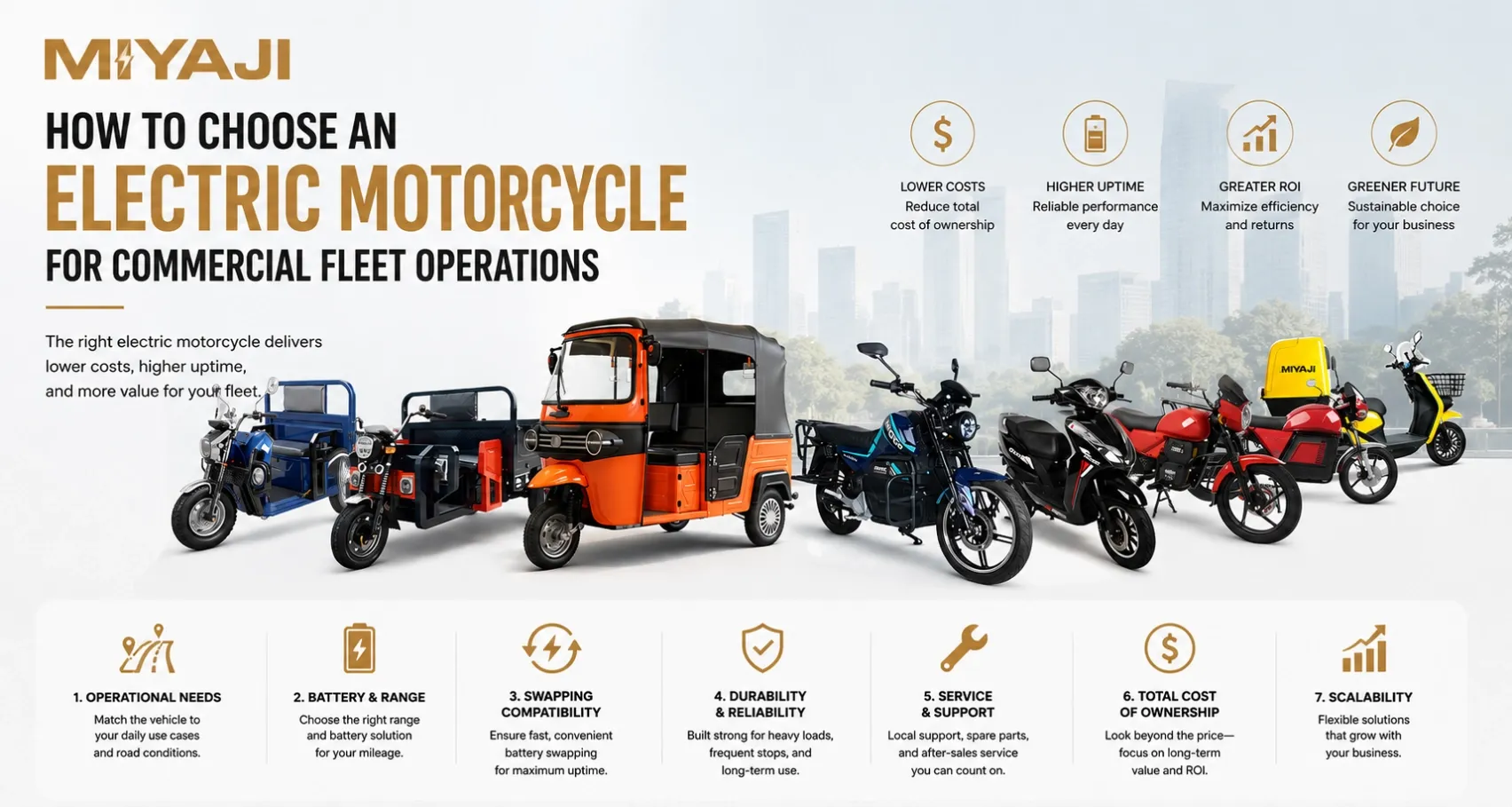
How to Choose an Electric Motorcycle for Commercial Fleet Operations
Choosing an electric motorcycle for personal transportation can be relatively simple.
Choosing one for a commercial fleet is different.
A fleet motorcycle may operate:
- Many hours per day
- Across multiple shifts
- With frequent stops and starts
- Under varying payloads
- In different weather conditions
- With limited maintenance downtime
For a commercial operator, the question is therefore not:
Which electric motorcycle has the highest top speed or longest advertised range?
The better question is:
Which vehicle configuration can reliably complete our daily operation at the lowest sustainable operating cost?
That requires evaluating the vehicle as part of a complete operating system:
Vehicle
-
Battery
-
Energy Replenishment
-
Maintenance
-
Fleet Operations
-
Total Cost of Ownership
This guide explains the most important factors commercial fleet operators, distributors and project buyers should evaluate before selecting an electric motorcycle.
1. Start With the Commercial Application
Do not start with the motorcycle specification sheet.
Start with the job the motorcycle needs to perform.
Different commercial applications create very different vehicle requirements.
Last-Mile Delivery
Typical priorities may include:
- High daily mileage
- Cargo capacity
- Frequent stop-and-go operation
- Low downtime
- Low energy cost
- Easy maintenance
Passenger Transport
Priorities may shift toward:
- Rider and passenger load
- Suspension
- Stability
- Continuous daily operation
- Range
- Durability
Corporate or Government Fleet
The buyer may prioritize:
- Standardized vehicle configuration
- Fleet management
- Serviceability
- Spare parts
- Documentation
- Long-term supply
Rental or Shared Mobility
Additional requirements may include:
- Vehicle tracking
- User management
- Battery monitoring
- Remote data
- Durable components
The correct vehicle depends on the operating model.
That is why commercial EV procurement should begin with a use-case definition, not a product catalog.
2. Calculate Daily Mileage Before Choosing Battery Capacity
One of the first questions should be:
How many kilometers does each vehicle actually travel per day?
Not:
“How much range do you want?”
These are different questions.
Suppose a fleet operates:
120 km per vehicle per day
That does not automatically mean the motorcycle needs a battery capable of completing 120 km on one charge.
The operator may instead use:
One Large Battery
Vehicle completes most of the day without replenishment.
Multiple Charging Sessions
Vehicle charges during predictable breaks.
Battery Swapping
Smaller batteries circulate through a swapping network.
Fast Charging
Vehicle receives additional energy during operating windows.
Therefore battery capacity should be designed around:
Daily Mileage + Operating Schedule + Energy Strategy
rather than range alone.
3. Do Not Use Advertised Range as Your Only Decision Metric
Electric motorcycle range can change significantly under different conditions.
Factors include:
- Speed
- Payload
- Road gradient
- Stop-and-go traffic
- Tire pressure
- Wind
- Temperature
- Motor efficiency
- Battery condition
- Rider behavior
A vehicle tested under light load and controlled conditions may achieve a very different result in commercial operation.
Commercial buyers should therefore ask:
Under what test conditions was this range achieved?
and:
What range should we expect under our actual payload and operating conditions?
This is much more useful than simply comparing:
150 km vs 180 km vs 200 km
on brochures.
4. Evaluate Energy Consumption, Not Just Range
A more useful fleet metric is:
Wh/km — Watt-hours per kilometer
This indicates how much energy the vehicle consumes to travel a given distance.
A simplified calculation is:
Daily Energy Requirement = Daily Distance × Energy Consumption per Kilometer
For example, if a vehicle hypothetically consumes:
45 Wh/km
and operates:
120 km/day
then:
45 × 120 = 5,400 Wh
or approximately:
5.4 kWh/day
This is only an illustrative example.
Actual consumption must be validated for the vehicle, payload and operating environment.
But this method is more useful for fleet planning because it connects:
Vehicle
→ Battery
→ Electricity
→ Charging
→ Operating Cost
5. Choose Motor Power Based on Operating Requirements
A larger motor is not automatically better.
Motor requirements depend on:
- Vehicle weight
- Rider weight
- Passenger or cargo load
- Target speed
- Acceleration
- Road gradient
- Duty cycle
A lightweight delivery motorcycle operating primarily on flat urban roads may have very different requirements from a motorcycle carrying a passenger on steep routes.
Oversizing the motor can increase:
- Vehicle cost
- Energy consumption
- Controller requirements
- Battery discharge requirements
Undersizing it can lead to:
- Poor acceleration
- Overheating
- Reduced hill-climbing performance
- Poor commercial usability
The goal is therefore not:
Maximum motor wattage
but:
Correct motor performance for the operating duty cycle.
6. Look at Torque and Hill-Climbing Ability
Motor power alone does not tell the whole story.
Commercial buyers should also evaluate:
- Torque
- Controller configuration
- Gear reduction
- Wheel size
- Vehicle weight
- Payload
- Gradient performance
This becomes particularly important for:
- Hilly cities
- Heavy cargo
- Passenger transport
- Frequent stop-and-go operation
If hill climbing is important, ask the supplier to specify the test conditions.
For example:
Gradient + Vehicle Load + Speed
is more meaningful than a standalone claim such as:
“Excellent climbing ability.”
7. Payload Changes Everything
Commercial motorcycles rarely operate under the same conditions as personal commuter vehicles.
A delivery motorcycle may carry:
- Rider
- Delivery box
- Packages
- Additional equipment
A passenger motorcycle may carry:
- Rider
- Passenger
- Personal luggage
Payload affects:
Acceleration
Braking
Range
Suspension
Tire wear
Motor temperature
Battery consumption
Therefore payload should be included when evaluating both performance and range.
A commercial EV supplier should ask:
What does the vehicle need to carry?
before recommending a configuration.
8. Choose the Battery Chemistry for the Application
Commercial electric motorcycles commonly use lithium-ion battery systems.
Two important chemistry families are:
LFP
Lithium Iron Phosphate
NMC / NCM
Nickel Manganese Cobalt-based lithium-ion
Neither chemistry should automatically be described as universally better.
Selection depends on factors including:
- Energy density
- Weight
- Cycle requirements
- Charging requirements
- Packaging
- Cost
- Thermal behavior
- Vehicle design
For example, an application prioritizing compact battery size and vehicle weight may make a different choice from a fleet prioritizing long-term battery asset utilization.
The correct comparison should therefore be based on the commercial duty cycle.
9. Battery Capacity Should Be Usable, Not Just Nominal
Battery energy is often estimated using:
Voltage × Amp-hours = Watt-hours
For example:
72 V × 60 Ah
=
4,320 Wh
=
4.32 kWh nominal energy
But nominal energy is not necessarily equal to the energy available for daily vehicle operation.
Actual usable energy may depend on:
- BMS limits
- SOC operating window
- Cell characteristics
- Temperature
- Battery age
- System configuration
Commercial planning should therefore distinguish between:
Nominal Battery Energy
and
Usable Operating Energy
This becomes particularly important when calculating fleet range and battery swapping requirements.
10. Choose the Right Energy Replenishment Strategy
The vehicle should not be selected independently from its charging strategy.
Commercial fleets generally have several options.
Standard Charging
Suitable when vehicles have long predictable parking periods.
Fast Charging
Useful when vehicles need additional energy during shorter operational breaks.
Battery Swapping
Useful when vehicle downtime must be minimized and battery standardization is practical.
Hybrid Energy Strategy
Some fleets may use:
Charging + Fast Charging
or
Charging + Battery Swapping
depending on operating conditions.
The correct energy strategy depends on:
- Daily mileage
- Operating hours
- Downtime tolerance
- Fleet size
- Parking
- Grid capacity
- Site infrastructure
This is why commercial EV procurement should consider:
Vehicle + Battery + Energy Infrastructure
together.
11. Evaluate Charging Time Carefully
When a supplier states:
“Fast charging supported”
ask:
From what SOC to what SOC?
At what charging power?
At what battery temperature?
Using which battery configuration?
Charging performance depends on:
- Cell capability
- Battery chemistry
- Battery capacity
- BMS
- Charger
- Temperature
- SOC
Faster is not automatically better.
Commercial fleets need a charging strategy that balances:
Vehicle Availability
with
Battery Performance and Lifecycle Requirements
12. Evaluate Battery Swapping at the System Level
If the fleet plans to use swapping, the motorcycle needs to be evaluated as part of a larger architecture.
Consider:
- Battery dimensions
- Battery weight
- Connector
- BMS communication
- Battery lock
- Station compatibility
- Charging limits
- Battery identification
- Software integration
A motorcycle being advertised as:
“swappable battery compatible”
does not automatically mean it is ready for a scalable commercial swapping network.
The complete system should work together.
13. Commercial Durability Is Different From Consumer Features
Commercial fleet buyers should be careful not to overvalue features designed primarily for showroom appeal.
For high-frequency operations, priorities often include:
Frame durability
Suspension
Brakes
Wheel and tire configuration
Motor reliability
Controller reliability
Battery enclosure
Connector durability
Water and dust protection
Serviceability
A large display or decorative lighting may be useful.
But it does not compensate for poor commercial durability.
The vehicle should be engineered around the duty cycle.
14. Check the Frame and Suspension
Commercial motorcycles can experience significantly more mechanical stress than private commuter vehicles.
Important considerations include:
- Frame structure
- Welding quality
- Suspension travel
- Shock absorber configuration
- Load capacity
- Wheel strength
This is especially important when vehicles operate:
- With cargo
- With passengers
- On uneven roads
- For long daily hours
Again, this does not mean every overseas market requires “rough-road motorcycles.”
The configuration should match the specific destination market and application.
15. Braking Performance Must Match Vehicle Load
A commercial motorcycle may regularly operate at higher total weight than a private commuter vehicle.
Therefore braking should be evaluated under the expected operating load.
Consider:
- Front brake
- Rear brake
- Brake type
- Tire grip
- Wheel size
- Vehicle weight
- Payload
- Target speed
A fleet buyer should evaluate the complete stopping system rather than comparing brake labels alone.
16. Maintenance Can Matter More Than Purchase Price
Imagine two motorcycles.
Motorcycle A
Lower purchase price
Frequent component failures
Long spare-parts lead time
Motorcycle B
Higher purchase price
Better component durability
Standardized parts
Fast maintenance
For a fleet, Motorcycle B may be cheaper over time.
Every day a commercial motorcycle is unavailable can represent lost productive capacity.
Therefore fleet buyers should evaluate:
Vehicle Purchase Price + Maintenance + Parts + Downtime
rather than purchase price alone.
17. Ask About Spare Parts Before Ordering Vehicles
This is frequently overlooked during procurement.
Before placing a large order, identify:
- High-wear components
- Recommended spare parts
- Spare-parts pricing
- Lead time
- Parts documentation
- Maintenance manuals
- Technical support
For international projects, waiting weeks for a small replacement component can be more damaging than paying slightly more for the vehicle initially.
A good fleet procurement plan should therefore include spare parts from Day One.
18. Consider Serviceability
A commercial vehicle should be relatively easy for trained technicians to inspect and repair.
Useful questions include:
Can common wear components be replaced easily?
Are parts standardized across models?
Can technicians access diagnostic information?
Is wiring organized and documented?
Can the supplier provide technical training?
As fleet size increases, serviceability becomes increasingly important.
19. Software and Connectivity May Matter
Depending on the fleet model, vehicles may need digital functions such as:
- GPS
- Vehicle status
- Battery SOC
- Battery SOH
- Fault data
- Rider information
- Trip information
- Energy consumption
- Remote monitoring
Not every project needs every function.
But for larger fleets, vehicle data can support:
- Dispatch
- Maintenance
- Battery management
- Energy planning
- Asset control
The vehicle should therefore be evaluated not only as mechanical hardware but potentially as a connected fleet asset.
20. Calculate Total Cost of Ownership
Purchase price is only the first cost.
A simplified commercial EV TCO model can include:
Vehicle Purchase Cost
-
Battery Cost
-
Energy Cost
-
Charging / Swapping Infrastructure
-
Maintenance
-
Spare Parts
-
Downtime
-
Battery Replacement
−
Residual Value
This gives a much better picture than comparing unit price alone.
A cheaper motorcycle can become expensive if:
- It consumes more energy
- Batteries degrade quickly
- Components fail frequently
- Spare parts are unavailable
- Vehicles spend too much time offline
21. Think in Cost per Kilometer
For fleet operators, one useful operating metric is:
Total Operating Cost per Kilometer
This can incorporate:
- Electricity
- Maintenance
- Battery depreciation
- Tire and brake wear
- Other operating expenses
It allows different vehicle configurations to be compared on the basis of productive work rather than purchase price.
For delivery or passenger fleets, this can be much more meaningful.
22. Run a Pilot Before a Large Fleet Order
If the project is significant, consider validating the vehicle under actual operating conditions.
A pilot can measure:
- Daily mileage
- Real energy consumption
- Range
- Payload performance
- Hill climbing
- Charging time
- Rider feedback
- Maintenance
- Component wear
- Battery performance
This provides real data before committing to a larger fleet.
A showroom test ride cannot reproduce several months of commercial operation.
23. Test the Vehicle in the Target Market
Market adaptation should be based on actual operating requirements.
For example:
Hot Climate
Evaluate battery and controller thermal performance.
High Rainfall
Evaluate water protection and electrical connections.
Dusty Environment
Evaluate sealing and maintenance requirements.
Hilly Routes
Evaluate motor, torque and braking.
Heavy Cargo
Evaluate frame, suspension and battery consumption.
High-Speed Urban Roads
Evaluate performance and braking requirements.
This is a better approach than applying one generic “developing market” configuration to every country.
24. Consider Future Fleet Expansion
A project may begin with:
50 motorcycles
and later expand to:
500
or
5,000
The vehicle platform should therefore be evaluated for scalability.
Ask:
- Can battery specifications remain standardized?
- Can spare parts be standardized?
- Can the same energy infrastructure support more vehicles?
- Can software support more users?
- Can local assembly become practical later?
A good pilot vehicle should not create unnecessary barriers to future expansion.
25. OEM, CKD and Local Assembly May Matter Later
For distributors or larger fleet projects, the first phase may use complete vehicles.
As volume increases, the project may consider:
CBU
→
SKD
→
CKD
→
Local Assembly
Potential motivations include:
- Logistics
- Import structure
- Local manufacturing policy
- Service capability
- Localization
- Long-term cost structure
Therefore vehicle selection can eventually become an industrial strategy decision rather than only a procurement decision.
Commercial Electric Motorcycle Procurement Checklist
Before selecting a supplier, confirm the following:
Area | What to Evaluate |
|---|---|
Application | Delivery, passenger, rental, corporate fleet |
Daily Mileage | Average and high-demand vehicles |
Operating Hours | Single shift or multi-shift |
Payload | Rider + passenger/cargo |
Motor | Power, torque, duty cycle |
Battery | Chemistry, voltage, capacity, usable energy |
Range | Real operating conditions |
Energy | Charging, fast charging, swapping |
Durability | Frame, suspension, brakes, connectors |
Environment | Temperature, rain, dust, road conditions |
Maintenance | Serviceability and diagnostics |
Spare Parts | Availability and lead time |
Software | GPS, battery, vehicle and fleet data |
TCO | Cost over operating life |
Scalability | Future fleet and infrastructure expansion |
Production | OEM / SKD / CKD options |
The Better Way to Select a Commercial Electric Motorcycle
Instead of:
Choose Motorcycle
↓
Choose Battery
↓
Figure Out Charging Later
a commercial project should ideally follow:
Define Operation
↓
Calculate Daily Mileage & Payload
↓
Define Vehicle Performance
↓
Calculate Energy Requirement
↓
Select Battery Architecture
↓
Choose Charging / Swapping Strategy
↓
Evaluate Durability & Maintenance
↓
Calculate TCO
↓
Pilot
↓
Scale
This reduces the risk of selecting a vehicle that looks suitable on paper but does not fit the actual business.
How MIYAJI Approaches Commercial Electric Motorcycle Projects
MIYAJI develops commercial electric mobility projects around the complete operating system rather than the vehicle alone.
The project can integrate:
Commercial Electric Motorcycles
-
Lithium Battery Systems
-
Fast Charging
-
Battery Swapping
-
Energy Management Software
-
OEM / CKD & Local Production Support
Vehicle configuration can be evaluated according to:
- Target market
- Application
- Daily mileage
- Payload
- Road conditions
- Operating hours
- Energy strategy
- Fleet size
- Future expansion
The objective is to select a configuration that supports reliable commercial operation and sustainable Total Cost of Ownership.
Planning a Commercial Electric Motorcycle Fleet?
For an initial vehicle evaluation, provide:
Target Country / City
Application
Fleet Size
Daily Mileage
Operating Hours
Average Payload
Target Speed
Road Conditions
Charging / Swapping Preference
Future Fleet Size
From these requirements, the project can evaluate:
Vehicle
→ Motor
→ Battery
→ Range
→ Charging / Swapping
→ Software
→ TCO
CTA Button
Discuss Your Fleet Requirements
Frequently Asked Questions
What should I look for in a commercial electric motorcycle?
Evaluate the vehicle according to daily mileage, payload, motor performance, usable battery energy, real-world range, charging or swapping requirements, durability, maintenance, spare parts and total cost of ownership.
What battery size is best for a commercial electric motorcycle?
There is no universal best capacity. Battery size should be selected according to daily mileage, vehicle energy consumption, payload, operating hours and the available charging or swapping strategy.
Is battery swapping better for delivery motorcycles?
Battery swapping can be useful for high-utilization delivery fleets where charging downtime affects productivity. Fleets with predictable parking or charging windows may instead use conventional or fast charging.
How much motor power does a delivery electric motorcycle need?
Required motor power depends on vehicle weight, payload, speed, gradients and duty cycle. Commercial buyers should evaluate torque and loaded performance rather than motor wattage alone.
How should commercial electric motorcycle range be evaluated?
Range should be evaluated under realistic payload, speed, road and environmental conditions. Advertised range under controlled conditions should not be the only procurement metric.
What is more important: vehicle price or TCO?
For commercial fleets, Total Cost of Ownership is generally more useful because it considers purchase price together with energy, batteries, maintenance, spare parts, downtime and replacement costs.
Should I test electric motorcycles before ordering a large fleet?
For significant fleet projects, a pilot can provide valuable data on real energy consumption, range, payload performance, maintenance and rider experience before larger deployment.
Can commercial electric motorcycles support both fast charging and battery swapping?
Some vehicle and battery architectures can support multiple energy replenishment methods, but compatibility depends on the battery, BMS, charging system and vehicle design. The energy strategy should be defined at the system level.