Sep 5, 2026Product & Industry Knowledge
Fleet Energy Management System: Optimize EV Charging, Swapping & Power Use
Learn how a fleet energy management system optimizes EV charging, battery swapping, charging priority, site power, battery availability and fleet energy use.
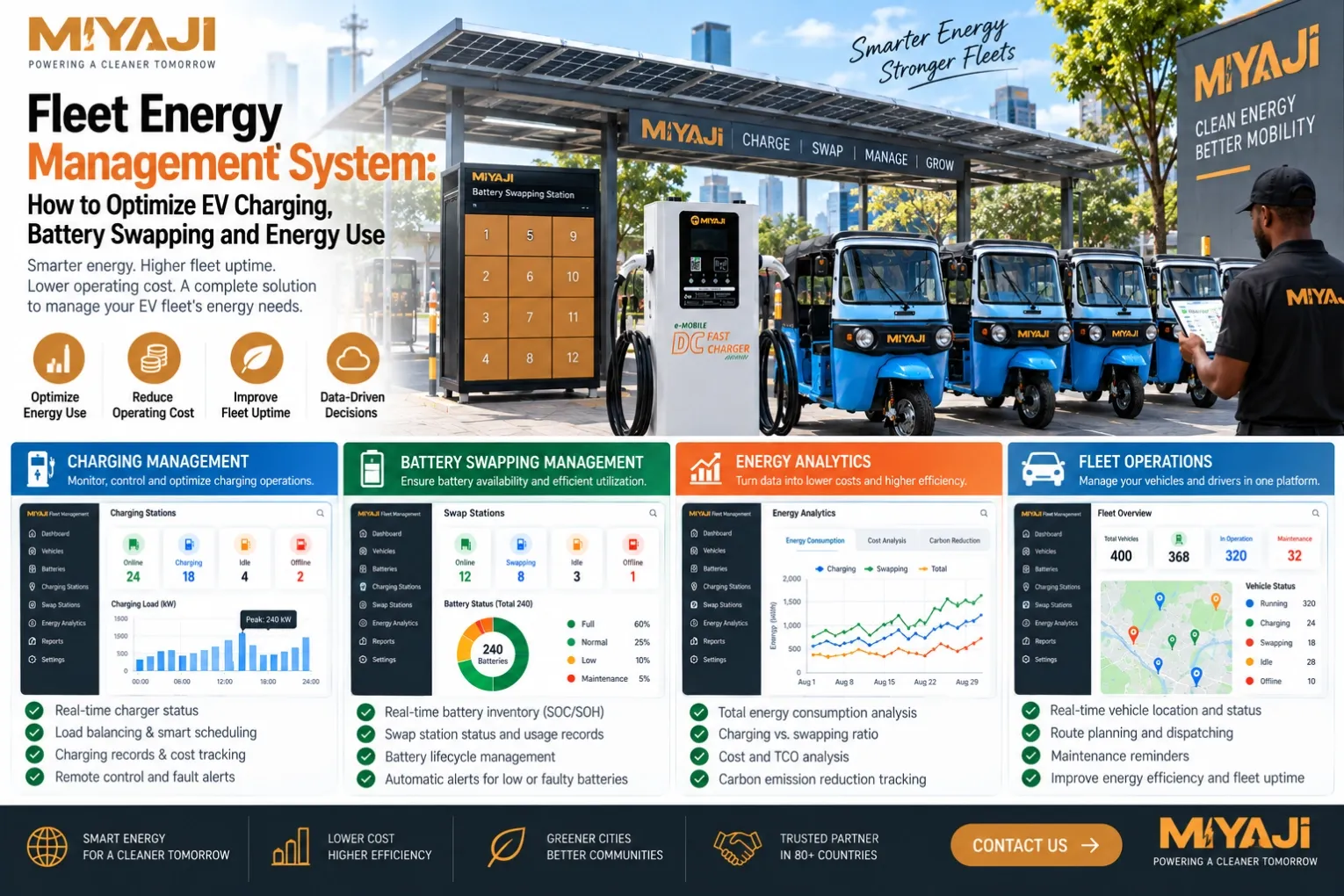
Fleet Energy Management System: How to Optimize EV Charging, Battery Swapping and Energy Use
As an electric vehicle fleet grows, energy management becomes increasingly important.
A small fleet may be able to charge vehicles whenever needed.
A larger fleet may need to coordinate:
- Vehicle charging
- Battery charging
- Fast charging
- Battery swapping
- Site electrical capacity
- Charging priorities
- Battery availability
- Operating schedules
Without coordination, a fleet can face problems such as:
- High charging peaks
- Insufficient ready batteries
- Vehicles waiting for energy
- Underused chargers
- Overloaded electrical infrastructure
- Poor battery utilization
A fleet energy management system helps operators coordinate these energy-related assets as one system.
The goal is not simply:
Charge every battery as fast as possible.
The goal is:
Deliver the right amount of energy to the right vehicle or battery at the right time.
What Is a Fleet Energy Management System?
A fleet energy management system is a software and control platform used to coordinate energy consumption across electric vehicles, batteries, chargers and battery swapping infrastructure.
Depending on the project, the system can manage:
Vehicles
Battery Packs
Chargers
Swap Stations
Site Power
Operating Schedules
and
Energy Data
It sits between the physical energy infrastructure and the fleet operation.
Fleet Management vs Energy Management
These two systems are related, but not identical.
Fleet Management
Focuses on:
- Vehicles
- Drivers
- GPS
- Maintenance
- Usage
- Routes
- Fleet performance
Energy Management
Focuses on:
- Charging
- Battery SOC
- Battery availability
- Site electrical load
- Charging priority
- Energy consumption
- Swap readiness
The two systems can work together.
Why Energy Management Matters for Commercial EV Fleets
Commercial fleets have one major constraint:
Vehicles need to be available when the business needs them.
Energy management therefore affects:
- Vehicle uptime
- Battery availability
- Charging downtime
- Infrastructure utilization
- Energy cost
- Fleet productivity
The larger the fleet, the more important this coordination becomes.
1. Understand Fleet Energy Demand
Energy planning starts with one basic question:
How much energy does the fleet require every day?
A simplified model is:
Daily Fleet Energy = Number of Vehicles × Daily Distance × Average Energy Consumption
For example, a hypothetical fleet of:
100 motorcycles
traveling:
120 km/day
at:
45 Wh/km
would consume:
100 × 120 × 45 Wh = 540 kWh/day
This is an illustrative calculation only.
Actual fleet consumption should be measured using real operating data.
Daily Energy Is Not the Same as Peak Power
This distinction is critical.
A fleet may require:
500 kWh per day
but that does not tell you how much electrical power is required at one moment.
If the energy is delivered gradually across many hours, peak power may be relatively moderate.
If many vehicles charge simultaneously, peak power can be much higher.
Therefore energy planning must consider both:
kWh — Energy
and
kW — Power
2. Understand Site Power Capacity
Before installing chargers or battery swap stations, determine:
- Available electrical capacity
- Transformer capacity
- Existing site load
- Available charging hours
- Distribution equipment
- Future expansion
A fleet should not select charging equipment independently from the site.
Example: Charger Power vs Site Capacity
Suppose a depot has:
20 chargers
Each charger has a maximum output of:
10 kW
The theoretical combined charging demand could reach:
20 × 10 = 200 kW
But if the site cannot support that demand, the operator needs another strategy.
Possible options include:
- Limit simultaneous charging
- Allocate power dynamically
- Stagger charging times
- Increase electrical capacity
This is where energy management becomes valuable.
3. Charging Scheduling
Not every vehicle needs to charge immediately.
Charging can be scheduled based on:
- Vehicle SOC
- Required departure time
- Next shift
- Route requirements
- Charging time
- Available site power
For example:
Vehicle A
leaves at 6:00 AM.
Vehicle B
leaves at 10:00 AM.
Vehicle A may be given higher charging priority.
4. Charging Priority
A simple charging-priority model might consider:
Departure Time
-
Battery SOC
-
Required Energy
-
Vehicle Importance
The system can then decide which vehicle should receive power first.
This reduces unnecessary competition for charging capacity.
5. Smart Charging
Smart charging means charging is controlled according to operational and electrical constraints rather than allowing every charger to operate independently.
The system may coordinate:
- Charging start time
- Charging power
- Vehicle priority
- Battery priority
- Site power limit
This can improve charging infrastructure utilization.
6. Dynamic Power Allocation
Dynamic power allocation distributes available electrical capacity between multiple chargers.
For example:
Available site power:
100 kW
Vehicles currently charging:
10
The system does not necessarily need to provide exactly:
10 kW each.
Some vehicles may need more power.
Others may have enough time to charge slowly.
Power can be allocated according to operational need.
7. Why Maximum Charging Power Is Not Always Best
Charging every battery at maximum power can be inefficient.
It may:
- Increase peak power demand
- Require larger electrical infrastructure
- Create unnecessary charging stress
- Reduce flexibility
If a vehicle will not be used for several hours, slower charging may be completely sufficient.
The correct target is:
Ready when needed
not:
Charged as fast as technically possible
8. Charging During Off-Peak Periods
Where electricity tariffs vary by time, charging may be shifted toward lower-cost periods when operationally practical.
For example:
- Overnight
- Low-demand periods
- Between shifts
This can reduce energy cost without reducing vehicle availability.
Tariff structures vary by market, so actual savings must be calculated locally.
9. Battery-Level Energy Management
For fleets using removable or swappable batteries, energy management becomes a battery-inventory problem as well.
The system may need to know:
- Which batteries are charging
- Which batteries are ready
- Which batteries are installed
- Which batteries require inspection
- Which batteries have low SOC
This allows the operator to manage energy across a battery pool.
10. Ready Battery Availability
For a swapping fleet, one of the most important metrics is:
How many charged batteries are ready right now?
A station can contain many batteries but still fail operationally if most are:
- Charging
- Low SOC
- Faulted
- Reserved
Therefore operators should distinguish between:
Total Battery Inventory
and
Ready Battery Inventory
11. Battery Charging Priority
Not every depleted battery needs the same charging priority.
For example, the system may prioritize:
- Batteries in high-demand stations
- Batteries needed for the next shift
- Batteries with lower SOC
- Batteries assigned to critical operations
This can improve battery availability without increasing the total battery pool.
12. Battery Swap Station Energy Management
A battery swap station is also a charging site.
The station may contain multiple batteries charging simultaneously.
The system therefore needs to coordinate:
- Battery charging
- Station power
- Ready battery inventory
- User demand
- Peak swap periods
A swap cabinet without intelligent battery management may become inefficient as demand increases.
13. Peak Swap Demand
Average swap demand can be misleading.
Imagine a station performs:
100 swaps/day.
If demand is evenly distributed, the station may operate smoothly.
But if:
40 swaps
occur during one short peak period, the station may run out of ready batteries.
Therefore:
Peak demand matters more than average demand alone.
14. Predicting Swap Demand
With enough historical data, operators can begin identifying patterns such as:
- Morning peaks
- Lunch-hour demand
- Evening peaks
- High-demand locations
- Weekday/weekend differences
This information can help optimize:
- Battery allocation
- Charging schedules
- Station capacity
15. Battery Redistribution
In a network of multiple swap stations, one location may have too many batteries while another has too few.
Operators may need to redistribute batteries between stations.
Software can help identify:
Surplus Station
→ Deficit Station
This improves network utilization.
16. Charging vs Swapping Energy Management
Charging-based fleets and swapping fleets have different priorities.
Charging Fleet
Focuses on:
- Vehicle charging
- Departure readiness
- Charger utilization
- Site load
Swapping Fleet
Focuses on:
- Battery inventory
- Ready batteries
- Station demand
- Battery circulation
- Station charging
A hybrid fleet may require both.
17. Hybrid Charging and Swapping
Some commercial fleets may support:
Battery Swapping
for rapid replenishment
and
Fast Charging
for certain vehicles or operating scenarios.
The energy management system can help coordinate both methods.
For example:
- Swapping during peak operations
- Charging during low-demand periods
- Fast charging for specific vehicles
- Overnight charging for reserve batteries
The objective is flexibility.
18. Fast Charging Management
Fast chargers can create significant instantaneous power demand.
Operators should consider:
- Charger power
- Number of simultaneous sessions
- Battery charging limits
- Site electrical capacity
- Charging schedule
A fleet energy management system can help avoid unnecessary simultaneous high-power charging.
19. Battery Protection During Charging
Charging control should respect battery limits.
These can include:
- Voltage
- Current
- Temperature
- SOC
- BMS restrictions
The charger and BMS must coordinate properly.
Software should not override safe battery-control limits.
20. Temperature-Aware Charging
Battery charging behavior can depend on temperature.
If the system receives battery temperature data, charging logic may be adjusted according to battery requirements.
The exact charging limits depend on:
- Chemistry
- Cell specification
- PACK design
- BMS settings
There is no universal charging rule for all batteries.
21. SOC-Based Charging
SOC can help determine charging priority.
For example:
Battery A:
20% SOC
Battery B:
70% SOC
If both are needed soon, Battery A may require more charging time.
But priority should still consider:
- Departure time
- Battery condition
- Charging rate
- Operational importance
SOC alone is not enough.
22. Energy Consumption Analysis
A fleet energy management platform can collect:
- kWh/day
- kWh/vehicle
- kWh/battery
- kWh/route
- Wh/km
This allows the operator to identify energy patterns.
23. Wh/km
A core efficiency KPI is:
Wh/km
This measures how much energy a vehicle consumes per kilometer.
If two similar vehicles operate on similar routes but one consistently consumes much more energy, investigate:
- Payload
- Driver behavior
- Tire condition
- Battery condition
- Vehicle faults
24. Energy Cost per Kilometer
Once electricity cost is included:
Energy Cost per km = Electricity Cost ÷ Distance
This helps operators compare:
- Routes
- Vehicles
- Charging strategies
It also feeds into fleet TCO.
25. Charger Utilization
Buying more chargers is not always the solution.
First ask:
Are the existing chargers being used efficiently?
Useful metrics include:
- Charging hours
- Sessions/day
- Energy delivered
- Idle time
- Availability
Low utilization may indicate poor scheduling rather than insufficient infrastructure.
26. Swap Station Utilization
Swap stations can be evaluated using:
- Swaps/day
- Swaps/hour
- Ready battery availability
- Charging utilization
- Downtime
This helps identify:
- Overloaded stations
- Underused stations
- Expansion priorities
27. Battery Utilization
A battery represents capital.
The operator should understand whether the battery is:
- Productively circulating
- Sitting unused
- Charging unnecessarily
- Repeatedly idle
Poor battery utilization increases the amount of capital tied up in the fleet.
28. Energy Infrastructure Utilization
The goal is to balance:
Vehicle Availability
with
Infrastructure Investment
Too little infrastructure can create downtime.
Too much infrastructure can create underutilized CAPEX.
Energy management helps find a better balance.
29. Energy Management and TCO
Energy management can affect TCO through:
- Electricity cost
- Charging infrastructure
- Battery inventory
- Vehicle downtime
- Charger utilization
- Battery utilization
This means software can influence both:
OPEX
and
CAPEX efficiency.
30. Avoid Overbuilding Infrastructure
A common project mistake is designing infrastructure for the theoretical maximum.
For example:
Every vehicle must be able to charge at maximum power simultaneously.
This can lead to unnecessary:
- Chargers
- Electrical upgrades
- Transformer capacity
If the fleet schedule allows staggered charging, a more efficient design may be possible.
31. Avoid Underbuilding Infrastructure
The opposite problem is also dangerous.
If charging capacity is too low:
- Vehicles may not be ready
- Batteries may not recharge in time
- Swap stations may run out of ready batteries
This creates operational downtime.
Infrastructure should therefore be sized from actual demand.
32. Pilot Energy Data
A pilot should collect real data such as:
- Wh/km
- kWh/day
- Charging time
- SOC at return
- Peak charging demand
- Swap frequency
- Battery turnaround time
This information can be used to plan the larger fleet.
33. Energy Planning From Real Data
A good scaling process is:
Pilot
↓
Measure
↓
Model Demand
↓
Size Infrastructure
↓
Scale
This is more reliable than designing a large system from assumptions alone.
34. Depot Energy Management
For depot-based fleets, the system may coordinate:
- Vehicle arrival
- SOC
- Required departure
- Charger availability
- Site power
A simple workflow can be:
Vehicle Arrives
↓
SOC Read
↓
Next Departure Identified
↓
Charging Priority Assigned
↓
Power Allocated
↓
Vehicle Ready
35. Multi-Depot Energy Management
Larger fleets may operate several depots.
The operator may need to compare:
- Energy consumption
- Charger utilization
- Power demand
- Vehicle readiness
across multiple locations.
This can help identify which depot needs:
- More chargers
- More power
- Better scheduling
36. Multi-Station Swapping Network
For a battery swapping network, the energy-management system may need to coordinate:
Station A
Station B
Station C
and the battery movement between them.
Important metrics can include:
- Demand by location
- Ready batteries
- Battery charging status
- Station availability
37. Renewable Energy Integration
Some fleet projects may integrate:
- Solar PV
- Battery energy storage
- Grid electricity
Depending on the project, energy management can coordinate these energy sources.
For example:
Solar
→ charge batteries during daytime
Grid
→ supplement when required
Stationary Storage
→ support site load
The economics depend strongly on the local site and tariff structure.
38. Solar Does Not Automatically Eliminate Grid Dependence
A common misunderstanding is:
Install solar and the fleet becomes independent from the grid.
Actual solar output depends on:
- System size
- Weather
- Time of day
- Site
- Fleet demand
The energy system should be calculated using real generation and consumption profiles.
39. Stationary Energy Storage
Some sites may use stationary battery storage to help:
- Shift energy
- Support peak demand
- Integrate solar
- Improve resilience
But storage adds additional investment.
It should be justified through project economics.
40. Grid Outage Strategy
In markets where electricity interruptions may affect operations, the project should consider:
- Required backup time
- Battery inventory
- Charging reserves
- Alternative power
- Stationary storage
The appropriate solution depends on local site reliability and fleet requirements.
41. Energy Management Alerts
Useful alerts may include:
- Site power limit reached
- Charger offline
- Battery temperature abnormality
- Insufficient ready batteries
- Station battery shortage
- Charging failure
- Low vehicle SOC
The system should focus on actionable alerts.
42. Energy Dashboard
A useful energy dashboard may show:
Today
- Fleet energy consumption
- Current charging power
- Vehicles charging
- Batteries charging
- Ready batteries
- Peak power
- Charger availability
- Station availability
This gives operators a quick picture of the energy system.
43. Historical Reporting
Historical data can help answer:
Which days have the highest energy demand?
Which station is busiest?
Which vehicles consume the most energy?
Which batteries are underused?
This supports future planning.
44. Forecasting
More advanced systems may forecast:
- Charging demand
- Battery demand
- Station demand
- Fleet energy requirement
Forecasting should be based on sufficient operating data.
It is not useful simply to label ordinary dashboards as “AI.”
45. API Integration
Energy data may need to connect with:
- Fleet management
- ERP
- Payment systems
- Utility systems
- Mobile apps
API capability can make the energy platform part of a larger operating system.
46. Energy Management for Electric Motorcycle Fleets
Electric motorcycle fleets may prioritize:
- Battery SOC
- Fast charging
- Battery swapping
- High-frequency energy replenishment
- Battery availability
This is especially relevant to:
- Delivery fleets
- Motorcycle taxi operations
- Rental fleets
47. Energy Management for Electric Tricycle Fleets
Tricycles may use larger batteries and have different energy profiles.
Operators may focus on:
- Larger daily energy demand
- Depot charging
- Fast charging
- Modular battery swapping
- Charging downtime
The same principles apply, but infrastructure requirements can differ.
48. What Does a Fleet Energy Management System Need to Connect?
A complete architecture may include:
Vehicle
↓
Battery / BMS
↓
Charger / Swap Station
↓
IoT / Communication
↓
Cloud Energy Platform
↓
Fleet Dashboard / API
All parts need compatible communication.
49. Hardware and Software Compatibility
An energy platform can only control or monitor functions supported by the hardware.
Therefore buyers should evaluate:
- BMS communication
- Charger communication
- Station protocol
- Vehicle communication
- Cloud API
before deployment.
This reduces integration risk.
50. Fleet Energy Management System Selection Checklist
Before selecting a system, ask:
Area | Key Question |
|---|---|
Vehicles | Can vehicle SOC and status be monitored? |
Batteries | Can individual batteries be identified and tracked? |
Charging | Can charging sessions and power be monitored? |
Power | Can site charging power be limited or allocated? |
Scheduling | Can charging be prioritized by departure time? |
Swapping | Can ready batteries and station inventory be monitored? |
Stations | Can multiple stations be managed centrally? |
Energy | Can kWh and Wh/km be analyzed? |
Alerts | Are power, charging and battery alerts available? |
Reports | Can energy data be exported? |
API | Can the platform integrate with other systems? |
Scale | Can multiple depots or cities be managed? |
Connectivity | What happens during network interruption? |
Common Energy Management Mistakes
Choosing Charger Quantity Before Studying Fleet Demand
Infrastructure should follow actual operating requirements.
Charging Everything Immediately
Not every vehicle needs power at the same time.
Ignoring Peak Demand
Daily energy alone is not enough.
Managing Vehicles but Not Batteries
Swapping fleets need battery-level visibility.
Buying More Batteries Instead of Improving Utilization
Poor scheduling can look like insufficient battery inventory.
Buying More Chargers Instead of Improving Scheduling
Low charger utilization may indicate an operational problem.
Ignoring Site Electrical Capacity
Chargers cannot be planned separately from the electrical system.
How Energy Management Supports Fleet Growth
During the first deployment, the system collects:
Vehicle Energy
Battery Data
Charging Demand
Swap Demand
Peak Power
These numbers create the basis for the next stage.
Instead of saying:
We need twice as many chargers because the fleet doubled.
the operator can ask:
What additional charging capacity is actually required based on utilization and peak demand?
This creates more disciplined scaling.
How MIYAJI Approaches Fleet Energy Management
For commercial electric fleets, energy infrastructure should operate as part of the complete vehicle system.
Depending on project requirements, MIYAJI can integrate:
Commercial Electric Motorcycles & Tricycles
-
Lithium Battery Systems & BMS
-
Fast Charging Equipment
-
Battery Swap Stations
-
Fleet & Energy Management Software
The objective is to coordinate:
Vehicle Demand + Battery Availability + Charging Capacity + Energy Infrastructure
rather than deploying each part independently.
This allows the project to be planned as one connected commercial EV ecosystem.
Planning Your Fleet Energy System?
Prepare:
Vehicle Type
Fleet Size
Daily Mileage
Operating Hours
Battery Capacity
Battery Quantity
Charging Strategy
Swap Strategy
Charger Power
Number of Chargers / Stations
Site Electrical Capacity
Future Fleet Size
From these inputs, the project can be evaluated around:
Energy Demand
→ Battery Inventory
→ Charging Power
→ Infrastructure
→ Software
→ Fleet Uptime
Discuss Your Fleet Energy Requirements
Frequently Asked Questions
What is a fleet energy management system?
A fleet energy management system coordinates charging, batteries, swap stations, electrical power and energy usage across an electric vehicle fleet.
What is the difference between fleet management and energy management?
Fleet management focuses on vehicles, drivers, maintenance and operations, while energy management focuses on batteries, charging, swapping, power and energy consumption.
How does smart charging work for EV fleets?
Smart charging schedules or controls charging based on factors such as battery SOC, vehicle departure time, charging requirements and available site power.
Can fleet software limit charging power?
If the charging hardware and control system support it, the platform can potentially allocate or limit charging power according to site capacity.
How can fleets reduce peak charging demand?
Possible strategies include staggered charging, charging priorities, dynamic power allocation and shifting charging to different times when operations allow.
How does energy management support battery swapping?
It can monitor battery SOC, charging status, station inventory, ready batteries, swap demand and battery movement across the network.
How many batteries should a swap station keep ready?
There is no universal number. Ready battery inventory depends on peak swap demand, battery charging time, station capacity and fleet usage.
Can fast charging and battery swapping be used together?
Yes, when the vehicle, battery, BMS and infrastructure are designed to support both energy strategies.
Can solar power be integrated into EV fleet charging?
Yes, depending on the project. Solar can supplement grid electricity, but system sizing should be based on actual generation and fleet energy demand.
Does an EV fleet need stationary energy storage?
Not always. Storage may be useful for certain grid, solar, resilience or peak-power requirements, but its economics should be evaluated separately.
Can MIYAJI integrate charging, swapping and fleet energy software?
MIYAJI can support project configurations connecting vehicles, battery systems, charging, swapping and software according to operational requirements.