Sep 2, 2026Product & Industry Knowledge
Battery Swapping Business Model: How Operators Make Money
Learn how battery swapping businesses make money through subscriptions, pay-per-swap, BaaS, fleet contracts and franchise models, and what determines profitability.
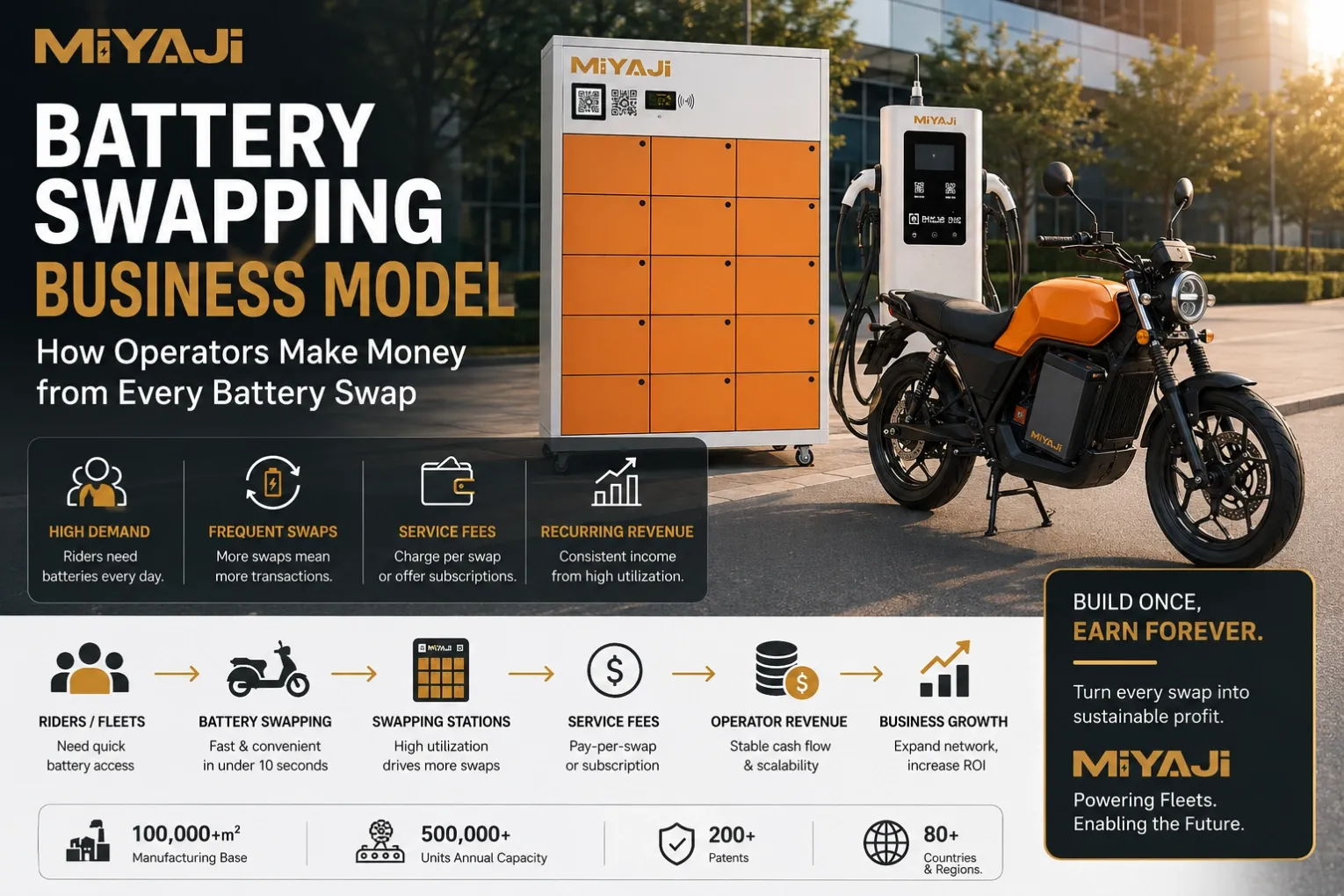
Battery Swapping Business Model: How Fleet and Swap Operators Make Money
A battery swapping business is not simply a business of selling electricity.
The operator may be managing:
Vehicles
-
Batteries
-
Swap Stations
-
Charging Infrastructure
-
Software
-
Users
-
Energy
-
Asset Financing
Depending on the model, revenue may come from subscriptions, swap fees, battery rental, fleet contracts, energy services or franchise partnerships.
That means there is no single battery swapping business model.
The right model depends on:
- Who owns the vehicle
- Who owns the battery
- Who owns the station
- Who pays for energy
- Who manages the network
- Whether users are individual riders or commercial fleets
- How frequently vehicles operate
- How capital is financed
Before investing in swapping infrastructure, these ownership and revenue relationships should be clear.
The Core Question: Who Owns What?
The first step is to separate the major assets.
A battery swapping ecosystem normally includes:
Vehicle
Battery
Swap Station
Charging Equipment
Software Platform
These assets do not have to belong to the same company.
For example, one operator may own everything.
Another model may look like this:
Rider owns vehicle
Battery operator owns battery
Station operator owns infrastructure
Software provider manages the platform
This changes both the investment structure and the revenue model.
So before asking:
“How much money can a battery swap station make?”
ask:
“Which assets are we investing in, and which revenue streams do those assets generate?”
Business Model 1: Fleet-Owned Battery Swapping System
This is one of the simplest models.
A delivery company, passenger fleet or logistics operator owns:
- Vehicles
- Batteries
- Swap stations
- Charging infrastructure
The network primarily exists to support its own fleet.
The objective is not necessarily to make money directly from each battery swap.
Instead, the value may come from:
- Higher vehicle utilization
- Lower downtime
- Lower fuel or energy cost
- Better battery management
- More predictable fleet operations
- Reduced dependency on public charging
In this model, the business case is mainly:
Does battery swapping reduce the fleet's total operating cost enough to justify the infrastructure?
The swap station is therefore an internal productivity asset rather than a retail energy business.
Business Model 2: Battery-as-a-Service
Battery-as-a-Service, or BaaS, separates battery ownership from vehicle ownership.
The rider or fleet may purchase the vehicle without owning the battery.
The battery operator retains ownership of the battery and provides energy access as a service.
The customer may pay through:
- Monthly subscription
- Weekly subscription
- Energy usage
- Swap frequency
- Mileage package
This model can reduce the upfront vehicle purchase cost because the battery is often one of the most expensive components of an electric vehicle.
For the operator, however, it also means carrying the battery assets on the business side.
The operator therefore needs to manage:
- Battery acquisition cost
- Battery depreciation
- Battery lifecycle
- Utilization
- Replacement
- Financing
A BaaS business works best when battery assets are used efficiently.
A battery sitting unused generates no revenue but still ties up capital.
Business Model 3: Pay-Per-Swap
In a pay-per-swap model, the user pays each time a battery is exchanged.
Conceptually, this resembles buying fuel.
The model is simple for occasional users because there is no long-term subscription requirement.
The operator may charge based on:
- Flat fee per swap
- Energy difference
- Battery size
- Time of day
- Membership tier
This model can be useful when usage is highly variable.
However, revenue becomes more dependent on transaction volume.
If a station performs very few swaps, fixed costs such as rent, equipment depreciation and software continue even when transaction revenue is low.
Therefore one of the most important metrics becomes:
Swaps per station per day
Business Model 4: Subscription Model
A subscription model charges users a recurring fee.
For example:
Weekly
Monthly
or
Fleet contract period
The subscription may include:
- Fixed number of swaps
- Fixed energy allowance
- Unlimited swaps under fair-use rules
- Tiered mileage or energy packages
For operators, subscription revenue can make cash flow more predictable.
For riders, it can simplify budgeting.
But pricing must be designed carefully.
If the subscription is too low relative to heavy user consumption, the operator loses margin.
If it is too high, low-mileage riders may not see enough value.
That is why usage segmentation matters.
Business Model 5: Energy-Based Billing
Instead of charging for each swap, the operator can charge according to energy delivered.
For example:
Customer returns a battery at 30% SOC and receives one at 90% SOC.
The system may calculate the energy difference and bill accordingly.
This can create a more direct relationship between:
energy consumed
and
amount paid
However, energy-based billing requires accurate:
- Battery SOC measurement
- Battery identification
- Transaction data
- Software integration
It also requires the operator to decide whether pricing includes only electricity or also battery depreciation, station cost, software and service margin.
Business Model 6: Fleet Contract
A commercial fleet may prefer a negotiated service agreement instead of rider-level billing.
The battery swapping operator may charge based on:
- Number of vehicles
- Monthly energy
- Minimum swap volume
- Battery availability guarantee
- Station availability
- Service level agreement
- Dedicated infrastructure
For example, a delivery company may pay a monthly fee for guaranteed access to enough batteries and stations for its fleet.
This can create more predictable revenue for the operator and more predictable operating cost for the fleet.
For B2B projects, this is often more relevant than a consumer-style pay-per-swap model.
Business Model 7: Franchise or Dealer Network
A battery swapping company does not necessarily need to own every station.
Local partners may invest in and operate stations.
Possible partners include:
- Motorcycle dealers
- Fuel stations
- Convenience stores
- Local entrepreneurs
- Fleet operators
- Distributors
The central company may provide:
- Hardware
- Batteries
- Software
- Branding
- Technical support
- User network
The local partner provides:
- Site
- Local operations
- Customer support
- Investment capital
Revenue may then be shared.
This model can help expand geographically with less central capital expenditure.
But it creates new challenges around:
- Quality control
- Revenue sharing
- Battery ownership
- Maintenance responsibility
- Software permissions
- Partner performance
Business Model 8: Vehicle + Energy Package
Another approach is to bundle the vehicle and energy service.
Instead of selling:
Motorcycle
and later selling:
Battery swapping service
the operator offers a complete mobility package.
The rider may pay:
Daily
Weekly
or
Monthly
for access to:
- Vehicle
- Battery
- Swapping network
- Maintenance
- Insurance or support
This can be especially relevant to delivery riders or commercial drivers who care more about daily operating cost than vehicle ownership.
The business therefore shifts from:
Selling an EV
to:
Selling productive mobility capacity
Where Does the Revenue Actually Come From?
Battery swapping revenue can be grouped into several categories.
Energy Revenue
Users pay for electricity or swaps.
Battery Service Revenue
Users pay for battery access rather than ownership.
Subscription Revenue
Recurring access fee.
Fleet Service Revenue
Commercial contracts with fleets.
Software Revenue
SaaS or platform fees.
Franchise Revenue
Fees or revenue share from local station partners.
Hardware Revenue
Sale or lease of cabinets, batteries or chargers.
Vehicle Revenue
Sale or lease of electric motorcycles or tricycles.
A mature business may combine several revenue streams rather than relying on one.
Revenue Does Not Equal Profit
A swapping network can generate significant transaction volume and still lose money.
Profit must account for costs including:
- Electricity
- Battery depreciation
- Battery replacement
- Station depreciation
- Rent
- Software
- Communication fees
- Maintenance
- Staff
- Customer support
- Logistics
- Financing
- Taxes
- Payment fees
A simplified formula is:
Operating Profit = Revenue − Energy Cost − Battery Cost − Infrastructure Cost − Operating Cost
The challenge is that some of these costs are immediate while others are spread over several years.
For example, batteries may be purchased upfront but generate revenue over many operating cycles.
That is why depreciation and asset utilization matter.
Battery Utilization Is One of the Most Important Metrics
Imagine two operators each own 1,000 batteries.
Operator A
Each battery circulates frequently and supports many paid swaps.
Operator B
Hundreds of batteries sit unused in low-demand stations.
Both invested similar capital.
But the economics are very different.
This is why operators should track:
- Swaps per battery
- Energy throughput per battery
- Battery idle time
- Battery SOH
- Revenue generated per battery
The battery should be treated as a productive asset.
Station Utilization Matters Just as Much
The same logic applies to swap stations.
A station has fixed costs whether it performs:
5 swaps/day
or
100 swaps/day
Typical fixed costs may include:
- Rent
- Equipment depreciation
- Communication
- Software
- Maintenance
Therefore low utilization can destroy station economics.
One useful metric is:
Revenue per station per day
Another is:
Swaps per station per day
These metrics help identify which locations are:
Profitable
Underutilized
or
Overloaded
How to Think About Unit Economics
For a simple pay-per-swap model:
Suppose:
Average revenue per swap = R
Average variable cost per swap = C
Then:
Contribution Margin per Swap = R − C
Variable cost may include:
- Electricity
- Battery degradation
- Payment fee
- Transaction-related operating cost
Fixed station costs still need to be covered.
So:
Break-even Swaps = Fixed Costs ÷ Contribution Margin per Swap
This is a simplified model, but it immediately shows why utilization matters.
A station with excellent hardware but insufficient users may never reach break-even.
The Hidden Cost: Battery Depreciation
Electricity is not the only energy-related cost.
Each battery gradually loses value through:
- Calendar aging
- Charge/discharge cycles
- Heat exposure
- High SOC storage
- High charging rates
- Operating conditions
Therefore each paid swap should indirectly contribute toward future battery replacement.
If the business charges only:
electricity cost + small markup
while ignoring battery depreciation, the model may appear profitable early and become unsustainable later.
The correct service price should consider:
Electricity
-
Battery depreciation
-
Infrastructure
-
Operations
-
Margin
Example of a Simple Business Model
Consider a hypothetical network.
This is an illustration only.
Suppose:
500 active riders
Each performs:
1.5 swaps/day
Then:
500 × 1.5 = 750 swaps/day
If average contribution margin after direct energy-related costs were hypothetically:
US$0.60 per swap
then daily contribution would be:
750 × $0.60 = $450/day
Monthly:
approximately $13,500 before fixed costs
The operator would still need to subtract:
- Rent
- Staff
- Software
- Maintenance
- Battery depreciation assumptions not already included
- Financing
- Administrative cost
The point is not the number.
The point is the formula:
Users × Usage Frequency × Contribution Margin
That is the engine of a transactional swapping business.
Why User Density Matters
A station network requires enough demand in a geographic area.
If 1,000 riders are spread across an entire country, station utilization may be low.
If 1,000 riders operate within a concentrated delivery zone, infrastructure can be much more efficiently used.
This is why fleet-based deployments can sometimes be easier to validate than public networks.
A fleet provides:
- Known users
- Known routes
- Known mileage
- Known operating hours
This makes energy demand easier to predict.
Public Network vs Closed Fleet Network
Closed Fleet
Users are known.
Routes are relatively predictable.
Payment can be centralized.
Station locations can be designed around operations.
Commercial validation can be easier.
Public Network
User demand is more variable.
Coverage expectations are higher.
More stations may be needed before usage becomes dense.
Marketing and customer acquisition become more important.
The public model may have greater long-term scale but usually requires stronger network effects.
Why Network Effects Matter
Battery swapping has a classic infrastructure problem.
Riders want many stations before adopting compatible vehicles.
Station operators want many riders before building stations.
Vehicle manufacturers want infrastructure before standardizing battery platforms.
This creates a chicken-and-egg problem.
One way to reduce this risk is to begin with:
Anchor Fleet
A known fleet creates immediate demand.
Once utilization is established, the network can later expand to:
additional fleets
and eventually
public users
This can be more financially disciplined than building a large public network first.
Pilot Economics Should Come Before Citywide Expansion
Before scaling, a pilot should answer:
- How many swaps does each rider perform?
- What is average energy consumed?
- What is average station utilization?
- What is peak utilization?
- What is battery degradation?
- What is electricity cost?
- What is maintenance cost?
- What price will users accept?
- What is customer retention?
- What is revenue per rider?
These numbers allow the operator to calculate real unit economics.
Without them, a business plan is mostly assumptions.
Important KPIs for a Battery Swapping Business
Operators should monitor at least:
Active Riders
How many users generate transactions.
Swaps per Rider per Day
Measures usage intensity.
Swaps per Station per Day
Measures infrastructure utilization.
Revenue per Rider
Measures customer value.
Revenue per Station
Measures site productivity.
Battery Utilization
Measures asset efficiency.
Station Uptime
Measures service reliability.
Battery Replacement Cost
Affects long-term margin.
Energy Cost per Swap
Shows direct operating cost.
Customer Retention
Shows whether users continue using the service.
What Can Make a Battery Swapping Business Fail?
1. Too Much Infrastructure Too Early
A large station network is built before demand exists.
Result:
Low utilization and high fixed cost.
2. Too Many Spare Batteries
Excess battery inventory ties up capital.
3. Too Few Batteries
Users arrive and find no charged battery.
Service quality collapses.
4. Poor Station Locations
The network technically exists but users avoid it.
5. Pricing Only Based on Electricity
Battery depreciation and infrastructure costs are ignored.
6. No Anchor Customers
Demand is uncertain from Day One.
7. Weak Software
The operator cannot see battery, station and transaction performance.
8. Scaling Before Unit Economics Work
A bad pilot becomes a bigger bad network.
What Makes a Battery Swapping Business More Sustainable?
A healthier model usually has several characteristics:
- High vehicle utilization
- High battery utilization
- High station utilization
- Predictable demand
- Standardized battery platform
- Low downtime
- Strong software monitoring
- Controlled battery degradation
- Good station placement
- Clear pricing
- Repeat users
- Disciplined expansion
In other words:
The business succeeds when expensive assets are used frequently and reliably.
Choosing the Right Model for Different Customers
Fleet Operator
Best fit may be:
Fleet-owned system
or
Fleet service contract
Delivery Platform
May prefer:
Subscription
or
per-rider service fee
Independent Riders
May prefer:
Pay-per-swap
or
subscription
Distributor
May prefer:
Dealer/franchise model
Investor or Energy Operator
May prefer:
BaaS + station network
Government or Large Project
May require:
public-private network + fleet anchor + local partners
There is no reason every market should use the same commercial structure.
Hardware Architecture Should Follow the Business Model
This is important.
If the project uses:
Pay-per-swap
then software needs transaction billing.
If it uses:
Subscription
the platform needs plan management.
If it uses:
Franchise
the platform may need multi-level permissions and revenue sharing.
If it uses:
Fleet contract
the platform may need vehicle and rider management rather than consumer billing.
So the commercial model should be defined before software requirements are finalized.
How MIYAJI Can Support Different Battery Swapping Business Models
MIYAJI can support battery swapping projects across multiple system layers:
Commercial Electric Vehicles
-
Lithium Batteries
-
Battery Swap Stations
-
Fast Charging
-
Energy Management Software
-
OEM / CKD & Local Production
This allows the project architecture to be adapted to different operating models.
For example:
Fleet-Owned Project
Focus on:
Vehicle uptime + battery management + operating cost.
BaaS Project
Focus on:
Battery assets + user subscriptions + station network + software.
Distributor / Franchise Project
Focus on:
Local deployment + station management + permissions + expansion.
Integrated Mobility Project
Focus on:
Vehicle + battery + energy + software as one commercial platform.
Planning a Battery Swapping Business?
Before discussing hardware quantities, prepare these inputs:
Target Market
Customer Type
Fleet Size
Expected Riders
Daily Mileage
Planned Pricing Model
Battery Ownership Model
Station Ownership Model
Expected Project Scale
Available Investment Budget
From these inputs, the project can begin evaluating:
Revenue Model
↓
Asset Ownership
↓
Battery Quantity
↓
Station Network
↓
Software Requirements
↓
Pilot Economics
↓
Expansion Strategy
CTA Button
Discuss Your Battery Swapping Business Model
Frequently Asked Questions
How does a battery swapping business make money?
Revenue can come from subscriptions, pay-per-swap fees, Battery-as-a-Service, fleet contracts, energy charges, software fees, franchise revenue and hardware or vehicle sales.
Is battery swapping profitable?
It can be, but profitability depends heavily on user density, station utilization, battery utilization, electricity cost, battery depreciation, pricing and operating expenses.
What is Battery-as-a-Service?
Battery-as-a-Service separates battery ownership from vehicle ownership. The user pays for access to batteries and energy instead of buying the battery with the vehicle.
What is the best battery swapping business model?
There is no universal best model. Fleet-owned, subscription, pay-per-swap, BaaS and franchise structures fit different customers and markets.
How many users does a battery swap station need to be profitable?
There is no fixed number. The break-even point depends on contribution margin per swap and the station's fixed operating costs.
Is a subscription better than pay-per-swap?
Subscription provides more predictable recurring revenue, while pay-per-swap can be more flexible for irregular users. Many operators can also combine the two.
Should a battery swapping business start with a fleet?
A known commercial fleet can make pilot demand easier to predict because vehicle numbers, routes and energy consumption are more measurable than in an open public network.