Sep 2, 2026Product & Industry Knowledge
Battery Swap Station Safety: What Commercial Operators Should Look For
Learn what makes a battery swap station safe, from battery and BMS protection to charging control, temperature monitoring, fire protection and remote alarms.
Battery Swap Station Safety: Key Safety Features for Commercial Battery Swapping Networks
Battery swapping can significantly reduce energy replenishment time for commercial electric motorcycles and other light EV fleets.
But putting multiple lithium batteries inside one charging cabinet also creates an important engineering question:
How should a battery swap station manage battery, charging and fire risks?
There is no single component that makes a swapping station safe.
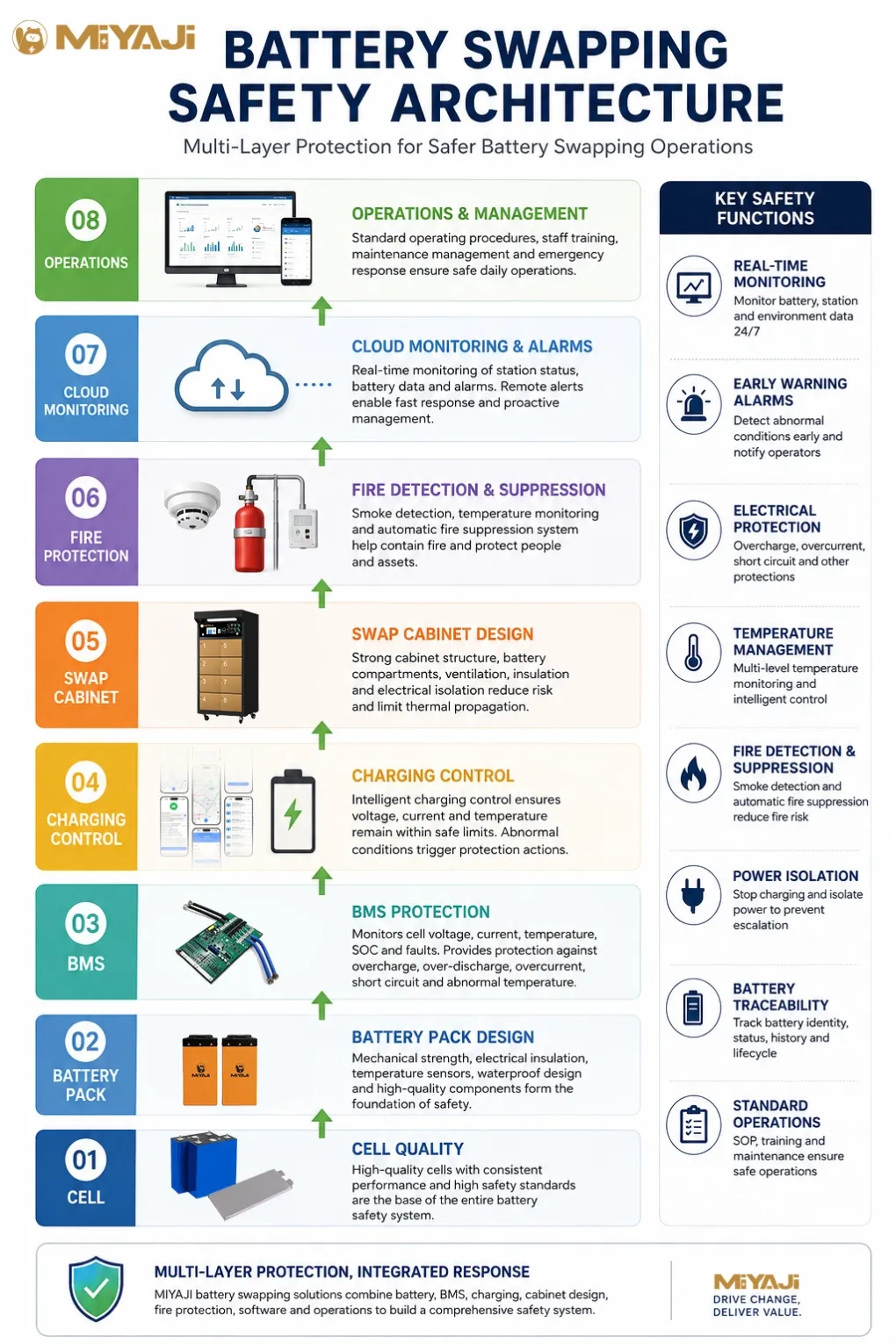
A professional battery swapping safety architecture should combine multiple protection layers:
Battery Design
↓
BMS Protection
↓
Charging Control
↓
Temperature Monitoring
↓
Station Protection
↓
Fire Detection & Response
↓
Software Monitoring
↓
Operating Procedures
The objective should not only be to respond after a serious battery event occurs.
A better system tries to:
Detect abnormal conditions → Stop escalation → Isolate risk → Alert operators → Support safe response
Understanding these layers is important when comparing battery swap station suppliers.
Why Battery Swap Station Safety Is Different
A conventional electric motorcycle normally carries one battery or battery set.
A battery swap station may simultaneously contain multiple batteries at different stages:
- Fully charged
- Partially charged
- Charging
- Recently returned from vehicles
- Waiting for inspection
- Potentially abnormal
These batteries may also have experienced very different operating conditions before returning to the station.
One rider may return a healthy battery.
Another battery may have experienced:
- High temperature
- Physical impact
- Water exposure
- Abnormal discharge
- Connector damage
- Internal electrical faults
Therefore the station cannot assume every returned battery is healthy simply because it can physically enter the cabinet.
The safety process begins before charging starts.
Layer 1: Start With the Battery Pack
A safe swap station cannot compensate for a poorly engineered battery pack.
Battery-level safety should consider:
- Cell quality and consistency
- Mechanical structure
- Electrical insulation
- Connector design
- Wiring
- BMS
- Temperature sensing
- Waterproofing
- Short-circuit protection
- Overcurrent protection
- Pack enclosure
- Vibration resistance
For swapping applications, mechanical durability becomes especially important because batteries are repeatedly:
removed
→
carried
→
inserted
→
locked
→
removed again
over their operating life.
The battery therefore needs to be designed for repeated commercial handling, not simply electrical performance.
Layer 2: Battery Management System Protection
The BMS is one of the most important electronic protection layers.
Depending on battery architecture, the BMS can monitor parameters such as:
- Cell voltage
- Pack voltage
- Current
- Temperature
- SOC
- SOH
- Charging status
- Fault conditions
It may provide protection against conditions including:
- Overcharge
- Over-discharge
- Overcurrent
- Short circuit
- Abnormal temperature
However, buyers should understand an important distinction:
A BMS is not a fire suppression system.
Its job is primarily to monitor and control battery electrical conditions.
If a battery has suffered severe mechanical damage or an internal failure outside the BMS's ability to control, additional protection layers are still required.
Layer 3: Battery Identification Before Charging
In a swapping network, each battery should ideally have a unique digital identity.
This allows the system to know:
Which battery entered the station?
Where did it come from?
What is its current status?
Does it have a previous fault record?
Should it be charged normally?
Battery identification can also support lifecycle tracking.
For example:
Battery ID: B000582
The system could associate that battery with:
- SOC
- SOH
- Cycle history
- Temperature history
- Previous faults
- Charging records
- Swap records
- Maintenance status
This transforms the battery from an anonymous energy container into a traceable fleet asset.
Layer 4: Check Battery Status Before Charging
A returned battery should not necessarily begin charging immediately.
The system should first determine whether important battery parameters are within acceptable operating limits.
Depending on system architecture, checks may include:
BMS communication
Battery voltage
Cell voltage
Temperature
SOC
Fault status
If an abnormal condition is detected, the system may:
Prevent normal charging
and
Generate an alarm for inspection.
This is an important principle:
Abnormal Battery ≠ Normal Charging Process
The earlier an abnormal battery is identified, the more opportunity the system has to prevent escalation.
Layer 5: Controlled Charging
Charging is one of the most important stages to manage carefully.
The battery, BMS and charger should communicate and operate within compatible limits.
Important parameters can include:
- Charging voltage
- Charging current
- Battery temperature
- SOC
- Cell voltage
- Charging duration
- Fault status
The charging system should respond appropriately when parameters exceed defined thresholds.
Depending on the architecture, this may include:
Reduce charging power
Stop charging
Disconnect charging
Generate an alarm
Charging strategy should be based on the actual battery chemistry and pack design rather than simply applying the highest possible charging power.
Layer 6: Temperature Monitoring
Temperature is an important battery safety signal.
Monitoring may occur at several levels:
Battery temperature
Charging slot temperature
Cabinet internal temperature
The purpose is to identify abnormal thermal behavior as early as possible.
For example, the system may detect that:
one battery's temperature is rising significantly faster than other batteries under similar charging conditions.
That does not automatically mean thermal runaway is occurring.
But it can justify:
stopping charging
and
flagging the battery for inspection.
The useful concept here is not merely:
“Does the cabinet have a temperature sensor?”
It is:
“What does the system do when temperature becomes abnormal?”
Layer 7: Smoke and Fire Detection
Temperature monitoring and smoke detection serve different purposes.
Temperature monitoring may provide earlier indication of abnormal thermal conditions.
Smoke detection can indicate that the situation has progressed further.
A swap cabinet safety system may therefore include:
- Temperature detection
- Smoke detection
- Alarm system
- Emergency power isolation
- Fire suppression equipment
The important issue is how these systems interact.
A sensor that only triggers a local light but does not:
- stop charging,
- isolate electrical power,
- notify the operator,
provides much less operational value than an integrated response architecture.
Layer 8: Electrical Isolation
When a serious abnormal condition is detected, continued energy input can worsen the situation.
Therefore an important safety capability is the ability to stop or isolate charging.
Depending on the design, the system may disconnect:
Individual Charging Slot
or
Charging Module
or
Cabinet Power
The objective is to prevent a detected abnormal battery from continuing to receive electrical energy.
For buyers, a useful question is:
Can the system isolate one abnormal battery without unnecessarily disabling the entire station?
The answer depends on cabinet electrical architecture.
Layer 9: Compartment and Cabinet Design
Physical structure also matters.
A battery swap cabinet is not simply a metal enclosure.
Its design may need to consider:
- Battery separation
- Slot structure
- Heat transfer
- Ventilation
- Cable routing
- Electrical separation
- Door structure
- Water ingress
- Dust ingress
- Maintenance access
Separating batteries into individual compartments can help create physical boundaries between packs.
However, buyers should be careful with simplistic claims such as:
“Each battery has its own slot, therefore thermal propagation is impossible.”
Physical separation can reduce certain risks, but actual propagation behavior depends on:
- battery energy,
- enclosure materials,
- ventilation,
- compartment design,
- spacing,
- thermal conditions,
- fire protection architecture.
Safety claims should therefore be supported by engineering and testing rather than marketing language.
Layer 10: Fire Suppression
Fire suppression is another layer of protection.
Depending on project design and local requirements, systems may use different suppression approaches.
The important questions for buyers are not simply:
“Does the station have a fire extinguisher?”
Instead ask:
How is an event detected?
How quickly does the system respond?
Is charging stopped first?
Is suppression automatic or manual?
Does suppression cover one compartment or the entire cabinet?
How are operators alerted?
What happens after activation?
Fire suppression should be considered part of a larger incident-response process.
It should not be treated as a substitute for battery quality, BMS protection or controlled charging.
Layer 11: Water, Dust and Outdoor Environment
Many battery swap stations operate outdoors or semi-outdoors.
That introduces environmental considerations including:
- Rain
- Humidity
- Dust
- Heat
- Direct sunlight
- Corrosion
- Flooding risk
Cabinet enclosure and installation should therefore be matched to the intended environment.
For outdoor installations, buyers should verify the actual enclosure protection specification and supporting test documentation rather than relying only on words such as:
“waterproof”
or
“weatherproof.”
Installation conditions also matter.
Even a properly designed cabinet should not automatically be installed in areas prone to flooding or unsuitable drainage.
Layer 12: Connector Safety
The battery connector experiences repeated mechanical cycles.
Every swap creates another:
connection
and
disconnection
Therefore connector design should consider:
- Current rating
- Contact resistance
- Mechanical durability
- Alignment
- Locking
- Arcing risk
- Water and dust
- Temperature rise
- Wear
A connector that performs well during initial testing may behave differently after thousands of physical insertion cycles.
For commercial swapping systems, connector durability is therefore both a reliability and safety issue.
Layer 13: Remote Safety Monitoring
A battery swap station should not depend entirely on someone standing beside it.
Cloud-connected systems can allow operators to monitor:
- Battery faults
- Station faults
- Abnormal temperature
- Charging status
- Communication failure
- Door status
- Battery availability
- Offline stations
If an abnormal condition occurs, the system can generate alerts to the operations team.
This changes the operating model from:
Wait until a rider reports a problem
to:
Detect abnormal conditions remotely and respond proactively.
For multi-station networks, this becomes increasingly important.
Layer 14: Battery Health and Lifecycle Monitoring
Not every battery problem appears suddenly.
Battery condition can deteriorate over time.
Useful long-term data may include:
- SOH
- Cycle count
- Capacity trend
- Internal resistance where available
- Temperature history
- Fault frequency
- Charging history
This allows the operator to identify batteries that may require:
inspection
maintenance
or
retirement from service
before they become serious operational problems.
The principle is simple:
Do not manage batteries only when they fail. Manage how they age.
Layer 15: Software Should Create a Safety Record
A mature swapping platform can create a digital history for every battery.
For example:
Battery ID
↓
Vehicle Usage
↓
Swap History
↓
Charging History
↓
Fault History
↓
Maintenance
↓
Return to Service / Retirement
This provides traceability.
If a particular battery repeatedly triggers abnormal temperature warnings, the operator can identify the pattern instead of treating each event as unrelated.
That makes software part of the safety architecture—not merely the billing system.
Hardware Safety vs Operational Safety
Even excellent equipment can be operated poorly.
Operational procedures should address issues such as:
- Damaged batteries
- Dropped batteries
- Water exposure
- Unauthorized repair
- Damaged connectors
- Abnormal swelling
- Unusual odor
- Excessive heat
- Fault alarms
Staff should know:
Which batteries can return to service
and
Which batteries must be quarantined for inspection.
A station should also have procedures for handling a battery that is suspected to be damaged.
This is why commercial battery swapping safety includes:
Hardware + Software + Operating Procedures
rather than hardware alone.
What Should Happen When an Abnormal Battery Is Detected?
A useful conceptual response sequence is:
Detect
↓
Stop Charging
↓
Electrically Isolate
↓
Generate Alarm
↓
Prevent Normal Redistribution
↓
Inspect Battery
↓
Repair / Return / Retire
If a serious thermal or fire event occurs, additional emergency and suppression procedures apply.
The exact sequence should be determined by the system design, battery characteristics and applicable local safety requirements.
What Should Buyers Ask a Battery Swap Station Supplier?
When evaluating suppliers, do not only ask:
“What is the cabinet price?”
Ask:
- How does the station communicate with the battery BMS?
- What battery parameters are monitored?
- What happens if battery temperature becomes abnormal?
- Can an individual charging slot be stopped?
- How are battery faults recorded?
- Does the station have temperature and smoke detection?
- What fire-response system is used?
- Can alarms be sent to the cloud platform?
- Can individual batteries be identified and tracked?
- What happens when communication with the BMS fails?
- How are charging limits controlled?
- What outdoor protection has been verified?
- What testing and certification documents are available?
- How is maintenance handled after an alarm?
- How are abnormal batteries prevented from re-entering normal circulation?
These questions reveal much more than a product brochure.
Be Careful With “100% Safe” Claims
Lithium battery systems involve energy storage.
No responsible manufacturer should reduce the entire safety discussion to:
100% fireproof
or
zero risk
A more credible engineering objective is:
Reduce Risk
-
Detect Abnormal Conditions
-
Limit Escalation
-
Protect People and Assets
-
Provide Traceability
This is also a better way for commercial operators to evaluate suppliers.
Battery Safety Starts Before the Swap Station
Another common mistake is evaluating the cabinet while ignoring the battery.
Suppose the station has:
- Temperature sensors
- Smoke detection
- Fire suppression
but the battery has:
- Poor cell consistency
- Weak BMS
- Poor connector quality
- Inadequate mechanical structure
The overall system can still be unreliable.
This is why battery swapping safety should be evaluated from:
Cell
↓
Battery Pack
↓
BMS
↓
Connector
↓
Charger
↓
Cabinet
↓
Software
↓
Operations
This is system-level safety.
Safety Requirements May Differ by Market
A battery swapping project may need to comply with different requirements depending on:
- Country
- Battery specification
- Vehicle category
- Electrical installation
- Station location
- Fire regulations
- Telecommunications
- Local certification requirements
Therefore buyers should not assume that one certification or one cabinet configuration automatically satisfies every market.
Before deployment, applicable requirements should be confirmed for the actual destination and use case.
How MIYAJI Approaches Battery Swapping Safety
MIYAJI approaches battery swapping as an integrated system involving:
Vehicle
-
Lithium Battery
-
BMS
-
Charging
-
Swap Station
-
Software
This makes it possible to consider safety across multiple layers rather than treating the swap cabinet as an isolated product.
Depending on the project configuration, the system can incorporate:
- Battery status monitoring
- BMS communication
- Charging protection
- Temperature monitoring
- Smoke detection
- Electrical protection
- Fire-response functions
- Remote alarms
- Battery lifecycle monitoring
- Operational traceability
The final configuration should be selected according to battery specification, station design, operating environment and destination-market requirements.
Evaluating a Battery Swapping System?
For a technical discussion, provide:
Target Market
Vehicle Type
Battery Chemistry
Battery Voltage / Capacity
Fleet Size
Expected Number of Stations
Indoor / Outdoor Installation
Charging Requirements
Local Safety / Certification Requirements
MIYAJI can then evaluate the battery, charging, cabinet and software architecture as one coordinated system.
CTA Button
Discuss Your Battery Swapping Requirements
Frequently Asked Questions
Are battery swap stations safe?
Battery swap stations can incorporate multiple safety layers including BMS protection, controlled charging, temperature monitoring, electrical protection, smoke detection, fire-response systems and remote monitoring. Actual safety depends on the complete system design, installation and operation.
What happens if a battery overheats inside a swap station?
The exact response depends on station design. A properly configured system may detect abnormal temperature, stop charging, generate an alarm and isolate the affected charging circuit, with additional emergency measures if conditions escalate.
Does a battery swap station need fire protection?
Fire-safety requirements depend on battery characteristics, station design and local regulations. Commercial projects should evaluate detection, electrical isolation, fire response and operating procedures together.
What does the BMS do in a battery swapping system?
The BMS monitors battery parameters such as voltage, current, temperature, SOC and faults and can provide electrical protection and communication with the charging or swapping system.
Can battery swap software improve safety?
Software can support safety by recording battery status, faults, charging history, temperature data and maintenance records while generating remote alerts for abnormal conditions.
What should I check before buying a battery swap station?
Evaluate battery compatibility, BMS communication, charging control, temperature monitoring, electrical protection, fire detection and response, enclosure design, connector durability, software monitoring and available test or certification documentation.
Is a fire suppression system enough to make a swap station safe?
No. Fire suppression is only one protection layer. Battery quality, BMS, charging control, temperature monitoring, electrical isolation, cabinet design, software and operating procedures all contribute to system safety.