Sep 14, 2026Product & Industry Knowledge
How to Choose a Fast Charger for Electric Motorcycles & Tricycles
Learn how to choose a fast charger for electric motorcycles and tricycles, including battery compatibility, BMS communication, charging power, safety and software.
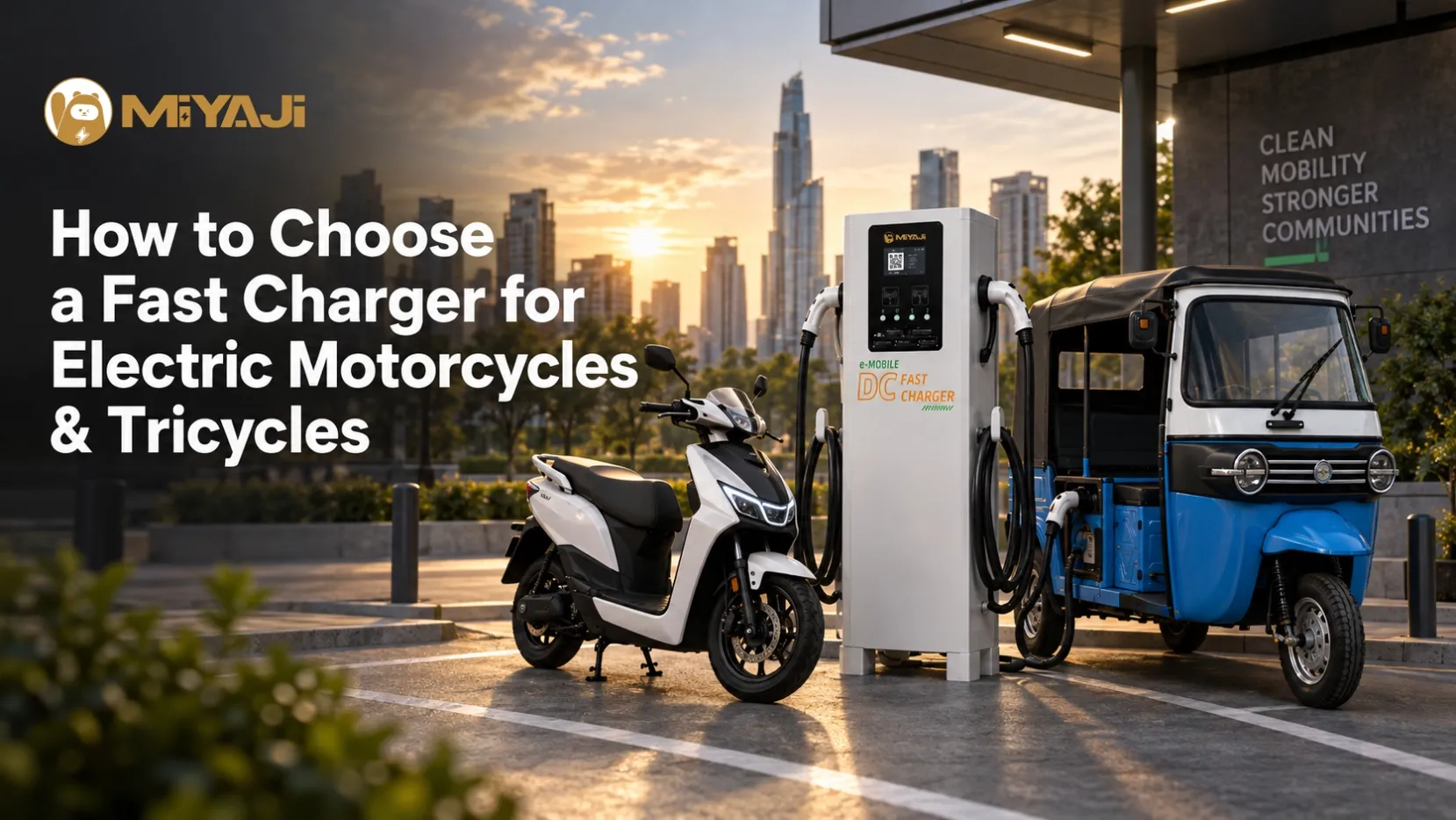
How to Choose a Fast Charger for Electric Motorcycles & Tricycles
Fast charging for an electric motorcycle or tricycle is not simply a matter of buying a charger with a higher power rating.
A 12 kW charger does not automatically mean that a 72V battery can safely accept 12 kW of charging power.
Before selecting a fast-charging system, buyers need to evaluate the battery cells, PACK configuration, BMS, charging current limits, communication protocol, connector, charger output and software as one complete system.
This is particularly important for commercial electric motorcycles and tricycles. Unlike simply connecting a conventional charger to a known battery specification, DC fast charging requires much closer coordination between the battery and charging equipment.
The key question is not how powerful the charger is, but whether the battery, BMS and charger are designed to fast-charge safely as one system.
This guide explains what B2B buyers should check before purchasing a fast charger for an electric motorcycle or tricycle project.
1. What Is Fast Charging for an Electric Motorcycle or Tricycle?
In a dedicated DC fast-charging architecture, the power-conversion hardware is located in the external charger rather than requiring the vehicle to carry the high-power conversion system itself.
The charger converts the incoming AC power into controlled DC power suitable for the battery.
A simplified architecture looks like this:
AC Grid → Fast Charger → Communication & Charging Control → BMS → Battery PACK
For commercial two- and three-wheelers, this architecture can be particularly useful because vehicles are often designed around cost, weight, packaging space and commercial utilization.
Instead of adding more high-power charging hardware to every vehicle, the charging infrastructure can be shared among multiple compatible vehicles.
However, moving the power conversion to the charger does not mean that any battery can simply be connected and fast-charged.
The battery must still be designed and validated for the required charging conditions.
2. Is Electric Motorcycle Fast Charging the Same as Automotive EV Fast Charging?
Not exactly.
Automotive DC fast charging also uses off-board power conversion, so the basic concept of supplying controlled DC power directly to the vehicle battery is not unique to motorcycles.
The major difference lies in the vehicle and battery ecosystem surrounding the charger.
Passenger EVs generally operate within relatively mature automotive charging architectures, communication standards, connectors and high-voltage battery platforms.
Electric motorcycles and tricycles can be much more diverse.
Depending on the manufacturer and project, two batteries described simply as “72V lithium batteries” may use different:
- cell chemistries;
- cell models;
- series and parallel configurations;
- BMS designs;
- maximum charging currents;
- temperature limits;
- connectors;
- communication interfaces; and
- charging-control strategies.
BMS solutions designed for electric motorcycles and tricycles commonly monitor parameters such as voltage, current and temperature, and CAN and RS485 are among the communication interfaces available in this market.
This is why buyers should not treat a two-wheeler fast charger as merely a lower-power automotive charging station.
The charger needs to be engineered around the battery system it will actually charge.
3. Fast Charging Starts With the Battery, Not the Charger
This is one of the most important principles for any electric motorcycle or tricycle fast-charging project.
Before deciding whether you need a 6 kW, 12 kW, 22 kW or higher-power charger, first determine:
Can the battery safely accept the required charging current?
The answer depends on more than nominal voltage and Ah capacity.
A proper evaluation should include:
- battery chemistry;
- cell manufacturer and cell model;
- series/parallel configuration;
- PACK capacity;
- maximum cell charging current;
- BMS charging-current limit;
- battery temperature range;
- connector and cable current rating;
- thermal design; and
- required charging time.
Different lithium battery chemistries and battery configurations have different charging requirements, while the BMS plays an important role in monitoring and controlling safe battery operation.
For this reason, two batteries labeled 72V 60Ah should not automatically be assumed to have the same fast-charging capability.
4. How Much Charging Power Can the Battery Accept?
A useful starting point is:
Charging Power (kW) ≈ Charging Voltage (V) × Charging Current (A) ÷ 1,000
For example, if a battery is charging at approximately 80V and the validated charging current is 100A:
80V × 100A ÷ 1,000 ≈ 8 kW
This does not mean the battery should automatically be charged at 8 kW.
It only illustrates the relationship between voltage, current and power.
The actual permitted charging current must come from the cell, PACK and BMS design limits.
Battery capacity alone is not enough
Suppose two batteries are both:
72V 60Ah
Battery A may use cells designed to accept a relatively high charging current.
Battery B may use cells optimized for energy density, cost or cycle life but with a lower allowable charging current.
Their nominal voltage and capacity look identical on a quotation sheet, but their safe fast-charging requirements may be completely different.
This is why charger selection should begin with battery engineering data rather than charger power alone.
5. Why BMS Communication Matters in DC Fast Charging
Depending on the system design, it can monitor information such as:
- PACK voltage;
- charging current;
- cell voltage;
- battery temperature;
- SOC;
- SOH;
- alarms; and
- charging limits.
Electric motorcycle BMS solutions with CAN and RS485 communication are commercially available, and BMS architectures can monitor battery voltage, current and temperature during operation.
In a properly integrated fast-charging system, communication allows the charger and battery-control system to coordinate charging rather than relying only on a fixed output.
Conceptually:
Battery → BMS → Communication → Charger
and:
Charger → Controlled Voltage / Current → Battery
This creates a feedback loop.
If battery conditions change during charging, the charging strategy can respond according to the system's programmed protection and control logic.
6. CAN vs RS485: What Should Buyers Know?
CAN and RS485 are both used in battery and light-EV applications, but simply seeing “CAN supported” or “RS485 supported” on two specification sheets does not guarantee compatibility.
The physical communication interface is only one part of the system.
The devices must also understand the required data and communication protocol.
For example, the charger may need information relating to:
- battery identification;
- SOC;
- PACK voltage;
- maximum permitted charging voltage;
- permitted charging current;
- temperature;
- charging status; and
- fault conditions.
Therefore:
Same communication interface ≠ automatically compatible communication protocol.
This is an important point for B2B buyers sourcing batteries, BMS units and chargers from different suppliers.
7. Can Any Electric Motorcycle Battery Be Fast-Charged?
No.
This is one of the most common misunderstandings among buyers entering the electric motorcycle and tricycle industry.
A battery that works correctly with a standard charger should not automatically be assumed to support significantly higher charging power.
Before fast charging, the supplier should verify the battery at several levels:
Cell level
Can the selected cell safely support the target charging current?
PACK level
Can the busbars, cables, connectors, fuse, thermal design and overall PACK structure handle it?
BMS level
Can the BMS monitor and control the required charging conditions?
Communication level
Can the BMS and charger exchange the information required by the charging strategy?
System level
Has the battery + BMS + charger combination actually been configured and validated together?
If these questions cannot be answered, simply increasing charger current is not a responsible fast-charging strategy.
8. What Happens If the Battery and Fast Charger Are Not Properly Matched?
An incompatible charging system can create conditions such as:
- excessive charging current;
- excessive cell voltage;
- connector or cable overheating;
- abnormal battery temperature;
- accelerated cell degradation;
- BMS protection trips;
- charging interruptions; and
- potentially serious battery safety events.
In severe fault conditions, lithium-ion battery failures can involve thermal runaway.
This is why the correct engineering question is not:
“Can you make the charger more powerful?”
It is:
“What charging power can this battery system safely support?”
9. Charger Power Should Be Selected After Battery Validation
Once the battery's charging capability is understood, charger power can be selected.
For commercial electric motorcycles and tricycles, MIYAJI offers different charger configurations for different project requirements rather than assuming that one charger specification fits every battery.
Based on project requirements, the selection may involve different:
- output-power levels;
- charging-gun quantities;
- output-current ranges;
- site-power requirements; and
- charging scenarios.
MIYAJI's current two- and three-wheeler fast-charging platform includes configurations ranging from lower-power commercial chargers to multi-gun and higher-power systems.
The correct model should be determined by the battery system and project requirement together, not simply by choosing the highest available kW rating.
10. Check the Charger Output Voltage Range
The charger must operate within the battery system's required voltage range.
For example, MIYAJI's dedicated electric motorcycle and tricycle fast-charging platform is designed around low-voltage commercial EV battery applications, with product configurations covering approximately 40–100V DC output.
But nominal battery voltage should not be confused with actual charging voltage.
A battery marketed as “72V” does not necessarily charge at exactly 72V.
Actual maximum charging voltage depends on factors such as:
- chemistry;
- series count;
- cell charging voltage; and
- BMS configuration.
This is another reason the supplier needs the actual battery specification before configuring the charger.
11. Connector Compatibility Is More Than Plug Shape
A connector that physically fits does not automatically mean the charging system is compatible.
Buyers should check:
Mechanical compatibility
Does the connector fit and lock correctly?
Electrical compatibility
Are voltage and current ratings appropriate?
Communication compatibility
Are the required communication pins and signals available?
Thermal capability
Can the connector and cable safely carry the target current?
There are emerging standards for DC charging of light electric vehicles; for example, IEC 62196-6 covers connectors intended for DC charging of certain light EV applications.
However, real-world motorcycle and tricycle projects can still involve different battery and connector architectures.
The interface therefore needs to be confirmed project by project.
12. Site Power Supply Matters Too
Selecting the battery and charger is only part of the project.
The installation site must be able to supply the charger.
Before ordering equipment, confirm:
- AC input voltage;
- single-phase or three-phase supply;
- available site capacity;
- number of chargers;
- expected simultaneous charging;
- distribution-board capacity;
- cable sizing; and
- protection requirements.
For example, installing several chargers simultaneously can create a very different site-power requirement from installing a single unit.
This becomes particularly important when deploying charging infrastructure at depots, dealerships, logistics hubs or commercial vehicle bases.
13. Safety Should Be Designed at System Level
A long list of charger protection functions does not by itself guarantee safe fast charging.
Safety should exist at multiple levels:
Battery level
Cell selection, PACK structure, thermal design and electrical design.
BMS level
Voltage, current and temperature monitoring plus protection logic.
Communication level
Correct battery information and charging commands.
Charger level
Electrical protection, charging control and fault response.
Installation level
Correct power distribution, grounding, cabling and environmental protection.
MIYAJI fast-charging equipment incorporates charger-side protections and battery monitoring functions, but these should work together with a compatible battery and BMS rather than replace them.
14. Do You Need Charging Software?
For one charger in a private location, sophisticated cloud functions may not always be the first purchasing priority.
For larger commercial deployments, however, software becomes much more useful.
- charger status monitoring;
- charging records;
- fault information;
- charging-session data;
- user access;
- QR code or card functions;
- payment integration;
- remote monitoring; and
- remote operation and maintenance.
These are valuable commercial features.
But they should not be confused with the core engineering requirement:
The battery and charger must first be compatible.
A charger does not become technically suitable for a battery merely because it has an APP, QR code or payment system.
15. Fast Charging vs Battery Swapping: Which Should You Choose?
Fast charging and battery swapping solve the same high-level problem—reducing vehicle energy replenishment downtime—but through different system architectures.
With fast charging:
The vehicle stays and the battery stays. Energy is transferred into the battery.
With battery swapping:
The vehicle stays, but the depleted battery is replaced by another charged battery.
The better option depends on the project.
Factors may include:
- vehicle utilization;
- battery size;
- acceptable downtime;
- fleet concentration;
- site infrastructure;
- battery standardization;
- initial investment; and
- local project requirements.
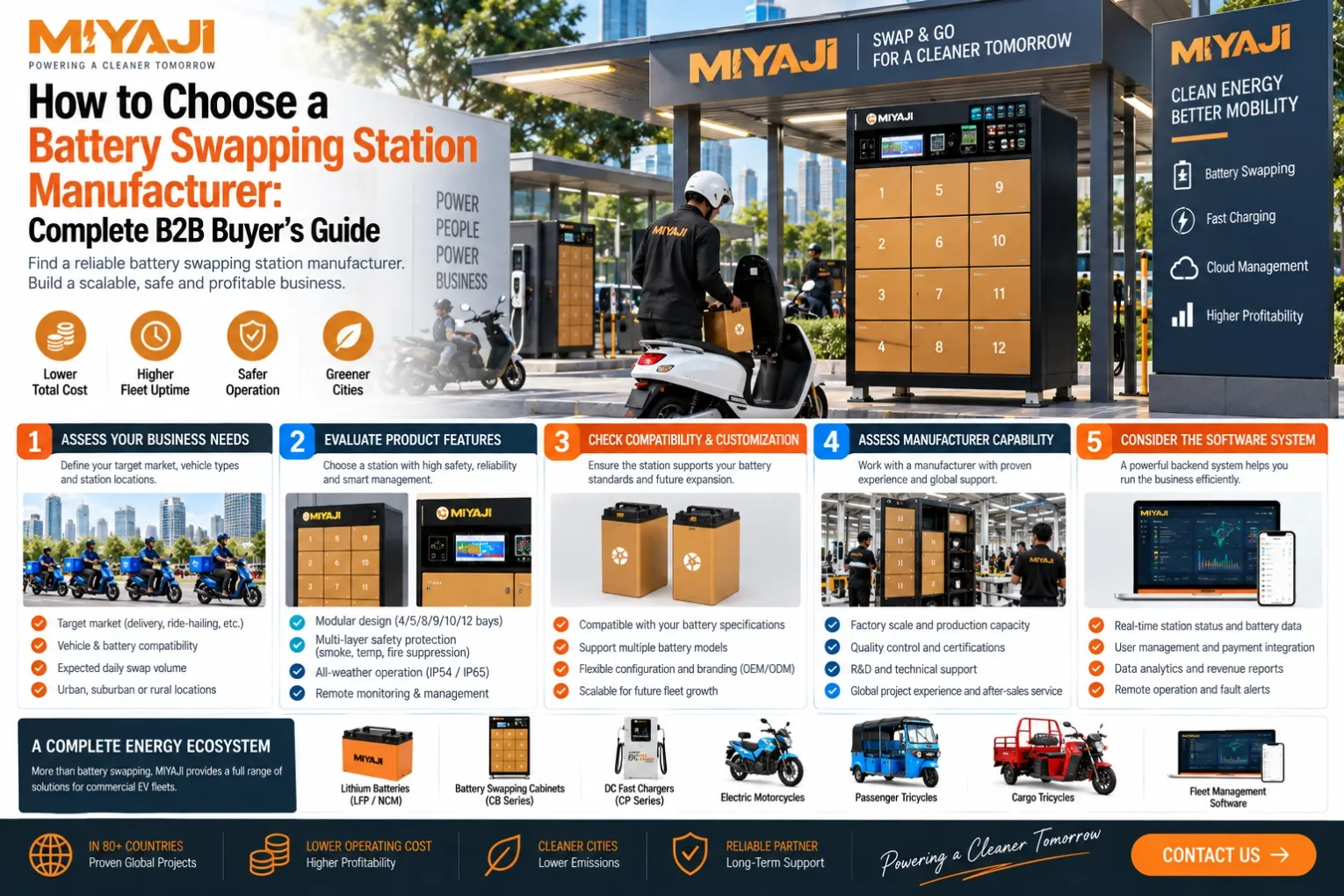
For a detailed comparison, see MIYAJI's existing guide on Battery Swapping vs Fast Charging for Commercial EV Fleets.
Importantly, these should be treated as two different energy solutions, not as the same product with different hardware.
16. What Information Should You Send a Fast-Charger Supplier?
Before asking:
“How much is a 12 kW fast charger?”
send the supplier the battery information first.
A useful project requirement sheet should include:
Information | Why It Matters |
|---|---|
Vehicle type | Motorcycle or tricycle application |
Battery chemistry | |
Nominal voltage | Defines battery platform |
Maximum charging voltage | Charger configuration |
Battery capacity | Energy and charging-time calculation |
Cell model | Determines charging capability |
Series/parallel configuration | Defines PACK architecture |
Maximum charging current | Determines feasible charging power |
BMS model | System compatibility |
Communication | CAN / RS485 / other |
Communication protocol | Required for data exchange |
Connector | Electrical + mechanical interface |
Target charging time | Helps define project requirement |
Number of vehicles | Infrastructure planning |
Local AC supply | Charger/site configuration |
If some of this information is unavailable, the charger supplier should identify what must be verified before finalizing the fast-charging configuration.
17. How to Evaluate an Electric Motorcycle Fast-Charging Supplier
A serious supplier should be able to discuss more than charger power and price.
Ask:
1. Can you evaluate whether our existing battery supports fast charging?
2. Can you review our cell and PACK specifications?
3. What BMS communication interfaces do you support?
4. Can you integrate our communication protocol?
5. How is charging current controlled when battery conditions change?
6. Can you provide the charger, battery and BMS as an integrated system if required?
7. Can the system connect to charging-management software?
8. How do you validate the battery–BMS–charger combination before deployment?
If the conversation never goes beyond:
voltage + kW + connector + price,
the project may not yet have addressed the most important part of two- and three-wheeler fast charging.
18. MIYAJI's Approach to Electric Motorcycle & Tricycle Fast Charging
MIYAJI approaches fast charging as a battery-system integration problem, not simply a charging-equipment sale.
Our dedicated fast-charging architecture for electric motorcycles and tricycles can integrate:
Battery Cells
↓
Battery PACK
↓
BMS
↓
Communication
↓
DC Fast Charger
↓
Charging Management Software
Because MIYAJI works across commercial electric vehicles, lithium batteries, battery cells, BMS integration, fast-charging equipment and software, the system can be evaluated from both the battery side and the charger side.
For projects using an existing vehicle or battery, compatibility should first be assessed.
For new projects, the battery, BMS, charging interface and charger can be designed around a common system architecture from the beginning.
The objective is not simply to deliver more charging power.
It is to build a charging system in which the battery knows its limits, the BMS communicates them, and the charger responds accordingly.
FAQ
Can a 72V electric motorcycle battery use a DC fast charger?
Potentially, but nominal voltage alone is not enough to determine compatibility. Cell specification, PACK configuration, BMS, charging-current limits, communication and connector design must also be evaluated.
Can I connect a higher-power charger to reduce charging time?
Not automatically. Charging power must remain within the validated limits of the cells, PACK, BMS, connector and thermal design.
Does an electric motorcycle fast charger need BMS communication?
For the type of controlled DC fast-charging architecture discussed in this guide, battery/BMS communication is an important part of coordinating charging and responding to battery conditions.
Does CAN or RS485 automatically mean my battery is compatible?
No. CAN and RS485 describe communication interfaces. The battery and charger must also use compatible communication protocols and data definitions.
Is an electric motorcycle fast charger the same as an automotive DC charger?
Both can use off-board DC power conversion, but electric motorcycle and tricycle projects can involve different voltage platforms, batteries, BMS architectures, connectors and communication requirements. Equipment should therefore be selected for the specific application.
Can MIYAJI fast chargers work with an existing battery?
Compatibility needs to be evaluated first. Battery chemistry, voltage, cell/PACK specifications, BMS, communication protocol, connector and allowable charging current should be reviewed before a configuration is confirmed.
Does MIYAJI provide both fast charging and battery swapping?
Yes. They are separate energy solutions. MIYAJI can provide dedicated fast-charging systems and battery-swapping systems according to project requirements.
CTA
Planning a Fast-Charging Project for Electric Motorcycles or Tricycles?
Before selecting charger power, send us your battery voltage, capacity, chemistry, cell specification, BMS information, communication protocol and target charging time.
MIYAJI can evaluate the battery–BMS–charger architecture and recommend a suitable fast-charging configuration for your project.
Discuss Your Fast-Charging Project →