Sep 14, 2026Product & Industry Knowledge
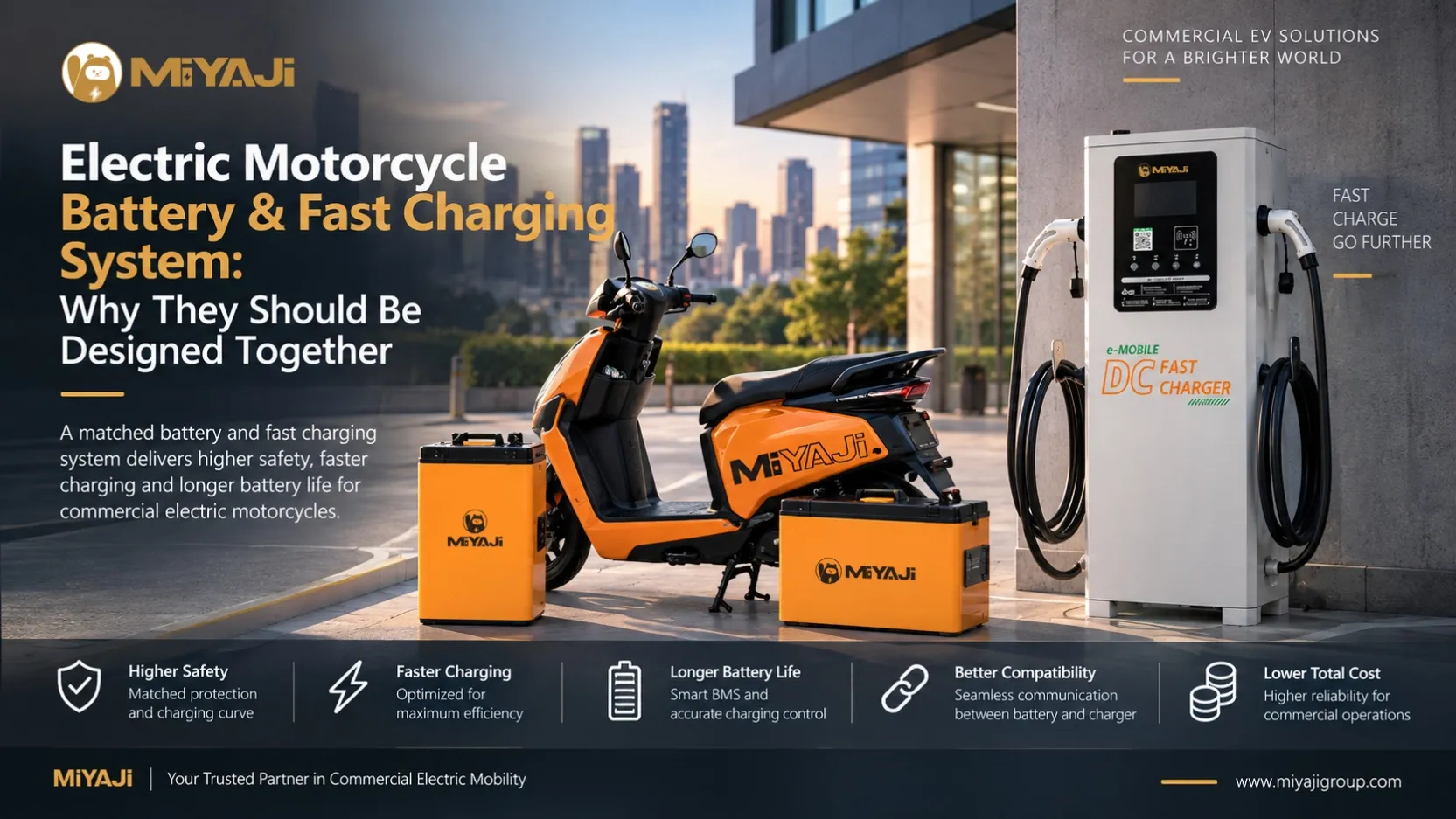
Electric Motorcycle Battery & Fast Charging System: Why They Should Be Designed Together
Learn why electric motorcycle and tricycle batteries, BMS and DC fast chargers should be designed together for compatibility, charging safety and reliable commercial deployment.
Electric Motorcycle Battery & Fast Charging System: Why They Should Be Designed Together
When buyers plan a fast-charging system for electric motorcycles or tricycles, procurement often starts by separating the project into two products:
Battery → buy from a battery supplier
Fast charger → buy from a charging equipment supplier
On paper, this looks simple.
In practice, the battery and fast charger are not independent systems.
Between them are the battery cells, PACK architecture, BMS, charging-current limits, temperature limits, communication protocol, charging connector and charging-control strategy.
That means two individually qualified products do not automatically become a compatible fast-charging system when connected together.
For commercial electric motorcycle and tricycle projects, a better approach is to consider:
Battery Cells → Battery PACK → BMS ↔ Communication ↔ DC Fast Charger
as one charging architecture from the beginning.
This guide explains why.
1. A Fast Charger Does Not Decide How Fast a Battery Can Charge
One of the most common misunderstandings in fast-charging projects is assuming that charger power determines charging speed.
For example:
6 kW charger = slower charging 12 kW charger = faster charging 22 kW charger = even faster charging
That comparison only makes sense when the battery system can safely accept the corresponding charging power.
The charger can provide energy.
But the battery determines how much charging current it can accept under specified conditions.
Those limits depend on factors including:
- battery chemistry;
- cell model;
- cell capacity;
- series/parallel configuration;
- PACK design;
- BMS limits;
- battery temperature;
- connector and cable capability; and
- charging strategy.
Therefore, selecting a higher-power charger does not automatically make an electric motorcycle or tricycle charge faster.
The correct question is:
How much charging power can the complete battery system safely accept?
For a detailed charger-selection guide, see #28 — How to Choose a Fast Charger for Electric Motorcycles & Tricycles:
https://www.miyajigroup.com/posts/how-to-choose-fast-charger-electric-motorcycle-tricycle2. Fast Charging Starts at the Cell Level
The charging system ultimately sends current into battery cells.
That makes cell selection one of the foundations of fast charging.
Two batteries may both be labeled:
72V 60Ah
but use completely different cells internally.
Their permitted charging currents may therefore be different.
When designing a fast-charging battery system, engineers need to understand information such as:
- cell chemistry;
- cell manufacturer and model;
- nominal capacity;
- recommended charging conditions;
- maximum charging current;
- operating temperature limits; and
- cell arrangement inside the PACK.
This is why battery specifications cannot be reduced to voltage and Ah capacity alone.
For more information about cell selection, see — How to Choose the Right Battery Cell for an EV Battery PACK.
3. Battery PACK Design Must Support the Required Charging Current
Even if the selected cells can support the target charging rate, the complete PACK must also be designed for it.
Fast-charging current passes through multiple components before reaching the cells.
These can include:
Charging Connector → Cable → Protection Components → Busbar → BMS Current Path → Cell Connections
Each part needs to be suitable for the required electrical and thermal conditions.
A PACK originally designed for conventional low-current charging should not automatically be assumed to support substantially higher charging current simply because a fast charger is available.
This is why fast charging should ideally be considered during battery development rather than added as an afterthought.
For more about battery PACK structure and quality control, see — Lithium Battery PACK Assembly: Process, BMS, Testing & Quality Control.
4. The BMS Is a Critical Link Between the Battery and Fast Charger
The Battery Management System is not simply a protection board hidden inside the battery.
In a communication-based DC fast-charging system, the BMS can become an important source of battery information and charging limits.
Depending on the architecture, the system may monitor or communicate information such as:
- PACK voltage;
- cell voltage;
- charging current;
- battery temperature;
- SOC;
- charging status;
- permitted charging voltage;
- permitted charging current; and
- fault conditions.
The charging system can then respond according to the battery state.
Conceptually:
Battery → BMS → Communication → Fast Charger
and:
Fast Charger → Controlled Voltage & Current → Battery
This creates a closed-loop charging relationship rather than uncontrolled power delivery.
5. CAN or RS485 Does Not Automatically Mean Compatibility
This point causes considerable confusion in real projects.
A battery supplier may say:
“Our BMS supports CAN.”
A charger supplier may also say:
“Our charger supports CAN.”
It is tempting to assume the two products are therefore compatible.
They may not be.
CAN and RS485 describe communication interfaces. The two devices must still understand the required communication protocol and data definitions.
For example, the charger may need to correctly interpret information representing:
SOC
Battery Voltage
Battery Temperature
Maximum Charging Voltage
Permitted Charging Current
Fault Status
If the battery and charger use different protocol definitions, simply connecting the communication wires does not solve the problem.
A useful rule for buyers is:
Same communication interface does not mean the same communication protocol.
This is one reason why the battery/BMS and fast charger should be integrated at system level.
6. Why Buying the Battery and Fast Charger Separately Can Become Complicated
Buying components from different suppliers is not inherently wrong.
The problem appears when no party takes responsibility for the complete charging architecture.
Consider a project with:
Battery Supplier A
+
Fast Charger Supplier B
The charger supplier needs battery information.
The battery supplier needs to provide BMS information.
The BMS protocol may require interpretation or modification.
The charger software may need adaptation.
The connector and communication pins need to be confirmed.
Charging parameters need to be agreed.
The actual combination needs to be tested.
If a charging problem occurs after delivery, responsibility may also become unclear.
The battery supplier may believe the charger is sending incorrect commands.
The charger supplier may believe the BMS is providing incorrect information.
Both individual products may technically function, while the integrated system still does not work as expected.
The issue is therefore not simply:
“Is the battery good?”
or:
“Is the charger good?”
It is:
“Have the battery and charger been validated to work together?”
7. One Supplier Does Not Necessarily Mean One Factory
For B2B buyers, system integration does not mean every component must physically come from the same production line.
Electric mobility systems involve different manufacturing disciplines:
- battery cells;
- battery PACK production;
- BMS;
- electric vehicles;
- charging equipment;
- communication hardware; and
- software.
What matters is whether one project supplier can coordinate the specifications, interfaces, testing and technical responsibility across those components.
For the buyer, the objective should be:
One Defined System Architecture. One Compatibility Standard. Clear Technical Responsibility.
This is particularly valuable when deploying commercial electric motorcycles and tricycles at scale.
8. Integrated Battery + Fast Charging Reduces Compatibility Risk
When the battery and charging system are designed together, several important parameters can be aligned before deployment.
Cell capability
The cells can be selected according to the intended charging requirement.
PACK design
The PACK can be designed for the required charging current and thermal conditions.
BMS configuration
Charging limits and communication requirements can be established in advance.
Communication
The BMS and charger can use a validated communication architecture.
Connector
Electrical, communication and mechanical requirements can be matched.
Charger configuration
Output voltage and current can be selected according to the actual battery system.
Testing
The intended battery–BMS–charger combination can be tested as one system.
This is very different from purchasing a charger first and attempting to make the battery compatible afterward.
9. Integrated Supply Also Creates Clearer Technical Responsibility
Compatibility is not only an engineering issue.
It is also a procurement issue.
When multiple suppliers are responsible for different parts of the same charging chain, buyers often become the system integrator themselves.
That means the customer may need to coordinate:
Battery Supplier ↔ BMS Supplier ↔ Charger Supplier ↔ Software Supplier
For companies with their own engineering teams, this may be manageable.
For buyers who want a complete commercial EV system, it creates additional project-management and technical responsibility.
An integrated supplier can reduce the number of interfaces the buyer needs to manage.
This becomes increasingly important as projects move from:
Samples → Pilot Deployment → Commercial Deployment
because small compatibility problems can become much more expensive when repeated across hundreds of batteries or vehicles.
10. What If You Already Have a Battery Supplier?
Not every project starts from zero.
Some customers already have vehicles and batteries before considering fast charging.
That does not automatically mean a fast-charging solution is impossible.
However, compatibility should be evaluated before the charger configuration is confirmed.
A preliminary review may require information such as:
Required Information | Example |
|---|---|
Battery chemistry | LFP / NCM |
Nominal voltage | e.g. 72V |
Maximum charging voltage | PACK-specific |
Capacity | Ah |
Cell model | Manufacturer + model |
Series/parallel configuration | PACK configuration |
Maximum charging current | Battery specification |
BMS model | Manufacturer/model |
Communication | CAN / RS485 / other |
Communication protocol | Protocol documentation |
Connector | Model / pin definition |
Target charging time | Project requirement |
Without sufficient battery information, a responsible supplier should not promise fast-charging compatibility simply from nominal voltage.
11. Third-Party Battery Integration Is an Engineering Service
There is an important difference between:
supplying a charger
and:
engineering a charger to work with an existing third-party battery system.
The second may require technical work such as:
- battery specification review;
- cell capability evaluation;
- BMS protocol analysis;
- communication mapping;
- charging-parameter definition;
- connector/interface adaptation;
- firmware or software configuration;
- prototype integration; and
- validation testing.
For this reason, third-party battery projects may require a separate Technical Compatibility Evaluation before the final charging solution can be confirmed.
Depending on the complexity of the project, engineering, integration and validation services may be quoted separately.
This is not simply an additional product charge.
It reflects engineering work required to establish whether components originally developed by different suppliers can operate together as a validated system.
12. When Does a Third-Party Battery Project Make Sense?
Using an existing battery system can still make sense in certain situations.
For example, the buyer may already have:
- an established vehicle platform;
- a standardized battery;
- a large installed fleet;
- complete battery technical documentation;
- access to the BMS protocol; or
- an engineering team capable of supporting integration.
In these cases, evaluating fast-charging compatibility may be worthwhile.
However, for a new project where the battery architecture has not yet been finalized, designing the battery and fast-charging system together is usually a more direct path.
It avoids creating an integration problem before the project has even started.
13. Integrated Battery + Fast Charging Is Especially Important for Commercial Projects
A private vehicle and a commercial vehicle can place very different demands on charging infrastructure.
Commercial electric motorcycles and tricycles may need to support repeated daily energy replenishment and predictable vehicle availability.
This increases the importance of:
- consistent charging behavior;
- battery protection;
- equipment reliability;
- fault visibility;
- standardized battery configurations; and
- centralized system management.
The objective is therefore not simply to achieve the shortest possible charging time.
A commercial system needs to balance:
Charging Speed + Battery Capability + Safety + Battery Life + System Reliability
That balance begins with system architecture.
14. Software Becomes the Next Layer of Integration
Once the battery, BMS and charger are connected, software can provide another layer of visibility and control.
Depending on the project configuration, charging-management software may support:
- charger status;
- charging sessions;
- charging records;
- battery charging data;
- fault monitoring;
- user access;
- QR or card authentication;
- payment;
- remote operation and maintenance; and
- energy-management functions.
However, software should come after the fundamental electrical and communication architecture is correct.
A sophisticated dashboard cannot compensate for an incompatible battery and charger.
The correct hierarchy is:
Battery → BMS → Communication → Charger → Software
For broader system-level energy management, see — Fleet Energy Management System: How to Optimize EV Charging, Battery Swapping and Energy Use.
15. Battery Swapping Is a Different Energy Architecture
Fast charging and battery swapping are both ways to replenish energy, but they should not be confused.
In fast charging:
Vehicle stays. Battery stays. Energy goes into the battery.
In battery swapping:
Vehicle stays. Battery is replaced with a charged battery.
A battery swapping cabinet also charges batteries internally, but that does not make it the same product or system architecture as a dedicated vehicle fast charger.
Each solution has different requirements for battery standardization, hardware, software and project design.
https://www.miyajigroup.com/posts/battery-swapping-vs-fast-charging16. MIYAJI's Battery + Fast Charging Architecture
MIYAJI does not approach fast charging as an isolated charger sale.
The preferred architecture is built around a compatible battery and charging system:
Battery Cells ↓ Battery PACK ↓ BMS ↕ Communication / Adaptation Layer ↕ DC Fast Charger ↓ Charging Management Software
By working across battery cells, PACK systems, BMS integration, charging equipment and software, MIYAJI can coordinate the system from the battery side through to the charger and management platform.
For new commercial electric motorcycle and tricycle projects, the battery and fast-charging architecture can therefore be evaluated together from the beginning.
This reduces the need to solve compatibility problems after individual components have already been purchased.
17. MIYAJI's Preferred Project Model
For commercial fast-charging projects, MIYAJI's preferred approach is:
New Projects
MIYAJI Battery System + Compatible BMS + MIYAJI Fast Charging System
The battery and charging architecture are configured as an integrated solution.
Complete Commercial EV Projects
The system can expand further to:
Vehicle + Battery + Fast Charging + Software
depending on project requirements.
Existing Third-Party Battery Projects
If a customer already has a battery system, MIYAJI can first review the available technical information.
Where deeper integration is required, a separate technical compatibility evaluation may be necessary before confirming charger compatibility and project scope.
Engineering and validation services may be quoted separately depending on the work involved.
This approach helps define technical responsibility before hardware is ordered.
18. What Should Buyers Ask Before Purchasing a Battery + Fast Charging System?
Before placing an order, ask the system supplier:
Battery
Can the battery cells support the target charging requirement?
PACK
Is the complete PACK designed for the required charging current?
BMS
Can the BMS communicate the information required by the charging system?
Protocol
Have the BMS and charger communication protocols been matched?
Charger
Is charger output selected according to the battery rather than simply maximum available power?
Connector
Are electrical, communication and thermal requirements validated?
Testing
Will the actual battery–BMS–charger combination be tested?
Software
Can charging equipment be remotely monitored and managed if required?
Responsibility
Who is responsible for compatibility across the complete system?
If these questions cannot be answered clearly, the buyer may be purchasing components rather than a complete fast-charging solution.
19. Final Takeaway
For electric motorcycles and tricycles, fast charging should not begin with:
“Which charger should I buy?”
It should begin with:
“What charging system can this battery support?”
The battery cells define fundamental charging capability.
The PACK carries the current.
The BMS monitors and communicates battery conditions.
The charger responds with controlled power.
The software manages the connected system.
Together, they form the charging architecture.
For commercial EV projects, designing these elements together can reduce compatibility risk, simplify technical responsibility and create a more predictable path from pilot testing to larger deployment.
Fast charging starts with the battery — and works only when the battery, BMS and charger are engineered to work together.
FAQ
Can any electric motorcycle battery use a DC fast charger?
No. Compatibility depends on the cells, PACK design, BMS, charging-current limits, communication protocol, connector and other system requirements. Nominal voltage alone is not enough to confirm fast-charging compatibility.
Can I use my existing battery with a MIYAJI fast charger?
Potentially, but the battery system must first be evaluated. MIYAJI may require battery specifications, cell information, BMS details, communication protocol and connector information before compatibility can be confirmed.
Does MIYAJI sell the battery and fast charger together?
MIYAJI's preferred fast-charging architecture combines a compatible battery system, BMS communication and DC fast charger as an integrated solution for electric motorcycle and tricycle projects.
Why can't I simply buy the battery and charger from different factories?
You can, provided the battery, BMS, communication protocol, connector and charger are properly integrated and validated. If different suppliers are involved, the buyer should clearly define who is responsible for system compatibility.
Does third-party battery integration cost extra?
Projects involving third-party batteries may require separate technical compatibility evaluation, protocol integration or validation work. Depending on the project complexity, engineering and validation services may be quoted separately.
Is battery swapping the same as fast charging?
No. Fast charging transfers energy into the battery while it remains in the vehicle. Battery swapping replaces the depleted battery with a charged battery. They are separate energy architectures.
CTA
Planning a Battery + Fast-Charging System for Electric Motorcycles or Tricycles?
For a new project, send us your:
Vehicle Requirement + Battery Voltage + Capacity + Target Range + Target Charging Time + Project Quantity + Local Power Conditions
MIYAJI can evaluate the battery, BMS and fast-charging architecture together and recommend an integrated configuration.
If you already use a third-party battery system, please also provide:
Cell Specification + PACK Configuration + BMS Model + Communication Protocol + Maximum Charging Current + Connector Information
Third-party battery integration is subject to technical compatibility evaluation.