Oct 21, 2026Product & Industry Knowledge
How to Avoid Integration Problems When Sourcing Commercial EV Systems From Multiple Suppliers
Avoid costly integration problems when sourcing electric vehicles, batteries, BMS, charging equipment and software from multiple Chinese suppliers.
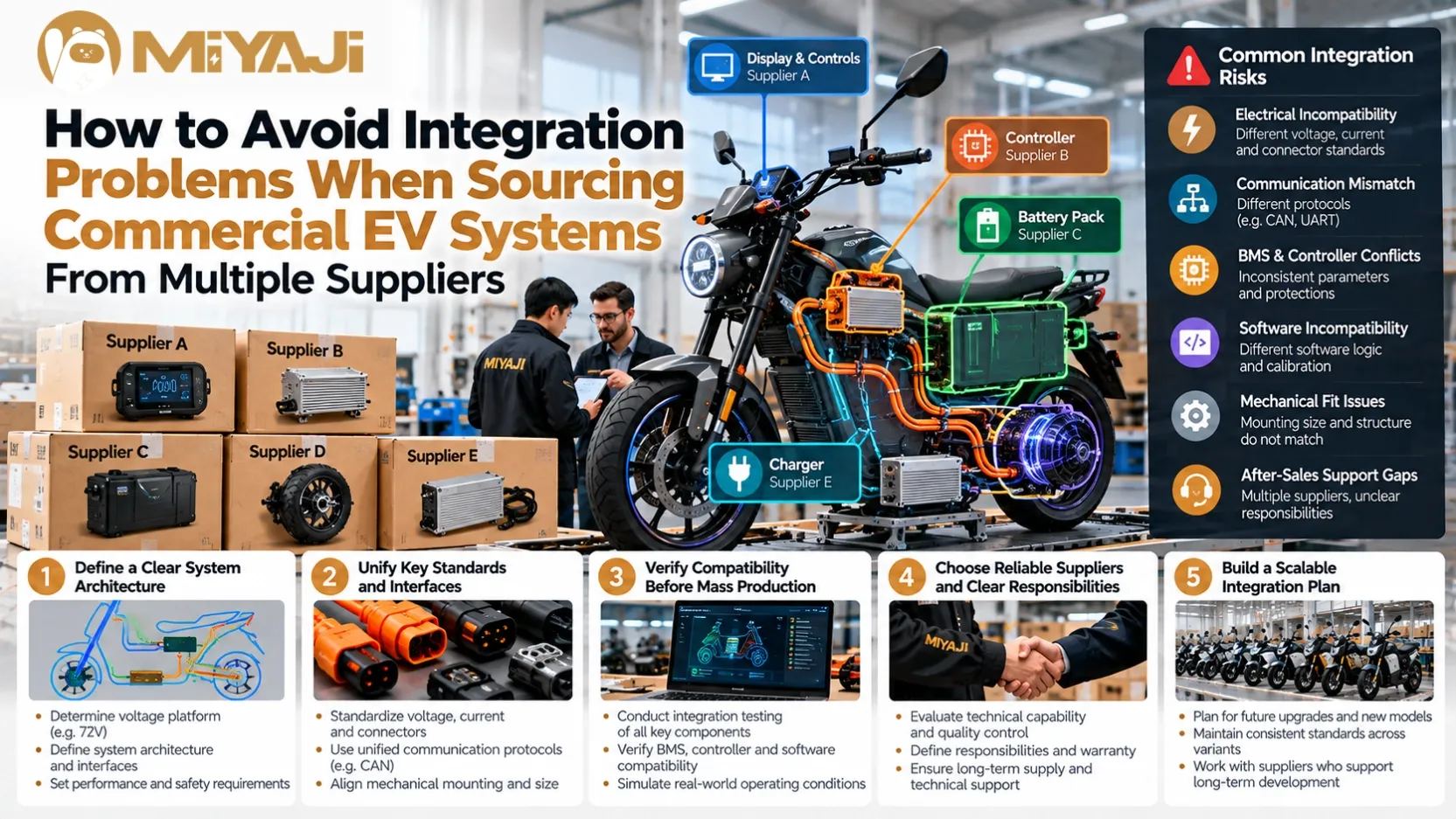
How to Avoid Integration Problems When Sourcing Commercial EV Systems From Multiple Suppliers
Buying electric motorcycles, batteries, charging equipment and management software from China can seem straightforward.
Find a vehicle manufacturer. Select a battery supplier. Purchase charging or battery-swapping equipment. Choose a software provider.
Each supplier provides a quotation, technical specifications and product samples.
But what happens when these products need to work together?
The motorcycle may function correctly during factory testing. The battery may pass its quality inspection. The charger may operate normally with the manufacturer's test equipment.
Yet when the products are connected, the complete system may not work as expected.
The problem is not always product quality. Sometimes, it is system compatibility and unclear integration responsibility.
For companies developing commercial electric motorcycle, electric tricycle or fleet electrification projects, understanding these risks before purchasing can prevent expensive modifications, project delays and disputes between suppliers.
This guide explains the most common integration challenges and what buyers should confirm before placing orders.
1. Why Commercial EV Projects Involve More Than One Product
A commercial electric vehicle project may involve several interconnected systems:
- Vehicle: Motor, controller, wiring harness, dashboard and vehicle control functions.
- Battery: Cells, battery PACK, BMS, connectors and protection systems.
- Charging equipment: Chargers, charging interfaces and charging-control functions.
- Battery swapping equipment: Battery identification, charging bays, locking mechanisms and swapping logic.
- Software: Vehicle connectivity, battery monitoring, equipment management and other project-specific functions.
Not every project requires all these components.
For example, a conventional electric motorcycle project may only need vehicles, batteries and standard chargers.
A battery-swapping project introduces additional requirements for battery standardization, station compatibility and software.
A fast-charging project may require coordinated battery, BMS and charger communication.
The more systems involved, the more important their interfaces become.
A collection of compatible-looking products is not necessarily an integrated commercial EV solution.
2. Why Products From Different Suppliers May Not Work Together
Consider a company planning to introduce electric motorcycles into its local market.
It purchases:
- Electric motorcycles from Manufacturer A.
- Lithium batteries from Manufacturer B.
- Vehicle control devices from Supplier C.
- Charging equipment from Manufacturer D.
- Management software from Provider E.
Every supplier may have delivered products that meet its own specifications.
However, several questions remain unanswered.
Can the battery provide the current required by the motor controller?
Can the charger communicate with the BMS?
Does the vehicle control device support the intended vehicle functions?
Can the software correctly interpret data from the installed hardware?
Who is responsible for testing the complete combination?
If these questions are not addressed before procurement, the buyer may discover integration problems only after the equipment arrives.
The problem is not necessarily that any individual supplier is incompetent.
It may be that no supplier was assigned responsibility for the complete system.
3. Five Common Integration Problems in Commercial EV Projects
Problem 1: The Battery and Vehicle Are Electrically Compatible but Not Operationally Matched
A buyer may select a battery based on nominal voltage and capacity.
For example, a motorcycle manufacturer specifies a 72V battery, and the buyer purchases a 72V lithium battery from another supplier.
The voltage appears correct.
However, voltage alone does not determine whether the battery is suitable for the vehicle.
Other factors include:
- Continuous and peak discharge current.
- Motor controller current demand.
- BMS protection thresholds.
- Voltage drop under load.
- Connector and cable ratings.
- Battery temperature limits.
A motorcycle may operate normally during light testing but experience battery protection events during acceleration, climbing or heavy-load conditions.
Before purchasing, buyers should confirm that the battery and vehicle are matched under the intended operating conditions.
Problem 2: The Battery and Charger Cannot Communicate Correctly
A charger and battery may have matching voltage ranges and physically compatible connectors.
But this does not automatically guarantee charging compatibility.
For communication-based charging systems, the BMS and charger may need to exchange information about battery status, permitted charging current, voltage limits and fault conditions.
Even when both products support CAN or RS485, their communication protocols may differ.
This can lead to charging failures, interrupted sessions or incorrect system responses.
For dedicated electric motorcycle and tricycle DC fast charging, the battery, BMS and charger should be evaluated together.
Problem 3: The Battery Fits the Swapping Cabinet but Cannot Complete the Swap Process
Battery swapping introduces another level of system integration.
A battery may physically fit inside a swapping cabinet but still fail to complete the required identification or charging process.
Potential issues include:
- Battery identification not recognized.
- Communication protocol mismatch.
- Incompatible battery connectors.
- Battery status not accepted by the station.
- Differences in locking or positioning mechanisms.
- Software configuration inconsistencies.
A swapping cabinet is not simply a storage cabinet with chargers inside.
It is a system that coordinates battery identification, charging, physical access, user interaction and software management.
Therefore, battery-swapping compatibility should be validated before large-scale equipment procurement.
Problem 4: Vehicle Control Hardware and Software Do Not Support the Same Functions
- Vehicle location reporting.
- Remote lock or unlock.
- Anti-theft functions.
- Geofencing.
- Vehicle status monitoring.
- Battery information reporting.
These functions depend on the actual vehicle electronics, communication device, firmware and software interfaces.
For example, a customer may purchase a third-party vehicle control device expecting it to support remote vehicle locking.
But the vehicle controller may not provide the required interface, or the device may use commands the vehicle cannot interpret.
The result is not necessarily a defective vehicle or defective control device.
It is a missing integration agreement.
Before procurement, buyers should define which functions are required and verify that the relevant hardware and software can support them together.
Problem 5: The Hardware Works, but the Management Platform Shows Incorrect or Missing Data
Connected EV systems may report information such as battery SOC, equipment status, faults and charging records.
However, different devices may calculate, encode or transmit information differently.
For example:
- The battery reports one SOC value.
- The vehicle dashboard displays another value.
- The management platform shows delayed or missing data.
Possible causes include differences in data definitions, communication interfaces, update frequency, device configuration or software interpretation.
Buyers should therefore confirm not only whether data can be transmitted, but also whether the receiving system understands and displays it correctly.
4. The Hidden Cost of Multi-Supplier Integration Problems
Integration problems can create costs that are not visible in the original purchase quotations.
Consider a project that has already received its vehicles, batteries and charging equipment.
If the components cannot work together, the buyer may need to arrange:
Additional engineering work
Engineers from multiple suppliers may need to investigate the problem and agree on modifications.
Replacement components
A controller, BMS, connector or communication device may need to be replaced.
Software or firmware changes
Interfaces and communication logic may need adjustment.
Repeated testing
The modified combination may need additional validation.
Project delays
Equipment may remain unused while technical issues are resolved.
Additional logistics
Replacement parts or modified hardware may need to be shipped internationally.
These costs can reduce or eliminate the savings achieved by selecting lower-priced individual suppliers.
This does not mean purchasing from multiple suppliers is always a poor decision.
It means the buyer should include integration responsibility and validation costs when evaluating the total procurement arrangement.
5. Why Factory Testing Alone Is Not Enough
A supplier may provide a factory inspection report showing that its product passed testing.
That is useful, but buyers should understand what the report actually covers.
A battery factory may test the battery using its own equipment.
A charger manufacturer may test its charger with a reference battery or simulator.
A vehicle manufacturer may test the motorcycle using its standard battery configuration.
These tests can demonstrate individual product performance under specified conditions.
They do not necessarily demonstrate that the buyer's final combination has been tested.
For a multi-supplier project, buyers should distinguish between:
Component Testing
Does each product meet its own requirements?
Interface Testing
Can the connected products exchange the required signals and information?
System Integration Testing
Does the complete vehicle, battery, charging equipment and software combination perform the intended functions?
Project Acceptance Testing
Does the delivered configuration meet the agreed acceptance criteria?
These testing stages serve different purposes.
A buyer should not assume that passing one stage automatically guarantees the others.
6. Define System Responsibility Before Placing Orders
One of the most important questions in multi-supplier procurement is:
Who is responsible for making the complete system work?
If the buyer purchases all components independently, the buyer may effectively become the system integrator.
This can work when the buyer has a qualified engineering team and access to the necessary technical information.
But if the buyer does not have these resources, responsibility can become unclear.
Before placing orders, the buyer should define:
Responsibility | What Should Be Confirmed? |
|---|---|
Vehicle compatibility | Who confirms motor, controller and battery matching? |
Battery compatibility | Who verifies battery limits and BMS requirements? |
Charging integration | Who matches the battery and charger? |
Swapping integration | Who validates battery and cabinet compatibility? |
Communication protocols | Who provides and integrates the required protocols? |
Software integration | Who connects hardware data to the management platform? |
System testing | Who organizes testing of the final configuration? |
Technical support | Who coordinates troubleshooting after delivery? |
These responsibilities should be documented rather than left to informal assumptions.
7. Share Technical Requirements Before Requesting Final Quotations
Many buyers begin by requesting prices from multiple factories.
However, a quotation is only meaningful when suppliers understand what they are expected to deliver.
For an integrated commercial EV project, a basic technical requirement document should identify:
Vehicle Requirements
Vehicle type, motor and controller specifications, expected load, battery arrangement and required electronic functions.
Battery Requirements
Chemistry, voltage, capacity, charging and discharging limits, BMS and relevant communication interfaces.
Energy Requirements
Standard charging, fast charging, battery swapping or a combination of these options.
Software Requirements
Which equipment must be connected, which data must be available and which functions are required.
Integration Requirements
Which components must communicate, who will provide technical documentation and who will perform integration testing.
Delivery Requirements
Sample testing, production configuration, inspection arrangements, documentation and technical support.
Not every project needs a lengthy engineering specification at the first inquiry stage.
But the major system requirements should be identified before suppliers finalize their technical and commercial offers.
8. Test the Intended System Before Mass Procurement
A practical approach is to validate the intended combination before committing to large-scale purchasing.
For example, a buyer may begin with a limited pilot configuration consisting of:
Vehicle + Battery + Charging Equipment + Required Communication Hardware + Software
The pilot should use the components and specifications intended for subsequent production.
Testing may cover:
- Vehicle startup and basic operation.
- Battery performance under representative loads.
- Charging initiation and completion.
- BMS communication.
- Battery swapping where applicable.
- Connected vehicle functions.
- Software data reporting.
- Fault handling.
- Relevant protection responses.
Any problems discovered during testing should be documented and resolved before the configuration is approved for larger orders.
Importantly, the tested configuration should remain identifiable.
If a supplier later changes a BMS, controller, connector or communication device, the change may require additional compatibility verification.
9. Can You Still Source From Multiple Manufacturers?
Yes.
Commercial EV systems involve different manufacturing specialties, and working with several manufacturers can be appropriate.
The key distinction is between:
Multiple Manufacturers With Coordinated Integration
and
Multiple Manufacturers Without a Defined System Owner
In the first arrangement, specifications, interfaces, responsibilities and testing are coordinated.
In the second, each supplier may focus only on its own product, leaving the buyer to solve the connections between them.
The number of factories is not the deciding factor.
The quality of the integration process is.
10. What Should Buyers Look for in a Commercial EV System Supplier?
When evaluating a supplier for an integrated commercial EV project, ask questions beyond the product catalogue.
For example:
Can you coordinate the vehicle and battery specifications?
A supplier should understand the compatibility requirements between the vehicle powertrain and battery system.
Can you support charging or battery-swapping integration?
The supplier should be able to explain the relevant battery, equipment and communication requirements.
Can you coordinate hardware and software interfaces?
Required functions and data should be clearly defined.
Can you arrange testing of the intended system configuration?
Individual product testing should not be confused with complete system validation.
Who takes responsibility for technical coordination?
Buyers should know who will organize communication between manufacturing and engineering teams.
What happens if a component specification changes?
The supplier should have a process for identifying changes that could affect compatibility.
These questions help buyers evaluate actual integration capability rather than relying only on claims of being a manufacturer or solution provider.
11. MIYAJI's Approach to Integrated Commercial EV Supply
MIYAJI works across the major components of commercial electric mobility projects, including:
- Electric motorcycles and tricycles.
- Lithium battery cells and battery PACK systems.
- Battery management and communication integration.
- Dedicated fast-charging solutions.
- Battery swapping systems.
- Connected energy and equipment management software.
- CKD/SKD supply and local assembly support.
Rather than treating these products as unrelated purchases, MIYAJI approaches projects through a coordinated system architecture.
For example, a commercial electric motorcycle project may require the vehicle, battery, charging interface and management software to work together.
A battery-swapping project adds requirements for battery standardization, station compatibility and swapping management.
A local assembly project may also require a defined supply configuration, technical documentation and production support.
MIYAJI's role is to coordinate the relevant manufacturing resources, technical specifications and integration requirements from the China supply side.
The customer remains responsible for its local business and operations, while MIYAJI supports the manufacturing and system supply behind the project.
The objective is to reduce fragmented procurement, improve compatibility planning and establish clearer technical responsibility before equipment is delivered.
12. A Simple Pre-Order Integration Checklist
Before placing a commercial EV system order, buyers should confirm the following:
Checkpoint | Key Question |
|---|---|
System scope | Have all required products and functions been identified? |
Vehicle and battery | Are the electrical and performance requirements matched? |
Battery and charger | Are charging limits and interfaces compatible? |
Battery and swapping cabinet | Have identification, physical and communication requirements been checked? |
Hardware and software | Are required functions and data interfaces defined? |
Supplier responsibility | Who coordinates the complete system? |
Technical documentation | Are necessary specifications and protocols available? |
Testing | Will the intended combination be validated? |
Configuration changes | How will substitutions or revisions be handled? |
After-sales support | Who coordinates technical troubleshooting? |
If these questions remain unanswered, the buyer may not yet have a fully defined procurement scope.
Final Thoughts
Sourcing commercial electric vehicle systems from multiple manufacturers is not necessarily a problem.
The risk appears when products are purchased independently without sufficient attention to compatibility, communication, testing and responsibility.
A battery can pass its factory inspection.
A charger can pass its own testing.
A motorcycle can operate correctly with its original components.
Yet the complete project may still encounter integration problems when different products are connected.
For buyers planning commercial EV projects, the most important lesson is:
Do not wait until the products arrive to discover who is responsible for making them work together.
Define the system architecture, supplier responsibilities and validation requirements before committing to mass procurement.
The goal is not simply to purchase individual products at competitive prices.
It is to receive a commercial EV system that works as intended.
Frequently Asked Questions
What is commercial EV system integration?
Commercial EV system integration is the process of ensuring that vehicles, batteries, charging or swapping equipment, communication hardware and software work together according to the project's requirements.
Can I purchase electric motorcycles, batteries and chargers from different suppliers?
Yes. However, the buyer should confirm electrical compatibility, communication requirements, system testing and responsibility for integration before placing orders.
Why can a battery work with one motorcycle but not another?
Different motorcycles may have different controller current requirements, connectors, communication interfaces and battery protection expectations. Matching nominal voltage alone may not guarantee compatibility.
Does CAN or RS485 support guarantee communication compatibility?
No. CAN and RS485 are communication interfaces. Devices must also use compatible communication protocols and data definitions.
Is it better to purchase a complete commercial EV system from one supplier?
An integrated supplier can simplify technical coordination and responsibility, but the most important factor is whether the complete system is properly specified, integrated and validated. A well-managed multi-supplier project can also succeed.
What should be tested before a large commercial EV order?
The intended vehicle, battery, charging or swapping equipment and software combination should be tested against agreed project requirements. The exact tests depend on the system architecture and application.
Planning a Commercial EV Project in China?
Looking for more than separate quotations from multiple factories?
MIYAJI supports overseas commercial EV buyers with coordinated vehicle, battery, charging, swapping and software solutions.
Share your target market, vehicle requirements, battery preferences, energy infrastructure plans and expected project scale.
We can help define the China-side supply scope, identify key compatibility requirements and coordinate the relevant manufacturing and engineering resources.
Discuss Your Integrated Commercial EV Project →