Oct 21, 2026Product & Industry Knowledge
Who Is Responsible When a Multi-Supplier Commercial EV Project Goes Wrong?
Who is responsible when EV batteries, chargers, vehicles and software fail to work together? Learn how to reduce supplier disputes and integration risks.
Who Is Responsible When a Multi-Supplier Commercial EV Project Goes Wrong?
Your electric motorcycles have arrived. The batteries have passed factory inspection. The charging equipment has been delivered, and the software provider says the platform is ready.
But during installation or testing, something goes wrong.
The batteries cannot communicate with the chargers. A remote vehicle control function does not respond. Or the management platform cannot display the expected equipment data.
You contact the suppliers.
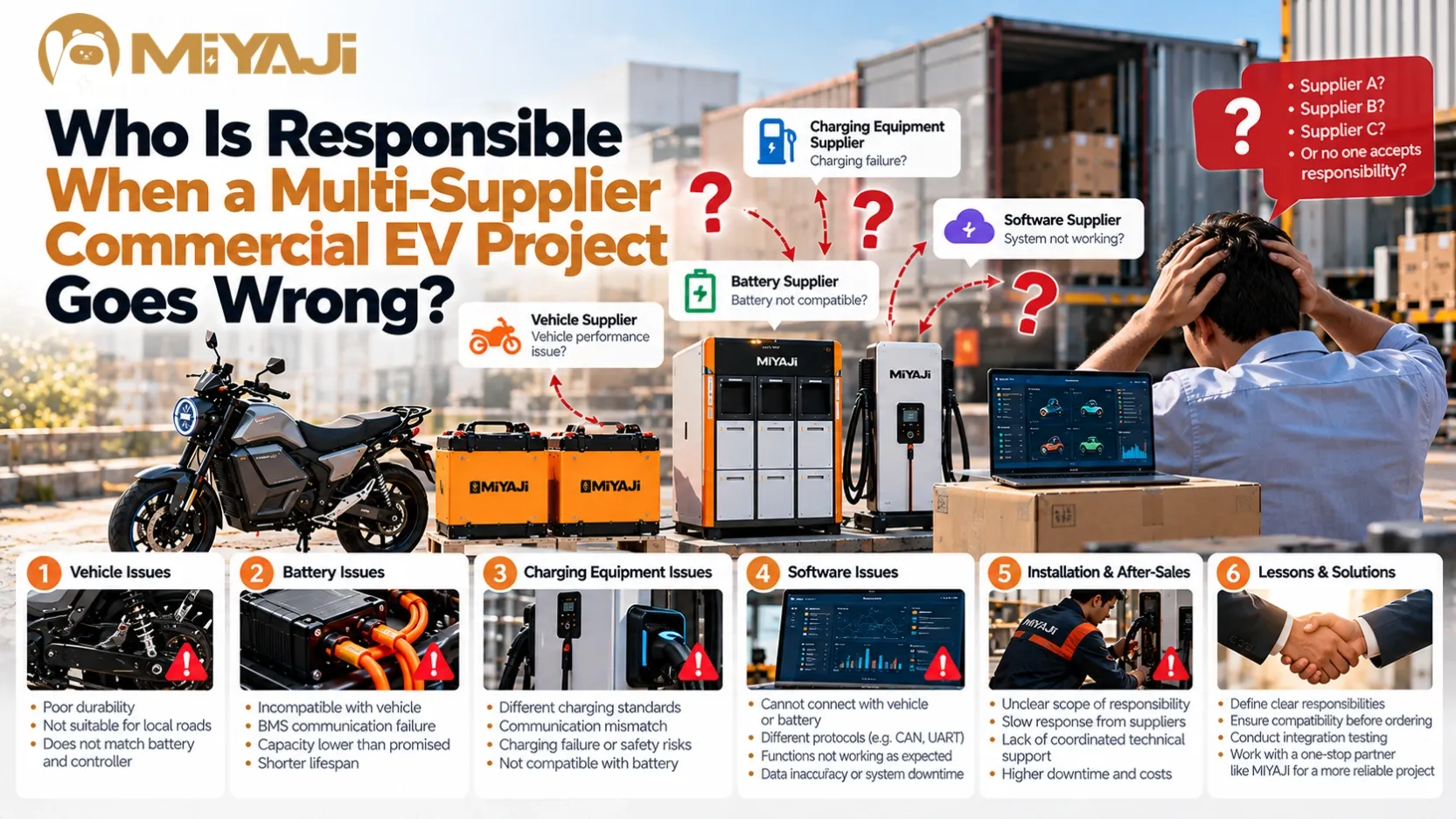
The vehicle manufacturer says its motorcycles work correctly. The battery supplier says its products meet the specifications. The charger manufacturer points to a communication problem. The software provider says the hardware is not sending the required data.
Every supplier may have delivered a working product. Yet the complete system still does not work.
Who is responsible?
For companies sourcing commercial electric vehicles, batteries, charging infrastructure and software from China, this is a question worth asking before placing orders.
The real challenge is not simply finding reliable manufacturers. It is making sure their products can work together, their engineering teams can coordinate, and someone is responsible for resolving problems when they occur.
This guide explains how buyers can reduce supplier disputes, define technical responsibilities and choose a more coordinated approach to commercial EV procurement.
1. Why Supplier Responsibility Is Complicated in Commercial EV Projects
A commercial electric vehicle project may involve several manufacturing and technology specialties:
- Lithium battery PACK production.
- Battery management systems (BMS).
- Charging and battery swapping equipment.
- Vehicle connectivity hardware.
- Software and management platforms.
Each product may come with its own specifications, warranty and supplier agreement.
The challenge begins when one product depends on another.
A battery must support the vehicle's power requirements.
A charger may need to communicate with the battery BMS.
A swapping cabinet must recognize and safely handle the intended battery.
A vehicle control device must support the required functions through compatible vehicle interfaces.
A management platform must correctly interpret information from connected hardware.
If these relationships are not defined before procurement, buyers may discover that purchasing all the required products does not necessarily mean purchasing a complete working system.
This distinction is especially important for overseas buyers who do not have their own engineering teams in China.
2. Product Defects vs. System Integration Problems
When a project encounters problems, buyers should first understand what kind of failure has occurred.
Product Defects
A product defect may exist when an item fails to meet its agreed specifications, quality requirements or contractual obligations.
For example:
- A battery PACK does not meet its specified performance requirements.
- A charger has a manufacturing defect.
- A controller fails under its agreed operating conditions.
- A connector does not meet the required specification.
The relevant supplier's obligations depend on the contract, warranty terms, applicable law and evidence of the failure.
System Integration Problems
An integration problem occurs when products cannot perform the intended functions together.
For example:
- A BMS and charger use incompatible communication protocols.
- A vehicle controller does not support the commands required by a third-party control device.
- A swapping cabinet cannot identify a battery that was not included in its validated configuration.
- A software platform cannot interpret the data transmitted by connected equipment.
In these situations, individual products may function correctly on their own.
The problem lies in the connections between them.
Unclear Project Requirements
Sometimes the problem starts before manufacturing.
A buyer may request "remote vehicle locking" without defining the required interface, control logic or acceptance criteria.
The vehicle manufacturer and connectivity supplier may interpret the request differently.
Both may believe they have fulfilled their obligations, while the buyer still cannot use the expected function.
This is why commercial EV procurement requires more than product quotations.
It requires clear system requirements, technical interfaces and responsibility for integration.
3. A Common Scenario: Three Suppliers, One Unresolved Problem
Consider a hypothetical commercial electric motorcycle project.
A buyer purchases:
- Electric motorcycles from Manufacturer A.
- Batteries from Manufacturer B.
- Vehicle connectivity devices from Supplier C.
The buyer expects the motorcycles to support location tracking, geofencing and remote locking.
During testing, location tracking works, but remote locking does not.
Manufacturer A explains that its vehicle controller uses a particular communication interface.
Supplier C explains that its device supports a different command format.
Manufacturer B has no involvement in the failed function.
Who should fix the problem?
The answer depends on the agreed responsibilities.
If Manufacturer A agreed to provide a specific interface but did not, its obligations may be relevant.
If Supplier C agreed to integrate its device with that vehicle controller, its responsibilities may be different.
If the buyer independently purchased both products without arranging integration services, additional engineering work may be required.
The lesson is simple:
Buying every component does not automatically mean someone has been appointed to make those components work together.
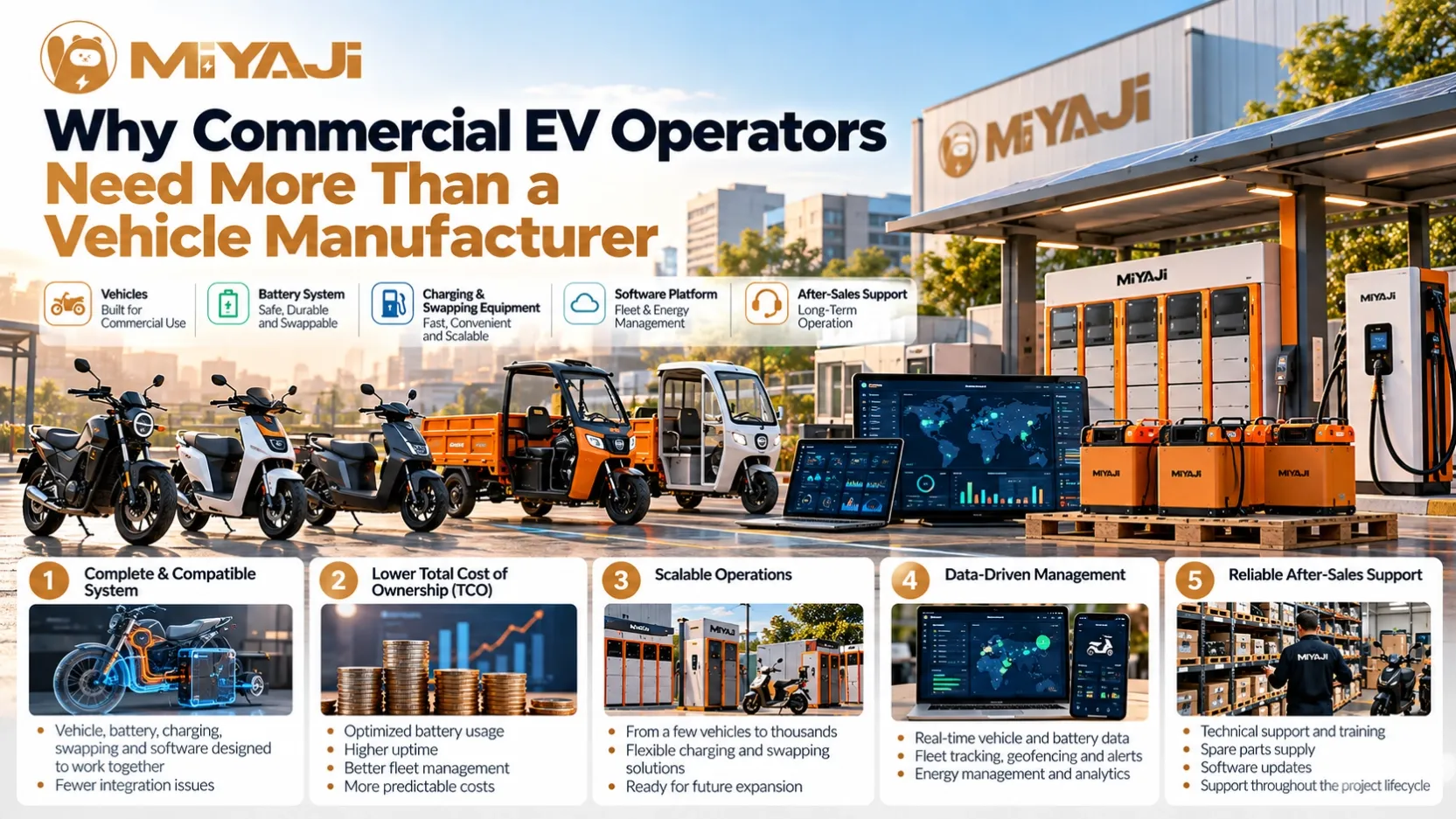
This is one reason why an integrated manufacturing and engineering ecosystem can be valuable.
4. Why an Integrated Manufacturing Ecosystem Can Reduce Coordination Risks
Commercial EV projects often require expertise from several different industries.
Vehicle manufacturers specialize in vehicle structures, motors, controllers, assembly and road performance.
Battery manufacturers specialize in cell selection, PACK engineering, BMS integration and battery testing.
Charging and swapping equipment manufacturers focus on energy transfer, equipment control, protection systems and related communication.
Software teams develop the interfaces and management functions that connect these products.
All these specialties are necessary, but they do not always operate within the same organization.
The Traditional Multi-Supplier Approach
In a fragmented procurement arrangement, the overseas buyer may need to coordinate every technical discussion.
If the battery does not communicate with the charger, the buyer contacts both manufacturers.
If the vehicle controller cannot communicate with the connectivity device, the buyer arranges another discussion.
If the management software displays incorrect information, the buyer must determine which hardware supplier should participate.
This process can become particularly difficult when suppliers have different engineering schedules, documentation practices and commercial priorities.
The Integrated Manufacturing Approach
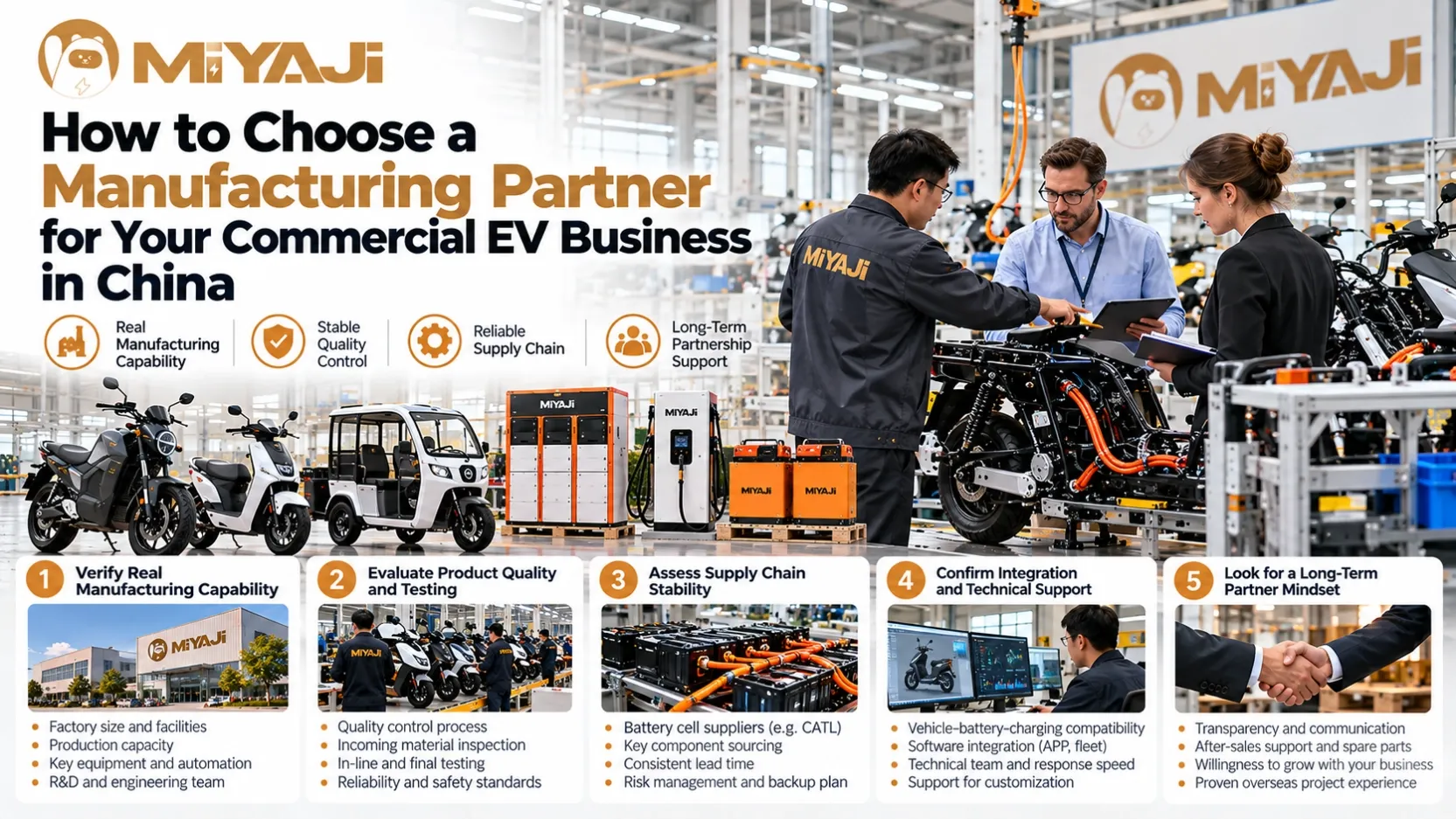
Another option is to work with a solution provider that already coordinates key manufacturing and engineering capabilities.
For example, when battery PACK production, charging and swapping equipment manufacturing, and software development operate within a coordinated business ecosystem, the relevant teams can align requirements earlier.
If the ecosystem also works with specialized commercial vehicle manufacturers, vehicle and energy system requirements can be reviewed together.
This creates opportunities to:
- Confirm important interfaces before production.
- Coordinate battery, vehicle and charging requirements.
- Organize joint technical discussions.
- Arrange testing of the intended system configuration.
- Identify who should investigate a problem.
- Reduce unnecessary communication between unrelated suppliers.
An integrated structure does not guarantee that technical problems will never occur.
However, it can make compatibility planning and problem resolution more manageable.
The advantage is not simply having fewer suppliers. It is having clearer coordination between the manufacturers and engineering teams involved.
5. Who Should Be Responsible for System Integration?
The system integrator is the party responsible for coordinating the agreed technical interfaces and ensuring that the intended combination performs its required functions.
Depending on the project, this responsibility may belong to the buyer, a lead supplier or an independent engineering integrator.
Option 1: The Buyer Manages Integration
Some experienced commercial EV operators have their own engineering and procurement teams.
They may prefer to purchase vehicles, batteries, chargers and software independently.
This can provide flexibility in supplier selection.
However, the buyer must manage compatibility requirements, technical documentation, testing, configuration changes and troubleshooting.
Option 2: A Lead Supplier Coordinates the System
A manufacturer or solution provider may coordinate several connected product categories under one agreed project scope.
This can simplify communication and create a clearer technical coordination structure.
However, buyers should confirm exactly which integration services, products and testing activities are included.
A supplier calling itself a "one-stop solution provider" does not automatically mean every possible integration task is included.
Option 3: An Independent Engineering Integrator
For complex projects, buyers may appoint a separate engineering company to coordinate interfaces and testing between manufacturers.
This can be appropriate when the buyer wants to retain multiple independent suppliers but lacks the resources to manage integration internally.
Whichever approach is selected, the buyer should know:
Who is responsible for the complete system, and what exactly has that party agreed to deliver?
6. Define Supplier Responsibilities Before Signing Contracts
One of the most practical ways to prevent disputes is to prepare a supplier responsibility matrix.
It does not need to be complicated.
The purpose is to identify which party supplies each product, which party confirms compatibility and which party coordinates testing.
Project Area | Responsibility to Confirm |
|---|---|
Vehicle | Who confirms motor, controller and battery requirements? |
Battery | Who defines BMS limits, battery configuration and communication requirements? |
Charging | Who verifies charger-to-battery compatibility? |
Battery swapping | Who validates the battery and swapping cabinet combination? |
Connectivity | Who integrates vehicle control hardware and vehicle electronics? |
Software | Who defines and verifies required data interfaces? |
System testing | Who organizes integrated testing and approves results? |
Technical changes | Who reviews changes affecting compatibility? |
After-sales support | Who coordinates investigation when multiple products are involved? |
These responsibilities should be reflected in the technical specifications, purchase agreements or other agreed project documents.
For example, a buyer should not assume that purchasing a charger automatically includes free engineering adaptation to any third-party battery.
Similarly, a vehicle manufacturer may not be responsible for integrating an independently selected software platform unless that work is included in its agreement.
Clear responsibility protects both the buyer and the suppliers.
It also makes the project easier to manage.
7. What Should Buyers Include in Their Purchase Agreements?
A commercial EV purchase agreement should identify more than model numbers, quantities and prices.
For connected systems, buyers should consider the following.
Product Scope
Clearly identify the products, approved configurations and required functions.
Avoid vague descriptions such as "smart battery" or "compatible charger" without supporting specifications.
Technical Interfaces
Document the interfaces that must work together, including relevant electrical requirements, communication protocols and software data requirements.
Engineering and Integration Services
Specify whether the quotation includes technical review, interface adaptation, firmware configuration, joint testing or other integration work.
Acceptance Criteria
Define how the buyer and supplier will determine whether the agreed functions have been delivered successfully.
Configuration Changes
Establish how changes to BMS hardware, controllers, communication modules, firmware or other critical components will be reviewed and approved.
Warranty and Technical Support
Distinguish between product warranty coverage and engineering support for system integration.
Corrective Action Procedures
Agree on how technical problems will be reported, investigated, documented and resolved.
These provisions do not mean one supplier must accept unlimited responsibility for the entire project.
They help establish a practical framework for delivery and technical cooperation.
8. Why Individual Factory Testing Is Not Enough
A battery manufacturer may test its battery using its own equipment.
A charger manufacturer may test its charger with a reference battery or simulator.
A vehicle manufacturer may test its motorcycle with its standard battery configuration.
These tests are valuable.
However, they do not necessarily demonstrate that the buyer's final combination has been validated.
For an integrated commercial EV project, buyers should distinguish between four activities.
Component Testing
Verifying that each product meets its own specifications.
Interface Testing
Verifying that connected products can exchange the required signals or information.
Integrated System Testing
Testing the intended vehicle, battery, charging equipment and software combination.
Project Acceptance Testing
Confirming that the delivered configuration meets the agreed project requirements.
For example, if a commercial electric motorcycle project uses a dedicated fast-charging system, the intended battery, BMS and charger configuration should be evaluated together.
If a project uses battery swapping, the battery, cabinet and relevant software functions should be tested as an integrated arrangement.
A successful component inspection should not be mistaken for complete system acceptance.
9. Why Established Engineering Relationships Matter After Delivery
Even well-planned projects can experience technical problems after delivery.
The important question is how those problems will be handled.
Imagine a motorcycle experiencing unexpected battery protection events during heavy-load operation.
The vehicle engineering team may need to review controller current demand and operating conditions.
The battery engineering team may need to examine BMS settings, protection records and battery performance.
If these teams work independently and have no established coordination process, the overseas buyer may need to organize every technical discussion.
Now consider a coordinated manufacturing ecosystem.
The vehicle and battery engineering teams already have a working relationship and can review the same issue through an agreed technical support process.
The same principle applies to other systems.
Battery and Charger Problems
Battery and charging equipment engineers may need to jointly review communication settings, charging limits and protection responses.
Battery Swapping Problems
Battery, swapping cabinet and software teams may need to investigate identification, communication or system configuration issues.
Vehicle Connectivity Problems
Vehicle electronics and software teams may need to verify control interfaces, device configuration and data exchange.
When the relevant teams are already connected through a coordinated supply structure, customers can have a clearer route for reporting problems and obtaining technical assistance.
This does not eliminate the need for fault investigation.
It helps reduce the burden of coordinating unrelated manufacturers independently.
Good after-sales support is not only about replacing defective parts. It is also about knowing which technical teams need to work together when a problem crosses product boundaries.
10. Why Approved Configurations Matter During Mass Production
A successful sample test is an important step, but buyers should also consider what happens after the sample is approved.
A manufacturer may change a controller, BMS, connector, communication module or firmware version during production.
Some changes may be harmless.
Others may affect compatibility with the rest of the system.
For example, a different BMS version may require communication verification with the intended charger.
A replacement vehicle control device may need additional software configuration.
For this reason, buyers should document the configuration used during successful testing.
Depending on the project, this may include relevant component models, hardware revisions, firmware versions and test records.
Critical changes should be reviewed before the modified configuration is accepted for production.
A tested system should remain a controlled configuration, not an undefined collection of interchangeable components.
This is particularly important for commercial EV projects involving repeated vehicle orders, battery replacements or future expansion.
11. How MIYAJI Brings Manufacturing, Engineering and After-Sales Coordination Together
Commercial EV projects require expertise from different manufacturing industries.
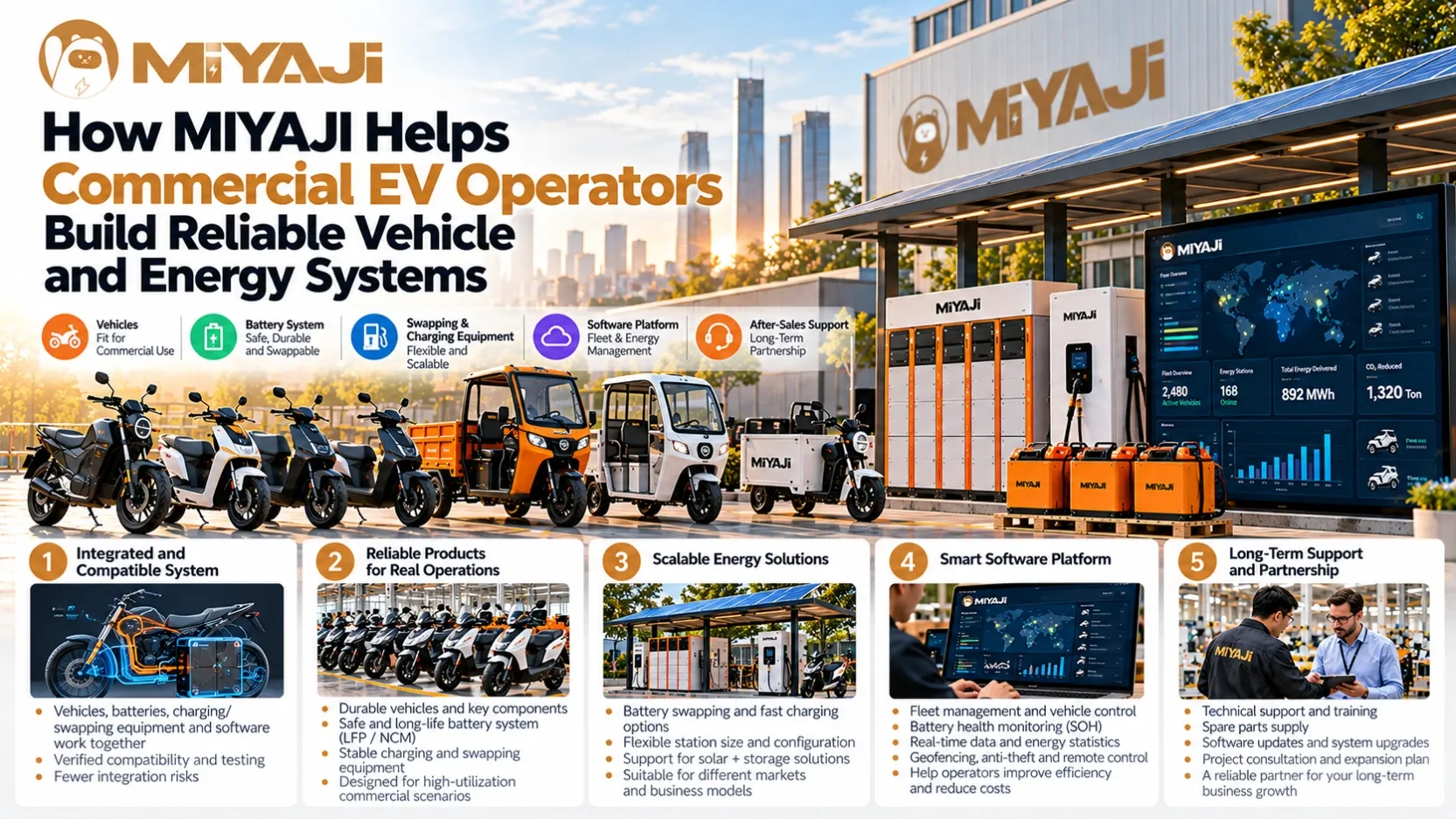
MIYAJI addresses this challenge through an integrated manufacturing and engineering ecosystem rather than treating vehicles, batteries, charging equipment and software as unrelated purchases.
In-House Battery, Charging and Swapping Capabilities
MIYAJI has its own lithium battery PACK manufacturing capabilities, charging and battery-swapping equipment manufacturing resources, and software development team.
These capabilities support coordinated development and supply across key commercial EV energy systems.
For projects involving batteries, charging or swapping, the relevant teams can work around agreed technical requirements rather than relying entirely on independent suppliers to coordinate with one another.
Cooperation With Specialized Commercial Vehicle Manufacturers
MIYAJI also works with professional electric motorcycle and electric tricycle manufacturers.
These manufacturing partners contribute vehicle design, production and application-specific expertise.
By combining specialized vehicle manufacturing with MIYAJI's battery, charging, swapping and software capabilities, the teams can review important system requirements together.
For example, a commercial electric motorcycle project may require coordination of:
- Motor and controller power requirements.
- Battery capacity and discharge capability.
- Battery installation and electrical connections.
- Charging interfaces and communication requirements.
- Vehicle connectivity functions.
- Software integration requirements.
For battery-swapping or fast-charging projects, additional compatibility and validation requirements may apply.
This coordinated approach helps identify potential integration issues earlier in the project.
Joint Engineering Coordination Before Delivery
Instead of asking the overseas buyer to independently coordinate every manufacturer, MIYAJI can organize relevant China-side technical discussions within the agreed project scope.
Vehicle, battery, charging and software teams can participate according to the requirements of the project.
Where necessary, this may include reviewing technical documents, confirming interfaces, arranging sample integration and coordinating appropriate testing.
The objective is to reduce avoidable compatibility problems before equipment is shipped overseas.
Coordinated Technical Support After Delivery
After delivery, some problems may involve more than one product category.
For example, a charging issue may require both battery and charger engineers.
A battery-swapping issue may require input from battery, cabinet and software teams.
For systems supplied under an agreed MIYAJI project scope, customers can report technical issues through the designated project contact, who coordinates with the relevant manufacturing and engineering teams.
This provides a clearer technical support structure than requiring customers to independently contact every factory involved.
Warranty coverage, engineering support and corrective-action responsibilities are defined by the relevant project agreements.
One Coordinated Ecosystem, Multiple Manufacturing Specialties
MIYAJI does not claim that every vehicle and component is manufactured in a single factory.
Its approach combines in-house battery, charging, swapping and software capabilities with specialized commercial vehicle manufacturing partners.
The advantage is not simply having access to more factories. It is having a coordinated manufacturing ecosystem that brings the relevant products and engineering teams together around one commercial EV project.
For overseas buyers, this can simplify technical communication, improve compatibility planning and provide a more structured approach to project delivery and after-sales support.
12. A Practical Supplier Responsibility Checklist
Before placing a commercial EV system order, buyers should confirm the following.
Checkpoint | Key Question |
|---|---|
System coordination | Who is responsible for coordinating the complete technical system? |
Manufacturing scope | Which company supplies each major product? |
Vehicle and battery | Who confirms electrical and performance compatibility? |
Charging and swapping | Who validates the intended battery and equipment combination? |
Software interfaces | Who confirms the required functions and data exchange? |
Engineering services | What technical work is included in the quotation? |
Sample approval | Has the intended system configuration been identified and tested? |
Production changes | Who reviews changes that may affect compatibility? |
Pre-shipment testing | Which system functions will be verified before delivery? |
Technical support | Who coordinates investigation when several products are involved? |
Warranty and responsibility | What obligations have been agreed in writing? |
A clear answer to these questions can help buyers evaluate the quality of a supplier's project coordination, not just its product catalogue.
Final Thoughts
When a multi-supplier commercial EV project goes wrong, responsibility is not always obvious.
A problem may involve a defective product, an incompatible interface, incomplete specifications or integration work that was never assigned to anyone.
The solution is not necessarily to avoid working with multiple manufacturers.
Commercial EV systems require different manufacturing specialties, and specialized suppliers can contribute important expertise.
What matters is how those capabilities are coordinated.
For overseas buyers, choosing a supply arrangement with clear technical responsibility, coordinated engineering and defined after-sales support can reduce unnecessary project complexity.
The goal is not simply to buy electric vehicles, batteries, chargers and software. It is to ensure that the products are supplied, integrated and supported as a working system.
Frequently Asked Questions
Who is responsible if an EV battery and charger are incompatible?
Responsibility depends on the agreed technical specifications, integration scope, supplier obligations and cause of the incompatibility. Buyers should confirm who is responsible for battery-charger matching before placing orders.
Does a product warranty cover system integration problems?
Not necessarily. Product warranties and engineering integration services may have different terms. Buyers should confirm which services and responsibilities are included in their agreements.
Is buying a complete EV system from one supplier always better?
Not always. The important factor is whether the system has clear technical requirements, coordinated engineering, appropriate testing and defined support responsibilities. A well-managed multi-supplier arrangement can also work successfully.
Why is joint testing important for commercial EV projects?
Individual products may pass their own factory tests but still encounter problems when connected. Joint testing helps verify that the intended configuration performs the required functions together.
What happens if a component changes after sample approval?
Changes to controllers, BMS hardware, firmware, connectors or communication devices may affect compatibility. Relevant changes should be reviewed and, where necessary, tested before the modified configuration is accepted.
How does MIYAJI coordinate different manufacturing teams?
MIYAJI combines its battery PACK, charging, swapping and software capabilities with specialized commercial vehicle manufacturing partners. Depending on the project scope, the relevant teams can coordinate specifications, technical interfaces, testing arrangements and after-sales investigation.
Planning a Commercial EV Project in China?
You should not have to manage every technical connection between multiple factories on your own.
MIYAJI supports overseas commercial EV projects through coordinated electric vehicle manufacturing, battery systems, charging, battery swapping and software capabilities.
Whether you are planning a new electric motorcycle fleet, a commercial electric tricycle project or an integrated charging and swapping solution, our team can help review your requirements and coordinate the relevant China-side manufacturing and engineering resources.
Your Market. Our Manufacturing Ecosystem.
Contact MIYAJI to Discuss Your Commercial EV Project.