Oct 7, 2026Product & Industry Knowledge
What Is Included in an Electric Motorcycle CKD Kit? A Buyer’s Guide
Learn what is typically included in an electric motorcycle CKD kit, how CKD configurations differ, and what buyers should confirm before ordering from a supplier.
For buyers planning local electric motorcycle assembly, one of the first questions is often:
What exactly will I receive if I order an electric motorcycle in CKD?
The simple answer is: the components required to assemble the motorcycle.
But in real procurement, it is more complicated than that.
A CKD electric motorcycle is not one universally standardized package. Different manufacturers may use different levels of disassembly, different pre-assembled components and different packaging methods.
Two suppliers can both quote the same motorcycle as “CKD” while delivering it in very different conditions.
For buyers, therefore, the important question is not simply:
“Is this motorcycle CKD?”
It is:
“What exactly is included, what is already assembled, and what must we assemble locally?”
This guide explains the basic structure of an electric motorcycle CKD kit and what buyers should confirm before placing an order.
1. What Does CKD Mean for an Electric Motorcycle?
CKD stands for Completely Knocked Down.
Instead of shipping the electric motorcycle as a fully assembled vehicle, the motorcycle is separated into components or assemblies and shipped to the destination market for local assembly.
A simplified process looks like this:
Manufacturing in China
↓
Component / Assembly Preparation
↓
CKD Packing
↓
Export
↓
Local Assembly
↓
Inspection & Testing
↓
Finished Electric Motorcycle
CKD can be used for several reasons, including:
- developing local assembly capability;
- supporting localization strategies;
- adapting to local import structures;
- improving shipping arrangements in some projects;
- building local technical capability; and
- preparing for larger-scale local manufacturing.
However, CKD does not automatically mean that every nut, bolt and component arrives completely separated.
The actual disassembly level depends on the project.
2. CKD, SKD and CBU Are Not the Same
Before discussing what is inside a CKD kit, buyers should understand the basic difference between the three common supply formats.
Format | Meaning | Typical Condition |
|---|---|---|
CBU | Completely Built Unit | Vehicle supplied fully assembled |
SKD | Semi Knocked Down | Vehicle partially disassembled |
CKD | Completely Knocked Down | Vehicle supplied in a more extensively disassembled form for local assembly |
In practice, the boundary between SKD and CKD is not always defined by one universal packing method.
One manufacturer may supply the front wheel as a complete assembly.
Another may separate the tire, rim, brake disc and related components.
Both projects may still be described commercially as knocked-down supply.
Therefore, buyers should confirm the actual delivery condition, not rely only on the words CKD or SKD.
For a broader comparison, see #12 — CKD vs CBU Electric Motorcycles: Which Is Better for Your Market?
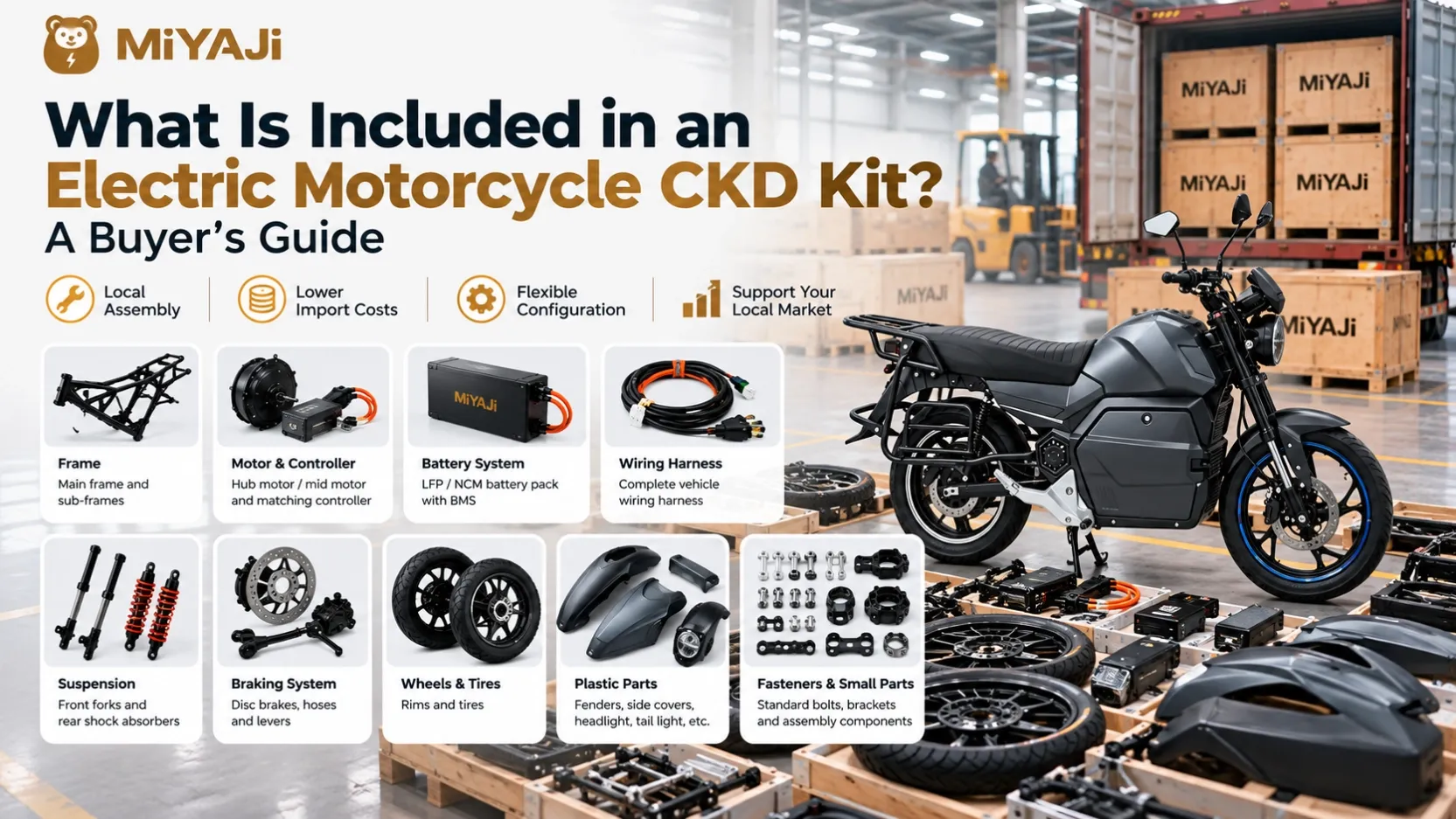
3. What Is Typically Included in an Electric Motorcycle CKD Kit?
The exact components depend on the motorcycle model and configuration, but a complete electric motorcycle can generally be divided into several major systems.
Frame and Body Components
These form the main structure and exterior of the motorcycle.
Typical components may include:
- main frame;
- rear frame or subframe where applicable;
- body panels;
- front and rear fenders;
- floorboard or footrest components;
- seat;
- brackets; and
- mounting components.
Depending on the CKD configuration, some brackets or structural parts may already be installed on the frame.
Motor and Drive System
The electric drive system normally includes components such as:
- electric motor;
- motor controller;
- motor wiring;
- drive-related components; and
- mounting hardware.
For hub-motor motorcycles, the motor may already be integrated into the wheel assembly.
For other vehicle architectures, the motor may be supplied separately.
This is one example of why a CKD list cannot be identical for every electric motorcycle.
Battery System
Depending on the commercial agreement, the battery system may include:
- lithium battery PACK;
- BMS;
- battery connector;
- battery cable;
- battery mounting or locking components; and
- charging interface.
Battery configuration can vary significantly between projects.
Some buyers purchase the vehicle and battery as one integrated system, while others may have specific battery requirements.
For commercial EV projects, battery voltage and capacity should be selected according to the actual vehicle and application rather than treated as an isolated specification.
See #10 — How to Choose Battery Capacity for Commercial Electric Motorcycles and Tricycles for more information.
4. Wheels, Tires and Suspension Components
A CKD kit will normally include the components required for the motorcycle's wheel and suspension system.
These may include:
- front wheel;
- rear wheel;
- tires;
- front fork;
- rear shock absorbers;
- wheel axles; and
- related mounting parts.
However, the assembly condition can vary.
For example, one supplier may provide:
Wheel + Tire + Brake Disc as one pre-assembled unit
while another may pack these parts separately.
This does not necessarily mean one method is better.
The appropriate configuration depends on local assembly capability, packaging requirements, production efficiency and the agreed CKD specification.
5. Brake System
Depending on the model, the braking system may include:
- front brake;
- rear brake;
- brake disc or drum components;
- brake caliper;
- brake hose;
- master cylinder;
- brake lever; and
- associated fittings.
Some brake components may be supplied as assemblies to simplify local installation.
For buyers establishing a local assembly operation, it is important to understand which safety-related components arrive pre-assembled and which require local installation or adjustment.
6. Electrical and Wiring System
An electric motorcycle contains much more electrical hardware than simply a motor and battery.
Depending on the model, the CKD kit may include:
- main wiring harness;
- controller wiring;
- DC-DC converter;
- switches;
- fuse and protection components;
- ignition or start system;
- charging connector;
- communication wiring;
- USB charging port;
- alarm system; and
- other electrical accessories.
The wiring harness is particularly important because incorrect connection during local assembly can cause faults that are difficult to diagnose later.
For new CKD projects, clear electrical connections and assembly guidance can significantly reduce commissioning problems.
7. Lighting, Dashboard and Controls
The kit may also include:
- headlamp;
- tail lamp;
- turn signals;
- dashboard or instrument cluster;
- handlebar;
- throttle;
- brake levers;
- switches;
- mirrors; and
- horn.
Different destination markets may require different lighting, display or regulatory configurations.
These requirements should therefore be confirmed before production rather than after the CKD shipment has already been packed.
8. Charger and Charging Components
A standard electric motorcycle project may include an appropriate battery charger.
The exact charger specification depends on the battery system and destination market.
Buyers should confirm:
- input voltage;
- plug type;
- output voltage;
- output current;
- battery compatibility; and
- charging connector.
For projects using DC fast charging, the charging architecture requires additional consideration.
Battery cells, PACK, BMS, communication and charger compatibility need to be considered together.
For this topic, see:
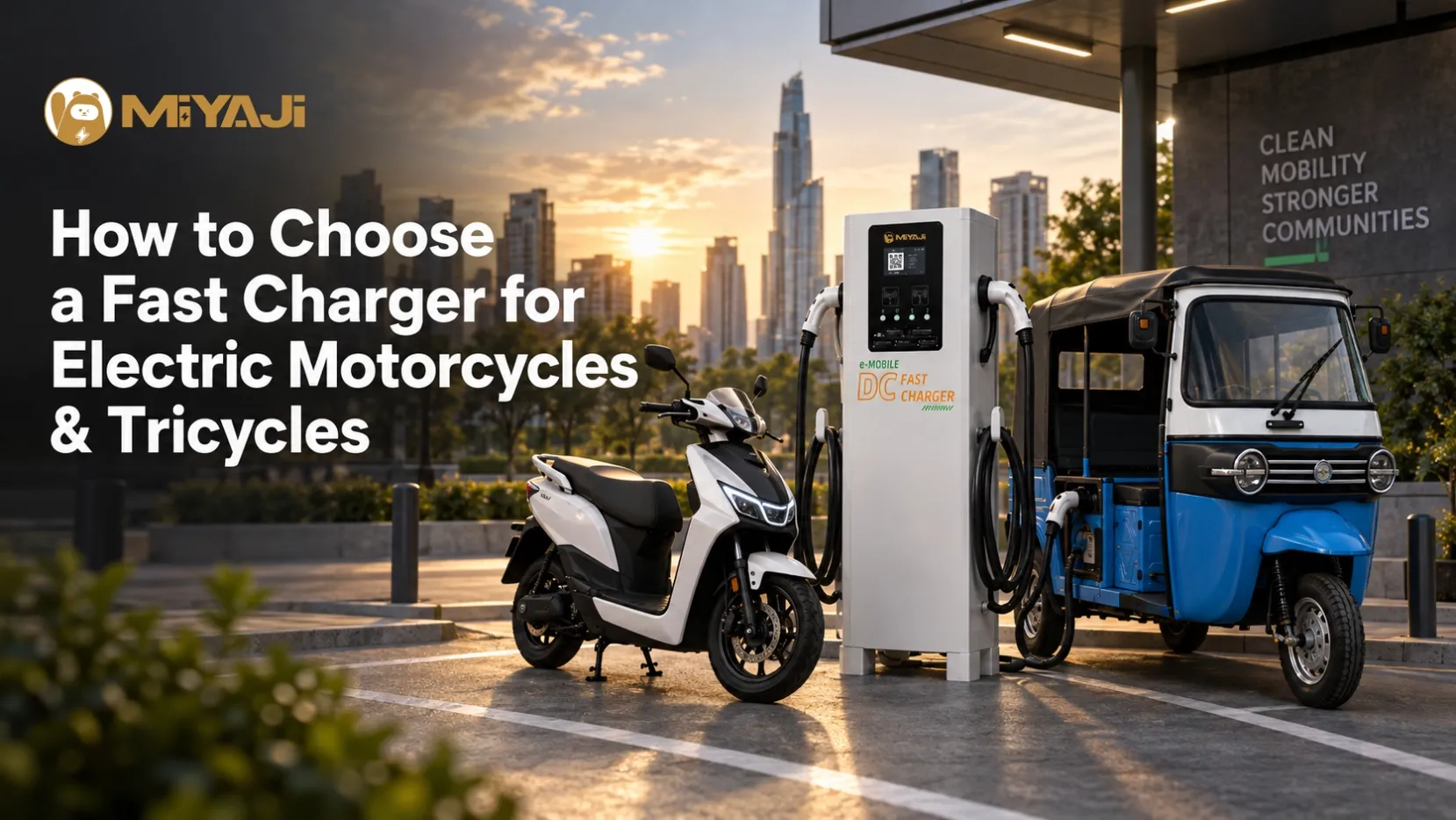
#28 — How to Choose a Fast Charger for Electric Motorcycles & Tricycles
https://www.miyajigroup.com/posts/how-to-choose-fast-charger-electric-motorcycle-tricycleand:
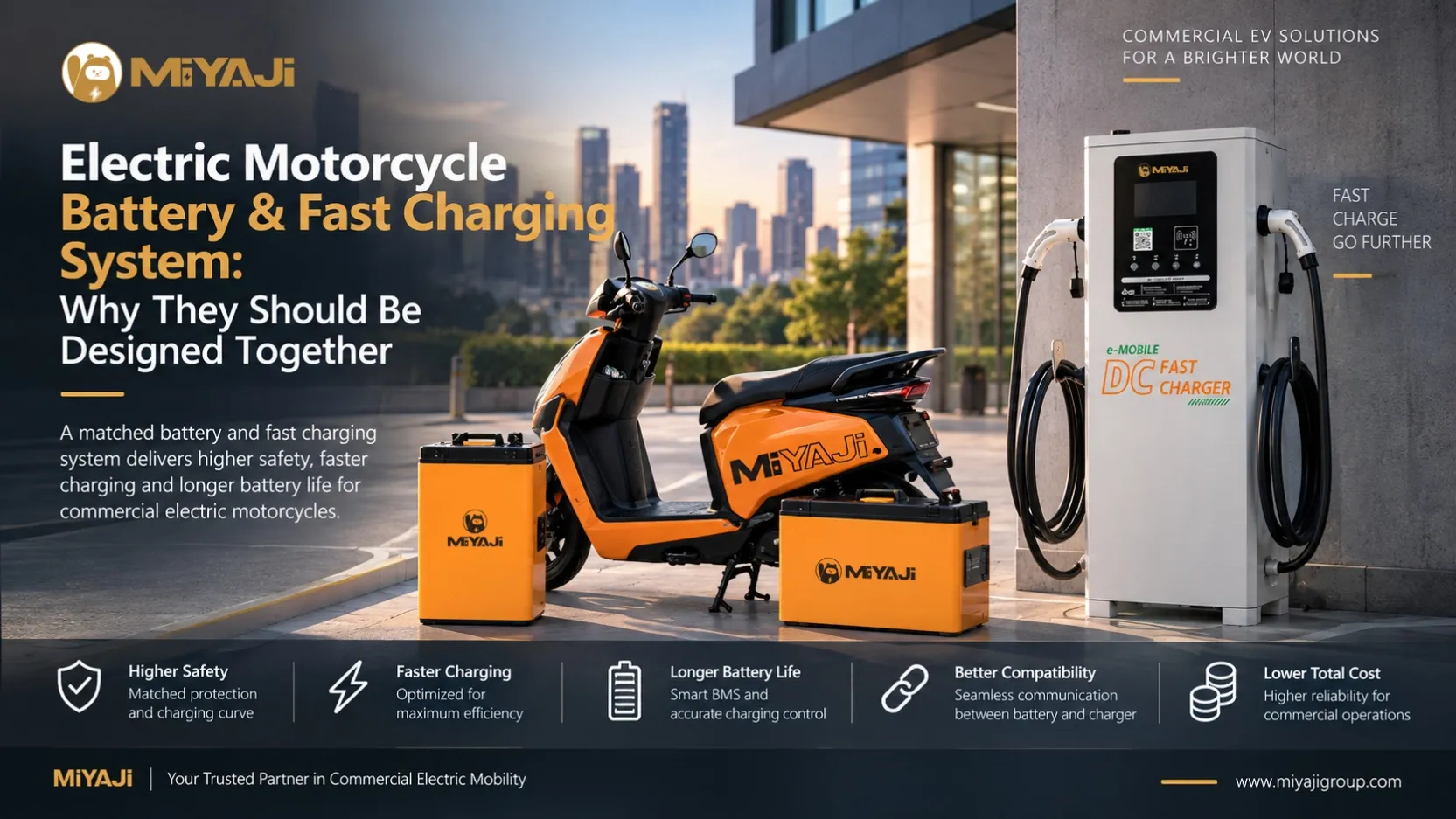
#29 — Electric Motorcycle Battery & Fast Charging System: Why They Should Be Designed Together
9. Small Parts and Fasteners Matter More Than They Look
A CKD motorcycle is not only a collection of large components.
It also requires many small parts, such as:
- bolts;
- nuts;
- washers;
- clips;
- brackets;
- rubber components;
- cable ties;
- covers; and
- other mounting hardware.
Individually, these components have little value.
But one missing component can prevent a vehicle from being completed correctly.
This becomes increasingly important when assembling dozens or hundreds of motorcycles.
A buyer should therefore confirm that the supplier has a clear method for packing, identifying and checking small components before shipment.
We will discuss CKD parts control and packing management separately in a more detailed guide.
10. Are Spare Parts Included in a CKD Kit?
Not necessarily.
This is an important point to confirm during quotation.
A CKD kit normally refers to the components required to assemble the ordered vehicles.
Additional spare parts for after-sales service may be quoted separately.
Depending on the project, buyers may consider preparing spare components such as:
- brake components;
- lighting components;
- switches;
- controllers;
- electrical parts;
- body panels; and
- other frequently serviced parts.
The appropriate spare-parts package depends on the vehicle model, order quantity and local after-sales strategy.
Therefore, buyers should not assume:
100 CKD motorcycles = 100 motorcycles + a complete spare-parts stock.
Ask the supplier what is included.
11. Is the Battery Always Included?
No.
This depends on the quotation and project structure.
A supplier may quote:
Vehicle CKD without battery
or:
Vehicle CKD + Battery
or a broader integrated package such as:
Vehicle CKD + Battery + Charger
For commercial projects, the system may expand further to include:
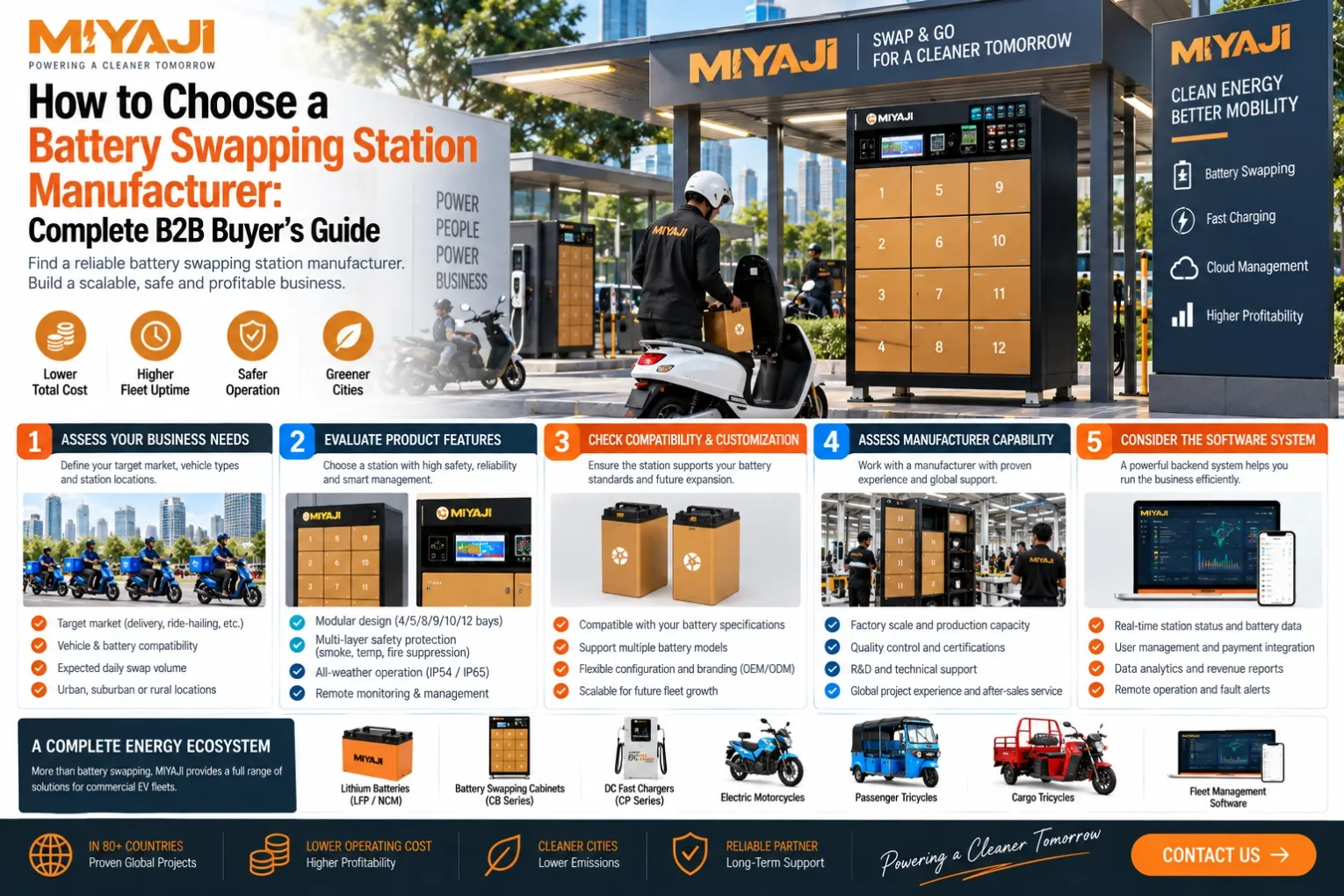
Vehicle + Battery + Fast Charging / Battery Swapping + Software
This is why buyers should compare the scope of supply, not only the unit price.
Two CKD quotations that look similar may actually include very different products.
12. Why Two CKD Quotations Can Be Difficult to Compare
Imagine two suppliers both quote:
Electric Motorcycle CKD Kit — USD XXX / Set
Supplier A includes:
Vehicle + Battery + Charger + GPS
Supplier B includes:
Vehicle only
The unit prices cannot be compared directly.
Even when both suppliers include the same major components, differences may still exist in:
- battery specification;
- motor power;
- controller;
- brake configuration;
- tires;
- lighting;
- accessories;
- charger;
- packaging;
- spare parts; and
- assembly condition.
Therefore, buyers should ask for a clear specification and scope before comparing prices.
A cheap CKD quotation is not necessarily a cheaper complete vehicle.
13. Does Every CKD Shipment Have the Same Disassembly Level?
Not necessarily.
The final CKD condition can depend on:
- motorcycle model;
- supplier production process;
- customer assembly capability;
- destination requirements;
- packaging method;
- shipping arrangement;
- order quantity; and
- agreed project specification.
For example, a customer with an established assembly line may want a more extensively disassembled configuration.
A smaller buyer beginning local assembly may prefer certain components to remain pre-assembled.
This leads to an important procurement principle:
CKD should be defined by the actual supply condition—not only by the label “CKD.”
Before ordering, both sides should clearly understand what will arrive as a component, what will arrive as an assembly, and what work will be completed locally.
14. What Documents Should Buyers Request?
For an initial CKD project, documentation can be almost as important as the physical parts.
Depending on the project and supplier, buyers may need documents such as:
- vehicle specification;
- component or packing list;
- assembly guidance;
- electrical diagram;
- battery information;
- charger specification;
- packing information; and
- inspection or testing requirements.
Larger local assembly projects may eventually require a more structured system involving detailed BOM management, part coding, production documentation and quality-control procedures.
Those topics become more important as local production scales and will be covered separately in future technical guides.
15. How Much Local Assembly Capability Do You Need?
Not every buyer needs to build a large motorcycle factory immediately.
The required setup depends heavily on the intended assembly depth and production volume.
At a basic level, local assembly may require:
- assembly workstations;
- suitable tools;
- torque tools;
- electrical testing equipment;
- battery and charger testing;
- vehicle inspection equipment; and
- trained technicians.
As production volume increases, the operation may require more structured:
Assembly Line → Material Handling → Quality Control → Testing → Warehouse → Production Management
This is why the CKD configuration and local factory plan should ideally be considered together.
For a broader introduction, see #13 — Electric Motorcycle Assembly Line: Equipment, Process & Factory Planning Guide.
16. Questions to Ask Before Ordering an Electric Motorcycle CKD Kit
Before confirming an order, buyers should be able to answer the following:
Vehicle
Which exact model and configuration are we buying?
CKD Level
Which parts are separated and which remain pre-assembled?
Battery
Is the battery included? What chemistry, voltage and capacity?
Charger
Is the charger included? Which input plug and specification?
Electronics
Are controller, wiring harness, dashboard and other electrical systems included?
Accessories
Are GPS, alarm systems or other optional components included?
Small Parts
How are fasteners and small components packed and identified?
Spare Parts
Are spare parts included or quoted separately?
Packaging
How will the components be packed for export?
Documentation
What assembly and technical documents will be supplied?
Local Assembly
What tools, equipment and technical capability will be required at destination?
If these points are unclear, the buyer does not yet have a complete understanding of what the CKD quotation actually represents.
17. MIYAJI's Approach to CKD Electric Motorcycle Projects
MIYAJI approaches CKD supply as part of a broader commercial EV project rather than simply shipping disassembled motorcycles.
Depending on project requirements, the supply scope can include:
Electric Motorcycle
↓
Battery System
↓
Charging Solution
↓
Software
↓
CKD / SKD Supply
↓
Local Assembly Equipment & Technical Support
For buyers starting with smaller volumes, the first priority is to define the correct vehicle configuration and practical assembly condition.
As the project grows, the system can become more structured, with deeper requirements for parts management, assembly processes, testing, quality control and local production equipment.
The objective is not to make CKD unnecessarily complicated.
It is to make sure the buyer knows exactly what is being purchased and what must happen after the shipment arrives.
18. Final Takeaway
An electric motorcycle CKD kit is more than a motorcycle packed into smaller pieces.
The buyer needs to understand:
What is included? What is already assembled? What must be assembled locally? What equipment will be required? What is not included?
Most importantly:
Do not compare CKD quotations only by price per set. Compare the complete scope of supply and the actual delivery condition.
A clearly defined CKD project creates a much stronger foundation for local assembly, future production expansion and long-term cooperation with the supplier.
FAQ
What does CKD mean for an electric motorcycle?
CKD means Completely Knocked Down. The motorcycle is supplied as components or assemblies for local assembly instead of being shipped as a fully assembled vehicle.
What is included in an electric motorcycle CKD kit?
It typically includes the major components required to assemble the motorcycle, such as the frame, motor, controller, wheels, suspension, brakes, wiring, lights, dashboard, body parts and hardware. Battery, charger, GPS, spare parts and other items depend on the agreed quotation.
Is the battery included in every CKD electric motorcycle?
No. Some quotations include the battery, while others quote the vehicle separately. Buyers should confirm the exact scope before comparing prices.
What is the difference between CKD and SKD?
SKD generally involves less disassembly, while CKD involves a more extensive level of local assembly. However, the exact packing condition varies by supplier and project, so buyers should confirm the actual component and assembly status.
Can a small importer buy electric motorcycles in CKD?
Potentially, yes, but the appropriate disassembly level depends on the buyer's local assembly capability, tools, technicians, order quantity and destination requirements. A simpler assembly configuration may be more practical for an early-stage project.
Are spare parts included with CKD motorcycles?
Not automatically. Spare parts should be confirmed separately during quotation and planned according to the project size and after-sales requirements.
CTA
Planning an Electric Motorcycle CKD Project?
Tell MIYAJI your:
Target Market + Vehicle Model + Quantity + Battery Requirement + Desired Assembly Level + Local Production Plan
We can help define a practical supply scope covering the vehicle, battery, charging system, CKD/SKD configuration and local assembly requirements.
Discuss Your CKD Project →