Oct 10, 2026Product & Industry Knowledge
Dual-Battery Electric Motorcycles: How the Batteries Work Together
Dual batteries can extend electric motorcycle operation, but connection strategy matters. Learn about switching, parallel operation, charging and swapping.
Two Batteries on One Electric Motorcycle: Why Does the Connection Strategy Matter?
MIYAJI Commercial Battery Insights — Part 9
An electric motorcycle has space for two batteries. Does that mean twice the range? Can it continue running if one battery fails? Must both batteries be swapped together?
The answers depend on how the system is designed.
“Dual battery” describes the number of packs. It does not explain how they supply power, how the vehicle manages them or what happens when their conditions differ.
For commercial fleets, these details affect daily mileage, charging schedules, battery inventory and driver instructions.
1. Two Batteries Can Work in Different Ways
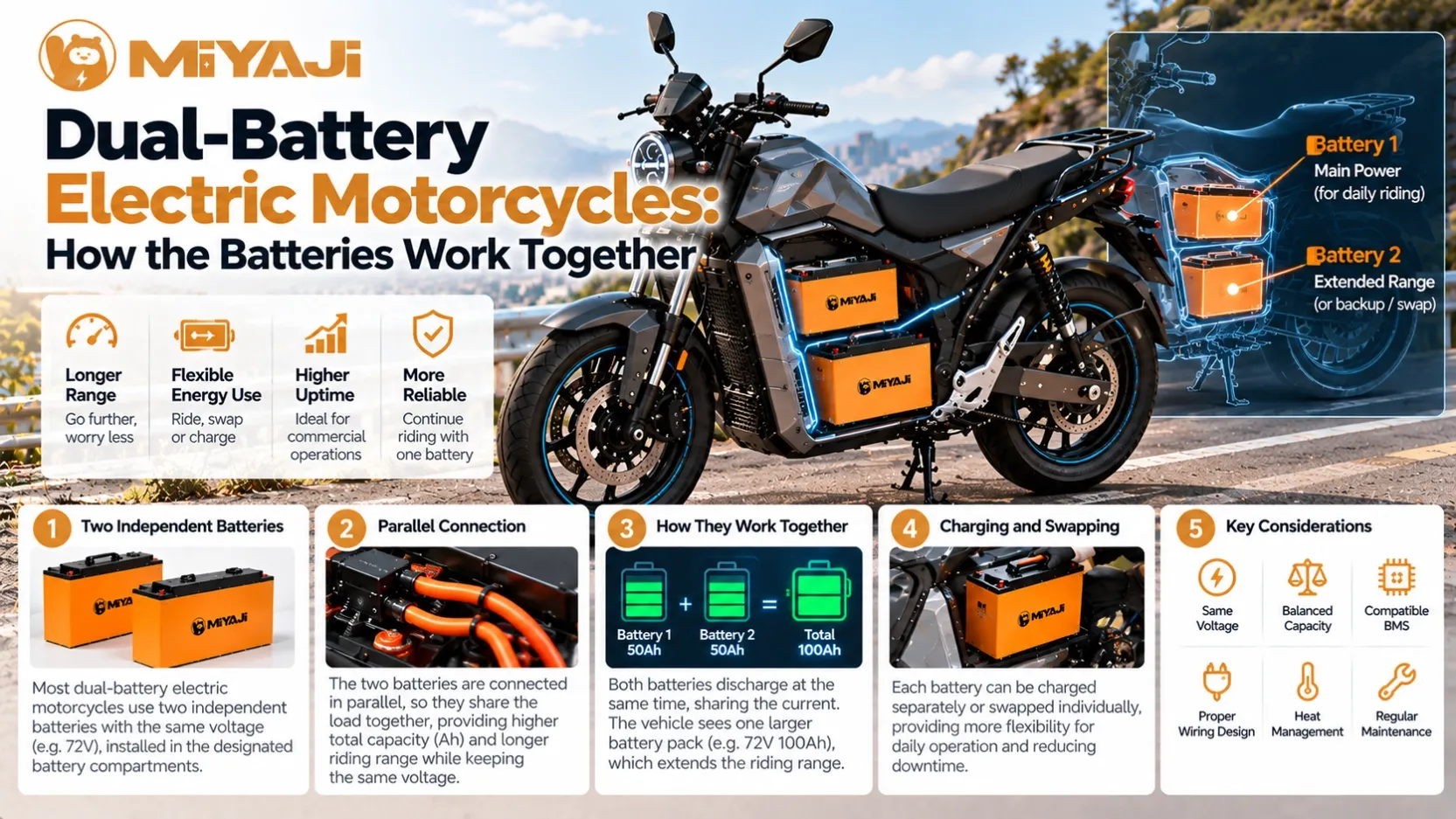
A vehicle may carry two batteries while using only one at a time. Another design may allow both packs to supply power together through an approved connection and control system.
These arrangements have different operating requirements.
Arrangement | Basic operation | What buyers should clarify |
|---|---|---|
One active battery, one spare | The spare replaces the active pack through the approved procedure | Whether replacement is manual and when it can be performed |
Controlled switching | The system selects which pack supplies the vehicle | Switching conditions and interruption behaviour |
Parallel operation | Both packs can contribute to the same electrical supply | Connection control, current sharing and protection coordination |
Series connection is a different arrangement: it increases voltage rather than simply adding capacity at the same voltage. Two packs must not be connected in series unless the complete system is specifically designed for it.
Before evaluating range claims, establish which arrangement the vehicle uses.
2. Two Batteries Do Not Automatically Mean Twice the Range
Two identical, fully charged packs provide approximately twice the nominal stored energy of one.
Actual driving range still depends on usable energy, operating limits and vehicle energy consumption. Carrying another pack also adds weight.
If the comparison changes from light riding to loaded commercial operation, the result cannot be attributed to battery count alone.
Range testing should state:
- Battery configuration and condition.
- Starting and ending charge levels.
- Vehicle load.
- Speed and route.
- Temperature.
- How the two packs were used.
For operators, the useful result is the distance achieved under conditions representative of the working day.
3. Parallel Batteries May Not Share Current Equally
In parallel operation, current distribution depends on pack voltage, internal resistance, connection resistance and the system’s control arrangement.
Equal capacity labels do not guarantee equal current.
Differences in charge level, temperature or battery condition can affect how the packs contribute. One pack may carry more load than the other.
Connection also needs attention. Directly joining packs at different voltages can produce unwanted current between them. Approved designs may use switching, isolation or other controls to manage connection and current flow.
This is why adding a simple branch cable does not establish a suitable dual-battery system.
4. What Happens When One Battery Stops Supplying Power?
In a parallel system, if one pack disconnects, the remaining pack may need to supply more of the vehicle’s demand.
Whether it can do so depends on its condition and permitted output.
The vehicle may need to reduce power, provide a warning or stop according to the system design. Otherwise, the remaining pack could also reach a protection limit.
In a switching system, continued operation depends on whether the second pack is available and whether switching is permitted under the current conditions.
Two batteries provide redundancy only when the design supports the relevant failure condition.
A shared controller, damaged common connection or other system fault may still stop the vehicle.
5. Battery Matching Needs More Than Voltage and Ah
A dual-battery configuration should define which packs are approved to work together.
Relevant characteristics include:
- Chemistry and operating voltage range.
- Capacity and output capability.
- BMS hardware and configuration.
- Communication requirements.
- Charging limits.
- Battery condition and permitted differences.
- Connector and mechanical compatibility.
A newer battery and an older battery may behave differently even if their labels match.
Whether they can be used together should follow the approved system requirements. Operators should not rely on appearance or nominal voltage alone.
6. The Dashboard Needs to Explain Both Batteries
A single percentage can hide important information.
For example, if two equal-capacity batteries report 80% and 20%, displaying their average as 50% does not explain whether both are connected, whether one has a fault or how much power is available.
For packs with different effective capacities, a simple average may also misrepresent remaining charge.
A useful display should make the operating state clear. Depending on the design, this may include:
Information | Why it matters |
|---|---|
Helps plan charging or replacement | |
Active battery or connection state | Shows how the vehicle is drawing power |
Battery warning or fault | Identifies a restricted pack |
Reduced-power status | Explains a change in vehicle performance |
Battery identity | Supports tracking and service |
Any combined estimate should have a defined calculation method. Remaining range is another estimate and needs vehicle consumption information.
7. Charging Arrangements Must Be Defined
Two batteries may be charged separately, sequentially or through an integrated arrangement.
The approved configuration should specify the equipment and procedure. A charger suitable for one pack is not automatically approved to charge two connected packs.
Questions to confirm include:
- Does each pack have its own charging connection?
- Can both charge at the same time?
- How are charging limits controlled?
- What happens if one pack cannot accept charge?
- Can charging and vehicle operation occur simultaneously?
- What charging status is shown to staff?
Drivers and site staff need clear instructions for the supplied configuration.
8. Dual Batteries Change the Swapping Process
A dual-battery vehicle may exchange one pack per visit or both. The system’s battery-matching rules determine what is acceptable.
Returning only one pack changes the mix of battery conditions on the vehicle. Returning both changes transaction handling, charging demand and station inventory requirements.
The platform should record the relevant battery movements rather than treat the motorcycle as a single anonymous battery asset.
For fleet planning, distinguish:
Batteries installed on vehicles: packs needed for the approved vehicle configuration.
Batteries in circulation: additional packs charging, ready for issue or awaiting service.
Fitting two batteries to every motorcycle does not remove the need to plan station stock and charging capacity.
What Should Operators Ask Before Buying?
A dual-battery proposal should answer these questions:
- Are the batteries used together or one at a time?
- Which battery combinations are approved?
- Can the vehicle operate on one pack, and under what limits?
- What happens when a pack trips protection or loses communication?
- How are charge level and faults displayed?
- How are the packs charged?
- Must one or both batteries be swapped?
- What tests support the stated range and load capability?
Request these answers for the actual supplied configuration.
Dual-Battery Planning with MIYAJI
MIYAJI coordinates commercial vehicles with its battery PACK, charging, swapping and software capabilities.
A dual-battery decision should start with the operating requirement: daily distance, load, routes, available vehicle space and replenishment opportunities.
Share your vehicle requirements and daily operating schedule with MIYAJI to discuss whether a single-battery or dual-battery configuration is suitable for your project.
Frequently Asked Questions
Can I add a second battery to an existing electric motorcycle?
Only after assessing the vehicle, battery interfaces, connection strategy and control requirements. An extra battery and cable alone do not establish compatibility.
Can two batteries with different charge levels operate together?
It depends on the approved design and permitted conditions. Do not assume direct connection is acceptable.
Will two batteries increase motor power?
Not automatically. Motor output also depends on the controller and vehicle design. Additional stored energy does not, by itself, increase power.
Can the motorcycle continue if one battery fails?
Only if the design supports that condition and the remaining battery can meet the permitted demand. Some faults still require the vehicle to stop.
Do both batteries need to be swapped together?
That depends on the system’s operating and matching rules. The process should be defined before deployment.
Next in the series: Why Can a Battery Pass Factory Testing but Develop Problems in Fleet Operation?