Oct 9, 2026Product & Industry Knowledge
Electric Motorcycle Battery Cuts Out Under Load: Why?
Why does an electric motorcycle or tricycle battery cut out during acceleration or climbing? Learn how battery, BMS and controller matching affects operation.
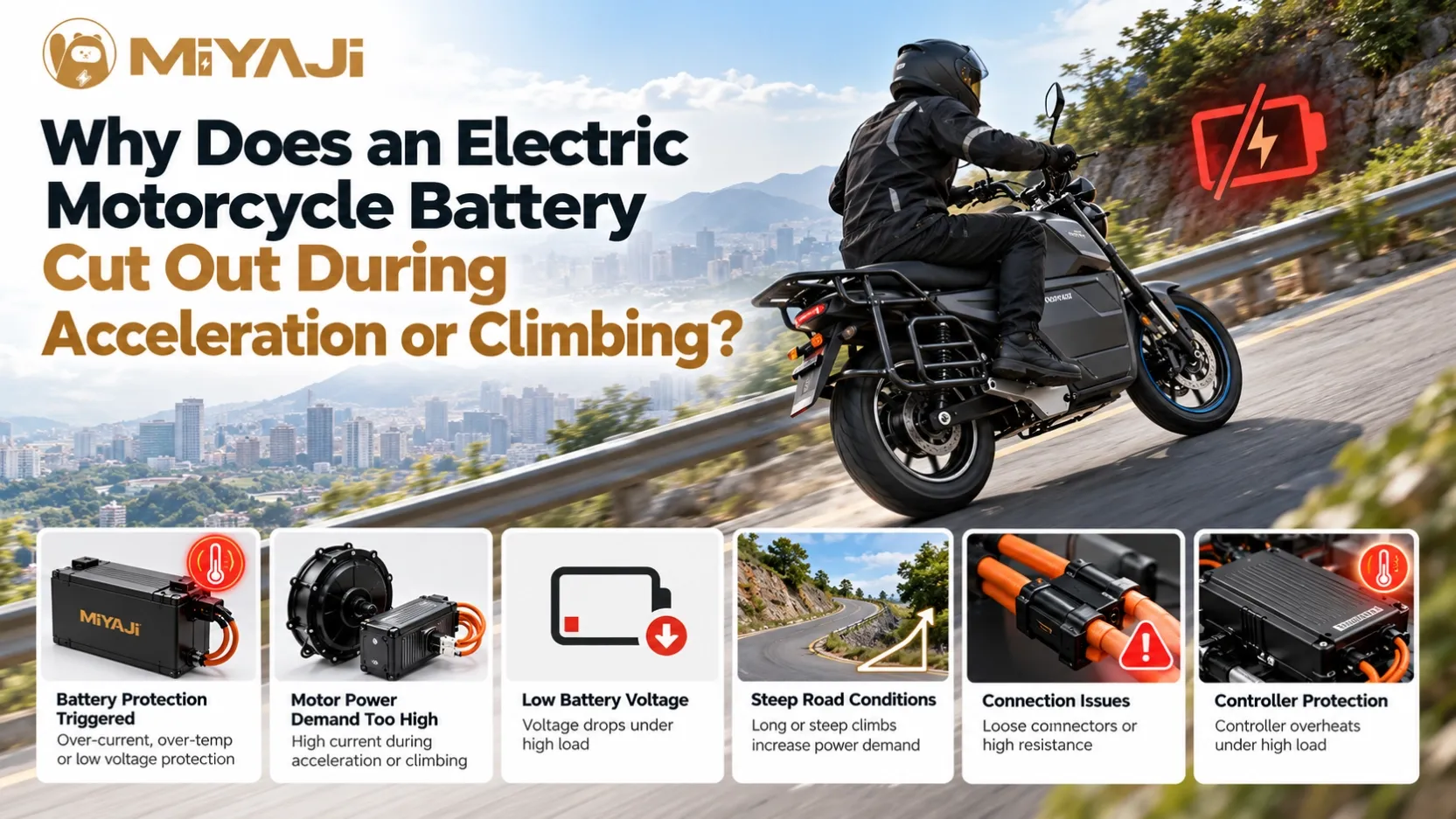
Why Does an Electric Motorcycle Battery Cut Out During Acceleration or Climbing?
MIYAJI Commercial Battery Insights — Part 1
Your electric motorcycle still shows battery charge. It runs on a flat road, but when the rider accelerates, carries a heavier load or climbs a hill, power suddenly cuts out.
For a delivery fleet or passenger tricycle operator, this means interrupted trips, delayed orders and lost working time.
It is tempting to blame the battery capacity or replace the battery management system immediately. However, the same symptom can have several different causes. Finding the right solution starts with understanding what happens when the vehicle demands more power.
Remaining Charge and Available Power Are Different
Battery capacity, usually expressed in ampere-hours (Ah), helps describe how much charge a battery can store. It does not, by itself, tell you how much current the complete battery pack can safely deliver.
During acceleration or climbing, the vehicle may require more battery current than it does during steady riding on a flat road. The exact demand depends on the controller, speed, load and operating conditions.
A battery can therefore have remaining charge while being unable to support the power required at that moment.
This is why selecting a commercial vehicle battery requires more than matching voltage and capacity.
What Can Cause the Power to Cut Out?
1. A Cell Group Reaches Its Low-Voltage Limit Under Load
Battery voltage normally drops under load. If one series-connected cell group drops far enough to reach its protection limit, the BMS may restrict or stop discharge—even when the total pack voltage appears acceptable.
Possible contributors include low charge, increased internal resistance, cell imbalance or deterioration in part of the pack.
The important question is not simply, “What is the battery voltage?” It is also, “What happens to the lowest cell-group voltage when the vehicle accelerates?”
BMS documentation identifies low cell voltage as a reason for reducing the permitted discharge current.
2. Current Demand Triggers BMS Protection
The BMS monitors conditions that may damage the battery. Depending on its design, these include discharge overcurrent, short circuits, low cell voltage and excessive temperature.
If vehicle demand exceeds the configured protection threshold for the relevant duration, discharge may be interrupted. Protection systems can use different thresholds and delays, so a current rating alone does not explain how a pack will behave during acceleration.
A protection event does not automatically mean the BMS is defective. It may indicate that the battery and vehicle demand are poorly matched, or that another fault needs investigation.
Simply increasing the protection threshold can leave the cells, connections or other components operating beyond their limits.
3. A Connection Creates Excessive Voltage Drop or Heat
The battery’s output depends on more than its cells and BMS.
Connectors, cables, terminals and internal connections must also carry the required current. A loose, damaged or unsuitable connection can cause voltage loss and local heating, with problems becoming more noticeable under heavier load.
In a battery-swapping operation, frequently used connectors deserve particular attention. A connection that works when stationary may behave differently during vibration or high-current operation.
Replacing the BMS will not fix a fault elsewhere in the current path.
4. Battery and Controller Settings Are Not Coordinated
The controller determines how the vehicle draws power. The battery has its own operating limits.
Matching them requires attention to battery-side current demand, permitted discharge current, voltage limits and protection behaviour. Battery current and motor phase current are different quantities, so specifications must be compared on the same basis.
In systems that support communication, the controller may also need to respond correctly to the battery’s permitted discharge current.
BMS manufacturers describe current-limit outputs intended to help external equipment operate within battery limits. This capability depends on the specific BMS and system implementation.
How Should the Problem Be Investigated?
Useful diagnosis connects the operating conditions with measurements taken when the fault occurs.
Information to check | What it helps establish |
|---|---|
Battery charge level and temperature | Whether the fault depends on battery condition |
Vehicle load, speed and road gradient | What demand produces the interruption |
Battery current during the event | Whether current demand is involved |
Lowest cell-group voltage under load | Whether one part of the pack reaches a voltage limit |
BMS fault record, where available | Which protection condition was detected |
Controller fault record | Whether the interruption originates in the vehicle |
Connector condition and voltage drop | Whether the current path contributes to the problem |
A voltage reading taken after the vehicle has stopped may miss the event: voltage can recover when the load is removed. Likewise, a slow-refreshing app display may not capture a brief current spike.
Where necessary, qualified technicians should use suitable logging equipment to capture the event. Any correction should then be checked under comparable operating conditions.
Why This Matters for Commercial Fleets
A battery that works for a lightly loaded commuter may not suit a passenger tricycle or a delivery motorcycle operating for long hours.
Before recommending a battery configuration, the project needs clear answers about:
- Vehicle and controller specifications.
- Typical passenger or cargo load.
- Road conditions and climbing requirements.
- Daily distance and operating hours.
- Charging or swapping arrangements.
- Local temperature and service conditions.
These details help define the battery’s required energy, output capability and place in the daily operating schedule.
For fleet buyers, a useful procurement question is:
“Has this battery configuration been evaluated with the intended vehicle, load and operating conditions?”
That question provides more insight than asking only for a larger Ah rating or a higher-current protection board.
How Battery Swapping Changes the Picture
With battery swapping, the battery must work across both the vehicle and the cabinet.
Mechanical fit is only one requirement. The system may also need compatible identification, communication, charging control and battery-status reporting.
If a battery repeatedly trips protection on a vehicle, recharging it in a cabinet does not necessarily remove the underlying cause. The vehicle’s demand, the battery’s condition and the relevant records still need to be reviewed together.
Consistent battery identification and version records also help operators determine whether an issue follows a particular pack, a vehicle or a configuration.
Planning the Battery as Part of the MIYAJI System
MIYAJI brings together commercial vehicles, battery packs, swapping cabinets, charging equipment and management software.
For a commercial project, battery planning should connect these elements to the intended operation. The objective is to select a configuration that supports the working load, fits the replenishment plan and can be supported throughout use.
If you are planning an electric motorcycle or tricycle fleet, share your vehicle requirements, typical load, routes, daily distance and charging or swapping plan with MIYAJI.
These are the starting points for evaluating a suitable vehicle-and-battery solution.
Frequently Asked Questions
Can a battery cut out even when the display shows remaining charge?
Yes. Remaining charge does not guarantee that the battery can meet the immediate power demand. Low cell-group voltage under load, overcurrent protection or other faults may interrupt output.
Will a higher-current BMS solve the problem?
Only if diagnosis confirms that the existing BMS specification is unsuitable and the rest of the pack can safely support the required current. Changing the BMS alone does not increase the capability of the cells, cables or connectors.
Does a higher-Ah battery always provide more power?
No. Ah describes charge capacity. Output capability also depends on the cells, pack arrangement, BMS, connections and thermal conditions.
Should the battery or vehicle supplier handle the diagnosis?
The investigation may require both. Battery measurements and fault records should be reviewed alongside controller behaviour and vehicle operating conditions.
Next in the series: Same Voltage, Same Ah—Why Do Commercial Battery Packs Perform Differently?