Oct 10, 2026Product & Industry Knowledge
Same Plug: Are Electric Motorcycle Chargers Interchangeable?
A matching plug does not guarantee charger compatibility. Learn what fleets should check about voltage, current, pin assignments and BMS communication.
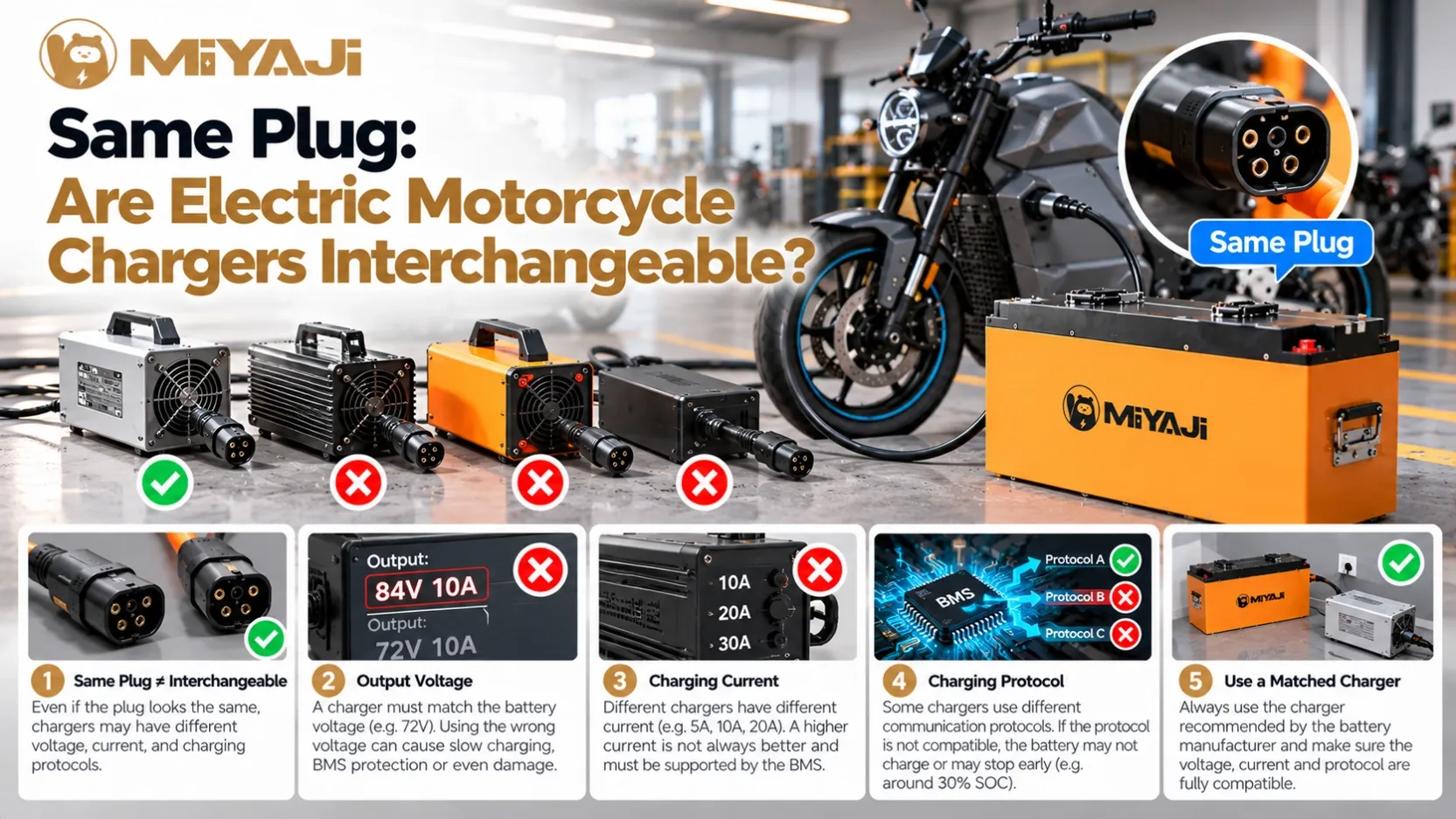
Same Plug, Different Charger: Can Electric Motorcycle Chargers Be Used Interchangeably?
MIYAJI Commercial Battery Insights — Part 6
A charger fails at your fleet’s operating site. A replacement is available, and its plug fits the battery.
Can you use it?
The connector is only the first compatibility check. Before a charger can be approved for an electric motorcycle or tricycle battery, its electrical output, charging profile, pin assignments and any control requirements must match.
For commercial operators, getting this right helps avoid charging interruptions, damaged equipment and batteries that are not ready for the next shift.
1. The Battery Voltage Label Is Not the Charging Voltage
A battery described as “72V” does not necessarily require a charger with a 72V maximum output.
Nominal battery voltage and full-charge voltage are different specifications. The required charging voltage depends on the cell chemistry, series configuration and approved charging limits.
Two batteries marketed in the same voltage class may therefore require different charger settings.
When selecting a charger, confirm:
- Exact battery chemistry.
- Number of series-connected cell groups.
- Approved charging voltage.
- Permitted charging current.
- Required charging profile and control method.
Use the battery manufacturer’s specification rather than choosing from the nominal voltage label alone.
2. Charging Current Must Suit the Complete Pack
A higher-current charger may shorten part of the charging process—but only if the battery supports that current.
The cells, BMS charging path, internal connections, cables and charging connector all need suitable capability. Permitted current may also depend on temperature and battery condition.
Do not assume that a BMS discharge-current rating is its charging-current rating. These specifications can differ.
For example, a battery capable of supplying substantial current to a vehicle may still require a much lower charging current.
The relevant question is:
3. The Same Connector Can Have Different Pin Assignments
Two connectors can look identical while being wired differently.
Their pins may carry battery positive, negative, communication, temperature information or an enable signal. The number and position of pins alone do not establish their function.
Compatibility checks should cover:
Connector detail | What to confirm |
|---|---|
Power pins | Correct polarity and assignment |
Current capability | Suitability of contacts, cables and assembly |
Signal pins | Function and electrical requirements |
Mechanical connection | Secure engagement and correct alignment |
Environmental protection | Suitability for the operating location |
An adapter changes the physical connection. It does not automatically correct voltage, charging behaviour or communication.
4. The Charging Profile Must Match the Battery
A charger controls how energy is delivered throughout charging.
Many lithium battery applications use a constant-current stage followed by a constant-voltage stage, but the actual settings and completion criteria must suit the battery. Other functions, such as automatic restart behaviour, also need review.
A charger intended for another chemistry or battery configuration should not be assumed suitable because charging appears to start.
Charger manufacturer Delta-Q advises matching the active charging algorithm to the battery’s requirements and checking compatibility when changing batteries.
For procurement, request the approved charging profile alongside the voltage and current ratings.
5. Some Systems Require More Than Power Connections
Not every charger needs digital communication. Some use an approved fixed profile; others receive an enable signal or communicate with the battery management system.
Where communication is required, both devices must agree on more than the interface name.
“CAN-compatible” or “RS485-compatible” does not, by itself, establish that two products can work together. The message definitions, timing, units and control behaviour must also match.
Important questions include:
- What allows charging to begin?
- How are voltage and current limits communicated?
- What happens when charging is no longer permitted?
- How is a communication timeout handled?
- How is charging completion reported?
BMS integration documentation describes charger-enable and shutdown arrangements, illustrating why the control interface forms part of compatibility.
6. BMS Protection Does Not Make Any Charger Suitable
The BMS provides protection, but it should not be used to compensate for an unsuitable charging profile.
Normal charging should be controlled within the battery’s approved limits. Protection provides a response when monitored conditions require it.
Repeatedly reaching a protection limit and restarting is a reason to investigate. Possible causes include charger settings, cell imbalance, control behaviour or another fault.
Likewise, a charger indicator changing colour is not enough to establish why charging stopped. Check actual current, battery status and any fault information.
What Can Charging Problems Look Like?
Different compatibility issues can produce similar symptoms.
Symptom | Areas to investigate |
|---|---|
Charger connects but does not start | Supply power, battery state, wake-up, enable signals and communication |
Charging stops earlier than expected | Charging profile, cell-group voltage, protection records and completion logic |
Charging repeatedly starts and stops | Control coordination, voltage limits, temperature and connections |
Charging is slower than expected | Actual current, battery limits, temperature, supply conditions and charging stage |
Connector becomes unusually hot | Contact condition, assembly, cable sizing and current |
Charger reports complete but dashboard SOC is low |
These observations guide diagnosis. They do not identify a failed component on their own.
What Should a Fleet Check Before Approving a Replacement?
A replacement charger should have a clear compatibility record.
Record the battery configuration, charger model, output settings, connector assignment and any software or profile version.
Validation should cover relevant starting conditions, normal charging, completion and the system’s response to faults or loss of communication.
For overseas projects, also confirm the charger’s input supply requirements and suitability for the installation environment.
Once approved, label equipment clearly so site staff can select the correct charger without relying on connector appearance.
Why This Matters for Battery Swapping
A swapping cabinet may charge several batteries at the same time. Compatibility problems can therefore affect battery availability across an operating site.
The cabinet needs to coordinate the battery, charging module and relevant control functions. Its power capacity and allocation also influence how quickly batteries return to service.
When a battery or BMS configuration changes, review whether the cabinet’s charging settings and interfaces remain suitable.
For operators, the goal is a repeatable charging process that makes compatible batteries available for the next trip.
Charging Within a MIYAJI Commercial EV System
MIYAJI manufactures battery packs, charging and swapping equipment, with software supporting the connected operating system.
For a commercial project, these elements need to be evaluated together with the vehicles and daily working schedule.
When discussing a charging or swapping solution, share your battery configuration, vehicle type, operating hours, available power supply and required turnaround time with MIYAJI.
This provides the basis for selecting compatible equipment and planning replenishment around actual fleet needs.
Frequently Asked Questions
Can I use another charger if the plug fits?
Only after confirming electrical, connector and control compatibility. A matching plug is insufficient.
Can two chargers labelled 72V have different outputs?
Yes. Confirm the actual output voltage and charging profile against the battery specification.
Will a higher-current charger always charge faster?
No. The battery must accept that current, and charging time also depends on temperature, starting charge level and the charging profile.
Does every lithium battery charger need CAN communication?
No. The control method depends on the approved system design. Where communication is required, the protocol must be compatible.
Can the BMS protect against an incorrect charger?
It may respond to certain monitored faults, but that does not make the combination suitable. Use a charger approved for the battery.
Next in the series: Why Does Fast Charging Require the Battery and Charger to Be Designed Together?