Oct 9, 2026Product & Industry Knowledge
72V Motorcycle Batteries: Why the Same Ah Performs Differently
Comparing 72V motorcycle batteries? Learn why the same Ah rating can deliver different power, usable energy and performance in commercial fleets.
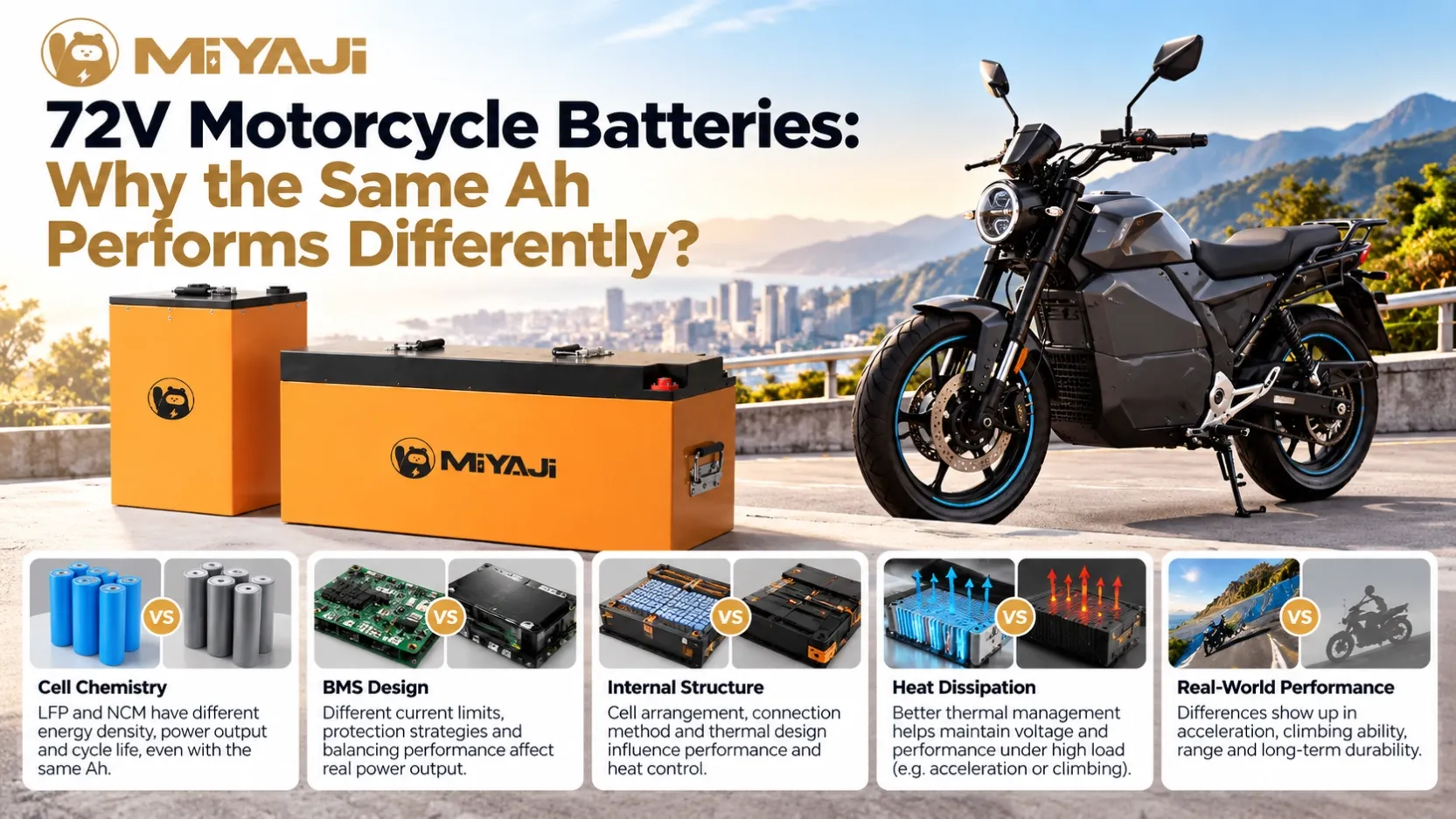
Same Voltage, Same Ah: Why Do Electric Motorcycle Batteries Perform Differently?
MIYAJI Commercial Battery Insights — Part 2
Two suppliers offer a 72V 60Ah battery for your electric motorcycle fleet. One costs more than the other. Both claim long range and reliable performance.
Are you comparing equivalent products?
Not necessarily. Voltage and ampere-hours describe important battery characteristics, but they do not fully describe the cells, output capability, construction or system compatibility.
For a commercial motorcycle or tricycle, these differences can affect acceleration, loaded range, charging and daily availability.
What Do Voltage and Ah Actually Tell You?
Nominal voltage helps identify the battery’s electrical operating class. Capacity in ampere-hours describes the amount of charge it can deliver under specified test conditions.
Multiplying nominal voltage by Ah gives an approximate nominal energy figure:
72V × 60Ah = 4,320Wh, or approximately 4.32kWh.
This is useful for an initial comparison. However, it is not a guarantee of usable energy or driving range.
Also, “72V” can be a market designation. Batteries sold in this class may use different cell chemistries and series configurations, resulting in different actual nominal voltages, full-charge voltages and operating limits.
Buyers should therefore confirm the complete specification rather than assume that every battery labelled 72V is interchangeable.
1. The Cells May Have Different Output Capabilities
Two cells with the same Ah rating can have different permitted discharge currents, internal resistance and temperature characteristics.
A battery designed for moderate current may work well during light riding. Under heavier acceleration or passenger loads, its performance may be different from a pack designed for that duty.
This matters when comparing batteries for:
- Delivery motorcycles with frequent starts.
- Passenger tricycles operating with changing loads.
- Cargo vehicles climbing hills.
- Vehicles working for extended hours.
The useful question is:
“What continuous and short-duration battery current can this complete pack support, under what conditions?”
A peak-current figure is incomplete without its permitted duration and operating conditions.
2. Cell Consistency Affects How Much of the Pack Can Be Used
A battery pack contains multiple series-connected cell groups. These groups need to work together.
If one group reaches its low-voltage limit before the others, discharge may need to stop while energy remains elsewhere in the pack. During charging, a group that reaches its upper voltage limit early may also restrict charging.
Differences in capacity, resistance or self-discharge can therefore affect the pack’s usable performance.
A cell brand name alone does not establish consistency. Buyers should ask about the cell model, source, matching process and traceability.
Likewise, a small voltage difference measured while the battery is resting does not, by itself, prove that all cell groups will behave similarly under load.
3. The BMS Can Change the Operating Experience
The battery management system monitors the battery and controls or communicates its operating limits.
Two batteries with identical voltage and Ah labels may have different:
BMS characteristic | Why it matters |
|---|---|
Discharge-current limits | Determines whether the battery supports vehicle demand |
Protection thresholds and delays | Affects when and how protection operates |
Temperature monitoring | Helps identify conditions requiring limits or shutdown |
Current measurement and SOC estimation | Affects the usefulness of displayed battery data |
Communication functions | Determines whether the battery can exchange required information with the vehicle or cabinet |
Fault records | Helps technicians investigate problems |
A higher-current BMS does not automatically make a better battery. Its limits must remain appropriate for the cells and the complete pack.
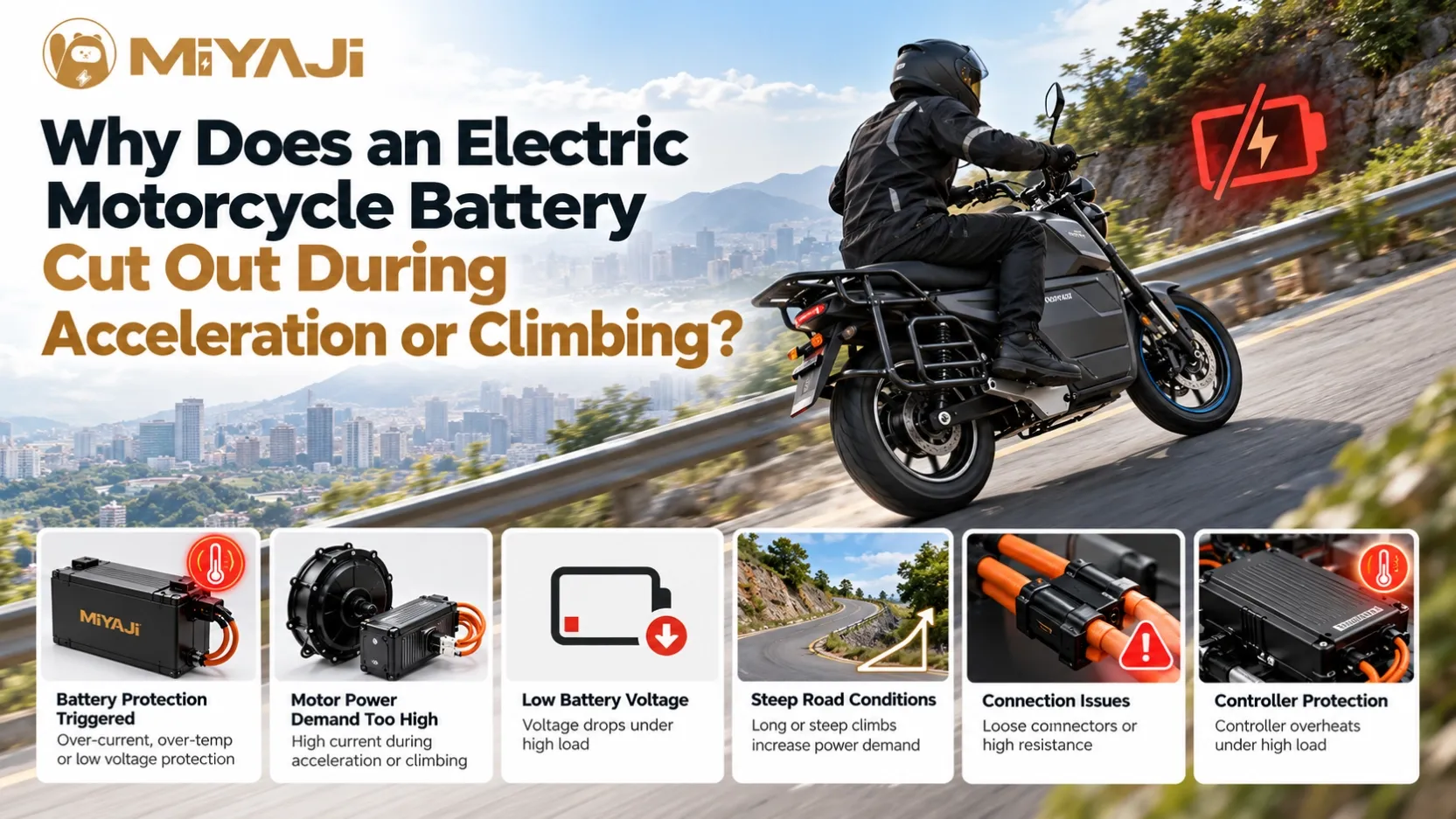
In the previous article, we explained how these factors can contribute to an electric motorcycle battery cutting out during acceleration or climbing.
4. Connections and Pack Construction Matter
The battery’s current passes through internal connections, output cables and connectors. These components must be suitable for the intended load.
Connection quality affects voltage loss and heating. Mechanical support, insulation and cable routing also influence how the pack withstands repeated use and vibration.
For a removable commercial battery, the enclosure and connector face additional demands from handling and frequent insertion.
Buyers should consider the finished pack, including:
- Internal connection quality.
- Cell and component support.
- Insulation and cable protection.
- Connector selection and mounting.
- Sealing and environmental protection.
- Service access and replacement procedures.
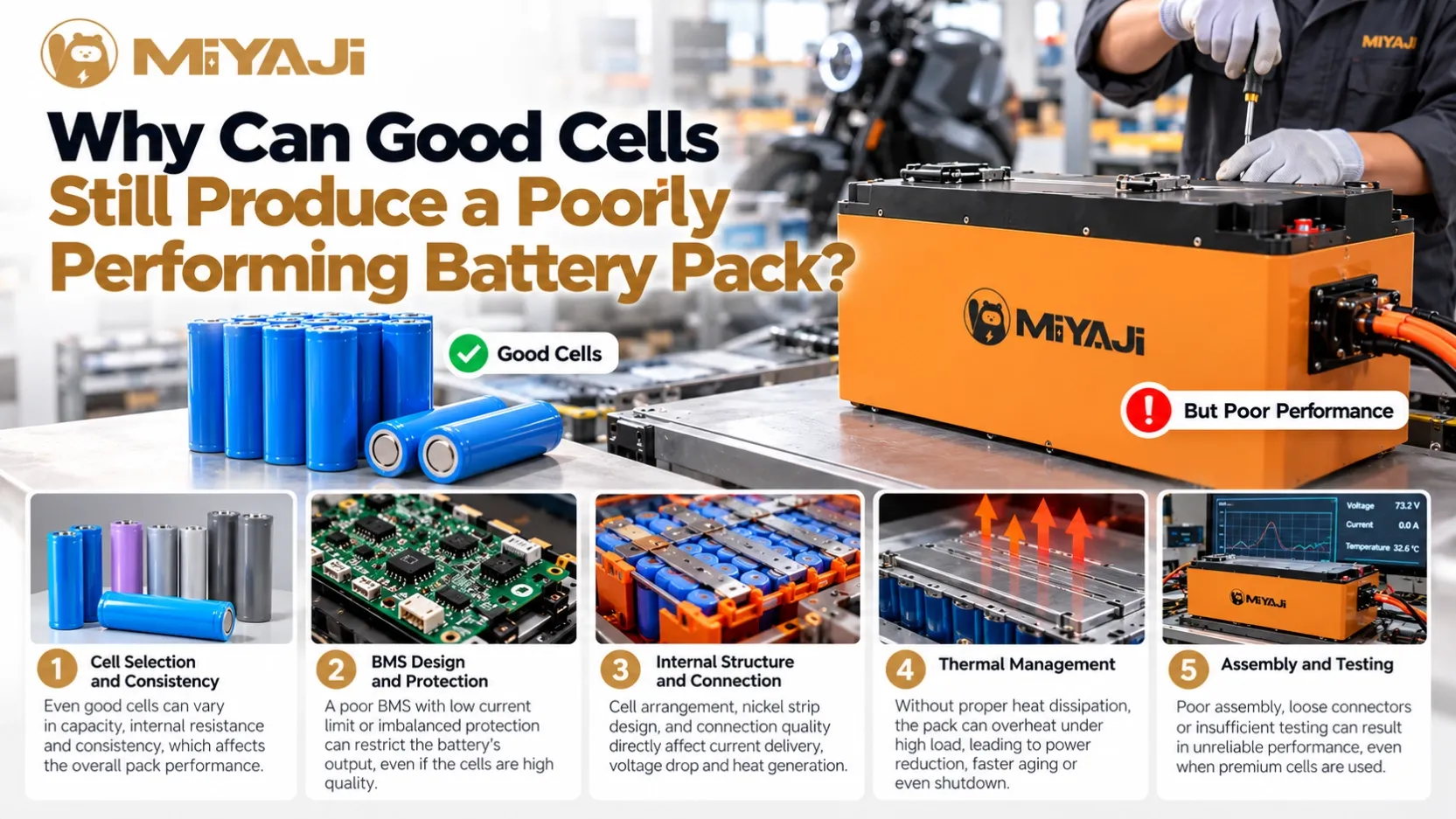
A good cell is an important starting point. The finished pack still needs appropriate engineering and manufacturing.
5. The Same Ah Does Not Mean the Same Charging Capability
A 60Ah capacity rating does not establish whether a battery supports fast charging.
Charging capability depends on the cell specifications, pack design, BMS, connections, temperature conditions and charging equipment.
Even when two batteries use similar connectors, their full-charge voltage, permitted current or communication requirements may differ.
For an operator, the practical question is:
“How long does this battery take to return to service with the intended charging equipment and operating conditions?”
That is more useful than comparing charger wattage alone.
A battery that supports your replenishment schedule may provide more operational value than a larger battery that spends too long charging.
6. Range Comparisons Need the Same Test Conditions
Different advertised ranges do not necessarily prove that one battery has more capacity.
Vehicle efficiency, speed, load, gradients, temperature and stopping frequency all affect energy consumption.
For example, a lightly loaded motorcycle on a flat route cannot provide a fair comparison with a passenger tricycle carrying several people over hills.
When comparing battery proposals, ask suppliers to state:
Comparison item | Information needed |
|---|---|
Vehicle | Model, controller configuration and relevant specifications |
Load | Rider, passengers and cargo |
Route | Distance, gradients and road conditions |
Speed | Typical speed and riding pattern |
Environment | Temperature and other relevant conditions |
Battery | Charge level, condition and test configuration |
Result | Distance travelled and measured energy, where available |
Comparable conditions make the results more useful for planning a fleet.
7. A Swapping Battery Has Additional Requirements
For battery-swapping projects, performance includes how the pack works with the cabinet and management system.
Two 72V 60Ah batteries may differ in dimensions, connector arrangement, identification, communication and charging control.
Before choosing a pack, confirm that the intended system supports:
- Correct battery identification.
- Compatible mechanical and electrical interfaces.
- Required charging control.
- Consistent interpretation of battery-status data.
- Traceable battery and configuration records.
A battery that works on a vehicle may still require additional development before it can operate correctly in a swapping network.
What Should Fleet Buyers Compare?
Start with voltage and capacity, then request enough information to assess the application.
A useful comparison includes:
- Exact electrical specification: chemistry, series configuration, nominal and full-charge voltage.
- Cell information: manufacturer, model and traceability.
- Output capability: continuous current and permitted short-duration current.
- BMS configuration: protection, monitoring and communication.
- Pack construction: connections, enclosure and environmental protection.
- Charging compatibility: permitted charging conditions and equipment.
- Application testing: results relevant to the intended vehicle and load.
- Support terms: warranty scope, diagnosis and replacement arrangements.
These details help explain price differences. A higher price still needs evidence; a lower price needs the same careful review.
Selecting a Battery for a MIYAJI Commercial EV Project
MIYAJI’s commercial EV solutions connect vehicles, battery packs, swapping cabinets, charging equipment and management software.
Battery selection needs to account for both the vehicle’s working demands and the operator’s replenishment plan.
For an initial project assessment, share your vehicle type, typical load, routes, daily distance, operating hours and charging or swapping requirements.
This provides a stronger basis for comparing configurations than voltage and Ah alone.
Frequently Asked Questions
Are all 72V batteries compatible with the same vehicle?
No. Confirm the actual voltage range, chemistry, connector, current capability and any communication requirements. The 72V label alone is insufficient.
Will two 72V 60Ah batteries provide the same range?
Not necessarily. Their usable energy may differ, and range also depends on the vehicle and test conditions. Compare measured results under equivalent conditions.
Does a larger BMS current rating mean better quality?
No. The rating must suit the cells, construction and vehicle demand. Quality also involves measurement, protection, reliability and manufacturing consistency.
Is the cell brand enough to choose a battery?
No. The exact cell model, consistency, pack construction, BMS and application compatibility also matter.
What should a swapping operator check beyond battery capacity?
Check vehicle and cabinet compatibility, charging behaviour, identification, communication, handling requirements and service support.
Next in the series: Why Can Good Cells Still Produce a Poorly Performing Battery Pack?