Oct 10, 2026Product & Industry Knowledge
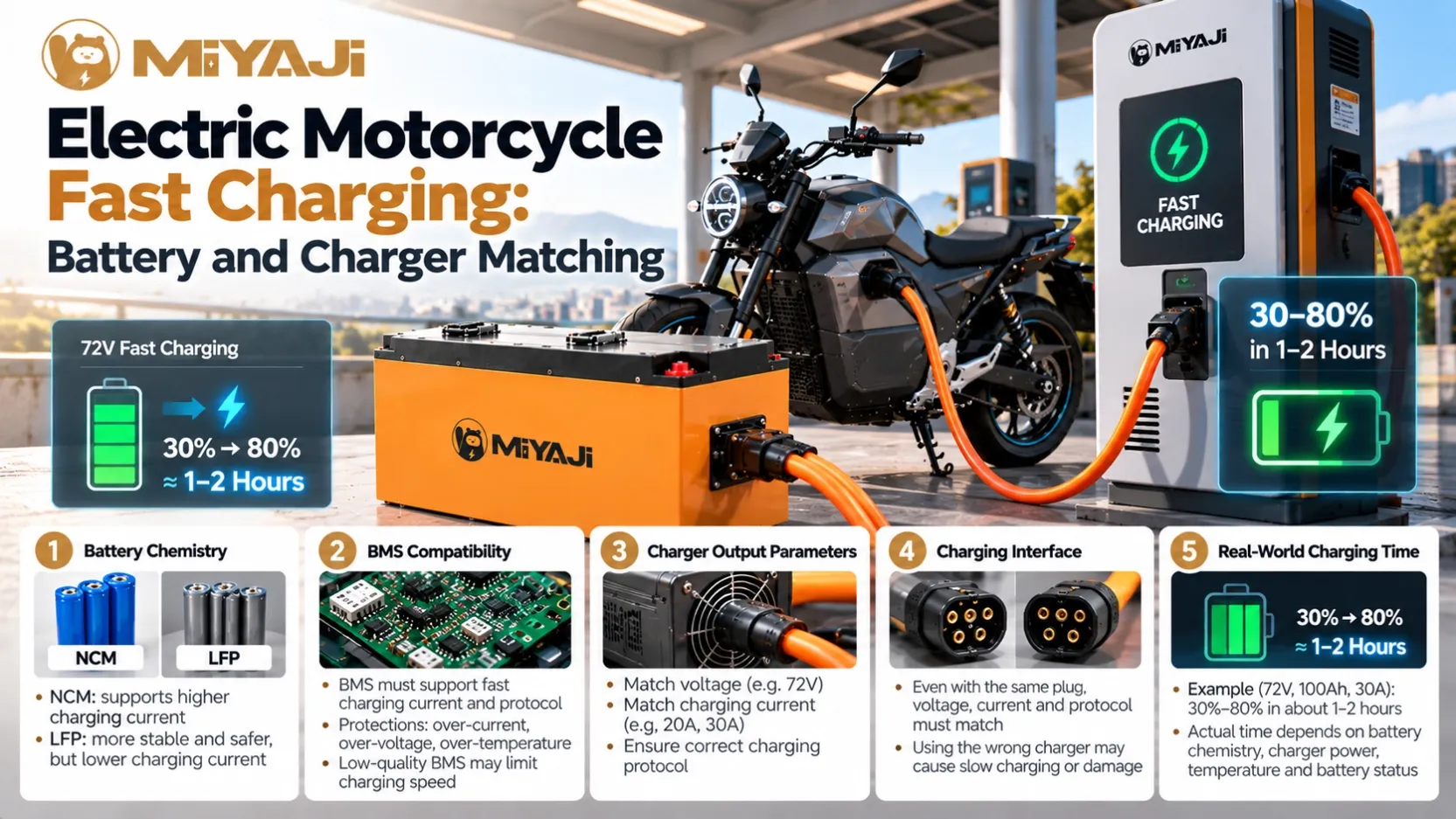
Electric Motorcycle Fast Charging: Battery and Charger Matching
Fast charging requires a compatible battery, BMS, charger and power supply. Learn what commercial motorcycle and tricycle fleets should evaluate.
Why Does Electric Motorcycle Fast Charging Require the Battery and Charger to Be Matched?
MIYAJI Commercial Battery Insights — Part 7
Your fleet needs shorter charging stops. A supplier offers a more powerful charger.
Will connecting it to your existing battery solve the problem?
For electric motorcycles and tricycles, fast charging involves the cells, battery pack, BMS, connections, charging equipment and site power supply. Each can affect how quickly a vehicle returns to work.
For operators, the useful measure is the charging time achieved under defined operating conditions.
1. Start with the Battery’s Approved Charging Capability
Battery capacity does not establish its charging capability.
Two packs with the same voltage and Ah rating may use cells with different permitted charging currents. Their BMS, connections and thermal design may also differ.
Charging current is sometimes expressed as a C-rate. For a 60Ah battery, 1C corresponds to 60A, while 0.5C corresponds to 30A.
These figures explain the relationship between current and capacity. They do not establish what that battery is approved to accept.
Confirm the permitted charging conditions for the exact cell model and finished pack, including temperature and any restrictions during the charging cycle.
2. The Complete Charging Path Must Support the Current
Even when the cells support faster charging, the rest of the pack needs suitable capability.
Review:
- BMS charging-current capability.
- Internal conductors and connections.
- Charging cables and terminals.
- Connector ratings and assembly.
- Switching components.
- Heat dissipation.
The BMS discharge rating cannot be used as a substitute for its charging specification.
A charging upgrade therefore needs a review of the complete current path, rather than a change to one component.
3. Charger Power Does Not Equal Power Accepted by the Battery
A charger’s rated power describes its capability under specified conditions.
Actual output can be limited by the battery’s permitted current, the charger’s voltage and current range, temperature, site power availability or control settings.
Battery-side charging power is approximately:
Charging power = battery voltage × charging current.
Voltage changes during charging, and actual power may change with it. Some chargers also have different current capability across their output range.
When comparing equipment, ask what output it can deliver throughout the intended battery’s charging voltage range.
4. Charging Usually Slows Near the Upper Charge Limit
Many lithium battery charging profiles include a constant-current stage followed by a constant-voltage stage. Current reduces as the battery approaches its charging endpoint.
As a result, charging from 20% to 80% and charging from 20% to 100% can take substantially different amounts of time.
A fast-charging claim needs clearly stated conditions:
Information | What should be specified |
|---|---|
Battery | Model, capacity and condition |
Charge window | |
Temperature | Relevant battery and ambient conditions |
Equipment | Charger model and approved settings |
Supply | Available input power |
Result | Measured elapsed time and any limits encountered |
For fleet planning, use the charge window that supports the next operating task. Do not compare different suppliers’ time claims without checking these conditions.
5. Temperature Can Change the Charging Schedule
Charging capability depends on temperature.
A battery returning from demanding operation may need reduced charging current or a pause, depending on its approved limits. Low temperature can also restrict charging.
The system needs suitable monitoring and a defined response when charging is no longer permitted. BMS integration documentation includes charger-control arrangements that respond to battery charging limits.
Where this affects the operating cycle, include cooling or waiting time in turnaround estimates.
For a commercial operator, “charging takes 40 minutes” is incomplete if the battery regularly needs additional waiting time before charging starts.
6. Charging Control Needs to Be Coordinated
An approved fixed charging profile may be suitable for some systems. Others use communication or control signals to adjust output as battery conditions change.
In a communicating system, the battery and charger need compatible definitions for permitted voltage, current, faults and charging status.
The design should also specify what happens if communication stops or data becomes invalid.
Charger manufacturers develop charging profiles around battery requirements and validate particular combinations. This illustrates why matching involves the charging behaviour as well as electrical ratings.
7. The Site Must Support Simultaneous Charging
A battery and charger may work well together while the operating site cannot provide enough power for the whole fleet.
When multiple charging points operate together, consider:
- Available electrical supply.
- Other loads using the same supply.
- Charger input requirements and efficiency.
- Distribution equipment and installation.
- Power allocation between charging points.
- Any restrictions imposed by a generator or solar-based system.
For illustration, ten chargers each delivering 3kW would provide 30kW of combined battery-side output. Required site input would be higher because conversion is not perfectly efficient, with other site loads added separately.
A station that shares limited power may charge more slowly during busy periods. Fleet planning needs to account for that operating condition.
8. Evaluate Repeated Charging, Not Just One Demonstration
A successful charging session establishes one result under one set of conditions.
Commercial operation may involve repeated driving and charging, changing temperatures and batteries of different ages.
Validation should reflect the intended duty cycle and record charging time, temperature, protection events and performance over time.
Faster charging can influence battery life depending on the cells and operating conditions. Buyers should request the conditions behind cycle-life claims and whether they include the intended charging profile.
There is no single charging rate that suits every commercial battery.
What Should Fleet Operators Ask Suppliers?
Before approving a fast-charging configuration, ask:
- What charging current is approved for this exact pack?
- What charge window does the quoted time cover?
- Under what temperatures was it measured?
- Can the charger maintain the required output across the battery voltage range?
- How does the system respond to battery limits and communication faults?
- What happens when all charging points operate together?
- What repeated-use testing supports the proposed duty cycle?
- Which battery and charger combinations are covered by the support agreement?
These questions connect the charging specification to the fleet’s actual schedule.
Fast Charging Within a MIYAJI Commercial EV Project
MIYAJI manufactures battery packs, charging and swapping equipment, supported by its software team and coordinated with commercial vehicle requirements.
For a fleet project, replenishment planning needs to connect the vehicle’s energy demand with battery capability, charging equipment and available site power.
Fast charging may support planned stops, while battery swapping may support rapid battery replacement. The appropriate arrangement depends on routes, operating hours, infrastructure and battery availability.
Share your daily mileage, typical load, available charging windows and site power conditions with MIYAJI to evaluate a suitable replenishment configuration.
Frequently Asked Questions
Can a standard battery become a fast-charging battery by changing the charger?
Only if the complete battery is approved for the proposed charging conditions. A charger upgrade alone does not establish that capability.
Does a 1C charging rate mean a full charge takes exactly one hour?
No. It describes current relative to capacity. Actual time depends on the starting charge, charging profile, current reduction and operating limits.
Is a more powerful charger always useful?
Only when the battery and site can use its capability. Otherwise, the additional rated power may not shorten charging time.
Can fast charging and battery swapping be used in the same project?
Yes, where the approved battery configurations, equipment and operating plan support both methods. Their roles should be defined during system planning.
Next in the series: Why Can a Battery Fit Inside a Swapping Cabinet but Still Fail to Work?