Oct 9, 2026Product & Industry Knowledge
Why Can Good Cells Still Produce a Poorly Performing Battery Pack?
Good cells are only the starting point. Learn how BMS selection, connections, pack construction and testing affect commercial EV battery reliability.
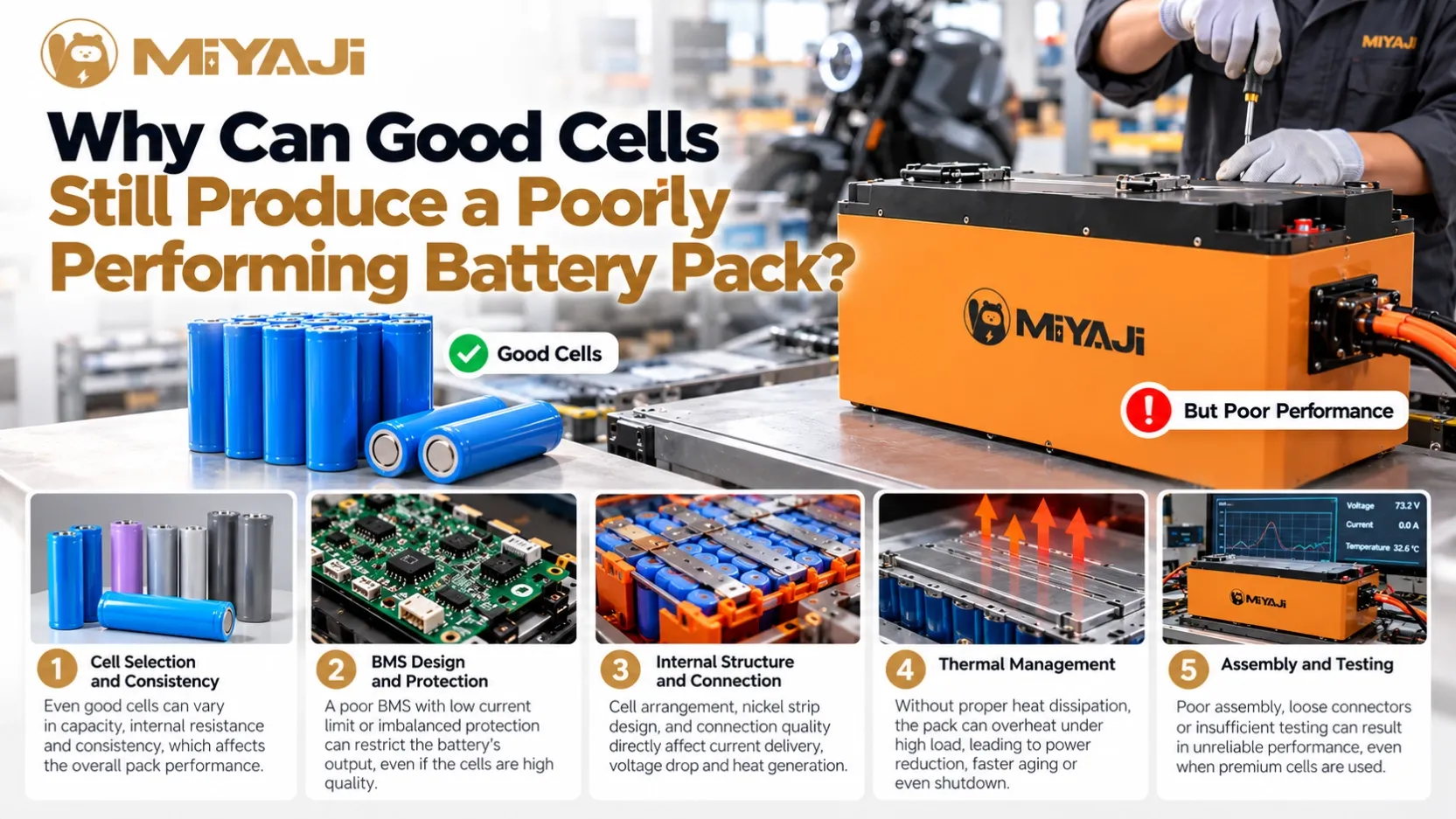
Why Can Good Cells Still Produce a Poorly Performing Battery Pack?
MIYAJI Commercial Battery Insights — Part 3
“Which cell brand do you use?”
This is an important question when buying batteries for electric motorcycles or tricycles. But it should not be the only question.
A battery pack made with reputable cells can still experience power interruptions, charging problems, inaccurate readings or connection failures.
The reason is straightforward: the vehicle uses a complete battery pack. Its performance depends on how the cells, battery management system, electrical connections and enclosure work together.
For commercial operators, understanding these details helps explain why cell specifications alone cannot guarantee reliable daily operation.
1. Good Cells Still Need to Suit the Application
A reputable cell manufacturer may offer different models for different uses.
Some cells prioritise energy capacity. Others support higher current or different charging requirements. The exact model matters alongside the brand.
Before selecting cells, the battery design needs to account for:
- Continuous and short-duration current demand.
- Charging requirements.
- Operating temperature.
- Available space and weight.
- Daily usage and replenishment schedule.
A cell suitable for light commuting may not be the right choice for a heavily loaded passenger tricycle working throughout the day.
The starting question should be:
“Is this cell model suitable for the intended operating conditions?”
2. Cell Matching Affects the Finished Pack
Cells assembled into one pack need compatible performance.
Differences in capacity, internal resistance and self-discharge can cause cell groups to behave differently during charging and discharging.
For example, one group may reach its low-voltage limit earlier under load. Another may reach its upper voltage limit before the rest during charging. Either condition can restrict how much energy the complete pack can use.
Matching therefore requires more than checking that resting voltages look similar.
Measurements also need consistent test conditions. Comparing resistance readings taken at different temperatures or charge levels can lead to misleading conclusions.
The BMS helps manage the pack, but it cannot restore lost cell capacity or repair an abnormal connection.
3. Electrical Connections Can Limit Performance
Energy passes through welds or other cell connections, busbars, terminals, cables and the output connector.
If a connection has excessive resistance, it can create voltage loss and local heating when current increases. A mechanically weak connection may also deteriorate under vibration.
This is particularly relevant for commercial motorcycles and tricycles operating on rough roads.
Connection design and manufacturing control should consider:
Area | What needs attention |
|---|---|
Cell connections | Suitable joining method and consistent connection quality |
Conductors | Current capability and temperature rise |
Terminals | Correct assembly and secure contact |
Output cables | Suitable sizing, routing and support |
Connectors | Electrical rating, mounting and expected usage |
The appropriate construction depends on the cell format and pack design. A method used for cylindrical cells cannot automatically be applied to every prismatic or pouch-cell pack.
4. BMS Selection Must Match the Whole Battery
The battery management system monitors operating conditions and provides protection. Depending on its design, it may also estimate charge level, record faults and communicate with other equipment.
Selecting it requires more than choosing a current rating.
The BMS must suit the cell chemistry, series configuration, permitted operating limits and intended application. Its temperature monitoring and communication functions also need to fit the system.
A larger current rating does not compensate for unsuitable cells, weak connections or insufficient thermal design.
Likewise, a protection event should be investigated before settings are changed. Raising a limit without checking the complete pack can move the problem elsewhere.
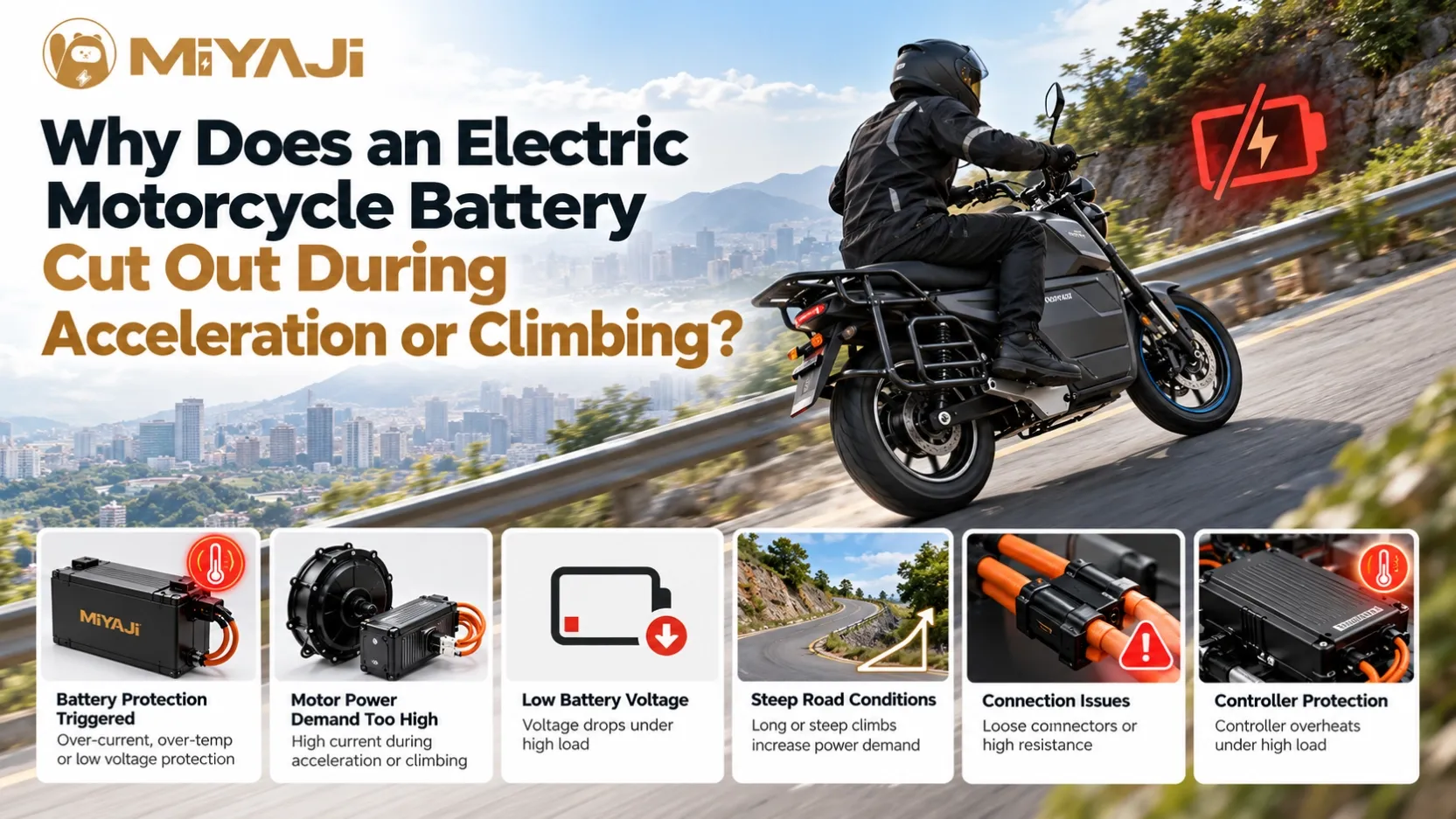
Our first article explains why an electric motorcycle battery may cut out during acceleration or climbing and why the cause needs to be identified before replacing parts.
5. Small Wiring Details Can Create Difficult Faults
Cell-voltage sensing wires and temperature sensors help the BMS understand what is happening inside the pack.
A loose terminal, damaged sensing wire or poorly supported harness can produce intermittent readings. The battery may appear normal while stationary, then report a fault during vibration.
These problems can be difficult to reproduce if testing only involves a battery sitting on a bench.
Good assembly practice includes secure connections, protected routing, strain relief and checks against the approved wiring arrangement.
Temperature sensors also need appropriate placement. Monitoring a cell, a power connection and a BMS switching component involves different objectives. Sensor locations should reflect the risks the design needs to detect.
6. The Enclosure Is Part of the Battery Design
An enclosure does more than make the battery look finished.
It helps protect internal components from movement, contact with other parts and environmental exposure.
A commercial battery design needs to consider:
- Cell support and permitted movement.
- Insulation between live parts and the enclosure.
- Clearance around boards, wires and fasteners.
- Sealing around joints and connectors.
- Heat dissipation.
- Handling and mounting loads.
For removable batteries, handles, locking features and connector alignment also affect repeated daily use.
An enclosure that fits everything tightly is not necessarily well designed. Components still need suitable clearances, support and protection.
7. A Capacity Test Does Not Answer Every Reliability Question
A controlled capacity test provides useful information about how much charge or energy the pack delivers under the stated conditions.
It does not, by itself, establish how the pack will perform during repeated acceleration, rough-road operation or frequent swapping.
A suitable validation plan may include electrical load testing, protection-function checks, temperature monitoring, vibration and environmental testing, depending on the application.
It is also important to distinguish between:
Design validation: evaluating whether a configuration is suitable for its intended use.
Production checks: confirming that manufactured packs meet the approved requirements.
Not every pack needs every design-validation test. However, production checks should be based on the risks identified during development.
For fleet buyers, ask what was tested, under which conditions and whether the results apply to the configuration being supplied.
8. A Well-Built Pack Still Needs System Compatibility
A battery can be correctly manufactured and still be incompatible with the intended vehicle or charging equipment.
For a vehicle, the operating voltage range, current demand, connector and any communication requirements need to match.
For charging, the permitted voltage, current and control behaviour need to be coordinated.
For battery swapping, additional requirements may include identification, cabinet fit, communication, locking and charging sequences.
These are separate from cell quality. A recognised cell brand does not resolve a protocol mismatch or an unsuitable connector.
What Does This Mean for Fleet Purchasing?
When comparing battery suppliers, look for evidence about the finished pack.
Buyer question | What it helps assess |
|---|---|
What exact cell model is used? | Application suitability |
How are cells tested and matched? | Consistency |
How are connections checked? | Electrical and mechanical quality |
How is the BMS configuration controlled? | Correct and repeatable operation |
What validation has this design completed? | Suitability for the intended use |
What checks are performed before shipment? | Production quality |
Has it been evaluated with the intended vehicle and charging system? | Compatibility |
Can a supplied pack be traced to its components and configuration? | Diagnosis and batch management |
Specific test records and clear specifications provide a stronger basis for comparison than a cell-brand logo alone.
From Battery Manufacturing to MIYAJI System Integration
MIYAJI’s battery PACK manufacturing forms part of its commercial vehicle, battery-swapping, charging and software solution.
For an operator, these elements need to work together throughout the daily operating cycle: driving, returning a battery, charging it and making it available for the next trip.
Battery planning therefore starts with the intended operation and continues through pack design, manufacturing and system matching.
If you are developing an electric motorcycle or tricycle fleet, share your vehicle requirements, typical load, daily distance and charging or swapping plan with MIYAJI.
These details help define the battery configuration and the validation needed for your project.
Frequently Asked Questions
Does using a well-known cell brand guarantee a reliable battery pack?
No. The exact cell model, matching, connections, BMS, construction and application compatibility all contribute to the finished pack’s performance.
Can the BMS fix inconsistent cells?
It can help manage charge differences within its capabilities. It cannot recover lost capacity or repair defective cells and connections.
Why can a battery pass a bench test but fail on a vehicle?
The vehicle may introduce loads, vibration, temperatures or interfaces that the bench test did not cover. Diagnosis should identify the actual difference.
Should fleet buyers request production or test records?
Yes. Records relevant to the supplied configuration help buyers understand what has been checked and support later diagnosis.
Next in the series: Will a Higher-Current BMS Stop Your Electric Motorcycle Battery from Cutting Out?