Sep 5, 2026Product & Industry Knowledge
Electric Motorcycle Fleet Cost: Budget for 100, 500 or 1,000 Vehicles
Learn how to calculate electric motorcycle fleet cost for 100, 500 or 1,000 vehicles, including motorcycles, batteries, charging, swapping, software, spare parts and local setup.
Electric Motorcycle Fleet Cost: How Much Does It Cost to Start 100, 500 or 1,000 Vehicles?
One of the first questions investors and fleet operators ask is:
How much does it cost to start an electric motorcycle fleet?
The simple answer is:
There is no universal price.
A fleet project is not simply:
Number of motorcycles × motorcycle price
A complete commercial electric motorcycle project may include:
Vehicles
-
Batteries
-
Charging or Battery Swapping Infrastructure
-
Software
-
Spare Parts
-
Shipping
-
Local Installation
-
Training
-
Working Capital
Therefore two projects with the same 500 motorcycles can require very different investments.
The correct approach is to build a project-level cost model.
What Is Included in Electric Motorcycle Fleet Cost?
A simplified fleet investment model is:
Initial Project Investment = Vehicle Cost + Battery Cost + Energy Infrastructure + Software + Spare Parts + Logistics + Local Setup + Initial Working Capital
Depending on the project, additional costs may include:
- Import duties
- Certification
- Registration
- Insurance
- Warehousing
- Local staff
- Financing
- Site rental
- Electrical upgrades
Some are CAPEX.
Others are operating costs.
They should not all be treated the same way.
1. Electric Motorcycle Cost
The vehicle is usually one of the largest initial investment categories.
Vehicle cost depends on:
- Motor power
- Frame
- Suspension
- Brakes
- Tires
- Electronics
- Display
- Connectivity
- GPS
- Cargo accessories
- Vehicle certification
- Order quantity
- OEM requirements
A commercial motorcycle should be evaluated differently from a low-cost consumer vehicle.
Why the Cheapest Motorcycle May Cost More
Suppose Vehicle A has a lower purchase price than Vehicle B.
But Vehicle A experiences:
- More breakdowns
- Higher spare-parts consumption
- More downtime
- Shorter component life
The lower purchase price may eventually create a higher operating cost.
For commercial fleets, evaluate:
Cost per Productive Kilometer
rather than only:
FOB Vehicle Price
2. Battery Cost
The battery can represent a significant part of project investment.
Battery cost depends on:
- Chemistry
- Cell manufacturer
- Capacity
- Voltage
- PACK architecture
- BMS
- Enclosure
- Current capability
- Communication
- Charging capability
- Quantity
For example, a:
72V 60Ah
battery and a:
72V 100Ah
battery represent different energy and cost structures.
Vehicle Quantity Does Not Equal Battery Quantity
This is especially important for battery-swapping projects.
A fleet of:
500 motorcycles
does not necessarily require:
500 batteries.
It may require more because batteries can simultaneously be:
- Installed in vehicles
- Charging
- Ready for swapping
- In reserve
- Under inspection or maintenance
Therefore:
Battery Investment = Required Battery Inventory × Battery Unit Cost
not simply vehicle quantity × battery price.
3. Conventional Charging Infrastructure
If the fleet uses conventional charging, the project may require:
- Chargers
- Charging points
- Electrical distribution
- Cables
- Protection equipment
- Installation
- Parking infrastructure
A depot-based fleet may be able to centralize this infrastructure.
A distributed fleet may require a different approach.
4. Fast-Charging Infrastructure
Fast charging may require additional investment in:
- DC fast chargers
- Electrical capacity
- Distribution equipment
- Installation
- Connectors
- Site preparation
The cost depends strongly on charging power and site conditions.
Therefore fast-charging infrastructure should not be budgeted independently from:
Battery + BMS + Charger + Grid
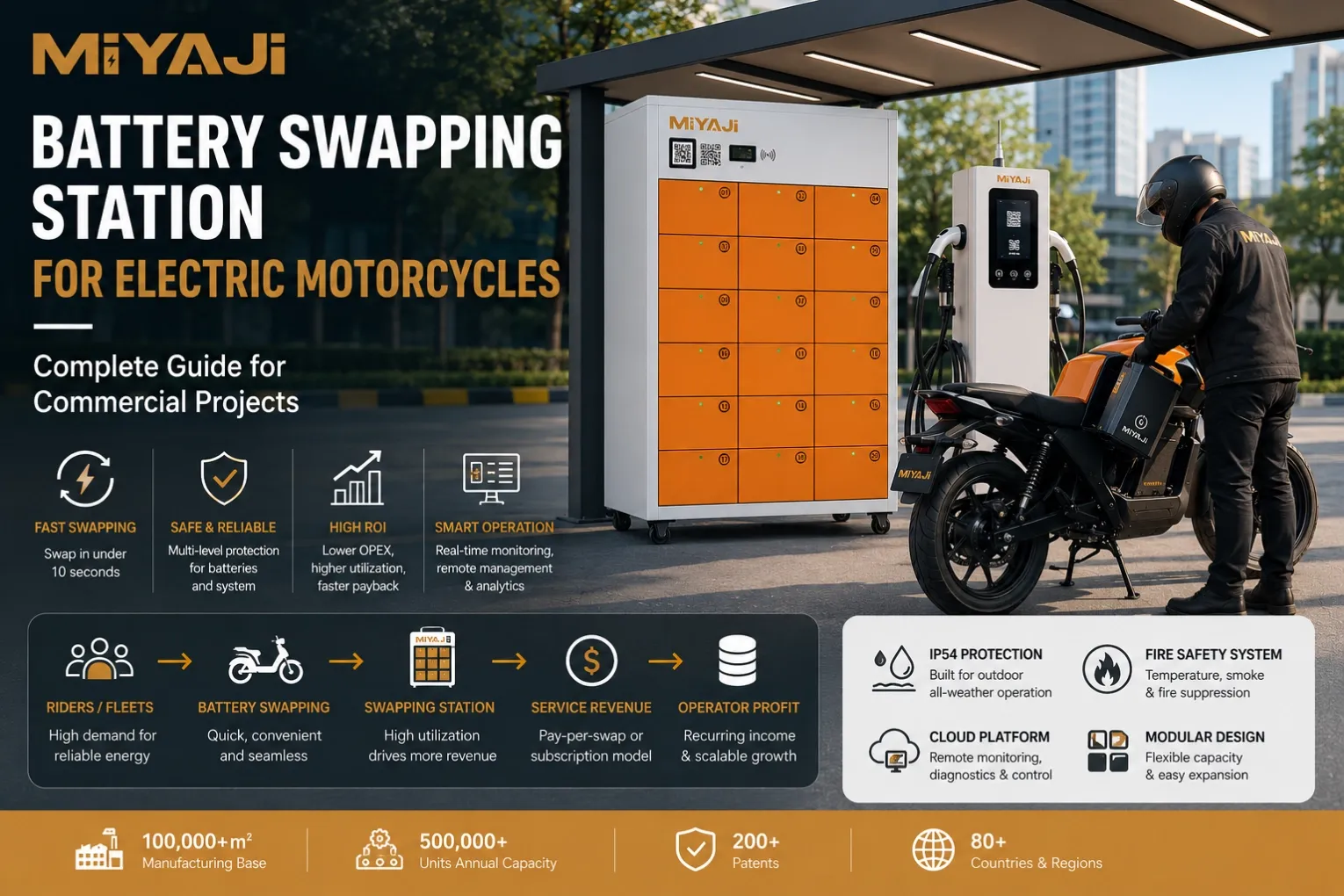
5. Battery Swapping Infrastructure
A swapping project can include:
- Swap cabinets
- Charging modules
- Swap batteries
- Electrical installation
- Site setup
- Connectivity
- Software
- Fire/safety systems
- Installation
The cabinet itself is only one part of the investment.
Battery Inventory Can Be Larger Than Station Cost
This is a common budgeting mistake.
An operator may focus heavily on:
How much does one battery swap station cost?
while underestimating the cost of the battery pool.
For some projects, additional batteries can represent a major part of total swapping-system CAPEX.
Therefore swapping budgets should calculate:
Station Hardware
-
Battery Inventory
-
Installation
-
Electrical Infrastructure
-
Software
6. Software Cost
Commercial EV fleets increasingly depend on software.
The system may manage:
- Vehicles
- Batteries
- Swap stations
- Chargers
- Riders
- Payments
- Subscriptions
- Alerts
- Maintenance
- Energy usage
Software costs can be structured in different ways.
For example:
- Initial deployment
- SaaS subscription
- Per-device fee
- Customized development
- Integration cost
The commercial model depends on the project.
7. Spare Parts Budget
Spare parts should be included before deployment.
A fleet may require inventory for:
- Brake components
- Tires
- Lights
- Controllers
- Displays
- Wiring
- Connectors
- Body parts
- Suspension components
- Chargers
The correct inventory depends on:
- Fleet size
- Vehicle usage
- Expected wear
- Local repair capability
- International lead time
8. Logistics Cost
For an international project, logistics can significantly affect landed cost.
Possible expenses include:
- Export packaging
- Inland transport
- Ocean or land freight
- Dangerous-goods logistics for batteries
- Port handling
- Customs clearance
- Inland delivery
Vehicles and lithium batteries may also have different logistics requirements.
CBU vs CKD Changes the Cost Structure
If vehicles are imported as:
CBU — Completely Built Unit
the project may have lower local assembly complexity.
With:
SKD / CKD
the project may reduce some logistics or tariff costs in certain markets, but create additional costs such as:
- Factory
- Assembly equipment
- Labor
- Training
- Quality control
- Local inventory
Therefore CKD should not automatically be treated as:
Cheaper than CBU
The complete landed and assembly economics should be compared.
9. Import Duties and Taxes
These can vary significantly by country.
Possible categories include:
- Import duty
- VAT or similar taxes
- Vehicle taxes
- Battery tariffs
- Component tariffs
CKD and CBU may also receive different tariff treatment depending on local rules.
Because these policies vary by market and change over time, they should be verified locally before final investment decisions.
10. Certification and Registration
Depending on the market, costs may include:
- Vehicle homologation
- Product testing
- Registration
- Licensing
- Local certification
- Charging-equipment compliance
These costs can be relatively small at scale but significant during initial market entry.
11. Local Infrastructure
A fleet project may require:
- Warehouse
- Service center
- Charging depot
- Swap-station sites
- Office
- Spare-parts storage
Some projects can use existing facilities.
Others require new infrastructure.
This can create a major difference between two otherwise similar projects.
12. Staff and Training
Local operations may require:
- Fleet managers
- Technicians
- Warehouse staff
- Battery technicians
- Customer support
- Software operators
Initial training may also be required for:
- Vehicle maintenance
- Battery
- BMS
- Charging
- Swap stations
- Software
13. Working Capital
This category is frequently forgotten.
A new fleet may need working capital for:
- Salaries
- Electricity
- Site rent
- Spare parts
- Battery replacement
- Maintenance
- Marketing
- Rider onboarding
before the operation reaches stable cash flow.
Therefore project investment should not end at equipment delivery.
CAPEX vs OPEX
A useful way to structure the budget is to separate:
CAPEX — Initial Investment
Examples:
- Vehicles
- Batteries
- Chargers
- Swap stations
- Assembly equipment
- Site infrastructure
OPEX — Operating Costs
Examples:
- Electricity
- Maintenance
- Staff
- Rent
- Software subscriptions
- Replacement parts
- Connectivity
This helps investors understand both:
How much money is needed to launch?
and
How much does the fleet cost to operate?
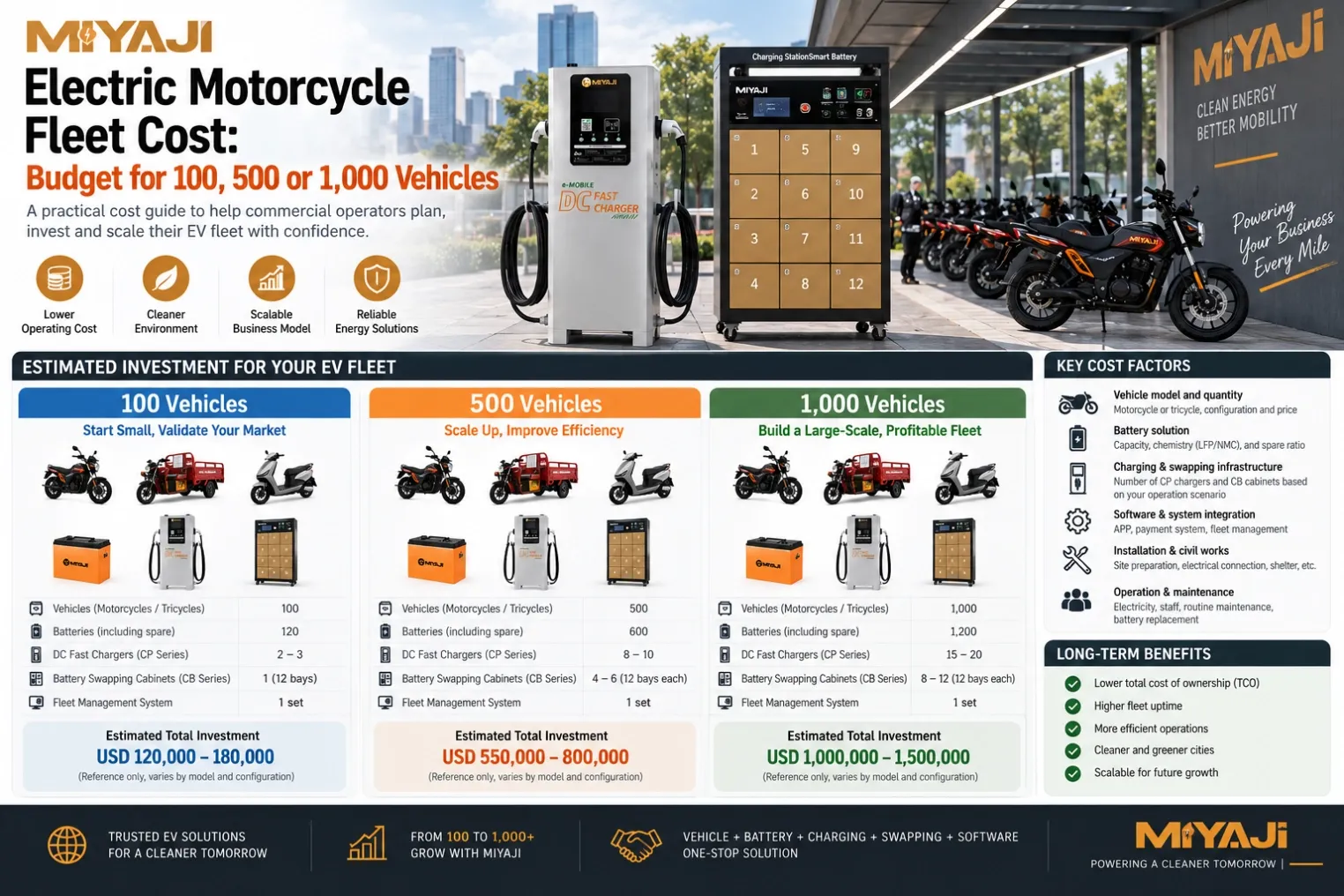
Cost Structure for a 100-Motorcycle Fleet
A 100-vehicle project is often suitable for:
- Initial commercial deployment
- City-level pilot
- Delivery operation
- Motorcycle taxi pilot
- Fleet validation
Instead of assigning a universal dollar figure, calculate:
Cost Category | Calculation |
|---|---|
Vehicles | 100 × vehicle unit cost |
Batteries | Required battery inventory × battery unit cost |
Charging/Swapping | Based on energy strategy |
Software | Setup + recurring fees |
Spare Parts | Initial fleet spare-parts package |
Logistics | Shipment + battery logistics |
Local Setup | Installation + service capability |
Working Capital | Initial operating reserve |
The key objective at this stage is usually:
Validate unit economics before aggressive expansion.
Cost Structure for a 500-Motorcycle Fleet
At 500 vehicles, operational design becomes much more important.
The project may require:
- Multiple charging locations
- Multiple swap stations
- Larger battery inventory
- Dedicated maintenance
- Larger spare-parts warehouse
- More sophisticated fleet software
- Greater electrical capacity
A 500-vehicle project should therefore not simply multiply a 100-vehicle pilot budget by five.
Some costs scale linearly.
Others do not.
Which Costs Scale Linearly?
Examples may include:
Vehicles
approximately scale with fleet size.
Batteries
generally increase with fleet size and energy strategy.
But infrastructure behaves differently.
For example:
A software platform serving 500 vehicles may not cost exactly five times as much as one serving 100.
A warehouse may also support significantly more vehicles without increasing proportionally.
Cost Structure for a 1,000-Motorcycle Fleet
At approximately 1,000 vehicles, the project begins to resemble a mobility infrastructure operation rather than simply a vehicle purchase.
Planning may need to include:
Vehicle Fleet
-
Battery Pool
-
Energy Network
-
Service Network
-
Software Platform
-
Spare Parts System
-
Operations Team
At this scale, small errors in unit economics can become significant.
Example: Why $0.01/km Matters
Suppose two fleet configurations differ in operating cost by:
$0.01/km
If each motorcycle travels:
100 km/day
then one motorcycle creates:
$1/day difference.
Across:
1,000 motorcycles
that becomes:
$1,000/day.
Over hundreds of operating days, the difference becomes commercially significant.
This is why fleet procurement should focus on:
Cost per kilometer
not just unit price.
A Simple Fleet Budget Formula
A preliminary project model can use:
Fleet CAPEX = Vehicles + Batteries + Energy Infrastructure + Software Setup + Spare Parts + Logistics + Local Setup
Then calculate annual OPEX:
Annual OPEX = Electricity + Maintenance + Staff + Rent + Software + Connectivity + Battery Replacement + Other Operating Costs
Finally:
TCO = CAPEX + Multi-Year OPEX − Residual Value
This creates a much more useful picture than purchase price alone.
Battery Swapping Fleet Budget Model
For a swapping project:
Initial Investment = Vehicles + Battery Pool + Swap Stations + Electrical Infrastructure + Software + Installation + Spare Parts + Logistics
Then operating costs may include:
- Electricity
- Site rent
- Maintenance
- Connectivity
- Software
- Battery replacement
- Staff
The key variables include:
Battery Utilization
Station Utilization
Fleet Utilization
If expensive assets remain underutilized, project economics can deteriorate.
Charging Fleet Budget Model
For a charging-based fleet:
Initial Investment = Vehicles + Vehicle Batteries + Chargers + Electrical Infrastructure + Installation + Software + Spare Parts + Logistics
The operator should evaluate:
- Charger utilization
- Vehicle charging downtime
- Electricity tariffs
- Grid capacity
- Peak charging demand
The cheaper infrastructure solution is not necessarily the cheaper operating solution.
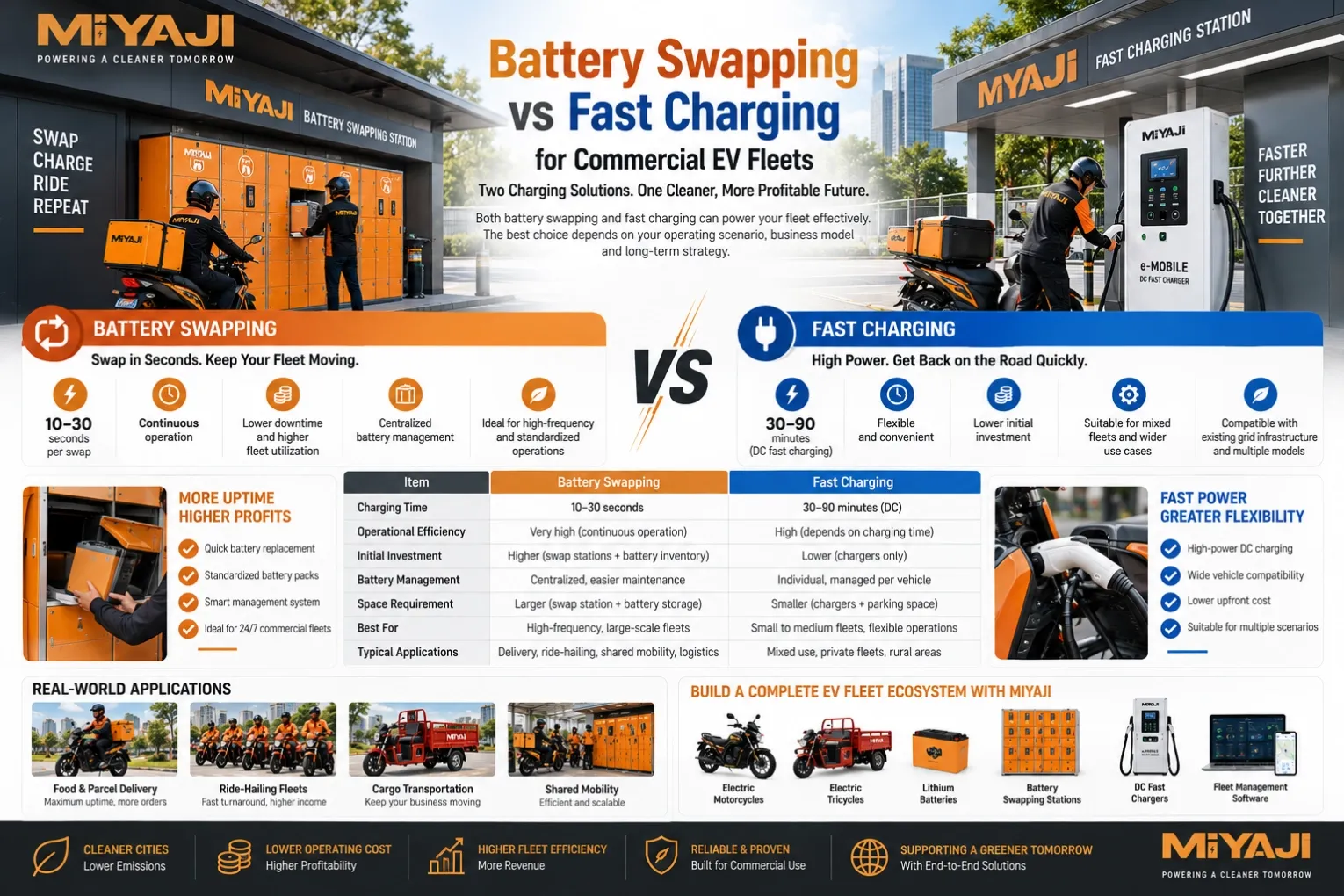
Fast Charging vs Swapping: Investment Perspective
From an investment perspective:
Fast Charging
may reduce the need for additional battery inventory but require:
- Higher charging power
- Compatible batteries
- Suitable electrical infrastructure
Battery Swapping
can minimize vehicle energy-replenishment downtime but may require:
- Additional battery inventory
- Swap stations
- More complex battery management
The correct comparison is:
Total system economics
rather than:
Charger price vs swap cabinet price.
How Much Should Be Spent on Batteries?
There is no universal percentage of fleet investment.
The correct battery budget depends on:
- Vehicle energy consumption
- Required range
- Battery chemistry
- Charging strategy
- Swap strategy
- Battery inventory ratio
- Replacement assumptions
A project with large fixed batteries may allocate capital differently from a swapping fleet using smaller standardized batteries.
How Much Should Be Spent on Spare Parts?
Again, there is no universal percentage.
The initial spare-parts package should be based on:
- Vehicle configuration
- Fleet size
- Expected usage
- Wear parts
- Critical components
- Shipping lead time
- Local service capability
A more useful approach is:
Criticality + Expected Consumption + Replenishment Lead Time
rather than using an arbitrary percentage.
Don't Forget Battery Replacement
Battery replacement is not always an initial CAPEX item, but it can become an important lifecycle cost.
The financial model should include assumptions for:
- Battery degradation
- Operating conditions
- Replacement threshold
- Replacement price
- Residual or second-life value where applicable
This connects initial investment to TCO.
Financing Changes Fleet Economics
Two projects with identical equipment can have different economics if their financing terms differ.
Consider:
- Down payment
- Interest
- Loan period
- Leasing
- Battery financing
- Vehicle financing
- Payment terms
Therefore:
Cash purchase price ≠ financed project cost
For large fleet projects, financing should be modeled separately.
Revenue Should Be Modeled Alongside Cost
An investment model should not stop at expenses.
Depending on the business model, revenue may come from:
- Delivery operations
- Passenger fares
- Vehicle rental
- Vehicle leasing
- Battery subscriptions
- Pay-per-swap
- Energy sales
- Fleet service contracts
The project becomes viable when the operating model generates sufficient contribution after costs.
Calculate Revenue per Vehicle
A simplified model can begin with:
Revenue per Vehicle per Day
Then subtract:
Energy + Maintenance + Battery + Financing + Operations + Downtime
to estimate:
Contribution per Vehicle
This allows the operator to understand whether adding more vehicles actually creates more profit.
Bigger Fleets Are Not Automatically More Profitable
Scale can reduce some unit costs.
But scale can also increase:
- Management complexity
- Infrastructure requirements
- Maintenance
- Battery inventory
- Working capital
Therefore:
A profitable 100-vehicle pilot should be optimized before becoming a 1,000-vehicle fleet.
100 → 500 → 1,000 Fleet Investment Strategy
A sensible expansion path can look like:
Stage 1 — 100 Vehicles
Validate
- Vehicle
- Battery
- Energy consumption
- Rider behavior
- Maintenance
- TCO
↓
Stage 2 — 500 Vehicles
Standardize
- Vehicle configuration
- Battery
- Charging/swapping
- Software
- Spare parts
- Operations
↓
Stage 3 — 1,000+ Vehicles
Scale
- Infrastructure
- Service network
- Battery network
- Software
- Local production where justified
This reduces the risk of scaling an unproven operating model.
When Does Local Assembly Make Financial Sense?
As volume grows, operators may evaluate:
CBU
versus
SKD / CKD
Local assembly may offer advantages depending on:
- Import policy
- Logistics
- Labor cost
- Local-content requirements
- Annual volume
But it also introduces:
- Factory investment
- Equipment
- Labor
- Quality control
- Inventory
- Training
Therefore local production should have its own business case.
A Better Way to Request a Fleet Quotation
Instead of asking:
“What is your price for 500 electric motorcycles?”
provide:
Fleet
- 100 / 500 / 1,000 vehicles
- Application
- Daily mileage
- Operating hours
Vehicle
- Speed
- Motor requirement
- Payload
- Passenger/cargo requirement
Battery
- Required range
- LFP/NMC preference if any
- Fixed/swappable battery
Energy
- Standard charging
- Fast charging
- Battery swapping
- Hybrid system
Market
- Country
- City
- Local electrical conditions
- Import strategy
Localization
- CBU
- SKD
- CKD
- Battery PACK assembly
This allows the supplier to quote a project rather than only a motorcycle.
Electric Motorcycle Fleet Budget Worksheet
A preliminary budget can be structured like this:
Category | Unit | Quantity | Unit Cost | Total |
|---|---|---|---|---|
Electric Motorcycles | vehicle | — | — | — |
Batteries | pack | — | — | — |
Chargers | unit | — | — | — |
Swap Stations | station | — | — | — |
Software | system/device | — | — | — |
Spare Parts | package | — | — | — |
Logistics | shipment | — | — | — |
Installation | project | — | — | — |
Training | project | — | — | — |
Local Setup | project | — | — | — |
Working Capital | reserve | — | — | — |
Total Initial Budget | | | | — |
This is much more useful than a generic:
“1,000 electric motorcycles cost $X.”
From Project Cost to Unit Economics
After calculating project investment, calculate:
CAPEX per Vehicle
Total Initial CAPEX ÷ Fleet Size
Energy Cost per km
Energy Cost ÷ Distance
Maintenance Cost per km
Maintenance Cost ÷ Distance
Battery Cost per km
Lifecycle Battery Cost ÷ Lifecycle Distance
Total Cost per km
Total Fleet Cost ÷ Total Fleet Distance
Vehicle Uptime
Productive Operating Time ÷ Available Operating Time
These KPIs help compare different project configurations.
How MIYAJI Approaches Fleet Cost Planning
MIYAJI commercial EV projects can combine:
Electric Motorcycles & Tricycles
-
Lithium Battery Systems
-
Battery Cells & BMS
-
Fast Charging
-
Battery Swapping
-
Energy Management Software
-
OEM / CKD & Local Production
Rather than calculating fleet investment from vehicle price alone, the project can be evaluated around:
Vehicle Cost
→ Battery Cost
→ Energy Infrastructure
→ Operations
→ TCO
→ Scaling
This allows different configurations to be compared before deployment.
Planning a 100, 500 or 1,000 Vehicle Project?
To prepare a meaningful project budget, provide:
Target Country / City
Fleet Application
Initial Fleet Size
Future Fleet Target
Daily Mileage
Operating Hours
Payload
Required Range
Charging / Swapping Strategy
Available Grid Power
CBU / CKD Requirement
Local Assembly Plans
With this information, the project can be evaluated as a complete commercial system rather than simply a vehicle quotation.
Request a Fleet Project Configuration
Frequently Asked Questions
How much does it cost to start an electric motorcycle fleet?
There is no universal cost. The budget depends on vehicles, batteries, charging or swapping infrastructure, software, spare parts, logistics, local setup and operating requirements.
How much does a 100-electric-motorcycle fleet cost?
Calculate the cost of 100 vehicles plus the required batteries, energy infrastructure, software, spare parts, logistics, local setup and working capital. The final amount depends on the project configuration and country.
How much does a 500-electric-motorcycle fleet cost?
A 500-vehicle project should be budgeted as an integrated fleet system. Infrastructure, maintenance, battery inventory and software do not necessarily scale linearly from a smaller pilot.
How much does a 1,000-electric-motorcycle fleet cost?
At 1,000 vehicles, the project may require a larger energy network, service system, battery pool, software platform, spare-parts operation and local infrastructure. A project-specific financial model is recommended.
Are batteries included in electric motorcycle prices?
It depends on the supplier and quotation. Buyers should confirm whether the vehicle price includes the battery, charger, accessories and other equipment.
Is battery swapping more expensive than charging?
Not necessarily. Swapping may require additional batteries and stations, while fast charging may require higher-power electrical infrastructure. Total system CAPEX and OPEX should be compared.
How many batteries are required for 100 electric motorcycles?
There is no fixed ratio. Battery quantity depends on the energy strategy, charging time, daily mileage, swap frequency, peak demand and reserve requirements.
Should I buy 1,000 motorcycles at once?
For a new operating model or market, pilot deployment can provide data before larger-scale investment. The appropriate rollout depends on project maturity and commercial risk.
Does CKD reduce electric motorcycle fleet cost?
It can in some markets, but CKD also creates local assembly, equipment, labor, quality-control and inventory costs. CBU and CKD should be compared using complete landed economics.
Can MIYAJI prepare a fleet project quotation?
MIYAJI can evaluate commercial EV projects according to vehicle quantity, battery requirements, charging or swapping strategy, software, local production and other project requirements.